Welcome to the official Patricia McConnell website. Skip directly to: main content, navigation, search box.

Archive for the ‘dogs and sound’ Category

Dognition Canine Assessment Tests

Friday, March 29th, 2013

Several readers have asked about the new product called “Dognition” that promises (quoting from the website), “You’ll learn your dog’s cognitive style by playing fun, science-based games — an experience that gives you the insight you need to make the most of your relationship with your best friend.” I was curious myself, given that the force behind the product is the work of scientist Brian Hare, whose relevant claim to fame is his research on the ability of dogs to inherently understand a person’s pointing gesture. I’ve argued that this claim needs more research, as does his suggestion that the long-standing relationship between dogs and people has resulted in the evolution of special communicatory skills in dogs (especially as regards to pointing). However, I love that his work has helped to energize research on canine cognition. (If you want to read more about whether dogs can inherently understand the pointing gesture of a person, see Do Dogs Inherently Understand Pointing Gestures? and  An Update on Pointing Gestures and Dogs.)

Dr. Hare has since come out with a new book, The Genius of Dogs: How Dogs are Smarter Than You Think, and a product called the Dognition Assessment Toolkit. I haven’t read the book yet, but was intrigued by a set of games he has developed that are supposed to increase one’s understanding of their dog’s personality and cognition style. The perfect cabin-fever reliever perhaps? Even better, the website explains that all the results will be aggregated and used as an example of “citizen science.” It says: “By gathering this data we can begin to understand more about all dogs, much more quickly and on a broader scale than if scientists had to conduct this research themselves.”

I signed up Willie, Tootsie and Katie’s dog Leo at $59 each, passing up the $129 offer of the toolkit + one year’s annual membership. Katie and I began the games last week, and finally finished with Tootsie yesterday. I say “finally” with intention: I want to tell you that the games were incredibly fun and that I learned oodles that I didn’t know about Tootsie. Alas, here’s the bottom line: Sometimes the “games” were fun, sometimes they were tedious, sometimes they were mildly aversive (more on that later) and I’m afraid I didn’t learn much about Tootsie that I didn’t know. I had planned to finish the games with Willie today, but realized that rather than looking forward to it I was… what’s the right word? “Dreading it” is too strong, but it felt like a great burden that I would have to slog through. Then I realized that I didn’t need to finish the games with Willie at all; I already had learned what I needed to know to make my own evaluation of the project for this post, and didn’t have any expectation that I would learn anything especially useful about Willie that I didn’t know before. Before I continue, let me be absolutely clear: Others might find the exercises great fun and the eventual evaluation extremely useful in improving their relationship with their dog. But all I can give you is my honest assessment of my own experience, for whatever it is worth.

Here is a bit about how the program works: There are five categories of games, labeled Empathy, Communication, Cunning, Memory and Reasoning.  Before playing the games one fills out an extensive questionnaire. I’d give it kudos for being thorough, but many of the questions should be answered with “I don’t know” (which, good for them, is always an option). For example, you are asked if your dog “understands” the cue to sit. Without testing Tootsie a la Ian Dunbar’s game, and asking her to sit while she is already sitting or while lying down, I can’t answer that question. I can answer if she does sit when asked, but that is an entirely different question (which was also asked, I should note). However, many of the questions were easy to answer, like “Is Tootsie friendly to other dogs?” One could answer “All the time, Some of the time,” etc. I choose “Some of the time” for Willie often, given that his behavior is so context dependent.  After the questionnaire, you begin the games. With a few important exceptions noted below, they are explained very clearly. If you decide to play, be aware that you’ll need someone to help with all of them, a fact not made clear before you begin and that threw me off when I first tried to get started by myself one afternoon.

Many of the games involve putting a treat on the ground on one side of you or the other. The treats might be on the ground, inside a cup or under a piece of paper. Your dog has a variety of ways, over the course of the tests, to choose the “correct” side, based on your pointing toward it, showing your dog that it is in the cup before turning the cup over, etc. Each of the games that require a dog to “choose sides” do a good job of establishing first whether your dog has a side preference. (Both Willie and Tootsie more often went to my right side (their left), which fits with the knowledge that most dogs are “left pawed.”) Katie and I did quite a few of the games together, either with her as the helper for me and Tootsie, or vice versa for her and Leo. The biggest snag that we ran into was a discrepancy between what the dog did and how we were asked to record it.

Here’s an example: You define “left and right” with 3 sticky notes, one directly in front of you, one each to the right and left of you on the floor. With a helper holding your dog, you might point to a cup with a treat hidden underneath it on your right side. The instructions tell you to score your dog as “retrieving the treat” if you pointed to the treat on your right, and your dog went between the sticky notes in front and to the right of you. Thus, passing between 2 sticky notes on the ground on the same side as the treat meant your dog had “retrieved the treat.” (The word ‘retrieve’ was confusing to us…’chosen’ or ‘focused on’ would be more helpful.) But here is what sometimes happened: Imagine I placed 2 cups on the floor on either side of me, one with a treat, and pointed to the one with the treat while Tootsie watched me from about 6 feet away. Let’s say that the cup with the treat was on my right. Tootsie was released and wandered through the sticky notes to my right, but paid no attention at all to the cup with the treat underneath, and passed behind me to vigorously sniff at the (empty) cup on the left. Based on the instructions we were told to score that as “retrieved the treat,” but her behavior indicated she was focused on the cup without anything in it.

Other games require you to say something to your dog and then stay stock still and silent for up to two and a half minutes. This was the part that Katie and I found a bit tedious. Standing silent and motionless while looking directly at your dog is so unnatural I found it unnerving. (In one test you stand still and silent for 1 minute, then 1.5 minutes, then 2 minutes and then 2.5 minutes. Katie and I were both ridiculously relieved when it was over.) One could argue that science is not about having fun, but is about designing and conducting good experiments. However, anyone who has taken Experimental Psychology 101 knows that the behavior of the experimenter must be carefully controlled in any study. For the results to be lumped together and analyzed, either only one carefully trained “handler” would have to be the one cuing the dogs in exactly the same circumstances, or a few well-trained handlers would have to undergo extensive training and testing to ensure that their behavior was consistent. Thus, it is hard to know what the results of an aggregate of hundreds or thousands of dog owners doing these tests in their own homes would actually mean.

The mildly aversive section occurred when I was to put a treat on the ground, say “No” or “Leave It,” and then wait for an entire (endless) 90 seconds without moving or speaking. This was not a problem with Tootsie, who doesn’t know a Leave it cue, and who trotted toward the treat and gobbled it up. However, Willie does know Leave It, and I wish I had a video of his face staring at mine for 90 seconds after being told Leave It when I placed a dried turkey heart on the ground. That 90 seconds lasted at least an hour… he looked so confused and unsure after about 10 seconds that I could barely maintain my stance. Next you are instructed to put the treat down, say Leave It and turn around so that your back if facing your dog. Willie waited 1 minute and 17 seconds and then padded over and ate the treat. Next you are to hold your hands over your eyes, and this time he waited less than 20 seconds. I have never been so thankful to have a dog disobey a Leave It in my life. Both Katie and I (she acting as recorder and dog holder if needed) darn near cheered when Willie took the treat, so that we didn’t have to wait another endless 90 seconds. I suspect that reading this one could argue: “Really Trisha. Ninety seconds? Seriouslyy, how long is that really?” Answer: When you have to stand still and stare at your dog for that period of time, it feels much longer than one might think.) (Cautionary note: After those games I worked on Leave It with Willie, reinforcing him for avoiding a treat on the ground for 2, 4 and 6 seconds; the games being the perfect way to ruin a well-trained cue if you don’t do some clean up work afterward.)

The results? We finished all the games with Tootsie (3 of 5 game categories are done with Willie) and immediately got her results. Tootsie was classified as a “Stargazer,” whose “unique genius lies in the mix of strategies that she uses to approach daily life… She certainly has a wild, wolf-like side that is especially useful in the environment of the rugged individual.” Labeling Tootsie, the 7-years-in-a-puppy-mill Cavalier King Charles Spaniel who wants nothing more than to eat (anything) and lie in one’s lap, as “wolf-like,” leaves me close to speechless. Her “empathy” scores were “off the charts,” even though it was Willie who yawned after I did and not Tootsie, yawning after seeing another yawn being indicative of empathy). Tootsie’s results also indicated that she is “highly collaborative;” I’m guessing that is because she did indeed focus on the food I pointed to in some of the tests. But categorizing her as such is a stretch, I’d argue. Tootsie is pretty much all about food, while Willie is often called “Trisha’s mood ring.” Willie appears to care deeply about how I am feeling, while Tootsie appears to care deeply about how quickly she can get the food out of my pocket. Of course, I could be wrong about my assessment and the tests could be more accurate, but I wouldn’t bet the farm on it.

The one result that I found surprising, and thus interesting, was that Tootsie did indeed focus more on the treats on the ground if I pointed to them (but not when the treat wasn’t visible ). Willie, who has learned exactly what an outstretched and pointing arm means, appeared to pay no attention. I suspect that pointing to something in the distance, with one’s arm almost horizontal to the ground, is a very different signal than pointing almost straight down toward the ground, with one’s arm just a few inches away from the torso. That got me thinking that perhaps what we call “pointing” could actually involve several different visual signals that should be considered independently. (And one more pointing note, skip if all this pointing stuff is tiresome to you!: Dognition actually has you both point AND turn your head toward and look at the object in question. Thus, pointing, and gaze are confounded here. That’s a technical point, but an important one to those who study animal communication.)

At one point the evaluation interprets Tootsie’s inconsistent responses in a series of tests as “switching back and forth” between strategies, a behavior labeled as “impressive flexibility.” Another way to label this is “having no strategy at all.” I’m just saying. Reading their evaluation of Tootsie reminded me of schools in which all the students get A’s and blue ribbons because, well, they are there. On the plus side, it appears that the designers of Dognition are working hard to clarify that there are no ‘right or wrong’ answers, and that every dog is using a different kind of cognition strategy to make their way in the world. That’s important, and I credit them for it. This is not about whether your dog is a Good Dog or a Not So Good Dog, but about finding what’s going on between those furry ears of hers. Learning more about your dog is a wonderful thing; however my guess is that most people who are motivated to spend the money to play these games with their dog, and get through all 2.5 to 3 hours required, already know more about their dog than a product like this can teach them.

A few notes if you decide you want to play: 1) Don’t even think about doing this all at once. You and your dog will be toast if you do. The website is well designed to allow you to pause, and wisely encourages you to do so. We did Tootsie’s tests over 4 different sessions. 2) Round up an assistant before you start, you absolutely have to have one for almost all of the games. 3) You need to be right beside your computer to play. Laptops and iPads work great. 4) Take your own notes about your dog’s responses. You don’t get a summary of what they did (“followed point 2 out of 6 times, for example) and I’d love to see the actual data. 5) Careful of the treats: Your dog could end up getting a lot of them. Tootsie basically ate the equivalent of two dinners during the last session, even when she didn’t “get” the treat much of the time.

Have you played it yet? I’d love to hear if you have and what you thought of it. I truly wanted to write a positive review myself;  the Advisory Board on this project reads like a Who’s Who in canine cognition, including Dr. Juliane Kaminski, Dr Richard Wrangham, Dr. Adam Miklosi, Dr. Laurie  Santos and Dr. Josep Call as well as Dr. Brian Hare. I know some of these scientists and not only admire their work, I like them personally. But good science is about evaluating the facts, and it would be disingenuous of me not to be honest in my assessment. Let me know what you think.

MEANWHILE, back on the farm. We’re melting! Finally finally finally the spring thaw has begun. It may be under freezing at night, and there is still plenty of snow and ice on the ground, but there are also patches of bare, spongy ground, and the air is rich with the songs of Redwing Blackbirds and the guttural calls of Sandhill Cranes.

The lambs are due to start dropping any day now, so Jim and I are busy in the barn. We had a lovely, long weekend at a friend’s cabin up north last weekend, and came home refreshed and ready for spring. I’m finishing up my Contemplative Photography course, which I’ve absolutely adored. Here are two of my photos for the the class, a Beech leaf and a scene from up the hill, just yesterday. Enjoy.


beech leaft small


willie sheep sky small


New Seminar in August, Chicago, Illinois

Tuesday, February 26th, 2013

Oh boy, what fun. As many of you know, I’m not doing many more full day seminars anymore, but I couldn’t resist pairing up with the Steve White for a two-day seminar outside of Chicago, Illinois on August 10th and 11th of this year. Thanks to a Facebook reader who jumped in with dozens of others with ideas for a title, we are calling the seminar Sense(s) and Sensibility. Thank you Mairi and kisses to your lovely dog, Layla!

On Saturday, I’ll be doing an updated and expanded version of  “Lost in Translation,” or How Dogs use Sight, Sound, Smell and Touch to Communicate. As usual, I’ll take a comparative approach, looking at the way our sensory systems (notice the focus on vision?!) affect the behavior of the animals at both ends of the leash. The day will be full of slides, videos and demonstrations, including the role of smell in dog-dog interactions, the power of touch (both positive and negative), how to use your voicemost effectively when communicating with your dog, and how to improve your ability to “read” visual signals given by dogs.

On Sunday, the incomparable Steve White will present “What’s the Problem, Five Simple Steps to Fixing Any Behavior or Performance Problem.”  Steve’s presentation will build on Saturday’s material, and is sure to send you off inspired to go home and work with your dog. Steve will argue that most behavioral problems are actually skill deficits, and will present fun, and effective training paradigms that change “failure” into reliability.

Special Sunday Lunch: At lunch on  Sunday, Steve and I will talk about the many routes to becoming an animal behaviorist and/or professional dog trainer. We’ll keep it casual and will be happy to answer any questions of the participants as best we can.

The first 100 people to sign up will be entered into a drawing, two of whom will get $100 off their registration. In addition, signing up five or more people results in a 15% discount on the ticket price. And please, please, if you are a blog reader, come up and say hi!

We picked the location because it is easy to both drive or fly to. It is close to Chicago’s O’Hare airport and at the confluence of several highways in Itasca, Illinois. The hotel is dog friendly and has a shuttle service from the airport to the hotel. Hey… we’ve gone to a LOT of seminars, so we are doing all we can to make this one as accessible and enjoyable as possible.

I’m not foolish enough to guarantee that this will be my last full-day seminar in the US, (never say never, right?) but there won’t be many more, so I hope you can come to this one. I’m loving doing evening fund raisers for shelters now, and am focusing on doing more of those in the year(s) to come. But I simply couldn’t resist pairing up with Steve White. I always learn from him, I love his sense of humor and I can barely wait to get home and work my dog at the end of one of his seminars. Steve has a long career with working dogs; he’s the cop you hope shows up when you need one, and has dedicated his life to promoting positive reinforcement in police dog training and to helping people like us find fun and benevolent solutions to canine behavior problems. We are going to have a ball… be there, or be square!

MEANWHILE, back on the blog: Our IT prince has fixed the bugs, so you shouldn’t see any text cut off anymore. We also redesigned the right hand column and added (as requested) the number of comments for all the recent posts listed. Thanks for all your feedback, you’ve been great!) By the way, if you are having the same problems (text cut off, for example), clear your web cache in whatever server you are using (not the one for your entire computer!) and you’ll see the new version.

Safe Off Leash?

Friday, January 11th, 2013

Last weekend Jim, Willie, Tootsie and I stayed in a lovely log cabin owned by friends in the woods in eastern Wisconsin. I mention that because for the first time in her nine years of life, Tootsie got to run off leash in an unfenced area off the farm. Wooo Hooo! Some people might not understand what a huge step that was for a little puppy mill dog, but I’m guessing that many of you get it completely. I was over the moon with happiness that I could unsnap the lead, and trust that she would stop when told, come when called, and as importantly, get to sniff and explore with more freedom than she’s ever had in her nine years of life.

The decision I made got me thinking about the issue in general: When IS it safe to let a dog off leash? What do you need to know to evaluate the risk and decide whether to take it? I thought it might be an interesting exercise to list some of my criteria and decision points in regards to Tootsie, and to hear your thoughts and experiences in addition.

I should probably mention here that it is my belief that one of the things dogs want more than anything in the world is a certain amount of autonomy. Some dogs have a ton of it, others almost none, but surely every dog wants to be able to do what she wants to do, when she wants to do it at least some of the time. Being off leash fulfills that to a great extent, but it also puts dogs at the potential of risk. So how does one decide when to unsnap the lead? Here are at least some of the things that need to be considered:

CONTROL: It is something of an irony that the more control we have over our dogs, the more freedom we can give them. Never is that more true when asking if a dog can be safe off leash, and it was the question I asked myself late Friday night when I decided it was 99.999% a sure thing that once off leash and out of the car, Tootsie would sniff around, relieve herself and then immediately come when I called. But how does one know if a dog will come when called in any context?  Ah, you don’t, not 100%, but here’s what I think you need to get to 99.9999%:

STOP ON A DIME: People often assume that all one needs to manage an off leash dog is a good recall, but I’m a big proponent of first teaching a dog to stop on cue. Asking a dog to stop on a dime might be critical for the dog’s safety, and if you think about it, that’s a very different exercise than asking a dog to come back to you. I can’t count the number of times I asked Willie to stop and stand still (I use “Stand,” a cue common in sheep herding that asks a dog to do exactly that: don’t lie down, but stop moving). Perhaps he was starting to sniff beside a partially frozen stream, or I wanted him to wait for me to catch up before he went around a corner on a trail we were walking.

Besides being a handy cue, I’ve learned it is much more effective to ask a dog to stop first before calling him to come back to you, especially if he is moving fast in another direction. Think about it: If a dog is running away from you, in order to back to you she has to 1) stop, 2) turn around and 3) come back to you. That’s three things, right? I’ve found it far more effective, especially with dogs who love to run, to teach them first to stop on cue before asking them to do a recall. It’s not all that hard to do: Just let your dog get a step or two ahead of you and say “Whoa!” or “Stand” and then reinforce with something ridiculously wonderful. Gradually use the cue when the dog is either 1) farther away from you and 2) moving faster. Try to keep those 2 components separate as much as you can, and gradually build up to asking the dog to stop while tearing off in another direction. Manage this carefully though and set your dog up to win: don’t yell “Whoa” when  your beagle is disappearing into the woods after a rabbit if you haven’t gotten full compliance at a much easier level. However, a good stop is not enough…. you also need:

A RIDICULOUSLY GOOD RECALL: Coming when called when there’s no environmental competition simply doesn’t count as a “good enough recall”. One of the reasons I decided to let Tootsie off leash in the woods last weekend is because we have spent several months working on her coming when called while running away from me at a dead run toward something she really, really wanted. I’ve worked on her recall ever since I got her a year and a half ago (if you missed those blogs, she had been a puppy mill brood bitch for 7 years). It took me months to let her off leash at the farm, and then only in specific contexts in which I felt her behavior was completely predictable. But it’s one thing to have a dog come when called in a predictable and consistent context. It’s an entirely different matter to be able to get a dog to come to you when it is already dashing away toward something it wants.

I was lucky here, because the farm provided the perfect set up. First, I have several fenced areas where I could safely let Tootsie off leash and work on her recall. The area around the house and barn is not fenced however, and has a road that runs by about 75 yards from the house, so I was much more cautious about letting her off leash there. In that context I first worked on teaching Tootsie to heel beside me as we walked from the house to the barn. She adores food, and so it didn’t take long to get a reliable response. Then I began asking her to stop or recall when I released her from the heel. I knew she would run straight to the barn, so I had no worries about her safety. I had her favorite food (chicken) in my pocket and asked her to stop the first time when she had just barely left my side. Gradually I began to give the cue when she was farther and farther away from me. Once I could get to her turn on a dime and run back to me even when twenty yards away I began to test it in other contexts. And sure enough, she flipped her little body in mid-air and came running.

CONTEXT: Location, Location, Location. Realtors aren’t the only ones who emphasize the importance of location. There are simply many places I would never let Tootsie off leash. Here’s an example: we went recently to visit a friend who lives in a suburb, with a small lawn between the house and the road. I asked her to potty before we went inside, and never would have considered letting her off leash in that context. Why? Because first, we were just too close to a road for comfort, she could have gotten into the road before I could blurt out a cue. Second, what would be the point? The cost/benefit balance was skewed far to the negative: the risk in no way was worth the pay off. At the cabin however, the closest road was a good 600 yards away,  and the payoff was huge. She got to be a dog off the farm for the first time in her little life, and although I’m sure some people would argue one should never take any risk at all, I’m not one of them. The only 100% guarantee of safety for Tootsie was to live in a cage, and she’d already done that for seven years. Enough is enough.

WHO’S YOUR DOG? If asked to name three things we all needed to consider before letting our dogs off leash, I’d say knowing each dog as a personality is the third. Tootsie spent 7 years in a cage, and didn’t know that the noises people made were meaningful for most of her life. She’s come incredibly far, but she’s still a Cavalier King Charles Spaniel that I got at age 7 who had never been trained to do anything for most of her life. Willie, on the other hand, came with recall software pre-installed. I could just about take him anywhere and let him off leash, although I still don’t take chances, because, really, what’s the point?

NEVER DONE: One last point: Don’t ever stop “training your dog to come.” I still often reinforce Willie for coming when called, sometimes with voice, sometimes with the toss of a toy or letting him chase me as I run away from him.  And I’ll never stop watching Tootsie like a hawk if she is off leash, and reminding her how very, very fun it is to come when called.

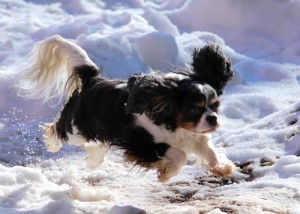
Here’s the little girl now, rounding the corner of the barn when I called her back to me from a dead sprint. She looks so serious, doesn’t she? But damn, she sure comes running!

MEANWHILE, back on the farm: A bit of a sad day. We’ve had a doe fawn living in the Orchard Pasture all spring and summer. Something was terribly wrong with her, she clearly wasn’t able to cope with living on her own. She would run smack into the fences at a dead run and was never able to jump them like all the other deer. She did well over the summer when there was a lot of food, but because she stayed in a very small area there was no way she was going to make it through the winter. There was also the concern about coyotes; eventually they would have found her and killed her. And so I contacted a DNR warden who came out, agreed that she was probably blind, and that she would slowly starve over the winter. Deer can’t be captured and re-located (they die of stress, it is horrifically cruel to try to capture and relocate them), and it was inevitable that the coyotes would find and kill her. The warden agreed that she should be put down, and did so humanely with one perfect shot. I know it was the right thing to do, and I know that deer are as common out here as beetles, but oh lordy they are lovely animals, and I’m feeling a big of sadness that such a beautiful thing didn’t make it.

Here she was yesterday:


New Research on Dogs and Music

Friday, January 4th, 2013

I recently read an interesting study about the effect of different types of music on kenneled dogs. (“Behavioral effect of auditory stimulation on kenneled dogs,” by Kogan, Schoenfeld-Tacher & Simon, J of Veterinary Behavior 7, 2012, 268-275.) The authors’ goal was to determine if different types of music, as has been reported in other species, had different types of effects on dogs, and the results indeed confirmed that this was true. The results suggested that 1) “classical music” increases the amount of time the dogs spent sleeping, and 2) “heavy metal” music increased body shaking (or trembling). Surprisingly however, “psychoacoustically designed” music, a piano piece specifically designed to calm dogs, resulted in no statistically significant change in behavior from silence.

First off, I want to acknowledge Kogan et al for doing important research on the effects of the acoustic environment on domestic dogs. We so often focus on other aspects of their environment–Is their dog bed comfy? Does it look pretty to us?–and fail to attend to the impact of sound on our dog’s environment (not to mention our own). This is by no means the first study to look at the responses of dog to sound or music, but it is an important step toward a more complete and nuanced understanding of how dogs respond to different types of sound, a topic near and dear to my heart.

Many of you know that my dissertation research was about the effect of different types of sounds on working domestic animals, and so it’s not surprising that I am especially interested in this topic. My study found that short, rapidly-repeated notes increased motor activity in dogs, and that long, continuous notes were universally used to soothe or calm working dogs and horses (Perspectives in Ethology, Vol 9, 1991). In another study, Wells found no observable changes in behavior in shelter dogs listening to human speech, “pop music” or no music, but increases in resting postures and decreased barking to “classical music,” while heavy metal music elicited increased barking and rising to a stand (2000, 2002, Applied Animal Behavior Science).

Kogan’s research replicates those findings (with an exception discussed below), but a conversation with Primatologist Charles Snowdon, PhD and an expert on animals and their responses to sound, reminded me of an important point. Kogan refers to “classical music” as resulting in more frequent observations of dog sleeping, but as Dr. Snowdon reminded me, “classical music”  includes a broad range of pieces, from soothing selections like “Moonlight Sonata” (one of the pieces played to the dogs in Kogan’s study) to the 1812 Overture, which one would hardly describe as “soothing,” at least not to humans. Thus, it is not the classification of the music that matters, but the features of each piece that make the difference. Leave it to some monkeys to emphasize that point for us . . .

In one of the decade’s most innovative pieces of research, Snowdon used his knowledge of Cotton Top Tamarin vocalizations to ask what effect human music would have on another primate species. He first found that “human” music had little observable effect on the monkeys, but when his collaborator, cellist and composer David Teie, modified the music based on the pitches and tempos of the vocal repertoire of the tamarins, they discovered that the monkey’s responses followed what appear to be common, if not universal, mammalian responses to certain aspects of music. Here’s a link to samples of the modified music.

Snowdon’s & Teie’s work reminds us that what is important is not whether the music is “classical” or “heavy metal,” but whether it includes a set of acoustic features that appear to be universally associated with soothing or stimulating internal states. Those features include:

1) Longer notes tend to be calming, staccato (short, repeated) notes stimulating (think saying “Sta-a-a-a-a-y” to a dog versus “Pup-pup-pup-pup” when calling to come).

2) Pure tones & regular rhythms are associated with positive states, harsh, noisy ones & irregular rhythms with negatives states (think about a high, clear repeated whine from a puppy who wants attention versus a low, “noisy” growl from a dog warning another off a bone.)

3) A tempo matching an animal’s resting heart rate (or respiration) tends to be calming.

All of this suggests that it can indeed be valuable to play certain types of music to individual dogs or dogs in kenneled situations. However, if you recall, Kogan’s work did not find that the “psychoacoustically designed” music had an effect on the dog’s behavior when compared to other pieces or to no music at all. The particular piece of music used in the study was a section of Music to Calm Your Canine  Companion, music included in the book Through a Dog’s Ear. We sell it on our website, and is also available separately as a CD.

Although I’m not qualified to analyze all the acoustic changes Leeds and Wagner made to make music especially soothing to dogs, the basic principles followed what we have learned about how sound effects the animal who hears it. The music (all piano played by musician Lisa Spector) is modified from “classical” pieces that follow the criteria above, so why wouldn’t it be equally effective at soothing the dogs who heard it?

I talked to Kogan about her results, and she too was surprised by the dog’s responses to the “Dog’s Ear” music. She felt confident that the results were robust, in that they made thousands of observations and the results were consistent.  For example, during the presentation of “classical music,” (Fur Elise, Moonlight Sonata, Blue Danube Waltz & Air on a G String) the dogs were observed sleeping 3.7 to 6.0 % of the time. That compares with 1.1 % of the time during periods of no music and 1.4 % of the time during the presentation of the Dog’s Ear music. (On the other hand, she reported that in as many as 71.2 % of the observational periods a dog was observed shaking (as if visibly nervous) during only the heavy metal music, a fact which makes me want to run back in time, turn off the music and give the dogs a belly rub.)

What could possibly explain these results? After all, the Dog’s Ear music is sold as having proven effects on dogs, and large numbers of people have reported that the music is helpful to their dogs. You can listen to some samples here. It also follows many of the criteria listed above. I spoke to author and musicologist Joshua Leeds about Kogan’s results, and he too admitted to being surprised at the outcome. His best guesses as to the lack of effect of Dog’s Ear music were 1) Acoustics: Sound is conveyed differently by different types of equipment and through different environments. Perhaps the speakers used conveyed the music of a full orchestra better than simple piano music? However, two of the “classical” pieces used in the Kogan et al study were also piano music, so that’s probably not the answer. However, his pieces are ‘simplified,” they have fewer notes and perhaps might be differentially affected by the speakers and room acoustics. 2) His pieces are designed as progressions, but in the study a short section of “Dog’s Ear” music was put on a tape loop and played repeatedly. Leeds modifies three factors in his music for calming dogs: tone (resonance), tempo (entrainment) and pattern. He modified the music he selected by eliminating certain frequencies, “simplifying” the music to make it more relaxing to the brain, and decreasing the beats per minute, and it is designed to be played in full, not in small, repeated units. To his credit, he and his colleagues did a pilot study that was supportive of the desired results (calmer dogs) but as is true for all pilot studies, it had some holes and wasn’t by any means the “definitive study.” But all we can do is speculate about the lack of effect of the Dog’s Ear music in Kogan’s study. It may be that the music truly doesn’t have any calming effect on dogs when tested objectively, but it also may be that there are other factors we don’t yet understand that are skewing the results.

What about you? I’m truly curious about your experience if you’ve tried any of the CDs from Through a Dog’s Ear. Have you tried it? If so, what was your experience? Katie here at the office saw no observable effect when her Dogo was an adolescent, but found that Lily dozed off as if on sleeping pills not too long ago when she heard the Dog’s Ear CD play. I tried it with Willie during acupuncture, and found no observable change in his behavior, but Lassie seemed to relax especially fast during acupuncture treatments if I played it to her. These are of course, only  anecdotal reports, but all of our observations can still be extremely valuable. I’d love to hear about your experience.

Here’s what we do know for sure: Some kinds of music or other sounds do indeed seem to have a positive effect on kenneled dogs, especially sounds with long, extended notes, pure tones and relatively slow tempos. We also know, from Snowdon’s research, that we need to look at the acoustic range and vocal repertoire of each species before we make too many assumptions about what kind of sounds have what effect. Here’s what we don’t know: exactly what are all the best acoustic features to calm and soothe dogs in over stimulating environments? How effective is music “simplified” and modified based on theory but not yet a lot of data? I’ll leave you with one very important comment made by Lori Kogan when I interviewed her about the study: It’s not just the dogs we want to think about. If the people who come to visit a shelter are in an attractive, pleasing environment, one that is playing pleasant, soothing music, surely they would be more likely to stay longer at minimum, and perhaps more likely to adopt?  A great point I think, and another reminder of the importance of the acoustic environment around us and our dogs.

MEANWHILE, back on the farm: Tootsie has been learning that leaping up and pawing at the gate to Willie’s crate is not the way to get a treat in her own kennel. Last week I realized I was mindlessly (but gently) pushing her off of Willie’s crate as I was closing his door in preparation to taking Tootsie to her own crate. Willie would enthusiastically run into his crate, Tootsie would dance and leap as I shut his door in excited anticipation of what was to come (a treat for her in her own crate.) Ah, a perfect opportunity to let Tootsie figure it out on her own. This week when she leaps up I simply stand up and go still. I reinforced her for standing four on the floor by moving one step toward her crate and sure enough, the leaping and pawing is almost gone. I’d say we are half way to her linking my shutting Willie’s crate as a cue for her to run into hers. I’ll keep you posted.

Winter is certainly here, it was quite a bit below zero (Farenheit) here a few mornings ago. The kitties are staying warm by cuddling together in a dog bed I bought for Tootsie (who still has more than she needs, believe me) which is placed inside of blankets and cardboard boxes in the garage. Not very fancy, but toasty warm and makes for one very adorable picture every morning when I open the farm house door to see Nellie and Polly cuddled up together. Tootsie has become one very hardy little Cavalier, she pounces around in the snow like an Arctic fox, although if it’s below 10 degrees I don’t take her out for long. Willie, not surprisingly, is oblivious. He’ll hold up a paw if it is truly bitter after we’ve been out awhile, and I am careful to avoid the potential of frost bite, but he basically adores cold weather and snow and probably thinks it was all created just for him.

Photos of Cardinals in winter are so common they are trite, but they are common for a reason. There’s little more cheerful than red birds with a background of evergreens and white snow. Most of the photos are of the strikingly colored males, but I have a soft spot in my heart for the females, their colors are so nuanced. Here’s one this morning:

And here she is flying to the feeder, directly toward me and my lens.

These photos are okay, but I can’t wait for my new camera! I’m counting the days til it arrives.

fMRI on Dogs: Too Wonderful!

Friday, June 1st, 2012

When I was doing my PhD research in the 1980′s I wanted to see how a dog’s brain responded to different types of sounds before and after training. This was in the 1980′s, and the only method available for animals was to do Evoked Potential tests, in which simple, tiny electrical sensors were glued to the scalp. This allowed one to measure activity in the brain in an extremely general way: What kind of brain waves does one see in the Temporal versus the Parietal lobe, for example, after hearing or seeing specific stimuli?

Evoked Potential tests are logistically easy to do on adults: You shave tiny areas of the scalp, glue on the sensors, and ask the subject to stay still for a set period of time. The research subject mustn’t move, because muscles move through electrical stimulation in the brain too, so any movement confounds the brain’s response to external stimuli. But how do you do it on dogs?  How would you keep them still? Absolutely motionless? And here I was in Zoology, not neurobiology, so how would I pull this off?

I felt lucky to be at a large research institution like the University of Wisconsin in Madison, and so I reached out to neurobiologists in other departments. “How does one do Evoked Potential tests on dogs?” I asked. “No problem” I was told. “It’s not that difficult.” “But how do you keep the dogs from moving while you’re doing the test?” I asked. I received a blank face and a silence as an answer. “I don’t understand.” the expert informed me. “What do you mean?” I repeated my question. His answer, after another pause, was “We just don’t bump the tray.”

Slowly, with growing horror, I began to understand why he was confused by my question. I hadn’t asked “How do you do Evoked Potential on live dogs?” The dogs they used for their research weren’t alive; they were killed and the tests were done immediately after their death. Not what I had in mind, needless to say. I left his office and found a researcher (Dennis Molfese at Southern Illinois University) who did Evoked Potential tests on human infants. We did use small dosages of Acepromazine to quiet the dogs, but also did lots of training, and had few problems keeping the dogs still. We ended up with good results that showed dogs paid more attention to short repeated notes when linked with recalls than long, continuous notes.

You can see then, why I am thrilled to read that researchers have now pulled off doing fMRIs on happy, healthy, live dogs. Scientist Berns and others in Atlanta worked with owners to train 2 dogs to sit motionless in an MRI machine for 10 seconds at a time. If you’ve ever had an MRI, you know that this requires far more than just lying still. For reasons once explained to me while I lay frozen with fear in a tight, dark tunnel, the magnetic part of the MRI creates an ear splitting series of pops and bangs and groans that is hard for many people to sit through. And yet, they pulled it off with dogs, and got some interesting results.

“The task was designed to determine which brain circuits differentially respond to human hand signals denoting the presence or absence of a food reward.” And sure enough, when a visual signal was given that meant food was coming (not unlike a clicker stimulus), the ventral straitum of the caudate cluster was more active than when a visual signal meaning “no food coming” was seen by the dogs. Activating the ventral straitum causes the release of dopamine, the “Oh Boy!” neurohormone mediating happy anticipation. It’s the same neurochemistry that occurs when you get your dog’s leash and she begins to dance in anticipation of a walk.

The results are interesting, but not earth shaking, given they were exactly what was expected. What IS earth shaking is that scientists have found a way to study what happens inside a dog’s brain in kind and compassionate ways. This is huge…. the amount of information we could derive from this is immeasurable. I have long said that our relationship with dogs provides us with research opportunities unlike any other, and here’s proof of it.  Stay tuned… the next couple of decades of research and our understanding of other animals are going to be absolutely amazing.

MEANWHILE, back on the farm: The lambs are thriving, the dawn chorus of bird song floods into the farmhouse around 4:30 am, but who could mind such a beautiful way to wake up?

And although the weather has been challenging of late, (hot, cold, wet, no rain, too much rain, you name it), the flowers continue to lift me up and make me happy. Here’s an Iris I planted last year, first time seeing it bloom:


Lure & Clicker Training to teach Sit – Advantages & Disadvantages

Friday, May 4th, 2012

It makes me so happy to say that Tootsie is doing great. Right now she’s sleeping in her crate beside my desk. The door is open, but she loves it there. The only places she likes as well are 1) being in bed with me, 2) being on the couch or 3) being by herself in the crate in the back of the car. She likes it so well in the car crate that I am actually having to train to leave it. I’m assuming this is baggage from her puppy mill days and that she feels most secure and comfortable in a small, confined space.

She’s progressed so well in so many ways: I’m especially taken with her flipping around mid-air when outside after I call her to come, ears flying like a furry dumbo, her open, happy mouth taking up half of her tiny little Cavalier head. As I mentioned in an earlier post, now that house training is behind us (wheee!), she can be outside off leash as long as I watch her like a hawk and keep her close to the house, she no longer barks to wake us up and produce her dinner, so it’s time to continue work on standard training. We’ve gotten started on sitting on cue, but I thought it would be fun to start her on clicker training at the same time.

I’ve worked on sit off and on, never with much diligence, but she is getting the hang of it. I started with lure training–using the smell of a great treat to ‘lure’ her body into a sitting position. Now that I’m going to start her with a clicker, I find myself thinking about the two different methods of training: luring and clicker training. Both have advantages and disadvantages, but I find that combining the two of them can be especially effective in some contexts.

Luring has the advantage of initial speed: In the case of sit, a la Ian Dunbar, you hold a tiny, tasty treat at the crown of a dog’s head and move it back toward their tail (not up, straight back.) As a dog’s nose follows the treat straight back toward their tail, their body finds it hard to stay standing, and so the hips automatically collapse and voila, your dog is sitting. Bingo, the treat gets popped into the mouth and your dog just got rewarded for sitting. Once you have the behavior established, you turn the motion of luring into a visual signal, and then bring in the verbal cue and start minimizing the hand motion.  (For a more detailed description, see The Puppy Primer.)

Luring also has a disadvantage: If you’re not careful to drop out the lure and the visual signal early on, the movement becomes the cue. You can end up with a dog who only sits when you move your hand, not when you say “Sit.”

Clicker training has the advantage of creating razor sharp precision, which helps you communicate clearly with your dog. It’s a great thing to teach a dog that their behavior can influence your own, and in a good way at that. I especially like that in most cases, the dog initiates the action, rather than you ‘helping’ him or her. However, strict operant conditioning suggests that you don’t do anything to initiate the behavior, you wait until the dog initiates him or herself, then click and treat to reinforce it. But truth be told, I’m not someone who is going to wait for a dog to sit when they feel like it, click opportunistically and then wait again for the next time. Not when I can lure a dog into a sit, get 15 reps into one sessions, and then take over with a clicker once I’ve got the behavior started. I tend to mix methods for actions that are easy to lure and for movements or behaviors that dogs do naturally. I should warn you: some trainers feels strongly that methods should never be combined, but I’m an equal opportunity employer, and so have no problems doing so as long as you know how to use them together without confusing your dog.

[10 minute break while Trisha goes to work with Tootsie]

First I used a lure/hand signal (with treat) to raise her chin and get her to sit down. My hand was just inches from her mouth and head. She responded well, and I repeated it 3 times.  Then I moved my hand 2 feet from her head, moved it with the same motion as while luring her (just farther away). She responded well until I moved my hand farther away. Now my hand was so far away from her head its motion probably  looked like a completely different signal. I stopped there because I wanted to  move on to clicker training.

I “loaded” the clicker with 25 click/treats (small dog kibble, which she adores… she adores bird seed shells for heaven’s sake, so finding a motivating treat is not a problem with Tootsie.).

Then I lured 3 times relatively close to her head (to create a success) and click/treated when she sat. I then proceeded to disappear the visual signal, added the word “Sit” and in 20 trials had her sitting just to the word “Sit.”

Ah, but here’s an important lesson: I noticed that while saying “Sit” I held both of my hands behind my back. Wondering if that might in itself be a visual signal, I moved the position of one of my arms. Sure enough, she looked at me as if completely confused. When I put both hands behind my back, she sat again when I said “Sit.” But the cue that she was responding to wasn’t the word, it was the position of my hands. Easily fixed, I just began moving my arms and hands into different positions, saying “Sit” and waiting up to 3 seconds for a response, and clicking immediately when she responded correctly. By the time we stopped she was sitting to the word sit no matter what I did with my hands.

And then… experienced trainers can predict the next stage…. I moved three feet backward into the kitchen. Now I was in a different room. Tootsie again looked completely befuddled. Easy to fix; just critical to remember that any action, any posture, any context, any location can be a relevant cue to a dog. In just a few trials she was sitting just to the word in the kitchen as well as the living room. We stopped so that Tootsie didn’t become a Tootsie roll sausage and I could finish this blog.  We’ll take it up again tonight and tomorrow, and start on some tricks this weekend. Ain’t training grand!!!

Question for you all: I know that some trainers are true purists, only using one method or the other. I’m a fan of mix and matching, as long as one understands the potential pit falls. You? [And fyi, I haven't forgotten about following up on the clicker study I wrote about earlier (clickers versus just food as reinforcement): I'm playing phone tag with the author, but I'll let you know as soon as I know more.]

MEANWHILE, back on the farm: Willie and I have 3 new sheep to work. I don’t like working him on my small ewe flock now, because they have young lambs and huge bags of milk that have got to be miserably uncomfortable when they flap/slap around whilst the poor ewe is being pushed by a dog. Willie and I try to work them slowly and carefully, but there are times it’s just not possible to keep them from speeding up. There’s another reason: Willie has lost a tremendous amount of confidence since his surgery and confinement, and my most aggressive ewe, Barbie, has gone after him and won several times now. I hate having a dog fight a ewe with a young lamb but I don’t want her winning over and over again and continuing to erode Willie’s confidence. So I have 3 new Katahdin ewes with no udders and no lambs. They are flighty and easy to move and will be great for Willie while he builds up his confidence. Jim, Willie and I just split the 3 newbies off and put them in the orchard pasture high behind the farm house. It took split second timing and quarter-horse short stopping by Willie, but we got it done. Everytime I see him slam his forequarters into the ground I wince: cross your paws for him that he’s not lame tonight, I can’t help but worry. I’ll do some stretching as soon as I’m done here and ice him if his shoulder feels hot.

Here are the new girls, as yet not named (though I’m leaning toward Chili for the red one in the middle). Okay, they aren’t bathing beauties, but they will have a good life here this summer and will be perfect for Willie and me to get our paws back into the game. Those of you who work sheep know that the one in the middle is going to be the challenge: see that lifted chin? Oh my!

Here’s a wider shot, showing you the only reason I could get a close shot of the sheep! Good boy Willie.

Missing the Sense, Scent of the Missing

Friday, January 27th, 2012

Part of the fun of preparing for the seminar I did in Orlando was working on the canine olfaction section. The overall topic of the day was Canine Communication (often compared to primates like us), and most discussions in this vein emphasize visual communication. That’s all well and good, I’m a visual signal groupie from way back, but I loved beginning the day talking about scent, and imagining what it would be like to be able to use one’s nose like a dog. We all know, intellectually anyway, how important smell is to dogs, but because we tend to be so oblivious to it, it is hard for us to imagine (Example of our obliviousness: What’s the common word used to described people who can’t smell?  Yup, there isn’t one.)

Hard to imagine what it’s like to be a dog (okay, impossible), but here are helpful hints, many of which I learned from Susannah Charleson, author of Scent of the Missing: Dogs can sort out individual scents just as you can visually distinguish different pieces that make up a stew. There are the carrots, the onions, the beef…. And if you are trained, you can taste the gravy and notice the hint of rosemary and thyme. Just as we can sort out visual stimuli, dogs can separate out all the components that make up one particular smell. What we don’t know (we know shockingly little about the world of scent to a dog) is what scents they perceive and notice in the environment, especially as it relates to other dogs. Does a good whiff in the grass relate to “Hmmm, a little female poodle, a large neutered boxer…”, or something more along the lines of “Female, slightly nervous, ate fish last night, having kidney trouble apparently…”

When working with tracking or trailing dogs, you also learn that scents are like objects in that they have a shape and a physical presence–imagine them as an oddly shaped balloon, whose shape depends on the soil moisture, wind currents etc. When dogs are searching for a scent (or just blunder into one), you can tell when they first discover the “edge of the envelope.” Of course, all dogs are different, but most dogs pause for a microsecond, and their posture changes: their tail might go up, or perhaps their head. It is usually quite clear when a dog first discovers the ‘edge’ of a scent. I saw Susannah illustrate this in human terms last November in Austin, and she graciously has allowed me to pass it on. I love doing so, because it is yet another way of trying to bridge the gap between canine and primate, my favorite game in life.

Here’s the demo: Have one member of the group volunteer to leave the room. Turn on a long playing piece of music (yup, music, bear with me) on a small device like an iPod or iPad. Turn it down so low that it can barely be heard, but is still clearly discernible if you are close enough, and hide the music somewhere in the room. When the volunteer returns, ask them to locate the music. People search for sound just the same as dogs search for scent, moving around until they …Ah! …think they might have heard something, and then gradually work their way closer and closer until it gets louder and louder, just as scent gets stronger and stronger. Of course, the music won’t be as affected by wind currents (I love how you can follow wind currents by watching a dog search for an object), but it is fascinating to watch a person try to localize sound, and clearly indicate, just as dogs do when they first discover a scent, that they have found it’s ‘edge.’

We did this demonstration in Orlando at the Communication Seminar (DVD coming in a few months if you missed it!) and it was truly great fun. You can do this with any group of people, it could even be fun in a basic dog training class if there was time. By the way, I learned so much about scent work, and loved Susannah’s writing so much, that we are selling her book, Scent of the Missing, on the website.  You might want to check it out. And stay tuned, I mentioned earlier that a TV show is in the works right now, based on Puzzle and Susannah and a cast of other S & R team members. (And yes, there’s a really hunky guy in it. Of course!)

What about you? Do you have any ‘scent games’ you play with dog owners to help them understand the umwelt of a dog? I’d love to hear about them. This sense of dogs is so important, and yet we so easily ignore it. I see it relevant in so many aggression cases (Ex: Willie once attacked a dog for ‘no reason’.. until I remembered that the dog’s house mate had attacked Willie once, so the scent of trouble was there all along.) I’d love to hear your perspective.

MEANWHILE, back on the farm. Willie is just back from PT, and Courtney is thrilled with his progress. We did have a set back early this week–running in semi-deep snow made him lame that night, but he recovered 95% in 2 days and that’s good. I am still working on accepting that this is just what it is, that just like my body, sometimes Willie’s is going to bother him. We’ll just make a note of it and avoid that activity if we can, and if not, then just let him rest up whenever he needs it. He’s just simply never going to be sound, but then, neither am I (neck, back, knee, spine, I could go on…..) but who cares! We just learn what works and what doesn’t and manage around it.

We have the go ahead to VERY VERY cautiously begin working sheep again.  Be still my heart. Of course, only a minute amount at first. A short little drive here. Then rest. Then maybe a very short, simple outrun and fetch on very quiet sheep there. There won’t be much sheep work now though, because it’s icy in some spots (the absolute worst for Willie; he even has to heel beside me all the way to the barn now, the driveway is a skating rink) and I don’t want to work in him snow deeper than two inches or so. He’ll wear his hobbles and I’ll set it up as carefully as I can, hold onto to my heart and go from there. I’ll keep you posted.

Here’s a photo that is, uh, a little out of the ordinary for this blog. It’s me mum as a little girl,  (yes, she was English), illustrating her love for animals at an early age. Mom has been gone a long time, but she adored animals, dogs especially, and somehow it just seemed right that she had a place here. I loved animals too even when I was tiny. I had 52 stuffed animals at one count, and refused dolls (because they weren’t soft and cuddly.) Anyone else crazed for stuffed animals when they were little?


Expectations: Adults versus Puppies

Wednesday, April 20th, 2011

Karen London and I are working on our edits to the new booklet on adopting adolescent and older dogs, and something hit me as I was writing that I thought was worth talking about. After considering my own experiences bringing “non-puppies” into my home, talking with folks in rescues and shelters, and working with clients for so many years, it strikes me that one of the biggest problems people have when they adopt an “older” dog (not old, but not puppy either) relate to unrealistic expectations.

I don’t mean that in the usual sense, say, for example, expecting a dog to behave perfectly on day one, but more in the sense that we have certain expectations of adults that we don’t have with puppies. Take house training, for example. Everyone expects puppies to have “accidents” in the house for a few weeks or so, but people are often shocked and angered when an adult dog urinates on the rug just hours after arriving. But of course, most dogs aren’t “house trained” in the sense that we define it (always go outside, never inside) but are trained not to go in a particular place. That doesn’t mean that they can generalize what “house” means, given that they don’t have access to our brains and can’t download the way we see the world.

In my experience people don’t realize how important basic house training is for the first few days when an adopted dogs enters the home. This is especially important for dogs who haven’t had much experience in a variety of houses. If they were taught to potty in one specific backyard and not in a specific living room, why would they generalize that to another location? The fact is, some do and some don’t, so it’s job one to pay attention when you first bring a new home dog. This doesn’t seem like rocket science, but I think it’s not intuitive, and I suspect that our reactions to an adult dog urinating in our houses are more like those we’d have if an adult human peed on our living room carpet. (Yuck, what an image, sorry!).

Staying close by and coming when called seem to present a similar disconnect between “puppy versus non-puppy.” Young puppies have an inherent follow response, and we don’t need to do much when we bring them home to keep them close by. Of course, we’re wise to start recall training right away, but it’s seductive to forget that and imagine your pup will follow you everywhere forever. All this relates to one of the biggest problems that I see owners, shelters and rescue group deal with: dogs who are either let outside off leash intentionally, or escape out the front door or through a hole in the fence and can’t be called back. I’m sure I don’t need to tell you that this causes no end of grief for the dogs, the fosters and the new families. Yet, it seems ever so common to expect an adopted dog to behave like a puppy and follow you everywhere, leashes be damned.

I’d love to hear your thoughts on this: What did you find surprising, or important to remember if and when you brought home an adopted dog who was well beyond puppy hood? I’m sure your stories will be helpful to us all.

MEANWHILE, back on the farm: Brrrr. Snow, sleet, hail, thunder and a ridiculous amount of stuff in between fell yesterday, but at least we escaped the damaging storms that plagued so much of the country. I hope you and yours are all safe and sound. Anyone out there need some sympathy?

This weekend some dear friends came to help with the sheep chores, and then we all got reinforced by being able to let the lambs out of the barn and go up the hill for the first time in their little lives. The day was warm and sunny (very rare this spring!), and we soaked up the breeze, the sun and the green grass like sponges. As you can see, the lambs seemed to like it too.

xx

Positives of Negatives & Negatives of Positives

Tuesday, February 22nd, 2011

Thanks to all who have commented so far in answer to the questions “Are you a 100 % positive trainer?” and “Would you sign a pledge to only use positive reinforcement and never use punishment?” I appreciate the thoughtful discussion that the questions have generated. I’ll jump in now, with the caveat that this topic deserves an all day seminar (at least) and I can’t begin to say all I’d like to in one post. I’ll start however, by summarizing some of my thoughts on the issue.

Let me start by saying that I consider myself to be an overwhelmingly “positive” trainer.  I would imagine that those who have seen me work would agree that I am a kind and gentle trainer, and primarily use positive reinforcement when working with dogs. That said, I’d never sign a pledge saying I’ll only “use positive reinforcement” in all my dealings with dogs. I wouldn’t consider it for a moment. Here’s why:

1. As most of us are well aware, the word “punishment” itself refers to two completely different concepts, depending on whether you are talking to the public or to professionals in animal training or psychology. I virtually never use the word when talking to the general public or a client, unless I define it first in operant conditioning terms. That’s because the public and generic dog owner usually defines “punishment” as something inherently aversive, and often as something involving pain or fear. But in operant terms, punishment simply means anything that decreases the frequency of a behavior, and that should be well understood by any professional group involved in dog training. If someone in the dog training field asked me to sign a pledge that I’d never use “punishment,” I’d assume they were aware of its precise meaning, and decline, being unable to say “I’d never do anything to decrease the frequency of a behavior.”

2. I love “Negative Punishment.” What? Trisha loves “negative” and “punishment?” Oh my, say it isn’t so. But remember: in learning theory terms, “negative” means to take something away and “punishment” means to decrease the frequency of a behavior. Period, that’s all. Nothing about aversive, or even “good” or “bad” for that matter.

Here’s an example: Say I’ve been working with a young dog for six months on sitting when asked. We’ve proofed the behavior in a million contexts, and Fido has gotten 10 gazillion pieces of chicken and 5 gazillion other times he’s got to run and play with another dog when he did as asked. Now we’re at home, there’s little going on, but Fido didn’t sit when I gave the cue. I’m as sure as one can be without speaking ‘dog” that there’s nothing physically bothering him, he just seems more interested in ignoring me and going somewhere else to sniff. I’ll take a piece of said chicken, let him sniff it and then withdraw it, saying, melodramatically, “Too bad…. ” and possibly, depending on the state of the chicken and my stomach, “Mmmm, this sure is good! Too bad you don’t get any.”

That’s “negative punishment:” I took something away (food) to decrease a behavior (ignoring my cue). I didn’t learn this technique until I’d been in the business for quite awhile, but I use it, in the right context, and have found it to be really and truly effective. (Leslie Nelson, for her great Reliable Recalls, uses a similar technique in which one dog ends up watching other dogs get treats when he didn’t come when called.) In the example above, once I’d withdrawn the food, I ask for a sit again, and then I’d back up so that my feet don’t get squished by the dog’s hindquarters hitting the ground. That’s how effective it is. I only use this once a dog has received positive reinforcement literally over and over and over again, and when I feel confident that he understands the exercise and is capable of performing it (not feeling poorly that day, not overwhelmed by a new environment, for example). But let’s be clear: it’s punishment, if you are going to use the term correctly.

3. What’s Positive for the Trainer may not be Positive for the Dog: As the opposite of “Punishment,” “Reinforcement,”is something that increases a behavior, period. If it’s “positive” (I’ll use +R here for Positive Reinforcement) then you have added something to the system, if it’s negative (-R), you’ve taken something away. In either case, you are looking for a behavior to increase. So how would you evaluate these  scenarios:

Scenario One is, regrettably, astoundingly common: A shy dog is greeted by a person, whether it’s a vet tech or a neighbor, with shrieks of joy and looming hugs and/or kisses to the nose. The person is being “positive” in their eyes, but the dog is being punished for its very existence, terrified as it is by the rude and overwhelming approach by the stranger. A perfect of example of +P to the dog  and +R to the human.

In Scenario Two, a trainer is waiting for a dog to raise it’s paw so that she can use +R and give it a treat, on her way to shaping a “high five.” The dog, having no clue what the trainer wants, tries sitting, circling, and lying down. The trainer stays still and quiet, an atypical posture for her, and turns her head away very slightly. She has just used +P to communicate to the dog, adding in an unnatural posture and an obvious turn of the head (obvious to the dog anyway) to decrease the frequency of the dog’s response in that context.

4. Positive Punishment (in which something is added to decrease the frequency of a behavior) isn’t always aversive. For example, after watching herding dogs influence the behavior of sheep without touching them, I took a page from their lesson plan and began using what I called “Body Blocks.”  For example, while teaching Stay, I’ll give a dog infinite quantities of treats for staying still when asked, but also move forward to block her movement if she starts to get up. “Taking the space” I’ve called it, and I’ve found it to be incredibly useful in helping dogs understand what you want. (This is similar to the Psych study one commenter noted, in which students were “trained” to perform a new behavior by either 1) only being told “Yes” when they did right, 2) only being told “No” when they did wrong or, 3) being told both “Yes” and “No.” The students who were told both what was right and what was wrong learned fastest.)

I realize that some people consider Body Blocks to be highly aversive to dogs, and don’t use them. One commenter noted that she never used Body Blocks, feeling that they were too aversive to use on her dogs. Two things come to mind here: one is that I’ve done Body Blocks on one or two dogs now (or maybe 5,000), and can tell you that they respond in a myriad of ways. Some field-bred Labradors seem to think it’s the best game in town, and try their best to beat you, eyes shining, until they figure out soon enough that something even better happens if they just stay still for a moment. They behave as though, if they could, they’d say “That was fun! Got any more cool games up your sleeve?” However, super soft dogs, let’s imagine a melty little Shetland Sheepdog, need a quiet little forward lean to be influenced, and if someone moved too fast and too abruptly they could indeed scare them. This is a perfect example of how important it is for a trainer to be able to ‘read’ a dog,  no matter what method they are using I would argue, and adjust their behavior based on the personality of the dog him or herself.

5. However, this does raise the question, the elephant in the room really, of using “aversives.” Are “Aversives” always bad? Ah, here’s where the rubber hits the road, isn’t it? We can all debate about what is +P and -P and +R and -R to our heart’s content, but isn’t the issue really “Is it ever acceptable to purposefully respond to a dog’s behavior with something that they perceive as aversive?” My own answer is another reason why I’d never sign a pledge to never use punishment, even as defined by the public. Life is just too complicated to be summed up in simple categories of black and white.

Do I think that we have a responsibility to be kind and gentle to our dogs? Yes.

Do I think that Positive Reinforcement is overwhelmingly the most effective method of training? Yes.

Do I use it 99.99% of the time? Yes.

Have I ever done something to a dog that I knew he would think was aversive to get him to stop doing something? Yes. Would I again? Yes.

Here’s an example:

When Willie first started working sheep, he had a bad habit of dashing into the flock and scattering them as if he was playing pool. Alisdair McRae, a brilliant trainer and teacher, explained that I simply had to prevent it from happening during the early stages of training, because there was nothing I could do that was more reinforcing to Willie. Not only did he get to watch the sheep bolt away (look what I can do!) and then chase them (wow is this fun!), he got to disperse the tension inside of his own body (and boy do I feel better!). So I set up practice after practice in which I was between him and the sheep, and just my presence was enough for him to stay back where he should when working. But once I had to move back away from the flock to begin short outruns, he began doing it again. We went back to working in closer, but every time I backed away far enough he’d eventually dash in, scatter the sheep and turn around, body relaxed, eyes shining, mouth open, having gotten the best reinforcement he could possibly get.

I began walking him away in response: you bolt in, session over. This helped a great deal, but not enough. Eventually, after several months of work, Willie charged in, for what I believed to be the simple joy of it. I responded a gruff voice (“Cut it out!”) and a fast and direct march toward him. I stopped a long way away but looked directly at him and said again, in no uncertain terms “You cut that out!” Willie, an extremely biddable dog, backed up and looked absolutely shocked . . . and didn’t do it again. He now has the most gorgeous outrun you can imagine, and he works right on balance 99.99% of the time.  Every once in a while, when he’s very tense, he’ll begin to dash in and I’ll say his name low and quiet, and he’ll curve back out again. Do I feel badly about raising my voice in that context years ago? No, not at all. Does that mean I use aversives often in training? Not at all. I quite literally never use them in any trick or “obedience” training, and primarily use +P and “Premack principle” methods to solve behavioral problems. (For example, Willie learned to lie down while working sheep because lying down on cue became the window to getting to work more.)

I’ll talk more next week about what’s critical to do or not do IF one is going to use punishment, but right now it’s time to go let Willie out to pee. No doubt relieving his bladder will be +R for him!

MEANWHLE, back on the farm: We’re pretty much at storm central here, being pummeled by ice and sleet at the same time that the politics of the area are swirling around in a social and legislative blizzard of epic proportions. (I’m right outside of Madison WI, and teach at the University, which is pretty much the eye of the storm here. FYI, for those of you out of the country, there is a huge political debate going on here, involving almost 70,000 protesters at our state capitol over the weekend. Enough said about that, except that everyone I’ve talked to agrees that the energy of the entire area is palpable, and not so much in a good way. I wonder if the dogs can sense it?)

Poor Willie injured his left foreleg again on Friday, darn. He’s been on leash restriction since then and he’s improving nicely, but not enough to let him off leash yet. If it’s not better in a day or so I’ll take him in to my sports medicine specialist vet. So Willie is bored and Sushi is disgusted–last week the warmer weather had her happily outside for hours at a time, now she’s sitting at the window slashing her tail. After I slide my way to the barn and feed the sheep we’ll do a bunch of trick training tonight a perfect time to exercise their brains instead of their bodies!

Here are some lovely clouds from a few mornings ago:

Are You “All Positive?”

Friday, February 18th, 2011

Recently there have been some debates and discussions about whether it is possible to be a “100% positive” trainer. This has become an issue because some seminar hosts have policies that they will not hire anyone for a seminar unless they only use positive reinforcement and “never use punishment or aversives.” Some people are being asked to sign pledges that they will never use punishment as a trainer.

I’m curious what you think. Are you a “100% positive trainer?” Do you ever use “punishment?”  Do you use what some people call “aversives”? Ever? If so, what kind and when? I’ll weigh in on this debate next week, (as you can guess I have a few opinions about the matter) but I’d love to hear what YOU think.

MEANWHILE, back on the farm: The snow is melting! It’s been well over freezing during the day all week, and as a result 1) we can actually see bare ground in some places, 2) the snow that’s left re-freezes every night so walking most places involves either teetering on a mouse-size mountain range of ice peaks and valleys, sinking into ankle deep mud, or having your boot fall through a foot of snow with a thin cover of ice on it. Let’s just say the footing is highly variable. There’s enough open ground that it’s muddy paw time here now, and I am reminded of how valuable it is to cue your dog when you are about to lift his feet. I’ve been saying “Ready” before I pick up each of Willie’s paws (I also do them in the same order) and he now lifts up 3 of his 4 paws for me when I say the word. It’s always the same one that he doesn’t pick up himself, and I suspect that it is because it is harder for him to do so. We are always working on some problems he has in his left shoulder and right hip, so I go especially slowly picking up his right hind paw, and wipe it off as fast as I can. Willie’s behavior is a great reminder to us all to be observant and thoughtful about our dog’s responses.

Besides the discovery of lots of dog poop (a universal sign of spring in snow country), I discovered something far more interesting today. I found a dead hawk below the pines lining the driveway, clearly one who had died recently. I believe it is an immature Red Tail, (Buteo jamaicensis) the most common hawk in the area.  There’s a pair that nests less than 100 yards from the farm house every year, and I wonder if it was one of their young from last year. Egg laying begins in late winter, in March or April, but I often have seen courtship begin in late February. I don’t know why the hawk died, it has no superficial injuries. The best guess (and it is only a guess) is that it starved to death. As I explained to my UW students recently, deep snow favors small rodents who can move through tunnels under the snow while staying out of sight of predators, and disfavors aerial predators like Red Tails. I wonder if the snow is melting just a few days or weeks too late for this one. I’m sorry that it died, but grateful to have a chance to appreciate its beautiful feathers.