Welcome to the official Patricia McConnell website. Skip directly to: main content, navigation, search box.

Archive for the ‘DVD’ Category

Play Bows as Meta-Communication

Friday, December 14th, 2012

We all know the signs of imminent danger between two dogs right? Immobile stiff bodies, direct eye contact, round eyes. Except when dogs are playing and then the exact same postures and expressions are nothing but pauses between frolics. That is a perfect example of what’s called meta-communication, or communication about communication.

Here’s a video of Willie and his new friend, Leo–the new pup of Katie Martz here at the office–illustrating meta-communication as well as any two dogs could. I look forward to your comments about it.

First, some background: Yesterday they met for the first time, and it went beautifully. Katie stood 40 feet from the door with Leo as I let Willie out and asked him “Where’s the Dog?” We played tug when he looked at Leo and then back at me. After 2 subsequent “autowatches” in which Willie looked at Leo and looked back at me without prompting (and was reinforced with a tug game for it), I released Willie to go meet Leo. He immediately ran over to Leo, who pilo-erected the fur on a dorsal line from neck to tail a little bit, but stood his ground and allowed Willie to sniff him. After a few short seconds Leo relaxed as Willie sniffed him, and both Katie and I felt sure (we discovered later as we talked about it) that he was about to put his forepaws onto Willie’s back. I wasn’t sure how that would go over with Willie so I said “Go to the barn!” to keep their first greeting positive. It all happened so fast I was acting on gut feeling as much as anything else, having learned with Willie and hundreds of client’s dog to avoid extended greetings between dogs. So Willie dashed off toward the barn and their first encounter went well.

Quickly we moved into a fenced 3 acre pasture, and both dogs got to run together off leash. They played beautifully together, although Leo is too young and small to keep up with grown-up, long-legged Willie. There’s a lot going on in this short video, but first watch how Leo’s long play bows correlate with both dogs standing stock still and staring directly at each other. Those signals, normally signs of trouble are not a problem however, because as meta-communication, play bows signal the other dog that stiff bodies and direct stares are just in fun. Just as a football jersey means a tackle isn’t true aggression (okay, maybe American football is a bad example?!), play bows signal other dogs that any behavior to follow is meant as play. That’s why you see them most often between unfamiliar dogs as they begin to play together.

Watch as Leo does beautiful, clear play bows at second 8, 20 (behind my legs), 118, 126, 148 while he and Willie stand stock-still. I love how both dogs stay still until one does what’s called “start-stop,” that quick little lunge that elicits a reaction. (I do it myself to see what will happen at second 40.) (By the way, YouTube changed its settings–surprise, sigh–so you may see another video after the end of this one. Just ignore until we figure out how to change things around!)

Watch too how Leo runs to me and sits beside my legs at second 30. My interpretation of this behavior is that it’s done by dogs who are a bit intimidated by another. There is a great interaction between the dogs right after that, with Leo doing what looks like an abbreviated muzzle punch at second 33 and then licking Willie’s muzzle.

If you watch the video to the end you’ll see Leo squat and pee, and then turn and look back toward Katie. He’s learned if he pees outside he gets a treat, and boy did he learn that lesson well!

There’s lots going on in this video, I’d love to hear any of your comments about what else you might have observed. If you’d like to read more about play, you might want to go the section in the Reading Room on Play, or check out the Dog Play DVD or Play Together,  Stay Together about play between people and dogs. I’ll look forward to reading your comments, and not to mention welcoming Leo back to play with Willie.

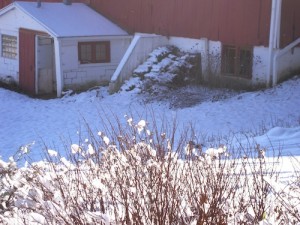
MEANWHILE, back on the farm: What a treat for it to be winter! If it’s going to be dark at night darn it, at least it can be crisp and pretty. And it is. I am loving the snow on the ground, although it is not much and melting fast. But it’s sunny and lovely and fresh and your boots crunch on the snow while the Chickadees call CHICKA-DEE-DEE-DEE from the woods. Time to take Willie boy and Tootsie girl on a walk. I hope you have some weather you can enjoy too.


What’s In Your Library?

Friday, December 7th, 2012

Now that winter is here, it seems like a good time to talk about some good books and DVDs to keep us busy during those long, dark evenings. Here are a few books and DVDs that I’ve enjoyed, some dog related, some not.

AWAY TO ME DVD: First, check out the trailer for a new DVD that has just come out, Away to Me! Anyone who works sheepdogs or likes to watch them will be interested in this video. I got to see the entire thing before it was finished, and it has some of the best scenes of close up interactions between dogs and range ewes I have ever seen. it follows three handlers as they compete in the well-known Soldier Hollow Classic sheepdog trial in Utah. Here’s the movie’s website where you can order it.

UNLOCKING THE ANIMAL MIND, is a great book by Franklin McMillan. Subtitled How Your Pet’s Feelings Hold the Key to His Health and Happiness, the author combines his experience as a veterinarian and work at Best Friends Animal Society with research on the biology of emotion. I tend to read it a chapter at a time, right now I’m enjoying the chapter on “A Long and Happy Life.”

PUKKA’S PROMISE: I was motivated to go back and read McMillan’s chapter on long-lived pets after finishing a pre-pub copy of Ted Kerasote’s new book, Pukka’s Promise: The Quest for Longer Lived Dogs. It won’t be out until February, but I can’t wait until it comes out. I’ll write a substantial review of it closer to the publication date, but put it on your list of ABSOLUTE MUST READS right now. It’s beyond fantastic.

OTHER BOOKS: I love reading books of all descriptions (except: Badly Written). Here are some I have especially enjoyed lately: the novel The Light Between the Oceans by ML Stedman. This is what one review said on Amazon:  “An extraordinary and heart-rending book about good people, tragic decisions and the beauty found in each of them.” (Markus Zusak, author of The Book Thief). I couldn’t say it any better myself. The book is heart rending and still uplifting and written so beautifully it made my heart ache.

Some other good novels are The Art of Fielding and Gone Girl, might be worth checking out if you are looking for some good fiction. If you’re looking for what I call a great “popcorn” book, (something to be done somewhat mindlessly, but still enjoyably) try Grisham’s new novel, The Racketeer. Both Gone Girl and The Racketeer will keep you up reading past your bedtime, so don’t say I didn’t warn you.

One more non-fiction book that, you will not be surprised, appeals to the cook (and enthusiastic eater) in me: Consider the Fork, by Bee Wilson. It is a fascinating history of not so much what we eat, but how we eat it. Who knew the history of silverware could be so interesting?

Last but not least, is a book some readers will love, others not so much. It is titled Tiny Beautiful Things: Advice on Love and Life from Dear Sugar, a collection of advice columns by Cheryl Strayed. Cheryl is the author who wrote Wild, which I mentioned earlier this year. Cheryl’s answers to people’s questions are both so benevolent and yet so bulls-eye honest that sometimes it takes your breath away. Some people would NOT like this book, Cheryl can talk like a sailor and is flat out honest about many of the bad choices she made when she was younger, but as one reviewer said, the advice within is “charming, idiosyncratic, luminous and profane.” I re-read the book when I need to be inspired about the value of honesty and forgiveness.

Your turn! What are you reading or watching? I’m all ears (well, okay, all eyes…but still, I am looking forward to hearing from you.)

MEANWHILE, back on the farm: King Charles the ram goes back to his other home tomorrow and Willie gets to work sheep on another farm. Tootsie is learning “Stay” and to not bark in her crate when I am in the house, and Nellie and Polly are struggling with an up and down relationship. They are best friends, unless a stray cat (orange and white, father to the litter that was born this summer in the barn?) appears. 95% of the time they get along beautifully, but I assume that the stray is the trigger for Nellie hissing at Polly one night, and Polly hissing at Nellie on some others. I’ve only seen the stray once (he darted out of the barn as I walked in), but other times Nellie has entered the barn cautiously, sniffing and looking around with vigilance. The only times I have observed the two cats hiss or growl has been either when Orange/White scampered out of the barn or one of the cats entered the barn as if something or someone unfamiliar was inside. Aggression between ‘best friend’ cats in the presence of a third, unfamiliar cat is common, it was no small part of my case load, so I suspect the the cats are exhibiting redirected behavior. My first job is to gather data…

And so, the great Lord of the Barn saga continues. I borrowed the motion sensor camera that I bought Friends of Ferals and hope to get it set up this weekend. Is, or is not, the orange and white cat coming into the barn and helping himself to the kibble in the self feeder? Is that what is going on with Nellie and Polly? Stay tuned, the chapters continue to unfold.

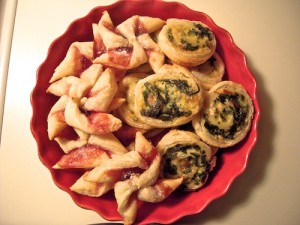
In keeping with the random nature of the books and videos I mentioned above, I’ve served up a random sample of photos. First up, here are some nibbles I made for a good friend’s birthday party (congratulations Harriet!). The roll ups on the right are pastry stuffed with chard and extra yummy cheese, the pinwheels on the left are made with a cherry marmalade made by good friends. It took me about half of the dough to figure out how to make pinwheels, I should have taken pictures of my failed attempts, it would have made quite a progression.


Here’s Katie’s new pup Leo greeting our official Stuffed Stimulus Dog, Roger. Roger has gotten the attention of many a visitor, including a delivery man who almost wet his pants one day. We have learned to be careful about where we put him!

And last but not least, here’s the garden behind the famous Alamo in San Antonio. It was interesting touring the building, but I’ve never been a big battle buff, so although what happened inside is an important event in American history, I could have spent a lot longer in the gardens behind the Alamo itself. Some gardener is doing a truly lovely job…

New DVD on Animal Assisted Therapy!

Wednesday, April 4th, 2012

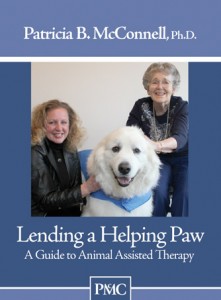
We just released a DVD of the seminar I did in Naples, Florida on Animal Assisted Therapy and Activities, “Lending a Helping Paw.” I’m excited about it, because it gives me the opportunity to help individuals and organizations who want to help others. It is an example of an activity we can do with our dogs that is a triple win (for us, our dogs, and people who need some oxytocin and/or physical therapy). Because of that, old social worker that I am, it’s near and dear to my heart.

Speaking of hearts, and what fills ours with happiness, the question arises about how effective AAT (Animal Assisted Therapy) and AAA (Animal Assisted Activities) really are. I remember a conference put on by the Delta Society many, many years ago that included a controversial study. It showed that, in this study anyway, the greatest benefit was to the owners of the dogs, not the patients in the facility. Whoops. While the audience greeted the news with a disapproving silence, I was cheering in the wings, because it’s good to examine the issue objectively, rather than just following our hearts in this case.

Indeed, the study was very useful and no doubt had an impact on “best practices” as currently defined. It found that the teams in this case had just walked into people’s rooms without asking permission. No surprise then that the residents weren’t all in favor of the project; they’d already lost so much control in their lives that the last thing they needed was to lose more. That’s why good programs like The Delta Society and TDI emphasize the importance of putting the patient first, and letting them drive the system.

But the question remains: Is AAT and AAA really effective? First, we need to distinguish between AAT and AAA. Much of what people call AAT isn’t truly therapy in the medical sense of the word.  To be labeled as therapy the interactions need to be directed or delivered by health and human service professionals, with goals set, treatment plans written and progress carefully recorded. Animal Assisted Activities, on the other hand, include visits, petting, games and tricks.

Here’s the good news for those of us who want to believe that AAA and AAT are beneficial to the recipients: There is indeed research that shows it’s efficacy in several modalities:  Two studies that I can think of off the top of my head found that visits from dogs decreased the perception of pain after surgery. One study asked children to rate their pain (Robbins et al, J of Holistic Nursing, Vol 24, No 1, 206) and another looked at the amount of pain medication used after joint surgery, which is a good, objective and quantifiable measure (Kaplan, AAT Conference Abstract 2004). A third study found that walking with a dog significantly increased compliance with physical therapy programs and increased ambulation exercise: 28% refused to walk without a dog, only 7.2% with a dog. In addition, steps walked more than doubled once patients did walk (Abate et al J. of Cardio. Nursing 2011).

This is not surprising to those of us who are aware of the impact of dogs on our oxytocin levels, and the impact of oxytocin on pain perception (it decreases), immune responses (it increases) and affect (it tends to make us feel safer and more secure). But we do have to be careful here: Not everyone benefits from visitations or therapy from a companion animals. You have to like dogs to get an oxytocin rush from them. (Most “therapy” animals are dogs, but some programs have cats or rabbits for selected patients. No reports of sheep yet….) Awhile ago I visited a senior center with a good friend and her dog. I’d guess about half the people we saw were interested in interacting. The rest appeared to be either neutral or clearly avoiding an interaction. My friend knows what she is doing, and was careful to not impose her dog onto anyone who wasn’t a dog lover.

This all gets back to one thing I emphasize in the DVD: The patient is the star of the program. Not your dog, not you. As much as we love our dogs, if we do this right we’re doing it for people who aren’t as fortunate as we are, and don’t have the opportunity to interact with dogs as we do. It’s all about them, and keeping that in mind is critical to a program’s success.

Other aspects of AAT and AAA are essential too: The Lending a Helping Paw DVD has an extensive section on what dogs are suited for therapy work, and how to ensure that your dog is really enjoying the process (these are the 2 most common problems that professionals in the field encounter). It discusses organizations that certify teams, what is required to obtain certification and how to work with facilities in a professional and pro-active way.

MEANWHILE, back on the farm: Instead of playing with the lambs or gardening, last night I went to a senior facility outside of Madison and delivered copies of the DVD to one of the stars of the show: Ruth Trameri. She’s the lovely lady on the right of the cover, with my good friend Beth Viney’s (on the left) and her certified therapy dog, Czar. (Czar was an early admirer of my Gr Pyr, Tulip… that’s actually how Beth and I met.) Here they are,  gracing the cover of the new DVD:

And here’s a video from the DVD of Tootsie’s first visit to a facility. We used her (and Willie and 3 other dogs) to evaluations of  potential therapy dogs. (Tootsie passed, Willie… no surprise here, does not: too enthusiastic). This video segment is testing for one of the most important qualities of a good therapy dog — sociability. Dogs need to be interested in everyone, true social butterflies, but calm and respectful at the same time. Watch how Tootsie tells us where she’d most like to be…. (and feel your oxytocin levels rise?). Thanks to Beth Viney, the Director of Pet Pals in Madison WI, Dr. Linda Sullivan, and Pet Pals volunteer Diane Peltin and Ruth Trameri for helping with the evaluation section of the video, we all had a great time and it resulted in some very instructive (and, I might add, amusing) videos.


Missing the Sense, Scent of the Missing
Friday, January 27th, 2012

Part of the fun of preparing for the seminar I did in Orlando was working on the canine olfaction section. The overall topic of the day was Canine Communication (often compared to primates like us), and most discussions in this vein emphasize visual communication. That’s all well and good, I’m a visual signal groupie from way back, but I loved beginning the day talking about scent, and imagining what it would be like to be able to use one’s nose like a dog. We all know, intellectually anyway, how important smell is to dogs, but because we tend to be so oblivious to it, it is hard for us to imagine (Example of our obliviousness: What’s the common word used to described people who can’t smell?  Yup, there isn’t one.)

Hard to imagine what it’s like to be a dog (okay, impossible), but here are helpful hints, many of which I learned from Susannah Charleson, author of Scent of the Missing: Dogs can sort out individual scents just as you can visually distinguish different pieces that make up a stew. There are the carrots, the onions, the beef…. And if you are trained, you can taste the gravy and notice the hint of rosemary and thyme. Just as we can sort out visual stimuli, dogs can separate out all the components that make up one particular smell. What we don’t know (we know shockingly little about the world of scent to a dog) is what scents they perceive and notice in the environment, especially as it relates to other dogs. Does a good whiff in the grass relate to “Hmmm, a little female poodle, a large neutered boxer…”, or something more along the lines of “Female, slightly nervous, ate fish last night, having kidney trouble apparently…”

When working with tracking or trailing dogs, you also learn that scents are like objects in that they have a shape and a physical presence–imagine them as an oddly shaped balloon, whose shape depends on the soil moisture, wind currents etc. When dogs are searching for a scent (or just blunder into one), you can tell when they first discover the “edge of the envelope.” Of course, all dogs are different, but most dogs pause for a microsecond, and their posture changes: their tail might go up, or perhaps their head. It is usually quite clear when a dog first discovers the ‘edge’ of a scent. I saw Susannah illustrate this in human terms last November in Austin, and she graciously has allowed me to pass it on. I love doing so, because it is yet another way of trying to bridge the gap between canine and primate, my favorite game in life.

Here’s the demo: Have one member of the group volunteer to leave the room. Turn on a long playing piece of music (yup, music, bear with me) on a small device like an iPod or iPad. Turn it down so low that it can barely be heard, but is still clearly discernible if you are close enough, and hide the music somewhere in the room. When the volunteer returns, ask them to locate the music. People search for sound just the same as dogs search for scent, moving around until they …Ah! …think they might have heard something, and then gradually work their way closer and closer until it gets louder and louder, just as scent gets stronger and stronger. Of course, the music won’t be as affected by wind currents (I love how you can follow wind currents by watching a dog search for an object), but it is fascinating to watch a person try to localize sound, and clearly indicate, just as dogs do when they first discover a scent, that they have found it’s ‘edge.’

We did this demonstration in Orlando at the Communication Seminar (DVD coming in a few months if you missed it!) and it was truly great fun. You can do this with any group of people, it could even be fun in a basic dog training class if there was time. By the way, I learned so much about scent work, and loved Susannah’s writing so much, that we are selling her book, Scent of the Missing, on the website.  You might want to check it out. And stay tuned, I mentioned earlier that a TV show is in the works right now, based on Puzzle and Susannah and a cast of other S & R team members. (And yes, there’s a really hunky guy in it. Of course!)

What about you? Do you have any ‘scent games’ you play with dog owners to help them understand the umwelt of a dog? I’d love to hear about them. This sense of dogs is so important, and yet we so easily ignore it. I see it relevant in so many aggression cases (Ex: Willie once attacked a dog for ‘no reason’.. until I remembered that the dog’s house mate had attacked Willie once, so the scent of trouble was there all along.) I’d love to hear your perspective.

MEANWHILE, back on the farm. Willie is just back from PT, and Courtney is thrilled with his progress. We did have a set back early this week–running in semi-deep snow made him lame that night, but he recovered 95% in 2 days and that’s good. I am still working on accepting that this is just what it is, that just like my body, sometimes Willie’s is going to bother him. We’ll just make a note of it and avoid that activity if we can, and if not, then just let him rest up whenever he needs it. He’s just simply never going to be sound, but then, neither am I (neck, back, knee, spine, I could go on…..) but who cares! We just learn what works and what doesn’t and manage around it.

We have the go ahead to VERY VERY cautiously begin working sheep again.  Be still my heart. Of course, only a minute amount at first. A short little drive here. Then rest. Then maybe a very short, simple outrun and fetch on very quiet sheep there. There won’t be much sheep work now though, because it’s icy in some spots (the absolute worst for Willie; he even has to heel beside me all the way to the barn now, the driveway is a skating rink) and I don’t want to work in him snow deeper than two inches or so. He’ll wear his hobbles and I’ll set it up as carefully as I can, hold onto to my heart and go from there. I’ll keep you posted.

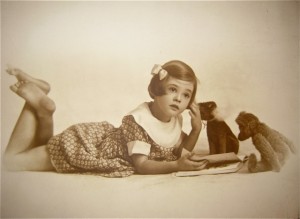
Here’s a photo that is, uh, a little out of the ordinary for this blog. It’s me mum as a little girl,  (yes, she was English), illustrating her love for animals at an early age. Mom has been gone a long time, but she adored animals, dogs especially, and somehow it just seemed right that she had a place here. I loved animals too even when I was tiny. I had 52 stuffed animals at one count, and refused dolls (because they weren’t soft and cuddly.) Anyone else crazed for stuffed animals when they were little?


Therapy Dogs – Born or Made?

Thursday, January 19th, 2012

As many of you know I recently presented a seminar on animal assisted therapy in Naples Florida. (Yes, it’ll be out as a DVD later this winter. Happy Dance!) One of the motivations for doing the seminar was the number of clients I had who wanted me to help them prepare their dog for therapy work. Sometimes it was like swimming downstream on a warm, cozy river. Their dog was a perfect fit and ended up doing wonderful work in the community. Other times… well,  it was reminiscent of trying to paddle up a cold, frothy waterfall. The fact is, therapy work can be hard work, and it takes a special kind of dog to be both good at it and to enjoy it. The directors of AAA and AAT (AAActivities and AATherapy) will tell you that one of their greatest challenges is working with people who want to volunteer but whose dogs just don’t qualify. Here’s a summary of the characteristics of a good therapy dog prospect, in hopes it will be helpful for those who are interested in doing this wonderful work:

Affiliative: This seems like a no-brainer, but the fact is that many dogs are presented for therapy work who really don’t like strangers all that much. They love their owners and good friends, but aren’t all that interested in other people. Good therapy dogs need to be the kind of dogs who ADORE people, all people, and want nothing more than to connect with them. It is, after all, the emotional connection that is often the therapeutic part of AAA and AAT.  It seems to me that dogs sort into 4 categories: 1) adore people, care little for other dogs, 2) adore dogs, care little for unfamiliar people, 3) adore members of both species and are thrilled to meet new ones and 4) adore neither dogs or people, except maybe their owner. Needless to say, only categories 1 and 3 are good therapy prospects.

Physically Calm: Many of the dogs who think all people hung the moon regrettably don’t fit into this category. Leaping, licking, pawing and body slamming just don’t work in senior centers and hospitals. This is why so many dogs don’t qualify when they are young, but could be great prospects when they are older. I wrote a chapter with Aubrey Fine for his great book The Handbook of Animal Assisted Therapy, and we had a long discussion about how many dogs would be GREAT for therapy work when they are six. Or eight. Or ten, but their owners get them evaluated at the age of two, the dogs are not “passed” and their owners never try again.

Psychologically Sound and Non-reactive: It doesn’t matter how much training or conditioning you do, therapy dogs need a certain level of rock solid soundness to be good prospects. Of course, the context does matter: some dogs are great in senior centers but are uncomfortable around children and would be disasters in a children’s hospital. It’s important to remember that AAA and AAT include a vast range of experiences, so every dog must be evaluated based on what they are going to be doing.  But it’s still essential to keep in mind that although your job is in part to protect your dog, once you are inside a facility you will have limited control over what happens. And what can happen (someone grabbing your dog, weird noisy medical equipment coming on, a medical crisis that results in tremendous chaos) is sometimes enough to terrify a sensitive dog.

Included in this category, although albeit somewhat different conceptually, is the state of being “emotionally mature” or able to handle frustration and deal with the world with a calm, measured demeanor. Again, just as in people, sometimes this takes several years to master.

Ridiculously clean and healthy: Unless you work in health care facilities it is easy to forget how differently sanitation needs to be handled in facilities and hospitals than it does in your own home. Pet Pals here in Madison, which organizes visits to the Children’s Hospital through the UW Vet School, requires that all dogs in the program go through extensive veterinary evaluations twice a year. This includes an entire day of testing for a vast range of diseases, from salmonella to MRSA. In this case the dogs are visiting children who are often immune compromised, and so their requirements are more stringent than some, but any facility, from a senior center to a hospital, is a very, very different place than your home. Germs love the kind of places that therapy dogs go to visit, and they can move around like wild-fire within very vulnerable populations.

Aware of their Job? This is gravy, pure gravy, but the fact is that some dogs do more than happily sit with strangers or participate in structured therapy treatment plans, as beneficial as that can be to some people. These dogs seem to sense why they are there, and seek out people who are especially needy, and make an emotional connection with them that changes their life. These connections happen, and hearing about them is enough to make you all gooey-eyed. Special stuff indeed.

I’ll leave the training and evaluations required to be a registered therapy team for another blog, but I thought it’d be interesting to ask all of you to add to this list–specifically, what type of personality do you think a therapy dog needs to be successful? If you’ve either had a working AAA or AAT dog, or been the beneficiary of one, I’d love to hear what criteria you’d put on the list. FYI, I’ll write another time about what the handler at the other end of the leash needs (a list too often ignored!), and some good books for people interested in getting involved, but right now I’d like to think about the dogs themselves. Aside from training for specific cues and conditioning to things like medical equipment, what traits do you think good therapy dogs need?

MEANWHILE, back on the farm: It was eight below (Fahrenheit) when I got up yesterday morning, three below today. I think the high is expected to be around eight or so, and we’re expecting 2 to 7 inches of snow tomorrow (2 to 7? that’s a big difference!).  I wish I didn’t have to drive to town to get ready to start teaching at the university (“The Biology and Philosophy of Human/Animal Relationships”), but still it’ll be sort of fun to get the snow. If it had been snowing all winter I’d be tired of it, but we’ve hardly had any winter at all til now, so it feels sort of good in some strange, possibly masochistic kind of way.

The great news is that Tootsie, who began her life here explaining to me that her paws did not participate in wet or cold, now trots happily outside in the worst of weather, does her business and then runs, ears flapping and tongue lolling, back into the garage. When we got her as a puppy mill dog she understandably had no concept of going outside and eliminating on cue right away, and then going right back in if the weather was inclement. She’d stand at the end of the garage and look plaintive and miserable, but refuse to go out. And even in great weather, once out she’d sniff and sniff and sniff and sniff… you get the idea.  What a great reminder of how handy it is to put peeing and pooping on cue.

And now you should see her! Out she runs, does her business and then runs back in… while Willie stays outside and looks at me like “WHAT? Go back inside now? Whatever for?” So Tootsie goes back inside and Willie and I play outside for awhile. I should tell you though that yesterday there was one time, during the coldest part of the morning, when she did refuse to go out. But she’d been outside to pee recently, and I took it as “Truly, I don’t have to go at all, and it’s really, really cold. Would it work for you if I stayed inside this time?” And indeed it did. Honor your dog, right? The next time I took her out her bladder was fuller, and out she went, did her business and ran to me for her treat. Now, I just have to work on her barking if she sees me and Willie outside through the window… One thing at a time!

Willie is good good good. His shoulder seems good (almost afraid to write that) and he’s loving everyone he meets lately. He still isn’t buddies with Tootsie. They STILL ignore each other, it’s a bit strange sometimes, but he is very tolerant of her and the only sign of problems I see is when I come home she has taken over our greeting rituals. Rather than being all over me, Willie runs to get a toy and lets her get the first attention. I’m not liking that, I think he is a bit frustrated, but doesn’t like competing with Tootsie for attention, and unwilling to get into any conflict about it… I’ll be working on that in the near future too. Never a dull moment with dogs, hey?

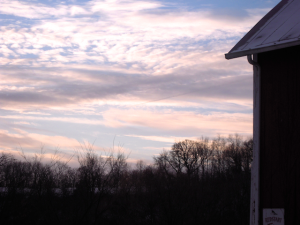
Why do I live in a place that can be colder in the winter than the inside of your freezer? Here’s the reason: Sunrise yesterday.  Eight below. And a sky simply too beautiful for words…


Early Bird Seminar Registration Almost Over

Wednesday, September 28th, 2011

My eagle-eyed conference coordinator, Katie, asked me to remind you all the early bird pricing (about 10% off) for the Madison Seminar on October 29 and 30th is over at midnight on Friday, September 30th.  The host hotel also has a special conference rate that expires on Friday too, and space for the seminar is limited (and registrations are pouring in, wheee!) so if you are thinking about coming, now’s the time to act. As always, if you are a blog reader please, please come up and say hi. I always love to meet readers in person. I also should mention that you can get up to 20% for groups of 10 and over, 10% off for 5 to 9.

I’m having a ball getting back to working on the seminar now that we are back from Scotland. Have I mentioned how much great research has been done on dog behavior lately (finally)? Did you know, for example, that ambidextrous dogs have higher levels of noise phobias than left-pawed dogs? (About the same percentage of dogs are left-pawed as people are right-handed. Cool, hey?) I’m working on genetics and behavior right now, and trying to figure out how not to spend the entire day on it. Don’t worry, I won’t. Too much to talk about regarding developmental effects on behavior, learning, communication, social systems, etc. I’ll be talking about all that on Saturday and soaking up Ken Ramirez’s practical advice, inspiration and amazing videos on Sunday. It’s coming soon. Oh boy and Eeeeeps! Get to work Trisha.

MEANWHILE, back on the farm: Willie and I went on a 35 minute walk yesterday in one of our favorite places, a county park of prairie and woods that was flaming with bright red sumac and soft purple asters. Although it was still on leash, it was our longest walk since February, and it was one of the first times I felt like maybe life will someday get back to normal. What a treat. We’ve started on the Hobbles for brief periods off-leash in the house, by next week he can be off leash in the Hobbles outside for a few minutes at a time. Ooooooooh, can barely wait.

Here’s Mr. Will this morning, leash attached (but hidden, not on purpose) and on a Sit/Stay for the camera.


DVDs 25% Off!

Tuesday, September 6th, 2011

Not very subtle, hey?  Apologies, but I was convinced by some well-motivated smooth talkers that some of you really would want to know that all my DVDs are 25% off until next Monday. So there, I did it, the woman who would flunk out of marketing class on the first day. Whew. Okay, now to the really important stuff….

It’s all about getting ready to go on a long trip right now, from seminar prep (just getting all my movies on a thumb drive is not small task!) to training new farm sitters to writing out instructions to, oh yeah, cleaning out the frig. [Ack, is that a new life form covering the yogurt?] If you’re in the same boat, check out the comments to a blog I wrote on preparing for a big trip without your dog. I hope my comments are helpful, but I’d also advise you to check out the reader’s comments, they are invaluable. As usual, you all come through with an impressive body of knowledge and good advice.

I’ve pre-posted a fun video that will be published this Thursday, hope you enjoy it. It should go out right around when Jim and I set down in Scotland. After I get over leaving Willie and Sushi (Ack, I am so bad at this), it’ll be wonderful to get back to my roots. My ancestors are English, Scottish and Welsh, and the first time I went to Scotland I got off the plane and thought: “Everyone looks like me! No wait, I look like everyone else!” Same square face and, oh so regrettably, short, stocky legs. All the better for scaling the hills of the highlands?

Willie had a great PT session today, 20 min on the treadmill and a re-fit of his  hobbles for when we get back. He doesn’t seem to mind them at all, pays them no attention, and now that his surgery is long past, they are easy to get on. Objectively, and, of course, scientifically, I think he looks rather elegant in them myself. I’m just saying.

DVD Sale; Anniversary Pie

Saturday, July 31st, 2010

I promised the people who keep an aging hippie social worker like me in business that I’d mention that the summer 1/2 price DVD sale is on. Okay, I did that. Good Trisha.

Sweet day today. Jim’s and my 10th anniversary. Making, as I write, a cherry/blueberry/strawberry/rhubarb pie for Jim. I will eat some myself to keep him company and prove that I love him. Greater love hath no woman.

I had planned to write a post yesterday about the correlation (if any) between testosterone and aggression, but got overwhelmed with speech preparations. I’ve got 6 separate talks to give in the next 2 weeks. Oh my. Giving a Keynote address to the Int’l Society of Human Ethologists on Monday, then off on Thursday the Best Friends Forever in Pennsylvania (giving 3 talks there, soooo looking forward to seeing my friends and colleagues and learning lots and lots from other speakers) home on the next Monday then off to Toronto after that to talk about Dog-Dog Aggression & the Biology of Play. So bear with me, I might be tad less productive than usual, but I’ll do my best to keep up. So many things I’d like to discuss with you all . . .

Time to take out the pie and go up the hill and feed the rams before we get the straw out of our hair and go to town to celebrate, but here’s Mr. Hope, all 5 months of him, eyeing the sheep. Notice how his tail is starting to go down (from up over his back). That’s a good sign, means he’s starting to think about herding rather than chasing. He won’t get a chance to do either until he’s much older, but it’s fun to watch the progression.

Here’s my pie for Jim, and here’s what I always sing when I make one, straight out of the movie Waitress, one of my all time favorite movies:

Baby don’t you cry

Gonna make a pie

Gonna make a pie with a heart in the middle . . .

Lucky for you, you are not able to hear me sing it.

Dog-Dog Aggression, Puppies and “Intensive Sniffing”

Thursday, November 12th, 2009

I’m curious about your experience with dogs who are dog-dog aggressive and what I’ll call “intensive sniffers.” Ever since I heard Sue Sternberg say that dogs who sniff obsessively in her office are often/usually/always?) dog-dog aggressive, I have paid more attention to “intensive sniffing behavior” (I don’t know what else to call it–but hey, I just made that term up, so don’t go looking in the literature!). I’m talking about the dog who enters a room in which other dogs have been previously, puts his nose down and doesn’t lift it up for minutes at a time. I did indeed find a correlation (just observations, no research) that dogs who can’t seem to stop sniffing an area where other dogs have been, are often dogs who have problems with other dogs, especially unfamiliar ones.

I remembered that when I first took Willie, over 3 years ago, to his first vet clinic appt. He was about 8 weeks or so, maybe a day or two older. He first panicked when he heard dogs barking in the background, and I mean panicked. He looked terrified. We moved away from the sound (which was a good 100 yards away–the outdoor area of a doggy day care) and to the front door of the clinic. I put him down and he slammed his nose into the ground and started sniffing loudly and, well… intensely. He would not move from that spot for food, squeaky toys, smooches, clicks or guarantees of an entire chicken for dinner on a daily basis.

I groaned silently, predicting that this could indicate serious trouble down the road. (He had been a bit fearful of my dogs when he first met them, but he was a 7 and a half week old puppy who withdrew but then came right back and let them sniff him. It didn’t seem excessive at the time at all.) I picked him up and took him inside, where he went happy, waggy, flappy body at the vet tech and the vet. As we were leaving the appt, we walked into the lobby to find a Bichon puppy in the middle of the floor. Willie ran under a chair and hid. From a Bichon puppy. As if it were a monster.

Ah, Trisha, you might ask: And why did you keep this puppy? All I can say is that for over a year I said “I’m not sure I’ll keep him, but I just want to work with him enough to keep him out of a shelter or a euthanasia appointment.” As many of you know, he did exhibit horrific problems with other dogs for a long time, and I worked my tail off on it. (I show a video of him meeting a new dog in the Dog-Dog Aggression DVD, including one of the ways I’ve treated his issues. (the DVD is now on sale, my staff tells me I’d better mention, or they’ll muzzle me for life). As many of you also know…. I am stupid in love with him and wouldn’t re-home him for any thing or any body.

Two questions, really: How many of you have seen dogs who exhibited the potential for dog-dog aggression at such an early age? I have no explanation for Willie’s behavior. He grew up around other BCs and Labs, the breeder swore nothing she can think of would have caused any problem. I can tell you that his dam an sire were bred again, and resulted in another puppy with the same issues.

The other question relates to the “intensive sniffing.” I’m curious about your experience with it. I can tell you that I’ve seen dozens of dogs now who are dog-dog aggressive to unfamiliar dogs who attach their noses to the ground and will not stop investigating the scents of other dogs. One of the markers, as a matter of fact, that I used to judge Willie’s progress was how intense he seemed about smelling the scents of other dogs. It makes sense when you think about it… if one is nervous/anxious/deeply concerned about unfamiliar dogs, then one would spend an abnormal amount of time checking “them” out, scent-wise that is. Willie, for over a year, acted as if every unfamiliar dog he saw was a monster. A raving, horror-movie, flesh eating monster. Now when he sees another dog he wags his entire body and whines to get closer. He’s doing extremely well, and I am proud and relieved (but dog parks well never be in our future……)

Here’s the little monster himself….

And here’s some of fall’s bounty, from the CSA down the road. Yum….

Lassie Self Handicaps with Willie

Thursday, September 10th, 2009

Here’s a video of Self Handicapping that I took 3 years ago, when Will was a young pup and Lassie was the stronger of the two. It’s a lovely illustration of appropriate dog play, showing how the stronger dog self handicaps to avoid overwhelming the weaker player.  Lassie, even now, is capable of pulling with a great deal of strength, but in this video she clearly damps down both the power of her pull and intensity used when she shakes her head. She moves more slowly and with less power than she would when playing with me.

There’s another piece to this video that I  just love: when Lassie decides she is done playing she gives Willie a very clear signal that play time is over. (Not long after she looks at me when I say “Jim! Turn the TV down” in the background!). She gives a second (more obvious) signal when Willie doesn’t seem to get the message… did you see the first one?

I showed this at the seminar on Dog Play (Dog Play DVD)  to illustrate appropriate and inappropriate play and followed it with a second video thatmakes me all gooey whenever I watch it. It was taken 2 years later, and shows the now grown up, and very strong Willie self handicapping while playing tug with Lassie, who at 14 is now the weaker one. I can’t tell you why, but it makes everyone who sees the comparison feel all oxytocin-y and big of heart.

Meanwhile, back on the farm: Or, rather, back at the office right before I drive away to pick up Willie from his FIVE AND A HALF HOUR root canal. I have been flipping out over here… five + hours under anesthesia? Oh lordy, be still my heart. (I know, I know, I am such a wuss. It’s pathetic. Talk about oxytocin! Is there such a thing as oxytocin poisoning?)