Welcome to the official Patricia McConnell website. Skip directly to: main content, navigation, search box.

Archive for the ‘herding dogs’ Category

Happy New Year and Happy Pictures!

Friday, December 28th, 2012

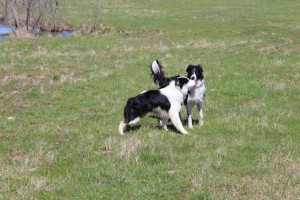
Trisha is feeling a little under the weather this week, but didn’t want to leave you without a few cheery pictures. Here is Willie playing a good game of chase with Lily, Katie’s Dogo Argentino, in the upper pasture this week.

From all of us at McConnell Publishing, have a happy, healthy, and safe New Year. Give your dogs a good belly rub from us!


__

Play Bows as Meta-Communication

Friday, December 14th, 2012

We all know the signs of imminent danger between two dogs right? Immobile stiff bodies, direct eye contact, round eyes. Except when dogs are playing and then the exact same postures and expressions are nothing but pauses between frolics. That is a perfect example of what’s called meta-communication, or communication about communication.

Here’s a video of Willie and his new friend, Leo–the new pup of Katie Martz here at the office–illustrating meta-communication as well as any two dogs could. I look forward to your comments about it.

First, some background: Yesterday they met for the first time, and it went beautifully. Katie stood 40 feet from the door with Leo as I let Willie out and asked him “Where’s the Dog?” We played tug when he looked at Leo and then back at me. After 2 subsequent “autowatches” in which Willie looked at Leo and looked back at me without prompting (and was reinforced with a tug game for it), I released Willie to go meet Leo. He immediately ran over to Leo, who pilo-erected the fur on a dorsal line from neck to tail a little bit, but stood his ground and allowed Willie to sniff him. After a few short seconds Leo relaxed as Willie sniffed him, and both Katie and I felt sure (we discovered later as we talked about it) that he was about to put his forepaws onto Willie’s back. I wasn’t sure how that would go over with Willie so I said “Go to the barn!” to keep their first greeting positive. It all happened so fast I was acting on gut feeling as much as anything else, having learned with Willie and hundreds of client’s dog to avoid extended greetings between dogs. So Willie dashed off toward the barn and their first encounter went well.

Quickly we moved into a fenced 3 acre pasture, and both dogs got to run together off leash. They played beautifully together, although Leo is too young and small to keep up with grown-up, long-legged Willie. There’s a lot going on in this short video, but first watch how Leo’s long play bows correlate with both dogs standing stock still and staring directly at each other. Those signals, normally signs of trouble are not a problem however, because as meta-communication, play bows signal the other dog that stiff bodies and direct stares are just in fun. Just as a football jersey means a tackle isn’t true aggression (okay, maybe American football is a bad example?!), play bows signal other dogs that any behavior to follow is meant as play. That’s why you see them most often between unfamiliar dogs as they begin to play together.

Watch as Leo does beautiful, clear play bows at second 8, 20 (behind my legs), 118, 126, 148 while he and Willie stand stock-still. I love how both dogs stay still until one does what’s called “start-stop,” that quick little lunge that elicits a reaction. (I do it myself to see what will happen at second 40.) (By the way, YouTube changed its settings–surprise, sigh–so you may see another video after the end of this one. Just ignore until we figure out how to change things around!)

Watch too how Leo runs to me and sits beside my legs at second 30. My interpretation of this behavior is that it’s done by dogs who are a bit intimidated by another. There is a great interaction between the dogs right after that, with Leo doing what looks like an abbreviated muzzle punch at second 33 and then licking Willie’s muzzle.

If you watch the video to the end you’ll see Leo squat and pee, and then turn and look back toward Katie. He’s learned if he pees outside he gets a treat, and boy did he learn that lesson well!

There’s lots going on in this video, I’d love to hear any of your comments about what else you might have observed. If you’d like to read more about play, you might want to go the section in the Reading Room on Play, or check out the Dog Play DVD or Play Together,  Stay Together about play between people and dogs. I’ll look forward to reading your comments, and not to mention welcoming Leo back to play with Willie.

MEANWHILE, back on the farm: What a treat for it to be winter! If it’s going to be dark at night darn it, at least it can be crisp and pretty. And it is. I am loving the snow on the ground, although it is not much and melting fast. But it’s sunny and lovely and fresh and your boots crunch on the snow while the Chickadees call CHICKA-DEE-DEE-DEE from the woods. Time to take Willie boy and Tootsie girl on a walk. I hope you have some weather you can enjoy too.


What’s In Your Library?

Friday, December 7th, 2012

Now that winter is here, it seems like a good time to talk about some good books and DVDs to keep us busy during those long, dark evenings. Here are a few books and DVDs that I’ve enjoyed, some dog related, some not.

AWAY TO ME DVD: First, check out the trailer for a new DVD that has just come out, Away to Me! Anyone who works sheepdogs or likes to watch them will be interested in this video. I got to see the entire thing before it was finished, and it has some of the best scenes of close up interactions between dogs and range ewes I have ever seen. it follows three handlers as they compete in the well-known Soldier Hollow Classic sheepdog trial in Utah. Here’s the movie’s website where you can order it.

UNLOCKING THE ANIMAL MIND, is a great book by Franklin McMillan. Subtitled How Your Pet’s Feelings Hold the Key to His Health and Happiness, the author combines his experience as a veterinarian and work at Best Friends Animal Society with research on the biology of emotion. I tend to read it a chapter at a time, right now I’m enjoying the chapter on “A Long and Happy Life.”

PUKKA’S PROMISE: I was motivated to go back and read McMillan’s chapter on long-lived pets after finishing a pre-pub copy of Ted Kerasote’s new book, Pukka’s Promise: The Quest for Longer Lived Dogs. It won’t be out until February, but I can’t wait until it comes out. I’ll write a substantial review of it closer to the publication date, but put it on your list of ABSOLUTE MUST READS right now. It’s beyond fantastic.

OTHER BOOKS: I love reading books of all descriptions (except: Badly Written). Here are some I have especially enjoyed lately: the novel The Light Between the Oceans by ML Stedman. This is what one review said on Amazon:  “An extraordinary and heart-rending book about good people, tragic decisions and the beauty found in each of them.” (Markus Zusak, author of The Book Thief). I couldn’t say it any better myself. The book is heart rending and still uplifting and written so beautifully it made my heart ache.

Some other good novels are The Art of Fielding and Gone Girl, might be worth checking out if you are looking for some good fiction. If you’re looking for what I call a great “popcorn” book, (something to be done somewhat mindlessly, but still enjoyably) try Grisham’s new novel, The Racketeer. Both Gone Girl and The Racketeer will keep you up reading past your bedtime, so don’t say I didn’t warn you.

One more non-fiction book that, you will not be surprised, appeals to the cook (and enthusiastic eater) in me: Consider the Fork, by Bee Wilson. It is a fascinating history of not so much what we eat, but how we eat it. Who knew the history of silverware could be so interesting?

Last but not least, is a book some readers will love, others not so much. It is titled Tiny Beautiful Things: Advice on Love and Life from Dear Sugar, a collection of advice columns by Cheryl Strayed. Cheryl is the author who wrote Wild, which I mentioned earlier this year. Cheryl’s answers to people’s questions are both so benevolent and yet so bulls-eye honest that sometimes it takes your breath away. Some people would NOT like this book, Cheryl can talk like a sailor and is flat out honest about many of the bad choices she made when she was younger, but as one reviewer said, the advice within is “charming, idiosyncratic, luminous and profane.” I re-read the book when I need to be inspired about the value of honesty and forgiveness.

Your turn! What are you reading or watching? I’m all ears (well, okay, all eyes…but still, I am looking forward to hearing from you.)

MEANWHILE, back on the farm: King Charles the ram goes back to his other home tomorrow and Willie gets to work sheep on another farm. Tootsie is learning “Stay” and to not bark in her crate when I am in the house, and Nellie and Polly are struggling with an up and down relationship. They are best friends, unless a stray cat (orange and white, father to the litter that was born this summer in the barn?) appears. 95% of the time they get along beautifully, but I assume that the stray is the trigger for Nellie hissing at Polly one night, and Polly hissing at Nellie on some others. I’ve only seen the stray once (he darted out of the barn as I walked in), but other times Nellie has entered the barn cautiously, sniffing and looking around with vigilance. The only times I have observed the two cats hiss or growl has been either when Orange/White scampered out of the barn or one of the cats entered the barn as if something or someone unfamiliar was inside. Aggression between ‘best friend’ cats in the presence of a third, unfamiliar cat is common, it was no small part of my case load, so I suspect the the cats are exhibiting redirected behavior. My first job is to gather data…

And so, the great Lord of the Barn saga continues. I borrowed the motion sensor camera that I bought Friends of Ferals and hope to get it set up this weekend. Is, or is not, the orange and white cat coming into the barn and helping himself to the kibble in the self feeder? Is that what is going on with Nellie and Polly? Stay tuned, the chapters continue to unfold.

In keeping with the random nature of the books and videos I mentioned above, I’ve served up a random sample of photos. First up, here are some nibbles I made for a good friend’s birthday party (congratulations Harriet!). The roll ups on the right are pastry stuffed with chard and extra yummy cheese, the pinwheels on the left are made with a cherry marmalade made by good friends. It took me about half of the dough to figure out how to make pinwheels, I should have taken pictures of my failed attempts, it would have made quite a progression.


Here’s Katie’s new pup Leo greeting our official Stuffed Stimulus Dog, Roger. Roger has gotten the attention of many a visitor, including a delivery man who almost wet his pants one day. We have learned to be careful about where we put him!

And last but not least, here’s the garden behind the famous Alamo in San Antonio. It was interesting touring the building, but I’ve never been a big battle buff, so although what happened inside is an important event in American history, I could have spent a lot longer in the gardens behind the Alamo itself. Some gardener is doing a truly lovely job…

Favorite “Non-Traditional Cues,” Part II

Thursday, October 18th, 2012

Wow. You all are amazing. So far there have been 165 answers to the question posed two weeks ago, “What’s Your Favorite Non-Traditional Cue?” I’ve read through every one of them with great interest (and often amusement). My plan was to go through all the comments, list every cue mentioned with it definition (some people included as many as 7 or 8), and see if I could  find some patterns.

Several hours later, and less than a fifth through all the cues mentioned, I suspected that a smart person might want to modify the plan. So that’s what I’ve done, whether either out of laziness or wisdom, I couldn’t tell you. I’m using the list I’ve generated so far as a sample, and have re-read all the rest of the comments that have been so thoughtfully provided.

Here’s what I’m seeing so far: First, the most common “non-traditional” cue appears to be “Wait.” It has several variants as to its exact intention, but in all cases the dog is being asked to pause or not move forward. Much more casual and less directive than a stay, I find this an invaluable cue that I myself use every day–at the door, at the car, while walking down a trail, etc. etc. It’s part of the curriculum in Family Friendly Dog Training, so I guess it’s clear that I think it would be good if it moved from “non-traditional” to “traditional.” It’s just so darn handy.

Another category of commonly used cues not often seen in standard dog training is the set of cues telling a dog either that an event is over (“Enough, All Done, All Gone”– ie, no more ball play, no more treats) or to go entertain him or herself (“Settle, Go Settle, Go to Your Place, Chill, Go Pass Out!”) These also seem to me to be incredibly useful cues that all dog owners (and dogs) would profit from knowing.  I use “Enough” several times a day, usually meaning that object play is over, but I as I’m writing this I realized I use a variant, “That’s Enough,” to mean “No more petting.” At first I assumed that Willie didn’t know the distinction, (since I only noticed it while writing this), but perhaps he knew it long before I did?

Notice that, in the variants of Settle, the dog can either decide him or herself to find a place to settle down, or go to a specific area taught in the past. I use Settle myself, meaning go anywhere you want, but for the love of all things good and true, please lie down and chill out for awhile.

The other most common group of cues relate to moving in space: “Turn Around, This Way, Up, Move Over, Back Out, Beep (my favorite!), Go Around,” etc. etc. These strike me as extremely useful as well, although more specific to individual owners and dogs.

One cue, mentioned by a few and one that I have discussed before is “Ready.” I truly wish more people would use this as a way of helping a dog understand what is about to happen. It can be used to prime a dog for action, as it often is in Agility, but also as I use it more often, to let a dog know that something is about to happen, especially if it involves being touched or handled. I use it for Willie when I am about to do something to him, like pick up a paw to dry it off. This gets into another conversation we could have about the balance between keeping cues short and sweet (very valuable at times) and not overwhelming a dog with meaningless chatter AND, at other times, using words to have interchanges with dogs that are more like conversations than a set of “commands.” I’m a fan of both…. Hummm, I’ll have to think about when and why I use different approaches.

While we ponder that, here are some of my favorite cues from the comments about non-traditional cues:

Whoopsie What you just did wasn’t what I wanted, try again.

Who’s a Goof? Roll in the Grass.

Be Bad (Okay, that’s mine, for jump up and put your paws on my chest.)

Who’s a Brave Girl? Go stand between my legs.

Use Your Words or Tell Me Your Story Bark

Sweetheart, can you put your Stagbar on the rug please? Self explanatory!

And What Should You Be Doing? Go lie on your rug

Watch Out for the Panty Hose! 4 on the floor

Chip! Really? As in, did you really just go into the garbage? Dog now puts his paws over his head.

There are a gazillion more, I encourage you to read through them if you haven’t, but it seems appropriate to end on the most unique one I could find:

Gheresh Bede or Farsi for “shake your booty”

MEANWHILE, back on the farm: Two inches of rain last weekend! Amazing! Some people got even more (and northern Wisconsin got snow, lots of it. Oh my.) Everything is so green now it’s hard to imagine it was ever brown. My pasture is still in rough shape, but the front lawn looks like it sprung to life except in a few places. All I can say is that the sheep are very, very happy.

Last Friday Willie was in his last sheepdog trial of the year. I’d say the results were mixed. I purposefully only ran a partial course with him in order to protect his shoulder. I leave tomorrow for a sheepdog training clinic with Patrick Shannahan, and I wanted to be extra sure that Willie was sound enough to work in the clinic. I also wanted him to leave the course wanting more, since the last two trials he was in were exceptionally difficult and stressful for all the dogs. This time his first run didn’t start well: Although he’d appeared to focus on the sheep in previous runs, when we walked to the post he kept looking in the direction of another group of sheep. (Your first job at a trial is ensuring that your dog can find the sheep where they are set out. This is harder than you might think. There are two other groups of sheep, and novice dogs often focus on those rather than the tiny little specks out in the distance.) Willie looked at everything but at the sheep he needed to work, and we messed around for what seemed like forever at the post until I finally just gave up and sent him in the belief that he’d go to the wrong group of sheep.

Nope, he did a perfect outrun to the right group, but by then the sheep had broken away from the dog and handler trying to hold them in place (who must have been cursing me, justifiably, believe me).  Willie didn’t get them back on line until he was pretty close to me, but he did, I stopped him, settled the sheep and said “That’ll Do.” He left the field happy and grinning and his shoulder looked good, so we did our second run a few hours later.

This time I sent him right away, and he did a perfect outrun again. Again the sheep broke from the handler  before he got to them, this time not our fault, but probably not the set out handler’s either: they were extremely flighty sheep. Again, Willie didn’t “cover” them, or flank around them far enough to get them back on line. He had no excuse for that, except his nerves: That’s what you see in dogs without enough confidence to directly confront a flock of sheep dead set on thundering back to the barn. He did get them to me however, pacing nicely as he got closer. We did a little drive which went relatively well, and then on the cross-drive Willie stopped, like a 1960′s civil disobedience protester, and stood still while looking at me and ignoring every signal I sent his way. Honestly, it was almost funny, except I’m quite sure Willie stopped because he was too anxious to continue. The sheep had to be moved directly toward the barn, exactly the direction in which Willie knew the sheep wanted to take off and run to. It’s very scary for dogs to feel in control of sheep if the sheep are moving AWAY from them and from their handler, and it takes guts and courage for dogs to learn to drive unfamiliar sheep on unfamiliar courses at a good distance from their handlers.

Ah, you know how much I love my Willie Boy, but I’m afraid “guts and courage” are not words one would use to describe him. The “Woody Allen of Sheepdogs” would be more like it: brilliant but ridden with angst. We’ll see how the clinic goes this weekend. I don’t want to run Willie in trials if they just distress him, but I would like learn to help him be as good as he could be. Even though his work at the trial had some serious flaws, we did well enough that we didn’t leave feeling badly. He seemed upbeat and happy all day, I had a good time and got some good experience under my belt. I can’t wait for the clinic, it should be lots of fun and very interesting. And to those of you who were there, I still can’t stop singing “Keep rolling, rolling, rolling, keep them doggies rolling, RawHIIIIIIIDE.” Sigh.

Things at the farm are good. It’s still gorgeous even though many of the leaves have fallen. We got another half inch of rain yesterday… will wonders never cease? Tootsie is a happy girl, except for this morning, during which she spent part of the time in the kitchen sink because she had diarrhea all over herself. And me. You all know how that goes. I think it was just a glitch, that she’ll be fine in the future, and am oh so grateful that I can wash her off in the sink. Very handy at 6 am in your bathrobe.

Nellie and Polly are good. Too good. Polly took one look at her momma being put into a carrier crate in order to go to the vet clinic for vaccinations, and darted up a tree. Here she is: Wanna play Find the Kitty? (And don’t worry, she was down the minute we came home and I let her mum out of the crate.)

Willie and Tongue Flicks and What it All Means

Monday, September 10th, 2012

As if any of us REALLY knows “what it all means,” right? But thank you for your interesting and thoughtful comments about the previous post’s video of Willie and the “Get Back” signal. They were great.

I’ll cut to the chase about my own interpretation. Here’s the data: Willie tongue flicks when I ask him to back away from somewhere or something he wants to go toward: the outside of the house, into the car, or toward the toy. All of these have been taught using lots and lots of reinforcement with food and play and “life rewards,” like going outside after I say “Get Back” or getting the toy as soon as he backs up (But  I don’t reinforce every single response every single time once he has a cue down pat. That would be unnecessary in my opinion, not to mention completely impractical.) But back to the tongue flicks:

The only time in the video when Willie doesn’t tongue flick after “Get Back” is he is directly facing the sheep, who are backed into a corner. Two highly relevant facts that can help us interpret his behavior are:

One, I’ve never used food to teach it in that context (sheep), I have in all the others. Is it possible that he has a classically conditioned response to the cue because it so often resulted in food? I thought that was an interesting comment from a reader. I think this bears considering, but, see # Two….

Two, (and I think in this case MUCH more relevant) Willie dislikes what is called “contact” with the sheep (not physical, think metaphysical) and is stressed by face-to-face confrontations with them. Did you see how quickly he backed away (see second 120) when I said “Get Back” in that context?  That’s because he is relieved. In this case he’d be likely to tongue flick when I said “Walk Up,” not “Get Back.”

Thus, I am inclined to agree with those who argued that Willie’s tongue flicking is displacement behavior. In all the cases in which he tongue flicked, he wanted to go forward, but couldn’t, so he did something else. What he did could be interpreted as a sign of low-level anxiety, stress or frustration, or as appeasement behavior. I experimented (have you with your own dogs yet?) and looked for tongue flicks in a variety of contexts and after a variety of cues. Lie Down and Sit all got tongue flicks. Come forward and touch my hand, pick up the toy, come to me, find the toy, and high five did not.

Willie appears to tongue flick when he wants to move forward but is asked to do the opposite. Is he stressed? I could well be wrong, but I don’t think so, at least not in the way the term is usually used. “Stressed” on Willie’s face is easy to read, and involves pinched facial muscles, ears flat and a look in his eyes somewhere between Tippi Hedren in Hitchcock’s The Birds and Anthony Hopkins in Silence of the Lambs. Is he thrilled about being asked to back up? Nope.

Notice how immediately before and after the tongue flicks, Willie’s body stays loose, his mouth open and he generally has on what I call his happy face. Would he rather go forward at the door, into the car, toward his toy? Yes. Would I rather eat ALL the chocolate in the cupboard right now? Yes. Am I stressed because I am not allowing myself to do so, with some inner voice firmly saying “Trisha, Get Back?” No. That’s my interpretation. Now that we all know more, what do you think?

A few more points in relation to your comments, and a reminder of what a great exercise these videos can be for us all. Several people commented about Willie, at second 24, sliding under my legs toward Tootsie as I am about to lift her into the car. There were some interesting guesses about what is going on here, but I can tell you with confidence that Willie is taking the opportunity to sniff her butt “under the radar.” He still primarily pretends that she doesn’t exist (and vice versa). They can eat off of the same plate if offered to lick our dinner plates, and she can dance on his head when greeting us and he has no visible reaction. He is remarkably tolerant of her (and her him). But they still do not acknowledge each other, and sneak in sniffs in rare moments, only when the other’s head is busy.

Some of you also commented about Willie’s dash away from the car door after I put Tootsie inside (second 40) and interpreted it as fear. Not a chance in this case, he was running in joy to the barn. Willie has learned that unless other cues have occurred (Tootsie’s car harness on, his travel collar on), Tootsie going into the car crate means we are going to the barn to work sheep.  Even though I think he often finds it stressful, he appears to love working the woolies as much as life itself.

And one last quick comment, just by way of explanation: Willie’s Stay signal means “Stay in place (not posture) until I give you a release.” Willie’s Wait signal means “Pause momentarily and then do what you want.” If he is still not moving once I’m ready for him to move on, I’ll say “Okay” just to get the ball rolling again. But it’s his choice, Wait just means pause. If I want him to not move until I give him a release I say Stay. I find that useful, myself. You?

MEANWHILE, back on the farm: We began last weekend with a rough day on Friday. Willie was entered into our second “big” sheepdog trial on Friday, and did the worst he’s ever done. It was, granted another really tough trial, with a tough course, tough sheep and with wind and rain blowing into my face. Willie improved tremendously on our second run, but I did the worst I’ve ever done and made two ridiculous mistakes. Ah well. But then we gloried in a perfect fall weekend: blue sky, dry air, ideal temperature &light breeze. I’m talking calendar cover weather, here, and boy did we deserve it after such a brutal summer. I planted asters and dug weeds and cooked, Jim cut down tree-sized Ragweed to help my allergies, finished a new wagon to transport the sheep and we generally puttered and watched sports on TV and relaxed. Heaven for us all.


Video Analysis: What’s Up with Willie?

Friday, September 7th, 2012

Here’s an interesting video for you to analyze. Katie and I were taping one of my favorite signals, “Get Back.” I use it in a variety of contexts, and can’t imagine life without it. You can see some of the ways I use the cue on the video below, and I’ll talk more later, if you’d like, about why I love the cue so very much.

After we taped, Katie and I were watching the video and I said “Oh wow, did you see how he [---] right after [---] happens? (Fill in the blanks!)

And so, that’s your assignment (should you decide to accept it Agent 99): Watch this video and tell us what we might have found interesting in it. I’m giving no more instructions than that… Who knows then what you might find that we didn’t! I’ll jump in early next week (and will answer comments sooner) about what we found so interesting, and as importantly, what we think it might mean. I’m guessing that this could lead to a very interesting discussion!

MEANWHILE, back on the farm: Willie clearly lost some confidence after working the almost immovable sheep at the trial last weekend, so I’ve been working on building it up. I’ve been encouraging him to come up, come on, keep them doggies moving… (This is where you burst into song, singing “Raw-hiiiiiiide” at the top of your lungs.) I’ll let you know how it’s going. Poor Mr. Willie boy, you know how much I love him; and that includes knowing who he really is: A slightly crazy, people-loving, hyper-reactive, sound-sensitive, fun-loving creature who lacks confidence in a variety of settings. I’ve always known he’ll never be a national level sheepdog trial competitor, but I love him more than I can say, and love him even more than that for trying so hard.


Here’s a photo of me and Willie a friend took (thanks Rich!) several years ago when we were at a sheepdog clinic (the first time I was able to let Willie greet unfamiliar dogs.. what a huge step that was for him!) It’s hard to imagine that he was out of the game for over a year and a half since then!


Barbie & Willie, Mad Dogs and Englishmen

Thursday, August 30th, 2012

I originally called this post “Barbie’s Not Always a Nice Girl,” but then I thought about what the title would look like on Google and the kind of people who’d click on it. Hmm, not really my “brand,” as they say.

I thought though, that you’d be interested in yet another interaction between Barbie, my cantankerous, lead ewe and Willie. Barbie, as you may recall, is the only sheep who has ever seriously challenged Willie. She won a few times when she had three-week old lambs this spring, literally chasing Willie away, her anvil-like head down and ready to bash Willie into the ground. He ran away like a frightened chipmunk, because Barbie was serious, and because we all know she can be a witch, and because well, he’s just not the bravest dog in the world. That’s partly why I love him so much, because he’s not perfect and neither am I, and he still tries his best, and when I’m being who I want to be, so do I.

Here are photos I took just a few minutes ago (Willie is still panting rapid fire at my feet.) First we found the sheep lolling in the shade of the woods on a steep hill between the barn and the main pasture. Barbie was lying by herself under a dead tree.

Soon after I took this photo she grudgingly got up (who could blame her? — it’s mid day and hot outside) and trotted down the hill with the others toward the barn. Willie picked them up (eventually, more on that later) and we moved them into the Orchard pasture and practiced driving a little bit.

In this next photo you can see, as is often the case, Barbie being the last to move away from Willie and turning  her head toward him. I imagine her saying something like “Your mother eats kitty litter.”

Willie stood his ground, good boy, and here’s the result: Barbie turned away and began walking forward.


You might ask yourself at this point: “I get the Barbie and Willie title, but what’s with the mad dogs and Englishmen in the title? Simple: Remember “mad dogs and Englishmen go out in the noonday sun?” (Words in an old song for those of you not familiar.) We were working in the noonday sun, and I’m wondering if I had a mad dog. Not “mad” as in with rabies, but “mad” as if angry.

We all know how often people wrongly assume their dog is being disobedient because they were “mad” at them. Usually it’s confusion or mis-understandings or pain or fear or anything beside the fact that some dog is ticked off at its owner. But, here’s my question to you: Can it EVER be true, even if rarely? Are dogs ever truly irritated by their owners, especially while doing difficult work? I wondered this while I was working/photographing Willie for this post. He behaved atypically: he didn’t listen as well, he seemed slow and disconnected. But more than that, he gave me a look a few times that was hard to interpret as anything but some canine equivalent of a finger. There are several reasons he could have been off his game: We’ve been working on driving for an upcoming trial, and it’s difficult, tiresome work. I think it’s stressful to dogs (constant whistle signals given out 2-3 to a second), and especially to dogs like Willie who don’t like being in constant contact with the sheep.

In addition, during the “photo shoot” the sheep got all the way back to the barn before Willie could round them up again, in part because I was busy taking that first photo of  Barbie. It’s hard work running down the steep forest floor, going into the small, enclosed area of the barn and forcing the sheep back up the hill. He wouldn’t have had to do it if I’d been paying more attention. Hummm.

It’s far more likely that Willie was tired from our work of the past few days, or maybe his shoulder was hurting. But that look he gave me started me thinking: Although most attributions of anger as a motivation for disobedience are undoubtedly incorrect, are they always? Have you had an experience in which you had good reason to believe that your dog was irritated by your behavior? I’m curious.

MEANWHILE, back on the farm: Today is all about wrapping up work and leaving for the WWSDA herding dog trial up in northern Wisconsin this weekend. Willie and I run in our first big Pro-Novice course  against some of the best dogs and handlers in the country. The outrun will be 250 to 300 yards, the drives through 2 drive panels ridiculously far away and over my skill set, and the sheep have never been worked by dogs until the day before. If we get numbers (ie, a score) versus letters (ie DQ for Disqualified or RT for Retired) I’ll be satisfied. If we get in the top half (there are about 42 entries) I’ll be thrilled. If we do any better than that I’ll be over the moon. Tonight I’m going to work Willie when it’s cooled down, and just ask him to do some simple, easy outruns. Then tomorrow he won’t work all day, so he should get a good rest. He deserves it.

I know several of you compete in a variety of dog-related sports, from Agility to Sheepdog Trials. You’ll understand then when I say that all I really want is to not let my dog down.  I have worked with dangerous dogs for decades, but standing at the post about to run my dog is a million times more nerve wracking to me. I am basically a lousy competitor because I get so nervous, but yet some strange compulsion is getting me back into the sport. So cross your paws that I don’t throw up at the post in front of all the other handlers, and am able to keep my senses about me enough to handle my good dog Willie as well as he deserves.


Willie & Trisha Back to Work

Friday, June 22nd, 2012

Some wonderful things to report today. The first is that I had a restful and relaxing vacation. I saw lots of friends, gardened, cooked and got back to working sheep with Willie (more on that soon). I took an entire three weeks off, which felt terribly indulgent, but also desperately necessary. The last two years have included many wonderful things, but they’ve also included some major challenges, including Jim’s snapped bicep, surgery and recovery, my badly smashed knee, a summer raising a puppy who was (and is) better off another home, the death of Jim’s sister, moving his mother to Madison three weeks later, the out-of-the blue death a month later of Jim’s brother, Willie’s shoulder injury, surgery and year-long recovery, and a raft of my own health problems that I’ve been fighting in 2012. Among some other issues, I’ve been lame with an “about to snap” achilles tendon since January, and have worn the infamous “boot” for far too long. Living in hilly Southwestern Wisconsin in an old farmhouse with steep, narrow stairs is not ideal for healing an achilles tendon, just in case you were wondering. So it was truly glorious to take the time off, focus on my own rehab and be able to start working Willie again. Now I’m back in the office, excited about the new website we’re working on, getting back to writing a memoir and working on a series of fund raiser speeches for shelters this fall.

But enough about me. Willie is the one who deserve the attention here. Last weekend we entered our first sheepdog trial since his injury a year and a half ago, outside of Pigeon Falls, Wisconsin. In a way it was his first trial, since the only other one we went to was a “Fun Trial” in fall of 2010. So it’s our second attempt at working in a competitive environment, although both events were low key and very relaxed (and yeah for that). Willie did very well in the first fun trial, but he lost a tremendous amount of confidence after his injury and long period of restraint. Like many sheepdogs who have big, beautiful outruns and are easy to handle, Willie hates confrontations. His injury and endless period of inactivity just exacerbated it. Even at the fun trial in 2010 he refused to take the flanking whistles I gave him on the fetch, clearly preferring to follow the sheep along and not put himself in a position where the sheep would put a lot of pressure on him. This spring my flock leader, Barbie, chased Willie a good twenty feet when we first started working again. Gradually, over the last 2 months, I’ve been trying to build up his confidence, but even recently there have been times when he wouldn’t “cover” the sheep (meaning he wouldn’t move to where he could stop them from going in one direction or another.) But he loves to work, lives for it really, and I love working with him.  I will never forget Willie’s physical therapist saying to a vet student after his surgery: “We’re working on increasing Willie’s shoulder stability so that maybe someday he can work sheep again.” I blurted out “Oh no. That’s not what we’re working on. Willie WILL work sheep again, it’s just a question of what we have to do to make that happen.”

Life doesn’t always work out that way, but it did this time. He here is, working sheep again. As I’ve said before, I have accepted that he’ll never be truly sound, but I can manage him so that he can work sheep with little or no pain. Yes, our sessions are short, and yes, I wince when he slams to a stop on a downhill, and yes, he’ll need exercises for the rest of his life. But so what? I’m not in such great shape either, so we’re in it together.

Jim video taped Willie’s run, here it is for you to watch. For those of you don’t know sheepdog trials, a ProNovice course is as follows: The sheep are set out and held by a person and dog from about 200 to 600 yards away, depending on the class. (About 250 yards in this case, we ran in what’s called ProNovice.) Once the sheep are settled (as best as possible anyway), you send your dog to the left or right, your choice. Ideally your dog runs in a big, wide semi-circle that keeps him away from the sheep until he gets on the back side. Then he does the “Lift,” which is the point in which the dog makes “contact” (not physical!) with the sheep and takes control over them. Next is the “Fetch,” in which the dog brings the sheep straight to the handler, through 2 gate panels called the Fetch Panels. The sheep are then to be wrapped around the handler as close as possible and then driven away through the first Drive Panels, about 100 yards away. After going through those panels (theoretically anyway), your dog begins the “Cross Drive,” moving across the field to the second set of Drive Panels. You attempt to get the sheep through them, then straight back to you and into a free standing pen. Most trials are won or lost at the lift and fetch: Your dog needs to put just the right amount of pressure on the sheep to take control of them, but not panic them. Lots of trials are lost by dogs who go too fast and create wild, out of control sheep.

Willie couldn’t have done much better at managing some pretty difficult sheep. They tried their hardest to push to the left and get back to the barn, but this time Willie covered them perfectly. You’ll see we were working Suffolks, famous for not flocking and confronting and fighting the dogs, so I was extra happy about his work here. He made one major mistake in the outrun: he stopped about twenty yards out and looked backwards and then at me. I think, just guessing, that he was looking at sheep behind him, asking “Don’t you want me to get those sheep?” He’s a very strong-eyed dog and its hard for him to leave sheep close to him. But that’s just part of trialing and part of being an experienced dog. I said “Come By” again, and off he went. If you’re trial experienced, you’ll see that Willie did a lot right, and made very few mistakes. On the other hand, I can name several mistakes that I made, but I’m not beating myself up about it. It’s only my second attempt too after all. And I learned a lot, had a wonderful time, and left feeling so much love for Willie that it’s practically embarrassing.

It was a small trial, but there were some good competitors, and I’m truly pleased with how we did and what we learned. We even would have gotten first if (ah, those “ifs!”) I’d gotten the pen gate closed one second earlier, or they hadn’t changed the allotted time from 7 to 6 minutes partway through the runs. Being able to say you won is fun, but what mattered far more was me and Willie having a great time. And my good friend Donna and her lovely little dog Shae won the Novice class, so we all drove home happy and glad we had gone.


Lure & Clicker Training to teach Sit – Advantages & Disadvantages

Friday, May 4th, 2012

It makes me so happy to say that Tootsie is doing great. Right now she’s sleeping in her crate beside my desk. The door is open, but she loves it there. The only places she likes as well are 1) being in bed with me, 2) being on the couch or 3) being by herself in the crate in the back of the car. She likes it so well in the car crate that I am actually having to train to leave it. I’m assuming this is baggage from her puppy mill days and that she feels most secure and comfortable in a small, confined space.

She’s progressed so well in so many ways: I’m especially taken with her flipping around mid-air when outside after I call her to come, ears flying like a furry dumbo, her open, happy mouth taking up half of her tiny little Cavalier head. As I mentioned in an earlier post, now that house training is behind us (wheee!), she can be outside off leash as long as I watch her like a hawk and keep her close to the house, she no longer barks to wake us up and produce her dinner, so it’s time to continue work on standard training. We’ve gotten started on sitting on cue, but I thought it would be fun to start her on clicker training at the same time.

I’ve worked on sit off and on, never with much diligence, but she is getting the hang of it. I started with lure training–using the smell of a great treat to ‘lure’ her body into a sitting position. Now that I’m going to start her with a clicker, I find myself thinking about the two different methods of training: luring and clicker training. Both have advantages and disadvantages, but I find that combining the two of them can be especially effective in some contexts.

Luring has the advantage of initial speed: In the case of sit, a la Ian Dunbar, you hold a tiny, tasty treat at the crown of a dog’s head and move it back toward their tail (not up, straight back.) As a dog’s nose follows the treat straight back toward their tail, their body finds it hard to stay standing, and so the hips automatically collapse and voila, your dog is sitting. Bingo, the treat gets popped into the mouth and your dog just got rewarded for sitting. Once you have the behavior established, you turn the motion of luring into a visual signal, and then bring in the verbal cue and start minimizing the hand motion.  (For a more detailed description, see The Puppy Primer.)

Luring also has a disadvantage: If you’re not careful to drop out the lure and the visual signal early on, the movement becomes the cue. You can end up with a dog who only sits when you move your hand, not when you say “Sit.”

Clicker training has the advantage of creating razor sharp precision, which helps you communicate clearly with your dog. It’s a great thing to teach a dog that their behavior can influence your own, and in a good way at that. I especially like that in most cases, the dog initiates the action, rather than you ‘helping’ him or her. However, strict operant conditioning suggests that you don’t do anything to initiate the behavior, you wait until the dog initiates him or herself, then click and treat to reinforce it. But truth be told, I’m not someone who is going to wait for a dog to sit when they feel like it, click opportunistically and then wait again for the next time. Not when I can lure a dog into a sit, get 15 reps into one sessions, and then take over with a clicker once I’ve got the behavior started. I tend to mix methods for actions that are easy to lure and for movements or behaviors that dogs do naturally. I should warn you: some trainers feels strongly that methods should never be combined, but I’m an equal opportunity employer, and so have no problems doing so as long as you know how to use them together without confusing your dog.

[10 minute break while Trisha goes to work with Tootsie]

First I used a lure/hand signal (with treat) to raise her chin and get her to sit down. My hand was just inches from her mouth and head. She responded well, and I repeated it 3 times.  Then I moved my hand 2 feet from her head, moved it with the same motion as while luring her (just farther away). She responded well until I moved my hand farther away. Now my hand was so far away from her head its motion probably  looked like a completely different signal. I stopped there because I wanted to  move on to clicker training.

I “loaded” the clicker with 25 click/treats (small dog kibble, which she adores… she adores bird seed shells for heaven’s sake, so finding a motivating treat is not a problem with Tootsie.).

Then I lured 3 times relatively close to her head (to create a success) and click/treated when she sat. I then proceeded to disappear the visual signal, added the word “Sit” and in 20 trials had her sitting just to the word “Sit.”

Ah, but here’s an important lesson: I noticed that while saying “Sit” I held both of my hands behind my back. Wondering if that might in itself be a visual signal, I moved the position of one of my arms. Sure enough, she looked at me as if completely confused. When I put both hands behind my back, she sat again when I said “Sit.” But the cue that she was responding to wasn’t the word, it was the position of my hands. Easily fixed, I just began moving my arms and hands into different positions, saying “Sit” and waiting up to 3 seconds for a response, and clicking immediately when she responded correctly. By the time we stopped she was sitting to the word sit no matter what I did with my hands.

And then… experienced trainers can predict the next stage…. I moved three feet backward into the kitchen. Now I was in a different room. Tootsie again looked completely befuddled. Easy to fix; just critical to remember that any action, any posture, any context, any location can be a relevant cue to a dog. In just a few trials she was sitting just to the word in the kitchen as well as the living room. We stopped so that Tootsie didn’t become a Tootsie roll sausage and I could finish this blog.  We’ll take it up again tonight and tomorrow, and start on some tricks this weekend. Ain’t training grand!!!

Question for you all: I know that some trainers are true purists, only using one method or the other. I’m a fan of mix and matching, as long as one understands the potential pit falls. You? [And fyi, I haven't forgotten about following up on the clicker study I wrote about earlier (clickers versus just food as reinforcement): I'm playing phone tag with the author, but I'll let you know as soon as I know more.]

MEANWHILE, back on the farm: Willie and I have 3 new sheep to work. I don’t like working him on my small ewe flock now, because they have young lambs and huge bags of milk that have got to be miserably uncomfortable when they flap/slap around whilst the poor ewe is being pushed by a dog. Willie and I try to work them slowly and carefully, but there are times it’s just not possible to keep them from speeding up. There’s another reason: Willie has lost a tremendous amount of confidence since his surgery and confinement, and my most aggressive ewe, Barbie, has gone after him and won several times now. I hate having a dog fight a ewe with a young lamb but I don’t want her winning over and over again and continuing to erode Willie’s confidence. So I have 3 new Katahdin ewes with no udders and no lambs. They are flighty and easy to move and will be great for Willie while he builds up his confidence. Jim, Willie and I just split the 3 newbies off and put them in the orchard pasture high behind the farm house. It took split second timing and quarter-horse short stopping by Willie, but we got it done. Everytime I see him slam his forequarters into the ground I wince: cross your paws for him that he’s not lame tonight, I can’t help but worry. I’ll do some stretching as soon as I’m done here and ice him if his shoulder feels hot.

Here are the new girls, as yet not named (though I’m leaning toward Chili for the red one in the middle). Okay, they aren’t bathing beauties, but they will have a good life here this summer and will be perfect for Willie and me to get our paws back into the game. Those of you who work sheep know that the one in the middle is going to be the challenge: see that lifted chin? Oh my!

Here’s a wider shot, showing you the only reason I could get a close shot of the sheep! Good boy Willie.

Balance

Friday, April 20th, 2012

Balance is a term used by sheep dog handlers, but I find myself thinking of its value in so many other contexts related to dogs.

In sheep herding, “balance” refers to a dog’s ability to place itself exactly where he or she needs to be to take control of the sheep without frightening them. It refers to two things really. One is the distance between the dog and the sheep. Too far away? — no control, no pressure. Too close? — forces the sheep to run away in a panic, or to turn and fight. Just right? Exactly at the point at which the sheep will turn and move away from the dog without panicking.

The other aspect of balance is side to side, left to right. For example, does the dog stop at exactly the right place on an outrun to move the sheep directly toward you once he begins to walk directly toward them? Novices tend to believe that a dog should always stop at 12 o’clock, but that’s not always true. If the sheep want to go to your left (as you face the dog and the sheep), then the dog needs to stop at 1o or 11 o’clock, not 12.

Dogs can learn better balance, but there’s little more valuable than a dog who just “has it,” and early in training, finds for him or herself that perfect position to manage the sheep. The perfect position is different for every flock, in every context and even at different times of the day, so it’s not easy at all. It just looks that way when a dog is really talented, just like great dancers and ice skaters make it look effortless.

But easy it’s not, it takes skill and experience. And while thinking about balance (see the photos below), that finding it in many other contexts isn’t so easy either. That’s as true in dog training as it is in sheep herding (not to mention the rest of life). And as with sheep dogs, some balance is innate and some can be learned. Over twenty three years of working with aggressive dogs helped me find a balance between reinforcing good behavior and practical, humane ways of inhibiting ‘bad’ behavior (often just management, but if we’re talking about biting people, the word “just” should be deleted).

Here’s another example: I’ve learned that Willie needs a balance of quiet time and exercise, more so than any of my other dogs. Too much fetching, for example, not only hurts his shoulder, but it makes him overly aroused, rather than relaxed. Too much stimulation (for example, leaving him loose to bark at noisy trucks passing by when I’m gone) makes him crazy; too little makes him fearful and neurotic. Granted, Willie will always be my special needs dog, but I think this general concept applies to all of our dogs in some ways.

I also need to balance my voice with Willie. Sometimes Willie needs me to use my voice to quiet him down, and so I speak with a low voice, either quiet, long words like “Slooooooooow” or “Eaaaaaaasy”. Other times I need to speak sharply to stop him (“Whoa!”) because, well, he’s being an idiot and about to get himself hurt. Other times, he needs encouragement, and I’ll use a completely different voice, higher pitched, more modulated and often short, repeated notes.

What about you? I’d love to hear your thoughts on this: Take the word balance and play with it awhile: What have you found you needed to balance with your dog? Yourself? Your methods? Open ended I know, but sometimes that leads to the most interesting conversations. (And if you have figured out the whole “work-play balance thing,” let me know how you found it.)

MEANWHILE, back on the farm: The unseasonal heat has left (yeah) but now the frosts are back a few nights a week. It got down to 24 F last week, low enough to cause some serious damage. But it’s lovely even in the rains we’ve had lately, and feels very spring-y indeed. The lambs make it even more so, here’s Rosebud’s triplets a few hours after birth. I’ve just dipped their umbilical cords in iodine, you can see them still attached:

And here’s Willie (if he’ll forgive me for advertising his error), illustrating a glitch in the balance I was talking about. I sent him around to the right to bring the flock to me. This was the first time I’d worked him on the flock since they lambed. I don’t work a dog on the sheep for the first 2 weeks after lambing, the ewes are understandably too protective around their lambs and it causes fights that I think are unnecessary. The ewes below have lambs over 2 weeks old, but are still willing to give Willie a hard time. He knows that, and in addition, Willie has lost confidence on sheep since his injury, surgery and lack of work for over a year.

Is that why he stopped short here? I don’t know, but you can see that he did. I sent him and waited to see if he’d pick the right place to stop and walk in on the sheep. He didn’t. He stopped short; see how the sheep are still heading toward the left? Some have turned their heads at least, but the dark one in the  middle, Lady Godiva is still facing left, and she and Barbie are the 2 leaders.


I stayed quiet, and Willie balanced himself, moving counter clockwise to get into the correct position. You can see how some of the sheep have already begun responding.


And here’s where he choose to walk in again. This time it was perfect. See how the sheep are facing me head on and walking directly toward me now? Good boy Willie.

You might have noticed that 2 of the sheep have their heads down grazing. That’s because I asked Willie to stop so that I could get a photo. His stopping took the pressure off, so they put their heads down to eat. Always a good choice (eating) as far as I’m concerned. Time for me to go do that now! As always, I look forward to your comments.