Welcome to the official Patricia McConnell website. Skip directly to: main content, navigation, search box.

Archive for the ‘Hope’ Category

The Plays The Thing

Thursday, November 18th, 2010

Here’s a video I’m going to show in New Zealand of Willie, Hope and friend Mico, from this summer. I’m not going to say much about it, because I am curious what words you would use to describe what you are seeing. Watch it a couple of times, and then if you are so inspired, describe the behavior of the two younger dogs. (Willie is the adult BC, Hope is the medium sized young BC, and the other black and white guy, the smallest dog, is what looks like a BC/Bully breed cross, but his genetics are unknown.) I’m especially curious how you describe a few of the things that Hope does….. Can’t wait to hear your comments!

MEANWHILE, back on the farm: Wheeeee… just a few more days before we go! Lots more to do, but we’ll make it. Can’t wait til the “drive away from the farm with Willie in the window” part is over. Argh, three weeks! Soooooo long to leave him.

While I’m gone I’ll try to post a blog once a week or so. I’ve pre-posted three of them, to come out once a week, and hope to add another each week from down under. I’ll have my cameras with me, so hope to send you photos of NZ. Our first full day there begins with a long walk on a black sand beach with our gracious host and a passle o’ dogs. Oh boy! Then the seminars Saturday and Sunday, which I’m truly looking forward to now that I have them all done and ready to go, and then it’s play play play. Oh my. Stayed tuned, hope to send you some great photos!

Life is One Continuous Mistake

Friday, September 3rd, 2010

Those are the words of Dogen Zenji, a Zen master, quoted in one of my favorite books, Zen Miracles by Brenda Shoshanna. I repeat them here, because I think they have the power to ease life’s journey for all of us. The message is simple, but profound. Of course you, and everyone around you are going to make mistakes. It is inevitable, because, as the saying reminds us, “Life IS one continuous mistake.” Once we accept that, it is much easier to be loving and compassionate, both to ourselves and to others.

When I first became interested in dog training, in the mid-80’s, I was shocked at how hard people were on their dogs. “Disobedience” by dogs was considered to be a direct challenge to a dog’s owner. Any time a dog responded inappropriately it was attributed to the dog being stubborn, or challenging the owner’s dominance, or worse, “having a mind of his own”. (I admit to being unable to repress a smile when I write that last one. Whose mind was the dog supposed to have?) Dogs who didn’t sit fast enough were at best given a quick, mild collar correction, and at worst yelled at or picked up and shaken. Dogs were not allowed to make “mistakes” and if they did, they were punished for it.

Thanks to the efforts of many wonderful people, from Ian Dunbar to Karen Pryor to William Campbell, much of dog training has become less like boot camp for marines, and more like a good elementary school for kids. And yet, as we became kinder to dogs, it seems to me that some of the anger, frustration and negative attributions have been re-directed toward our own species. I read about “they” all the time, the people who don’t treat dogs as they should, who dump them at shelters, who use abusive training methods or who make bad decisions that cause harm to some individual of some species, sometime, somewhere. So many mistakes. Bad people, bad people.

Part of why I wrote The Other End of the Leash is because I like people, and I wanted to help others understand more of “why we do what we do around dogs.” (That’s the subtitle, fyi.). My hope was that increasing our understanding of the behavioral predispositions of both species would make life better for us all, humans and dogs.

And so I bring this around to the topic of the hour on this blog, the issue of re-homing dogs in general, and of placing Hope in another home specifically. Every day I make a mental list of what I am thankful for, and one thing I am thankful for is the thoughtful conversation that this chapter in my life has stimulated. I am thankful for the compassionate words of support, and I am thankful for the criticism, because it forces us to carefully consider our beliefs and our decisions. I knew when I made the decision to place Hope that it would disappoint some people and anger others. I am especially thankful, and impressed, by some of the most insightful comments: that perhaps placing a dog in another home brings up deep-seated, personal issues of belonging and a fear of rejection and of failure—no wonder this is a hot button topic, yes?

I understand that it would have been more satisfying to many if I had kept Hope and worked through all of his and Willie’s issues. It would have been to me as well. I understand that some readers believe that I made mistakes along the way. One interesting aspect of “Life as a Continuous Mistake” is that for any given situation, each person evaluates a stream of decisions differently. A mistake to one person is not to another.

Look at all the choice points involved in my decisions related to Hope:

- Deciding to get a puppy 4 years ago when I had 3 very old dogs because a litter related to my soul mate dog, Luke, became available

- Choosing Willie from the litter

- Keeping Willie after it became clear that he had a myriad of serious problems

- Deciding to get another dog after Lassie died because Willie loves to play with other dogs and I’d like more than one myself.

- Deciding to buy a puppy from a breeder rather than getting a dog from rescue

- Choosing the puppy Mick out of the litter

- Deciding to take Mick back to the breeder after some red flags appeared

- Returning home with the puppy Hope because Willie seemed to adore him

- Deciding to work with Hope after it became clear he was not the puppy that both Willie and I thought he was

- Deciding to let Hope go to another home

- Choosing to write about it in public

I wrote out that list to point out that everyone has their own opinion about what decision or choice might have been a mistake. Some of my colleagues, years ago, counseled me to get rid of Willie, and with benevolence and care for my well being, told me I’d be sorry for a very long time if I didn’t. Many of them think I am raving mad for writing about my own dogs in public. Others think getting a puppy was a mistake, or not getting a dog from rescue, or choosing the pup I did, or taking him back, or not taking him back sooner, or, or …

Here’s the reason that I bring this up. If I could live this summer over again, I might have made some different decisions. I might not have, it’s too soon to say. The one decision in particular that I would revisit was when I had returned Mick to the breeder and was agonizing over whether to choose another from the litter, or drive home without a puppy at all . While I was struggling with the decision, admittedly both physically and emotionally exhausted, Willie met Hope and instantly adored him. Willie took one sniff, and circle-wagged, and then play bowed and the two of them frolicked on the grass like Willie and Lassie used to do. As I stood watching them, it was windy and wet, and brutally cold, and I had to decide right away what to do or lose the chance to take a pup. Willie’s reaction to Hope (very different from his reaction to all the other puppies) had a profound effect on me. I picked up Hope, and he flattened his ears and kissed my face and Willie circle-wagged again and that was that.

A mistake? Could have been. I’m not sure yet.  Was it a mistake to place Hope into a better home than mine could ever be? Nope. Absolutely not. At least, not in my opinion. But perhaps in yours.  And that’s okay, because, after all, Life is One Continuous Mistake. I will always make them, whether we agree on what exactly the mistakes are or not. If someone needs perfection from me, they are benevolently advised to go elsewhere.  I cannot carry that burden for you, and I cannot try to carry it for myself.

And that brings us full circle to the most important point of all. Benevolence. Most people do the best they can. Yes people do things that disappoint us. Yes others will do things that we consider to be mistakes. Yes some people do horrible things to dogs, not to mention to other people. But the more we can feel compassion for other people, as much as we do for our dogs, the better off we will all be. Over the decades that I have been in the dog world, I have seen so much anger about the behavior of others, and so much guilt from wonderful people about decisions they have made with the best of intentions. If only we could gather up all that negative energy we could power the world on it. But in my humble opinion, it’s not what the world needs right now, and it’s not what each individual within it needs. Listen up here: It is not the behavior of others that is hardest to forgive, and if we focus on that we are fooling ourselves. It is our own imperfections that are hardest to forgive. What a challenge it is to feel love and compassion and forgiveness for ourselves, and for all of the mistakes we each make. And yet, we are the only judge of own behavior that really matters. Life is One Continuous Mistake. If we do our best, with the best of intentions, and try to learn from our inevitable mistakes, then all we can do beyond that is to sit back and enjoy the ride.

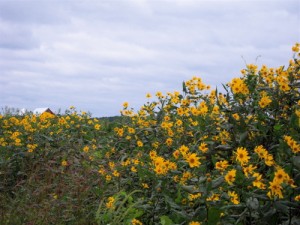
MEANWHILE, back on the farm. It is cool and gorgeous and the horrid, hot, humid weather is behind us, at least for now. The country is a canvas of yellows: bright yellow gold finches are everywhere, butter- colored sunflowers line the country roads, and streams of goldenrod wave in the fields.

Willie and I got two glorious lessons with the best herding dog handler in the country (Alisdair McRae) yesterday, and had as much fun as it is possible to have. For those of you in Wisconsin, there is a great herding dog trial going on right now,  Friday through Labor Day, outside of Portage Wisconsin. You can learn more about it by going to WWSDA.

I wanted to get some pictures of Willie and I working with Alisdair, but I got lost in training rapture, and forgot that I had the camera in my pocket. But here’s are some scenes on the way home… no wonder the colors of the state’s football team are green and gold.


Update on Hope

Tuesday, August 31st, 2010

Here’s the latest on Hope and Willie: Both Willie and Hope continued to be “spooky” to all number of things. This occurred both on and off the farm, and to all sorts of sights and sounds. Willie began high-arousal barking and lunging to other dogs when on leash, and off leash he growled and tooth displayed at familiar dogs he’s been fine with for years. He backed away, ears flat and commissure retracted, to men he’s known and loved for years. Hope growled, barked and lunged at dogs, strange shapes and heaven only knows what else. Out of the blue, at least to us, one of the dogs would run charging toward the window that overlooks the driveway, making low, growly barks, hackles up, and set the other off to do the same.

It was simple, in a way. Both dogs were insecure in their current environment, and were setting each other off. It’s all fine to say that we humans need our dogs to look to us for direction and security, but no one talks ‘dog’ more clearly than another dog, and Willie and Hope were both increasing each other’s insecurities. The irony was painful, because their relationship was improving in many ways. They played “tooth fencing/wrestle play” beautifully in the house, and Willie was just, finally, beginning to stop being such a victim when Hope bullied him in the house. Hope still would growl, lunge and bite at Willie’s shoulders as they moved to the door, for example, and Willie often responded by tongue flicking and dropping  his head, but in other contexts Willie would discipline Hope for some perceived rudeness with an inhibited muzzle bite.

As I would with a client’s dog, I sat down and considered the options:

I. Do nothing and hope that the dogs would come out of it.  In Hope’s case, it is true that some dogs seem to come out of what I call Juvenile Onset Shyness by themselves, but lots of dogs don’t, and in my experience, it is crucial with most dogs to actively help them through this stage with environmental management and behavior modification. As a four year old, Willie’s background level of being an inherently anxious dog meant he would most likely regress to his previous behaviors of serious aggression to unfamiliar dogs, and further degrade into being at least fearful, if not problematic, around unfamiliar people.

Probability of success: Small to Zero.

II. Actively treat both dogs with environmental management and behavior modification. That would include:

1) Full health checks, although a medical cause of this behavior was highly unlikely, it is still always good to check.

2) Physical support from Chinese Medicine, Vet Acupuncture, possible inclusion of pheromones (DAP for example) and scents (lavender for example) and homeopathic medicines (Willie is already on Shen  Calmer, possibly add that to Hope’s diet as well?). Also included is diet, specifically the amount of grain and the protein source. In addition, Hope could not drink the well water from the farm without developing crystals in his urine, so he drank distilled water that we had to purchase. No chance of any improvement there.

3. Stimulus Management: Take dogs off the farm separately, so they don’t set each off and I could work with each of them by one on one. This is no problem when leaving the farm, but doesn’t solve their behavior at home.

4. Behavior modification: Use Operant and Classical Conditioning to condition the dogs to have a different emotional (classical) and behavioral (operant) reaction to the stimuli that are setting them off.  For Willie I would continue going back to what worked in the past around unfamiliar dogs: Start by saying “Watch” which he knows means to look at me, whenever another dog appeared. When he turned to face me, he got to play a rousing game of tug. That reinforced him for looking away from the other dog in many ways–he got to play a favorite game and the tug game allowed him to release pent up tension. The goal was to get him to “AutoWatch,” or look at me automatically when he saw another dog, and then he’d get a game of tug. That not only taught him a behavior incompatible with barking and lunging, it classically conditioned him to feel good when another dog approached. For unfamiliar men, I’d have them toss toys or balls for him (can’t train other dogs to do that or I’d use it with other dogs!), conditioning him to love it when men approach.

For Hope, who spooked mostly at strange shapes (but that included a woman carrying a small bag while walking a small dog), I have been teaching “What’s That?” The meaning of that cue is to look at something, turn and get a treat or a toy. (Treats seemed to work better with Hope than play, so I began using them more often–every dog is different.). This works well if you can anticipate what stimulus sets off the dog, but is harder if you don’t know what the dog is responding to.

5. Lots more training… of course, always more training! Willie was taught to bow on cue, and it’s a great way to help  him relax when he is nervous. (He does it himself often now, I suspect he uses it as way of relieving stress himself.) All dogs profit, as do their owners, by having lots of behaviors that they can perform that relax them, that are incompatible with the ‘problem’ behavior. Play bows are one of my favorites, because they not only relax the dog they often act to relax other dogs (people too.) The list of behaviors that are helpful to put on cue goes on, but you get the idea.

Probability of success? 70/30? 60/40? 50/50? Given the seriousness of Willie’s insecurities, it’s hard to say. Probably couldn’t make a good judgment about prognosis until about 4 to 6 months into treatment and Hope is older.

III. Re-home one of the dogs. Given that the insecurities of both dogs appear to be feeding off of each other, the last reasonable option is to re-home one of the dogs. I’ve re-homed 2 dogs in the past 25 years, always because I felt it was in the best interest of the dog. Every time it was brutally hard on me for a while, and every time the dog was better off for it. Here’s my criteria for doing so that I shared with clients for over 22 years: the new home has to be better than the home the dog is in now. Period. Pure and simple. (Of course, if one dog is putting others, either people or dogs, at risk, the criteria must be considered differently.) In each case, you have to carefully consider which dog would be better off in a new home; in some cases the answer is simple, in multi-dog households it can be more difficult. In the case of Willie and Hope, which dog to re-home would be  simple.  Willie is over 4 years old, I have moved heaven and earth to keep him alive and happy, I am bound to him as if he were a part of me, and my first commitment is to him. Hope is not even 6 months old, is a much sounder dog than Willie will ever be, and would be a much easier dog to place than Willie for a gazillion reasons.

Probability of success? 95 to 100 % if it was the perfect home, but where would one find that? How could you know what’s “perfect?” My heart goes out to those of you who commented that you have a dog you think is in the wrong place, but can’t imagine where the dog would go. It’s not always easy, I know. Because I have had Hope long enough now to know him well, in his case it would have to be a home in which he 1) lived in a settled group of dogs in which he could play with the young ones, learn boundaries from the elders and feel secure in a home with trustworthy people and dogs, 2) live in the house with people who are kind, clear, patient, humane and who would give him the kind of health care that, frankly, few dogs get and 3) once he is ready, work sheep on a daily basis with people who know what they are doing, who use humane versions of training and take learning how to do it well seriously.

I’ve been working on Option 2 diligently, wrapping my life around it, and then, like a karmic piece of toast, the perfect home for Hope popped into our lives. A  home with a settled pack of 6 dogs–a puppy his age to play with, elder males and females to provide boundaries and security. A kind, loving home, in which the dogs sleep on the couch, get home cooked food and cutting edge health care. A farm in the country with sheep and people who devote their lives to working dogs, going to clinics, herding dog trials, taking private herding lessons from the best in the country. The dogs get far more work on sheep than one of my dogs ever would, at least until I can afford to retire, which isn’t going to be for awhile.

That’s where Hope is now. He’s been there awhile, long enough to know he’s thriving there. Willie not only went back to his old self in 24 hours, he has never been happier. Recently we were out walking on leash at a public park, he saw another dog, did a loose body wag, turned and looked at me, mouth open and relaxed, and turned back to the other dog as if he’d love to say hi. He is back to loving everyone, unfamiliar men included. Never once did he look for Hope, or act in any visible way that he wondered where he was or wanted him back. (But of course, who knows what he was thinking? Did he wonder where Hope went? If he did, he certainly showed no signs of it.) He has been happy and playful and relaxed at home and everywhere else. He is no longer licking his paws, alarm barking at the slightest noise or tongue flicking.

By all accounts, Hope is happier than he’s ever been. He plays with a five-month old female pup much of the day, has been corrected for rudeness a few times by his elders and is now on his best behavior. He is behaving beautifully around all people and all dogs, has never yet had a house training “accident” in the house (he did relatively often at our house and I suspect now it was as much about anxiety  as anything else). He has “spooked” at one thing, one time, and nothing else. He fit in the day he moved in, and it sounds like he has never been happier. His new humans adore him, are eternally grateful for all of his training and socializing, and say he acts like he’s been there all of his life.

And so, the dogs are doing great. I don’t need to tell you who this has been hard on. I won’t belabor it, but what’s called “Separation Distress” in animals is the same thing we call grieving, and it’s recorded in a primitive part of your brain as if it were a serious, painful injury. (That’s why we talk about “healing” from the death of a loved one.) Willie and Hope have shown no signs of it; they appear to be happier than before. It’s the humans who are suffering. The first three days after Hope left were brutal, even though I knew it was better for both him and Willie. I gave up trying to do any work at all one day, just let myself give in to the sadness and the feeling of loss. It’s better now, but I look forward to the day when it still doesn’t feel quite so raw. One of my few regrets is knowing that, to a lesser extent, this news will be a bit hard on some of you who have followed Hope’s story with me throughout the summer. I wish I could wave a magic wand and make this change as easy for the humans as it has been for the dogs, but I can’t.

I knew it would be hard personally, and I knew it would be made even harder because of the public nature of this decision, and because some people will criticize me for it.  But here was my choice: send Hope to a better home with the highest of all probabilities that it would be better for him and Willie both, or keep Hope because I loved him too much to let him go, or because I didn’t want to lose professional credibility with the people who believe that if I was good enough I would have ‘fixed it,’ or that it is never acceptable to re-home a dog, no matter what the circumstances. I can be a real coward sometimes, but I couldn’t live with myself if I passed up the best solution for two wonderful dogs because I was afraid of what people would say. This is a good place, however, to thank all of you who have been supportive during this process; there have been a lot of you, and I am forever  grateful to you. Truly. Thank you.

As you can imagine, there was a lot of talking and soul searching before this decision was made. I talked to numerous other behaviorists and shelter/rescue experts–the list of people I consulted would drive a seminar host mad with envy. The consensus was clear: it ranged from “Of course that is the right thing to do” to “Why didn’t you do it sooner?” Most of our discussions ended up asking what we could do to help people understand that sometimes the kindest thing you can do for a dog is to get him out of one situation and help to find a place in which he will thrive.

A word of caution: Please don’t try to generalize this situation too much to  any other. It concerns me that someone might read about the solution I have chosen and decide then that they should do the same. Every situation is different. If the perfect home hadn’t arisen for Hope, I never would have made that choice. What I will say to those of you who are struggling with this, based on 22 + years of working with clients, is that IF you have a situation in your home that is truly untenable, don’t assume that there isn’t either 1) help from someone to improve the problem or 2) another good home out there somewhere for one of your dogs. I have had clients work with trainers and behaviorists and end up resolving problems that they initially thought were unsolvable. I have had other clients who choose to re-home dogs with a variety of serious behavioral problems, and in many cases, the problems either went away, or the new owners managed the issues without any disruption to their lives.

Bottom line? There will always be Hope… sometimes it just lives in unexpected places.

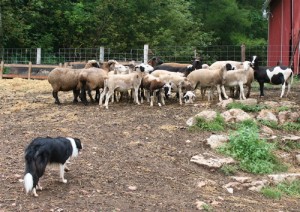
MEANWHILE, back on the farm: The sheep still need feeding, the water tanks filled. Willie has just brought the flock out of the main pasture, through the woods, for their afternoon snack. The ewes get a little bit of alfalfa hay, and the lambs luxuriate with their noses deep in a mixture of corn, oats and a protein balance pellet. The lambs stopped growing for awhile when it was so hot, but they are doing well now.

Here’s a photo showing how big some of them are now. Hard to tell a few of the biggest from their mommas.

Here’s Snickers and one of her lambs, looking through a window in the barn. Is dinner ready yet?

It is very quiet here, but Willie is very, very happy, and that is a good thing.

One Step Forward, Several Steps Back

Tuesday, August 24th, 2010

The Hope chronicles continue, with progress and problems. The good news is that Willie, on occasion, is stepping up to the plate a bit and not letting Hope bully him as often when they are in the house. As an example, ever since he was tiny, Hope has lept up growling and bitten at Willie’s shoulders as they move through space.  At first I  thought it was play, but if it was, it’s the kind of play in which one individual is having fun, the other not so much. Sometimes Willie seemed to ignore it, other times he’d tongue flick and look anxious. I came to see it more and more as a behavior related to controlling space, perhaps in part motivated by herding instincts, but rude nonetheless.

All Willie needed to do was snap at him one time, and I suspect it would have stopped. I’ve never seen Hope do this to any other dog; Hope is totally appropriate around all other dogs, giving lots of appeasement gestures or playing beautifully, with lots of self handicapping and never becoming overly aroused. As I’ve said earlier, I think Willie has a V for Victim on his forehead.

Recently, Willie has corrected Hope on a few occasions with a perfectly measured inhibited muzzle “bite.” (That is ‘discipline’ in dog language. A bite anywhere else, even if very inhibited, is either a fight or done in play). Willie’s corrections to Hope have been while wrestling/tooth fencing or over a resource. I don’t like Willie being a resource guarder (both he and Hope are to some extent), but I did love that Willie has gained a bit of confidence and is at least trying to teach Hope some boundaries. [And oh yes, yes yes, to the comments that perhaps it would be helpful to have a female like Tulip in the house. I have often said I wish she was still here for many reasons, Hope and Willie's insecurities being one of them. But I should add that getting a third dog as an experiment to fix things between Willie and Hope doesn't seem like a good risk right now, not for us and not for her.]

What’s concerning is that Willie’s behavior has recently degraded in other ways. Willie has regressed back to the fearful, neurotic dog he used to be. I believe that this is due to the fact that Hope has moved into a “Juvenile Shyness” period, and has begun barking and growling at unfamiliar shapes (strangely shaped signs, an empty grandstand, a large white rock). Hope adores people and other dogs, but if someone appears with a strange silhouette he’ll growl, lunge forward and bark. It’s very much “I’ll get you before you get me” and is, without question, fear-based.

Since this behavior appeared in Hope, Willie has behaved in ways that he hasn’t in years. While walking in town he barked and lunged at a small dog who was a good 40 feet away. He hasn’t done that in over two and a half years. He snarked and made ugly face to a BC he’s known for a long time, and was so worried about his presence on our entire 45 minute walk that he never stopped tongue flicking. Much of the time he hid behind my legs. Equally concerning is that recently he wouldn’t get near a man he knows well, and has always adored. Willie loves guys best, always has. It’s true that in his own juvenile fear period he began to act fearfully around unfamiliar men, but it was a mild version that was brief and was easily turned around. Willie’s major problems when he was young were a pathological fear of his own species, and an extraordinary level of sound sensitivity.

People who meet Willie now, at least until last week, often don’t believe me that Willie was a mess of fear and rage when he was young. He has lots of good dog friends. For the last year or so he has been completely comfortable around unfamiliar dogs he sees on the street, acting as though he’d love nothing more than to greet them. He’s greeted many unfamiliar dogs, loose bodied and comfortable, although I will say that size definitely matters.  The smaller the better according to Will. He is, however, not comfortable with any other dog coming into the house, and large dogs in the house make him extremely anxious. (That’s part of why I wanted a puppy.) His girlfriend Mishka, the beautiful Dobie he loves to run with, made him a nervous wreck when she came into the house. The dogs he’s been most comfortable in the house with have been small, male Border Collies and a Cavalier.

Until recently, if you came to the house by yourself, or saw Willie out on the street around other dogs, he’d look like a happy, care free dog. But underneath that full body wag lies years of hard work trying to help Willie out of a world of fear and panic, and I am concerned that Hope’s behavior is bringing it back out. They both strike me as insecure dogs who are feeding off of each other. Right now I’m teaching Hope “What’s That?!” (look at something before barking, turn and get a treat). I’m back to conditioning Will that if he sees another dog he gets to play tug with his favorite toy (play is MUCH more effective with Will than food, vice versa with Hope).

Because so many of you have been so kind and gracious about my writing about my own dogs, and said that it was helpful to hear about them, I will share with you that my heart fell when I saw Willie bark, growl and lunge at another dog. When he backed away from a man he’s loved for years I was stunned –he’s always loved men except for a short juvenile period during which I had guys throw balls for him and he decided they were the best thing since, well, the invention of tennis balls. I suspect that many of you know what it feels like to have a behavior problem regress; it’s tough. Willie and I have come so far, and we have worked so hard together to get him to where he is. My first job now is to carefully evaluate the situation and do what I need to do to bring back Willie’s confidence. Raising and loving Willie, a dog with problems as serious as any I’ve seen in twenty-two years, has always been a challenge, and I admit to sometimes wishing life with Willie was simpler. But it’s not, and I love him, and that’s that. I love Hope too, and I am equally committed to helping him have the best life that he can. I’ll keep you posted.

Meanwhile, I’m interested in how many of you have raised dogs who have developed what I call Juvenile Onset Shyness (fear of unfamiliar things or people developing from around 5 to 9 months of age). I’m curious about the breed effect–it appears to me to be especially common in herding and guarding breeds, but I don’t believe there has been any study that compared it’s occurrence in different breeds. Anyone know of any? Of course it varies from a short, temporary period of mild fear of unfamiliar things to all out fear-based aggression, but I’m curious if there is a breed-specific predisposition. We do know that shyness is highly heritable, so it would make sense to be affected by breed and lines within a breed. Anyone seen any research?

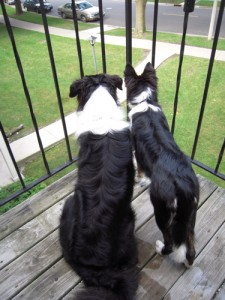
Meanwhile, not on the farm (at least in the photo) here are the boys on Sunday morning, looking out of the balcony where we stayed in town so that the farm house floors could be refinished. It was fun to be in town in many ways, and good for the dogs, but ooooh, it’s nice to be home to the farm now.

Hoping for Hope Part II

Friday, August 13th, 2010

I’m between washing off the sweat and dirt from worming our lambs and finishing my talk on Play in Toronto (got some great new video!), but I couldn’t get on the plane without adding a few more words about Hope, Willie and the comments that have come in. I know that many readers don’t read the comments, so I thought I’d address some of the questions that came up after my last post about Hope and Willie.

If you haven’t read yesterdays post, I wrote to alert readers that it is not yet clear to me that Hope is the right dog for Redstart Farm. He’s only 5 months old, and I won’t decide what is best for me, him or Willie until he gets older, but I wanted to let readers know that there are some red flags rising, so that you wouldn’t be blindsided if I decide he’s not a good fit. I didn’t write the post for me, I wrote it because I’m aware that many readers become attached to my dogs–I will be forever grateful for the hundreds of sweet comments written when Lassie died. I’ve posted lots of pictures of Hope and Willie playing well, but I realized that I wasn’t presenting the whole story, and that wasn’t fair in a way to not alert you to the possibility of problems down the road. There is one thing I wrote yesterday that needs amending. I wrote: “And so, here I am, in the process of deciding whether Hope is the right dog for Willie.” What I should have written is: “.. whether Hope is the right dog for me, for Willie, for Redstart Farm, and if we are the right home for him.”

Ironically, one reader commented that it seemed I was uncomfortable with uncertainty, so perhaps I shouldn’t have gotten a puppy.  I’ve always said, in numerous writings and speeches, that you can never tell how well one dog will do in an environment until they’ve been there for awhile. That’s doubly true with puppies, and so when I got a puppy I was, and am, perfectly comfortable knowing that I can’t know if it’s a good match until it some time passes. That’s especially true of working herding dogs–you simply can’t know if their style will match yours until they are 10 to 12 months of age. I’m fine with that, although of course I’d much rather not be seeing some potential red flags. It’s traditional to “audition” working dogs, to see if you and they are a good match. It’s not only commonly done, it’s considered responsible. You bring in a dog with potential, work together once they are old enough, and if you are responsible and wise, only keep the ones that match your own style and temperament and find the others a better match.

If Hope’s style of herding doesn’t match mine, that’s what I’ll do, for his sake and mine. If Hope and Willie end up being two males in one household who are always vigilant and anxious, I’ll find Hope a great home and be proud of all the time and energy I’ve put into giving him the best start possible. I’m perfectly okay with that, but I know that some readers are not.

There are two ways I could go here: Stop writing about my own dogs, and limit my posts to information about behavior and training. I’m fine with that, there’s so much of interest to talk about, and I love this international inquiry we all are in together. I’ve written about my own dogs as part of the blog for a few reasons, the most relevant being that I’ve always believed it is helpful to others to see how people who are considered experts handle real life. And real life is not black and white, it’s not always a happy movie, and it’s full of complexity and uncertainty. I’ve been reading an interesting book, titled Wrong, about the problems inherent in both research and pop “experts.” One of the author’s points is that the public wants experts to speak in absolutes, whether they are accurate or not, while scientists are often ignored, because the issues they are discussing are complex and can’t be understood in a 15 second sound bite. Although there indeed some black and whites to dog behavior, there are a lot of colors in between, and I will always be drawn to the golds and midnight blues of real life, and want to write about them.

But for now, since I have been writing about my dogs, know that I’m going to make a decision about Hope based on my responsibility to ensure that the dogs in my care live healthy, happy lives. If worst comes to worst (and I’m NOT saying it will, it’s much too soon to say), forcing dogs to stay together, even if they are anxious and uncomfortable when trapped in the same house, is not responsible, loving or kind. I have seen client after client who had 2 dogs who clearly were miserable living together, but the client could not bear to do what the dogs needed, which was live apart. If our herding styles don’t mesh, then I’ll find him a place where he can work sheep and be a loving and beloved member of the family. It’s a lovely egocentrism to believe that each one of us is the perfect home for every dog, and that if we just try hard enough we can fix anything, but every behaviorist in the country will tell you that’s not true. My decision will not only be made on whether Willie and Hope play well together (I might have emphasized that aspect of it too much in my previous post), it will be made on what is best for me, Jim, Willie and Hope. I’m comfortable that as time goes on I will know what I need to know to make that decision.

Eeeps, gonna miss my plane if I don’t wrap this up! One last point: I love that many of you have suggested an older female as a buffer. Great minds…. if I had $100 for every time I’ve said “If only Tulip were still alive,” I’d retire!

Here’s a photo to make us smile, smiling is a good thing, isn’t it?

Hoping for Hope

Thursday, August 12th, 2010

This is a tough one to write. As regular readers know, I primarily got Hope as a playmate for Willie, my turned-around crazy dog who took three years of intense work to deal with his pathological fear-based aggression to other dogs, his episodes of all-out rage, his extreme sound sensitivity, his dysfunctional gut, etc etc etc. And inside all that was one of the sweetest dogs I’d ever met, and that is the dog you’d meet if you came to the farm today–a sweet, people-loving healthy dog who loves his dog buddies and goes all happy-faced and loose bodied when he sees an unfamiliar dog approaching him. I’d never take him to a dog park, and he becomes a nervous wreck if a large dog he’s never met comes into the house, but with a little easy management he is a wonderful dog, and I love him now like life itself.

My dear Lassie-girl, the one who died in January, was Willie’s best friend, and they played together up to a few days before she died. Soon after she did, I started looking for another dog, primarily a play mate for Willie. I surfed on rescue sites for months, any breed would do, never quite finding what looked like the right dog, and then heard about a litter of BC’s from a great breeding with a super track record. That’s where Hope came from, and he indeed is a super dog. He is the smartest Border Collie I’ve ever had, and I don’t need to explain to any of you what that means. He is so fun to train it’s addictive. I could happily quit all my jobs, including this blog, and spend the next few years training Hope. He’d be doing rocket science by the time he turned five. I’ve rarely had this much fun training a dog, and especially now that we’re over the worst of the early puppy stages (including having to pee every eight minutes), he is a joy.

He’s also competitive, and that has become the basis of his relationship with Willie. As Hope matures, Willie has stopped greeting him when we come downstairs in the morning. They have stopped playing tug games, I suspect because they were never games to Hope. He’d work his way up the toy until he was an inch from Willie’s mouth and do all he could to get the toy and run away with it. Unlike other dogs, he seemed serious about it from the first time he played. Not so some other dogs: I have a video of Lassie playing tug with Willie when he was a puppy, and she continually gave it back to him if she pulled it out of his mouth. But at nine weeks of age Hope  wanted the toy, period. Willie and Hope don’t play much wrestle play anymore either. They do on occasion, but it’s much less frequent and doesn’t last very long. Some of this could be related to Hope’s age, he is getting older after all, but he’s only 5 months old, not exactly in his dotage.

Hope is not the only problem. Willie, who wasn’t able to play with dogs outside of the house until he was almost one and a half, turns out to be no fun to play with outside if you are a young puppy. As the strongest eyed BC I’ve ever had, Willie loves to herd other dogs, running around to the front of their forward motion and stopping them by diving in and either nipping or just plowing into them. I hadn’t seen too that much of this until I got the pup, because usually  Willie has played with older dogs who are as fast as he is. Wilie plays “let’s race!” and the dogs run shoulder to shoulder, sometimes I swear slowing down and then speeding up on purpose to keep the game going. However, he has tried herding other dogs before. Once he tried herding one of his BFF’s, Mishka the Dobbie bitch, who, with the power and confidence of a canine Serena Williams, told him in no uncertain terms never to do that again. He got all flat-eared and grinny-faced after she disciplined him and he got the message. He’s never done it to one of his other friends, a year-old BC, who is as fast as he is and who loves to play “Let’s be race horses!” along with Willie. But Hope is just a puppy, and can’t possibly keep up with Willie, so sometimes they play well outside, Hope running after Willie or Willie running circles around Hope, and sometimes, more and more often it seems, I have to call off Willie because it starts to look more like harassment than play.

Willie also seems to have a V on his forehead for Victim. When Hope was younger, Willie never corrected him for the usual things that rude, young puppies get disciplined for by older dogs. Instead, Willie would  hang his head and look oppressed, or look as though nothing had happened while I was thinking “Willie! Stand up for yourself!”

And so, here I am, in the process of deciding whether Hope is the right dog for Willie. He is a great dog, but I am not looking for “a dog.” I’m looking for a friend for Willie, and although you can treat and manage a multitude of behavioral problems, you can’t force a friendship if it’s not there inherently. {Added later today: I don’t need them to be best friends, but Hope’s competitiveness and adult male behavior as a young pup might be a red flag that could be some serious problems between him and Willie down the road.}  My loyalties have to first be to Willie, and I have to do what I think is best for him. Nothing would make me happier if I decide that Hope is the right match. Hope is smart and fun and probably will be brilliant on sheep and damn it, has gotten drop-dead gorgeous as he’s grown up. He is not perfect: he is a resource guarder (he is already 50% better, yes I think there’s a genetic basis but I totally disagree with some who say it can’t be treated), he’s a tad pushy (barks for attention, jumps up and slams against you) but no pup is perfect and all of his ‘issues’ are things I not only know how to treat or manage, I enjoy doing it. The problem is that this isn’t a training issue; I wish it was because then I could better deal with it. The fact is, no one can make two dogs into friends if they don’t want to be, any more than you can force two people to love living together. {Again, they don’t need to be best friends, but I’ve seen dogs living in constant states of vigilance and anxiety and that’s not a life that is good for anyone.}

Cross your paws for us. I haven’t decided what is best yet, but thought I should let you know where things stand. This issue does bring up an interesting question related to all of us: that of friendship between dogs. I’d love to hear from you about the dogs in your life who have either become best friends, or not… and why. I think the issue of relationships between dogs is often not addressed at the right level: we talk about resource guarding or appropriate play, but what about true friendship? Camille Ward’s research on play found that as dogs mature they seek out the same play partners more and more, and she suggested we need to think more about whether our dogs need BFFs of their own species. Your thoughts?

MEANWHILE, back on the farm: Sad news from last night. We lost another lamb to a new worm in the area that is resistant to worming medicine. It was our best lamb, a ram lamb I kept as a potential breeder. He looked fine two days ago, and then I found him dead last night. I talked to my vet and he said that 3 other farms in the area have been losing lambs right and left; one farm lost 20 lambs before they could blink. I’ll be trying a new medicine tomorrow after the sheep are kept off food for 12 hours (we’ve learned that worming meds work best on an empty stomach), so tomorrow before I fly out Jim and I will be cowboying sheep in the barn at dark-thirty in the morning. (And thanks friend Kathy for helping with the dead lamb. Never a fun way to spend an evening.)

Happier  news: here’s Hope playing with a new friend, a four month old BC mix pup who came over and played non-stop for almost an hour and a half. Hope played beautifully with him… he always does with other dogs it seems. The younger pup was always on top by the way, and look at that tail!

DVD Sale; Anniversary Pie

Saturday, July 31st, 2010

I promised the people who keep an aging hippie social worker like me in business that I’d mention that the summer 1/2 price DVD sale is on. Okay, I did that. Good Trisha.

Sweet day today. Jim’s and my 10th anniversary. Making, as I write, a cherry/blueberry/strawberry/rhubarb pie for Jim. I will eat some myself to keep him company and prove that I love him. Greater love hath no woman.

I had planned to write a post yesterday about the correlation (if any) between testosterone and aggression, but got overwhelmed with speech preparations. I’ve got 6 separate talks to give in the next 2 weeks. Oh my. Giving a Keynote address to the Int’l Society of Human Ethologists on Monday, then off on Thursday the Best Friends Forever in Pennsylvania (giving 3 talks there, soooo looking forward to seeing my friends and colleagues and learning lots and lots from other speakers) home on the next Monday then off to Toronto after that to talk about Dog-Dog Aggression & the Biology of Play. So bear with me, I might be tad less productive than usual, but I’ll do my best to keep up. So many things I’d like to discuss with you all . . .

Time to take out the pie and go up the hill and feed the rams before we get the straw out of our hair and go to town to celebrate, but here’s Mr. Hope, all 5 months of him, eyeing the sheep. Notice how his tail is starting to go down (from up over his back). That’s a good sign, means he’s starting to think about herding rather than chasing. He won’t get a chance to do either until he’s much older, but it’s fun to watch the progression.

Here’s my pie for Jim, and here’s what I always sing when I make one, straight out of the movie Waitress, one of my all time favorite movies:

Baby don’t you cry

Gonna make a pie

Gonna make a pie with a heart in the middle . . .

Lucky for you, you are not able to hear me sing it.

Markers and Secondary Reinforcers

Friday, July 23rd, 2010

We’ve been talking about secondary reinforcers and markers, and the good question has come up about the difference between them. On the one hand, we know that a click or a “yes” can be used to communicate to a dog that a specific behavior is what is about to be reinforced. Clicking or saying “yes” at exactly the right moment is incredibly powerful in that it is a precise way of communicating to an animal exactly what it was doing that will elicit the reinforcement (clicks are more precise than words, by the way).

However, you could also call a click or “yes” a 2ndary reinforcer, since to be effective it is paired with a primary reinforcer like food, and the animal learns to associate the click/marker with the treat, right? So which is it? Ah, you gotta love the English language: sometimes it helps us understand things, sometimes it makes things more confusing.

Let me answer that question from a different perspective. Ethology, the study of animal behavior in its natural environment, spends a lot of time studying communication. One of the traditional ways at looking at communication is to distinguish between the Message and the Meaning. The Message can be thought of as what the sender is trying to convey, whether intentionally or not. The Meaning, on the other hand, is the information the receiver gets from the signal. As every human who has ever been in a relationship knows, those aren’t always the same thing. So in this case, the Message  of a click or other marker is clear: “THAT, what you JUST did, is what will get you a treat!” [I first inadvertently wrote "meaning," thanks to an alert reader for noticing the mistake! Jeez]

At the other side of the signal, we  don’t know what the receiver makes of it–do they have any idea that we are intentionally ‘marking’ a behavior?  Are they consciously aware that the click/yes leads to a treat if they do that exact, specific thing again? (They don’t have to be to perform brilliantly, as a matter of fact we’ve all seen animals perform perfectly and then have it all fall apart, often when they start thinking about what they are doing!) Are they simultaneously or uniquely becoming classically conditioned to the sound of a marker (I think they are being CC’d, no matter what else is going on)… It seems reasonable that our dogs, if we could talk to them, would define the Message of a marker as both a marker AND as a 2ndary reinforcer. Perhaps what is most important from our perspective is how we define it, because that is what drives how we use it.Does this make sense? I have to admit sometimes I worry less about labels and more about actual behavior, but still, it’s a fun intellectual inquiry.

Question for you: I’m curious: How many of you use markers, of any kind, at all? Did you consciously decide to use a marker and follow it up with praise (sometimes, as a 2ndary)…? If you use a marker in the strict sense of the word, what do you use? Click from a clicker? A word?

MEANWHILE, back on the farm: Over 6 inches in the last 24 hours. No kidding. Another 1 to 3 today. Eeeeeps. Last night there were many small tornadoes reported in the area, one not far at all from the farm. I take these babies very seriously, the infamous Barneveld tornado (9 people killed, the town 90% destroyed) freight-trained just one valley away from my farm, less than a 1/2 mile away, and I will never forget the impact of the first view I had of a close neighbor’s farm, metal roofing blown over a 1/2 mile into tree trunks, 5 buildings destroyed, the ground littered with siding and bricks and fertilizer and corn and thousands of things in tiny pieces too small to identify.

I was in town with friends during the worst of it, and we were all happy to return home to find the structures still standing, the dogs, cats, sheep, etc. fine. Sorry, no pictures yet, it was raining, again, so hard this morning when I left that I didn’t want to take the camera outside.

But here’s Hopey-boy (don’t you love knicknames?), a  helpless victim of Sherman the Sheep, who somehow developed a wound in his neck and is attempting to blame it all on an innocent little puppy. Tall two-leg female is not upset, however. Sherman has been played with, tugged upon, bitten, and thrown around every day for a long time, and has shown an impressive amount of stamina. Besides, we just got in Polly the Pig (seriously) to sell on the website, and Tall Two-Leg is forced to take her home for the dogs to try out. Poor dogs.

Using Secondary Reinforcers – Wisdom from Ken Ramirez

Tuesday, July 20th, 2010

I wish the world could have seen Ken’s seminar on Sunday in Worcester MA, it was fantastic. For those of you who don’t know his name, he is the Training Director and Senior Trainer at the Shedd Acquarim, has trained exotic animals for over 30 years, and could train just about anyone to do anything. I left inspired and crazed to train something, anything, and had to stop myself from trying to teach the flight attendant to scratch her head on cue.

When I got home, close to midnight, I sat down with Hope and taught him to flip his hips sideways while lying down to “Settle” before I even walked upstairs. Took five minutes. Scary easy, and extra fun because of being inspired by Ken.

However, in order to get home Sunday night, I had to miss the last hour of Ken’s videos. I heard they were great… anyone care to tell us what I missed?

Here’s what I didn’t miss: some excellent points about what are often called “Secondary Reinforcers.” [Note to training geeks: there are some details about terminology that Ken went into that I found fascinating, but it would take a couple of posts to explain them, and you're better off going to see Ken in person if you are interested in terminology.] But here is a summary of points that I think are  relevant to all of us:

First, many of you know that “Primary Reinforcers” are things that are inherently reinforcing (that automatically cause an animal to increase the frequency of a behavior). Strictly speaking, they are things that an animal needs to survive: food, water, etc. When you give your dog a treat for sitting on cue, you are using a primary reinforcer.

Secondary reinforcers are things that are learned by an animal to be associated with Primary Reinforcers, and thus eventually elicit a similar response through classical conditioning. For example, if you repeat “Good Dog” and follow up it with a treat enough times, eventually your dog will work to hear you say it. But here’s what I learned from Ken:

It is critical to continue to link a secondary with a primary  part of the time, no matter how long you’ve been using it. In his experience with his animals (who have to perform perfectly in shows and when being treated medically), even if the animal inherently enjoys the secondary reinforcement, it has to be maintained with a primary if you want a totally reliable behavior. That’s true even if the animal loves the secondary reinforcement. For example, at the Shedd, Beluga Whales love having their tongues rubbed, it clearly feels good to them and they seek it out. However, Ken considers it still a secondary reinforcement, and is very careful not to over use it.

He advises that you condition ALL secondary behaviors as if they were a behavior. In other words, rub tongue, give treat. Rub dog’s belly, give treat. Even if your dog likes it inherently, initially reinforce it with food if your dog likes food. That makes it much more powerful in the long run.

Once your dog is clearly thrilled with what you are doing, then begin to use it as reinforcement by asking for a simple behavior, then use your 2ndary R, and follow with the primary R. After that, for a long time, use the 2ndary by itself only twice in a session, and never in a row. Gradually increase the use of the 2ndary, but be very careful not to overuse it. (By the way, he is NOT talking about a click for those of you who are clicker trainers. He considers that a marker, not a reinforcer.) Clearly there is a lot to talk about here, but this is enough for now to get us all thinking about the issue.

MEANWHILE, back on the farm, I had a chance to think especially  hard about all this the day after the seminar. I loaded up the dogs, the plastic bags, the treats, the water, the camera and the leashes and drove over to a wonderful place to walk the dogs. Hope has been there off leash 5 times before, but I am very careful because in the beginning it is close to a road. In the past he’s gotten lots and lots of food treats for coming when called, and for checking in with me on his own.

When we arrived I looked for my bait bag and discovered I’d left it on the counter in the house. Whoops, no food. No primary reinforcer for a young pup who was going to be off leash for 45 minutes. I pondered keeping him on leash the entire time (I always start with him on leash) and thus him getting less exercise, but decided to forge ahead because 1) the path has a natural boundary of high grasses 2) Hope tends to follow Will, who always stays on the path 3) Hope has had 5 lessons there and had done very well and 4) I DID have a primary reinforcer: water. It was hot, and I knew the dogs would be thirsty after not very long. So I decided to risk it, but here’s what I did:

1. Unlike our other trips, during which I called him back to me often for training purposes, I decided to call him back only when absolutely necessary. I knew he wouldn’t always be thirsty, and wanted to have the water retain its power. I ended up calling him to come five times in 45 minutes. Every time he came he got water, but I didn’t let him drink his fill. The last time he drank one quick lap and moved away, so I immediately leashed him up. We were close to the end anyway, and at a place I have always put him back on leash, because it gets close to the road.

2. I used Willie to move Hope around in space, calling Willie (by name “Willie Willie!). This helped a lot and meant I only had to call Hope 5 times total. I also used clapping to get the dogs to come. Clapping is not trained as a recall, but is used to motivate the dogs to speed up, sometimes when they are playing with each other, sometimes when running to me. I could use it without polluting my “Hope, That’ll Do!” cue.

3. I managed to keep my hands to myself and never pet Hope when he came back, because he behaves as though he hates it when he is active. He only likes petting when he is sleepy and tired. Petting would have been punishment. Most relevant to Ken’s talk, I didn’t fool myself that “Good Dog” or any other 2ndary R was going to be effective, at least not for long. And I didn’t want to take away its power, so I said “Good Dog” only twice before he started to drink, and kept my mouth shut the rest of the time. Please send chocolate, this is not easy for me.

4. I was ready at any second to bail and put him on leash if I saw the slightest sign that he was going to get himself into trouble. Most of the walk was a long, long away from the road, and there were plenty of scents and sounds to keep him occupied. If he had put his head up and started air sniffing, or completely ignored any signals from me, I would have leashed him up in a microsecond.

Here he is, coming when called, Goooooooooooood Boy!

And here I am Saturday night in Masssachusetts, after a lovely dinner with our host Dana Crevling from Dogs of Course!, another trainer Carolyn whose last name I have rudely forgotten, Ken Ramirez and Karen Pryor (how great that she was there too for the entire weekend!). We ate at a restaurant with a giant crab balloon on its roof. Seriously. And I only had one Corona for dinner,  honest.

What’s In It for Me?

Monday, July 12th, 2010

Lots of dogs go through a “what’s in it for me?” stage (and this stage lasts longer in some dogs than others, right?). Mr. Hope is dancing around it right now, especially when I ask him to come into the house. Several of you asked about ways to handle it; not surprising, since most dogs aren’t like the Lassie on television and don’t automatically do what we want just because we love them.

Here are some of the things I’m doing right now to get Hope to come back into the house from the yard. Of course, “But I don’t wannnaaaaaa” is going to occur in different contexts, but many of the principles here apply to all situations, they just need modifying to fit the problem.

COMING IN MEANS GOING OUT Hope loves loves loves to be outside. He’d happily stay outside all day long if he could. So, sometimes, his reinforcement for coming inside is . . . wait for it . . . going outside. It’s the perfect example of the Premack Principle:  using a high probability behavior to reinforce a low probability one. I can count on him always going outside (high probability) because he loves it there, so I can use that to reinforce him for coming inside (right now it’s a low probability that he’d do it on his own). That means that sometimes when he comes in when asked, I say Good Boy! and dash outside again for a few more minutes.

JEALOUSY IS YOUR FRIEND This only works if there is some other living thing in your house that loves food or toys. But if you do, it’s powerful stuff. When Hope started pausing 20 feet away when I called him to come into the house, I began calling Willie and giving him a treat when he came. Will always comes when called, and I can give him a treat for coming and entering the house whenever I need to. As soon as Hope saw Willie getting a treat,  he instantly came running, only to discover that treats are only available on a limited basis. “Oh, too bad” I say, with sincere sympathy. “You missed the treats this time!” Right now he isn’t getting a treat for coming to the door ‘late,’ but if he then enters the house I’ll give him a treat once he’s inside.

UP THE ANTE I always have a mix of food treats available, from pieces of kibble to real meat. Right now he gets a jack pot of real meat if he comes, first time, when I call him to the door to the house.

MIX IT UP I’m very conscious with Hope of the importance of varying not just the reinforcement schedule, but what Hope gets as a reinforcement. You want to mix it up with any dog, but for some reason it feels more important with Hope than with others I’ve had. He’s pretty independent (okay, for a BC), and I want to condition him early on that if he does what I ask he’ll feel good (versus the more narrow “he’ll get food”). Although I use high value food most of the time for coming into the house, I also use play, effusive praise in which I get down on the ground and laugh like a loon while letting him leap all over me and lick me like a popsicle and again, getting to go back outside.

IF HE WON’T MOVE, YOU SHOULD If all else fails, don’t stand where you are and continue to call (and pollute your cue!) The few times that Hope simply plants his feet and won’t move toward me, or turns and goes farther outside to dig or look for sheep poop to eat (a favorite), I stop saying anything, ensure that I have a great food treat in hand, and go to him. Moving quietly, never scolding, I’ll show him what I’m holding and lure him toward me and back to the house. I’ll shape this, giving him a treat for just a few steps if he was overwhelmed with a distraction (New stinky sheep poop! Fox poop even better! Do you get the pattern here? … there is a reason the word for dog in Navajo translates: “eater of horse poop.”). If the distraction was only so-so, I’ll expect him to come further before I give him the treat.

Are we done yet? Oh my no, he’s just beginning adolescence after all. I expect we’ll work on these things for at least a year. However, he is already much improved; I haven’t had to walk to him more than once or twice in the last 4 days.  Now he comes voluntarily when we move from outside to inside about 75% of the time, even when I don’t call him to come, we just run into the house together. That’s an increase from — I’m guessing here — about 20% of the time, so that’s great progress.

What about you? Tell us your stories of your free spirit, and what you’ve done to work through it. I can’t wait to read what you send, and will be sure to have Hope read them too.

MEANWHILE, back on the farm: We had 2 days of hateful weather on our short vacation, but thankfully the weather cleared and we were able to enjoy Perrot State Park in western Wisconsin for a few days. Jim got to take off his hateful Iron Man brace for part of the day and I even hiked up a steep bluff for a little bit, although it was a far cry from what we intended. But we got time off and a sweet visit with my niece and her new husband. Ummmm, so good to visit with such wonderful people. And we’re related! Go figure.

We returned home to a dying lamb, spent Friday night trying to save it, but to no avail. Turns out, even though we have wormed the sheep on a careful schedule and have alternated wormers, that worms all over the world are developing resistance to worming medicines, and that’s what is happening here.  The little white ewe lamb, the one I bottle raised, took a dive when we were away and was too far gone to save by the time we got back. The next day we started a new worming protocol, aware that no matter what we do it might not be enough. Seems so strange to lose an animal to worms — that just doesn’t happen in dogs (yet) but I understand it’s becoming a problem in horses as well. Gotta give those parasites credit, but I hate losing a lamb to something that it seems like I should be able to prevent. There are 2 lambs I have my eye on, one looks especially thin, but all the others are thriving, and clearly are inherently resistant to worms. I’ll pay special attention to which ewes have resistant lambs when I breed next year.

On a lighter note, here’s the small prairie at the foot of the bluffs at Perrot State Park (on the Mississippi flyway). It’s a beautiful park and a lovely little restored prairie. Hard to imagine that there were 10,000′s of thousands of acres of this across the midwest.

And here’s a happy scene to any farmer: a winter’s worth of hay being delivered to the barn. Thank you Gary, Gus, Gordy and Brad for doing all the work while Jim and I felt guilty (but cooler) in the house!