Welcome to the official Patricia McConnell website. Skip directly to: main content, navigation, search box.

Archive for the ‘medicine and dogs’ Category

fMRI on Dogs: Too Wonderful!

Friday, June 1st, 2012

When I was doing my PhD research in the 1980′s I wanted to see how a dog’s brain responded to different types of sounds before and after training. This was in the 1980′s, and the only method available for animals was to do Evoked Potential tests, in which simple, tiny electrical sensors were glued to the scalp. This allowed one to measure activity in the brain in an extremely general way: What kind of brain waves does one see in the Temporal versus the Parietal lobe, for example, after hearing or seeing specific stimuli?

Evoked Potential tests are logistically easy to do on adults: You shave tiny areas of the scalp, glue on the sensors, and ask the subject to stay still for a set period of time. The research subject mustn’t move, because muscles move through electrical stimulation in the brain too, so any movement confounds the brain’s response to external stimuli. But how do you do it on dogs?  How would you keep them still? Absolutely motionless? And here I was in Zoology, not neurobiology, so how would I pull this off?

I felt lucky to be at a large research institution like the University of Wisconsin in Madison, and so I reached out to neurobiologists in other departments. “How does one do Evoked Potential tests on dogs?” I asked. “No problem” I was told. “It’s not that difficult.” “But how do you keep the dogs from moving while you’re doing the test?” I asked. I received a blank face and a silence as an answer. “I don’t understand.” the expert informed me. “What do you mean?” I repeated my question. His answer, after another pause, was “We just don’t bump the tray.”

Slowly, with growing horror, I began to understand why he was confused by my question. I hadn’t asked “How do you do Evoked Potential on live dogs?” The dogs they used for their research weren’t alive; they were killed and the tests were done immediately after their death. Not what I had in mind, needless to say. I left his office and found a researcher (Dennis Molfese at Southern Illinois University) who did Evoked Potential tests on human infants. We did use small dosages of Acepromazine to quiet the dogs, but also did lots of training, and had few problems keeping the dogs still. We ended up with good results that showed dogs paid more attention to short repeated notes when linked with recalls than long, continuous notes.

You can see then, why I am thrilled to read that researchers have now pulled off doing fMRIs on happy, healthy, live dogs. Scientist Berns and others in Atlanta worked with owners to train 2 dogs to sit motionless in an MRI machine for 10 seconds at a time. If you’ve ever had an MRI, you know that this requires far more than just lying still. For reasons once explained to me while I lay frozen with fear in a tight, dark tunnel, the magnetic part of the MRI creates an ear splitting series of pops and bangs and groans that is hard for many people to sit through. And yet, they pulled it off with dogs, and got some interesting results.

“The task was designed to determine which brain circuits differentially respond to human hand signals denoting the presence or absence of a food reward.” And sure enough, when a visual signal was given that meant food was coming (not unlike a clicker stimulus), the ventral straitum of the caudate cluster was more active than when a visual signal meaning “no food coming” was seen by the dogs. Activating the ventral straitum causes the release of dopamine, the “Oh Boy!” neurohormone mediating happy anticipation. It’s the same neurochemistry that occurs when you get your dog’s leash and she begins to dance in anticipation of a walk.

The results are interesting, but not earth shaking, given they were exactly what was expected. What IS earth shaking is that scientists have found a way to study what happens inside a dog’s brain in kind and compassionate ways. This is huge…. the amount of information we could derive from this is immeasurable. I have long said that our relationship with dogs provides us with research opportunities unlike any other, and here’s proof of it.  Stay tuned… the next couple of decades of research and our understanding of other animals are going to be absolutely amazing.

MEANWHILE, back on the farm: The lambs are thriving, the dawn chorus of bird song floods into the farmhouse around 4:30 am, but who could mind such a beautiful way to wake up?

And although the weather has been challenging of late, (hot, cold, wet, no rain, too much rain, you name it), the flowers continue to lift me up and make me happy. Here’s an Iris I planted last year, first time seeing it bloom:


New DVD on Animal Assisted Therapy!

Wednesday, April 4th, 2012

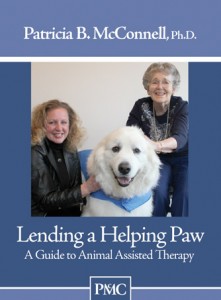
We just released a DVD of the seminar I did in Naples, Florida on Animal Assisted Therapy and Activities, “Lending a Helping Paw.” I’m excited about it, because it gives me the opportunity to help individuals and organizations who want to help others. It is an example of an activity we can do with our dogs that is a triple win (for us, our dogs, and people who need some oxytocin and/or physical therapy). Because of that, old social worker that I am, it’s near and dear to my heart.

Speaking of hearts, and what fills ours with happiness, the question arises about how effective AAT (Animal Assisted Therapy) and AAA (Animal Assisted Activities) really are. I remember a conference put on by the Delta Society many, many years ago that included a controversial study. It showed that, in this study anyway, the greatest benefit was to the owners of the dogs, not the patients in the facility. Whoops. While the audience greeted the news with a disapproving silence, I was cheering in the wings, because it’s good to examine the issue objectively, rather than just following our hearts in this case.

Indeed, the study was very useful and no doubt had an impact on “best practices” as currently defined. It found that the teams in this case had just walked into people’s rooms without asking permission. No surprise then that the residents weren’t all in favor of the project; they’d already lost so much control in their lives that the last thing they needed was to lose more. That’s why good programs like The Delta Society and TDI emphasize the importance of putting the patient first, and letting them drive the system.

But the question remains: Is AAT and AAA really effective? First, we need to distinguish between AAT and AAA. Much of what people call AAT isn’t truly therapy in the medical sense of the word.  To be labeled as therapy the interactions need to be directed or delivered by health and human service professionals, with goals set, treatment plans written and progress carefully recorded. Animal Assisted Activities, on the other hand, include visits, petting, games and tricks.

Here’s the good news for those of us who want to believe that AAA and AAT are beneficial to the recipients: There is indeed research that shows it’s efficacy in several modalities:  Two studies that I can think of off the top of my head found that visits from dogs decreased the perception of pain after surgery. One study asked children to rate their pain (Robbins et al, J of Holistic Nursing, Vol 24, No 1, 206) and another looked at the amount of pain medication used after joint surgery, which is a good, objective and quantifiable measure (Kaplan, AAT Conference Abstract 2004). A third study found that walking with a dog significantly increased compliance with physical therapy programs and increased ambulation exercise: 28% refused to walk without a dog, only 7.2% with a dog. In addition, steps walked more than doubled once patients did walk (Abate et al J. of Cardio. Nursing 2011).

This is not surprising to those of us who are aware of the impact of dogs on our oxytocin levels, and the impact of oxytocin on pain perception (it decreases), immune responses (it increases) and affect (it tends to make us feel safer and more secure). But we do have to be careful here: Not everyone benefits from visitations or therapy from a companion animals. You have to like dogs to get an oxytocin rush from them. (Most “therapy” animals are dogs, but some programs have cats or rabbits for selected patients. No reports of sheep yet….) Awhile ago I visited a senior center with a good friend and her dog. I’d guess about half the people we saw were interested in interacting. The rest appeared to be either neutral or clearly avoiding an interaction. My friend knows what she is doing, and was careful to not impose her dog onto anyone who wasn’t a dog lover.

This all gets back to one thing I emphasize in the DVD: The patient is the star of the program. Not your dog, not you. As much as we love our dogs, if we do this right we’re doing it for people who aren’t as fortunate as we are, and don’t have the opportunity to interact with dogs as we do. It’s all about them, and keeping that in mind is critical to a program’s success.

Other aspects of AAT and AAA are essential too: The Lending a Helping Paw DVD has an extensive section on what dogs are suited for therapy work, and how to ensure that your dog is really enjoying the process (these are the 2 most common problems that professionals in the field encounter). It discusses organizations that certify teams, what is required to obtain certification and how to work with facilities in a professional and pro-active way.

MEANWHILE, back on the farm: Instead of playing with the lambs or gardening, last night I went to a senior facility outside of Madison and delivered copies of the DVD to one of the stars of the show: Ruth Trameri. She’s the lovely lady on the right of the cover, with my good friend Beth Viney’s (on the left) and her certified therapy dog, Czar. (Czar was an early admirer of my Gr Pyr, Tulip… that’s actually how Beth and I met.) Here they are,  gracing the cover of the new DVD:

And here’s a video from the DVD of Tootsie’s first visit to a facility. We used her (and Willie and 3 other dogs) to evaluations of  potential therapy dogs. (Tootsie passed, Willie… no surprise here, does not: too enthusiastic). This video segment is testing for one of the most important qualities of a good therapy dog — sociability. Dogs need to be interested in everyone, true social butterflies, but calm and respectful at the same time. Watch how Tootsie tells us where she’d most like to be…. (and feel your oxytocin levels rise?). Thanks to Beth Viney, the Director of Pet Pals in Madison WI, Dr. Linda Sullivan, and Pet Pals volunteer Diane Peltin and Ruth Trameri for helping with the evaluation section of the video, we all had a great time and it resulted in some very instructive (and, I might add, amusing) videos.


BOOKS BOOKS BOOKS

Thursday, December 29th, 2011

So many books, so little time! Here are a few I’m enjoying:

Magnificent Mind at Any Age by Daniel Amen. This is a fascinating book by a psychiatrist who began doing SPECT scans of his patients brains and discovered how many psychological/behavioral problems related to brain function. It’s an inspiring book for anyone looking to improve their health and behavior, and besides being motivated to exercise more and stop drinking diet soda (I know, I know), I find myself thinking about dog behavior on every page. Daniel relates multiple cases of people with behavioral problems (fear, depression, anger, impulsivity) that are improved through diet, exercise, supplements and medications that specifically work on areas of the brain related to those problems. Anyone out there see any dogs who are fearful, impulsive, etc etc…?)

Your Dog’s Best Health by Nancy Kay: The subtitle of this compact, highly readable book is “A dozen reasonable things to expect from your vet.” This book is a great summary of how to have the relationship you’d like with your veterinarian, written by a vet herself. Just as the book above can be extended to our dog’s health, I’d say this book could also be expanded to our relationships with our physicians. This book is short, sweet and full of useful information.

There’s a Dog in the House by Nancy Chwiecko and Amy Fernandez. “A practical guide for creating today’s dog friendly home,” this has got to be the only book out there that looks at your home from your dog’s perspective, advises on dog-proof but attractive furniture, has a chapter on helping dogs with special needs and how to repair the wall that your dog with SA chewed through.

I also just finished Therapy Dogs Today, which I read as part of my preparation for the seminar I’m doing in Naples on January 12 on AAA and AAT. By Kris Butler, this is by far the best book I’ve read on the subject, far superior to anything else I’ve seen. What I like about is especially is her focus on the patient’s and the dog’s needs, (owner/handler–your job is to present your dog and get out of the way) and her understanding that real ‘therapy’ can only occur if a true relationship has been formed between the dog and the receiver. She also emphasizes the importance of observing your dog carefully for signs of stress or discomfort, a common problem I’m sorry to say that I’ve seen often in my experience. If you are interested in ever doing this work with your dog, this is a great book to get.

What are you reading? I always love to hear . . .

MEANWHILE, back on the farm:

Great news about Willie. I’ve put him back on a strict diet w/ no chicken or lamb, increased his greens, got him acupuncture, increased his mental exercise, carefully managed Sushi in a way relaxing to us all and put his hobbles back on when we are out or he is meeting unfamiliar men. I speculated that the hobbles acted almost like an anxiety wrap or thunder shirt, and that taking them off (as I have in the last few weeks) when he was free and off leash was at least one factor in his regression. Think of prisoner let out of jail with not enough time to adapt to freedom. It’s only been a week since I made all those changes, but he’s met several guys (all dog savvy and carefully coached), and Willie has showed no signs of fear or anxiety. He ran right up to all the guys like they were his best friends. Yeah!

The first guys Willie met were all off the farm, then the next ones met him outside the house first before coming inside. Tonight a dog savvy friend (yeah Justin!) is coming over. They met on Monday first outside, but this time I’m going to have him meet Willie inside the house (where Willie was first shocked by the presence of a guy several weeks ago.). It will also be at night, and most fearful dogs are more easily frightened at night than during the daytime. So I’ll go slowly and carefully. I’ll keep you posted. It’s very early in the process, so I’d never say that we are “done,” but I am encouraged at how things are going. I should add that, with dogs like Willie, one is never really ‘done.’ They slide out of balance so easily that one has to always be on the look out for regressions. If you want to read more about my speculations about what’s going on, go back to the earlier post and read my comments.

It continues to be warm and gloriously sunny, although snow is predicted for tonight. What a change that will be! Poor Tootsie is going to have to wear her coat when we go out again. Willie will love the cold weather; he doesn’t seem phased until it’s below 10 F, and it doesn’t look like we’ll get anywhere near that. We’ll have a lovely New Year’s dinner with friends at the farm, and then it’s all about getting ready for the seminars I’m doing in Orlando and Naples.

Here’s Tootsie, showing off her hair extensions (We are developing a story about a poor 5 year old beauty contestant, whose mother bought her hair extensions and elaborate costumes, but was unable to cover up her Andy Rooney eyebrows. Thus, her career was doomed from the start — judges being unlikely to award blue ribbons to little girls who look pissed off all the time.) (She’s not. Tootsie, that is. She just needs a stylist who does eyebrows.)

Treatment Plans for Behavioral Regressions

Thursday, December 22nd, 2011

Or, alternative title: Adventures in the Willie Wonka Fear Factory. If you’re cocking your head in confusion, this is about Willie’s recent (and relatively new) fear of men. To review briefly: As a puppy he was pathologically afraid of other dogs, exceptionally sound sensitive and, in some contexts, quick to anger. But he adored people, loved everyone. As an adolescent, like many dogs, he developed new fears, and became cautious around unfamiliar men, but it was easily handled by having guys throw balls for him. I always knew I’d need to manage it and that I could never completely close the book on his fears, but it was easily handled and he usually appeared to be thrilled to meet unfamiliar men after about 4-5 months of counter conditioning.

And then, three weeks or so ago, he barked in terror at a male visitor. He was so fearful he urinated on the spot (the spot being the living room rug–no worries there, it is ancient and god knows how many microscopic particles live within in it, but I mention it just to let you know he saw the visitor, barked in terror and peed his pants where he stood.) A week later he avoided another male visitor, a guy he’s met multiple times and always been friendly around. His fear was overwhelmingly obvious–no barking, but avoidance, tail tucked, head down, eyes round, commissure retracted, weight backward, etc etc.). We had our friend toss treats and that helped, but he never completely settled into what I’d call comfort.

Two questions arise when a behavioral problem you thought was handled pops up again like a moldy piece of toast: 1) What on earth caused the regression?, and most importantly, 2) Now what? I write this out in hopes it will help others follow along if/when their reactive dog slips backwards a few steps. Of course, all cases are different, but it often helps to follow a treatment plan as a way of storing potential tools in your tool box…

Skipping ahead to #2, “Now what?” has already started: Willie has so far had treats thrown by 3 unfamiliar men. So far, all sessions have gone well. All sessions have also been out of the house, and Willie appeared much more relaxed around the guys than he did inside the farm house. Here’s what’s good about that: First, it’s always good to start classical conditioning exercises (CC) at the lowest level of intensity. If and why Willie is worse at the house is an interesting question, but my first sessions of CC taught me that 1) new-guy-at-home is scarier than new-guy-not-at-home; potentially important information, and 2) outside is where we should start because it’s the lowest intensity trigger for him.

After Christmas I’ve arranged for several male friends to come by. We’ll start with Willie meeting them outside, first far away, then closer. Then I’ll have them come inside with food or toy in hand. If that goes well, I’ll ask the next guys to come inside the house before meeting Willie outside. They’ll be asked (okay, told) to avoid approaching Willie, but to toss treas or toys for him. One of my challenges is that Willie’s best CC’er is to chase after a thrown toy. I can’t let him do that yet with his shoulder, so I’m asking guys to toss the toy directly to Willie so that he can catch it in his mouth.

I’ve made other changes too, but to explain those I need to go back to the question of what the heck caused this in the first place. Whenever you have a problem like this, it’s smart to sit down and write out all the possible causes you can think of. You may never know the answer, but it can help create a comprehensive treatment plan. Here’s my list, along with some thoughts about the potential of each to have affected Willie:

1. Isolation after injury and surgery. Seems reasonable, but since the injury was in Feb and the surgery in May, you’d think it would have shown up a bit sooner. He saw almost no visitors for about 3 months after surgery, but after that we did start having people come to the house and he seemed fine. The first sign of trouble was actually at PT about 3 weeks ago, when he barked, for the first time, at seeing someone out the window in the treatment room door. Both Courtney and I were surprised, because he’d never done that before, and he’d been there twice a week since late June. I would have thought this would have shown up at least by fall if that was the primary issue BUT I’d still rate it high on the scale of probable causes.

Implications: Set up more CC sessions with guys I trust to not overwhelm Willie, following the protocol in The Cautious Canine. We have some CC scheduled for next week, with dog savvy guys who actually will pay attention to directions and CC rather than scare Willie. It’s a bit challenging, because the best CC for Willie is a thrown toy, and I can’t do that yet with his shoulder. We’ll use treats and I’ll use Watch and Tug, plus guys tossing treats and toys. I’ll keep you posted.

2. Effects of anesthetic. I’ve seen several dogs in my practice who did indeed change after surgery (also noted by a thoughtful comment from JH in the comment section) and have often wondered about the effects of anesthetic on certain physiologically sensitive dogs. This is possible, but again, it seem less likely because the problem showed up relatively recently. The dogs in my practice became hyper-reactive early on after surgery.

Implications: Doubtful it’s a cause, but never hurts to think about a dog’s internal physiology. He had another acupuncture session last night, this time for calming and soothing. We discussed potentially using laser acupuncture versus needles, given how sensitive and reactive Willie is.

3. Effects of surgery itself. Not sure what to say about this, but given what a huge assault a major surgery is on the body, it has to be considered. However, again, the regression seems so far after the fact that it seems unlikely.

Implications: Same as above.

4. Presence of Tootsie. Tootsie had been at the farm for about two months before the first signs of trouble appeared. As I’ve written, Willie was clearly not comfortable around her for the first few days, and they still (still!) work hard to ignore each other, but he seems to have adapted to her as the new normal. He still gets lots of attention from me, and has learned that she’ll never challenge him for anything, although she’ll try to squeeze in when he’s getting petted. I suspect he’s learned that although he’d rather not have to compete, life goes on even with a pushy, tiny little princess in the house. I don’t think just her presence is a factor; just guessing here, but I’m bet some serious money on it.

Implications: Tootsie is here to stay, so I’ll go back to CCg him with Tootsie’s name (I did that for about 3 weeks, “Where Tootsie?”).

5. Tootsie’s barking. This one has a higher probability in my mind of having an effect on Willie’s emotional circuits. Tootsie came as a barker–she barked in the morning to get let up on the bed, she barked for her dinner, etc etc etc.  We’ve made great progress, none of the above happens anymore BUT I still can’t leave her either in her crate or loose in the house if I leave it without her barking. I’ve done lots of management around this, but about a month ago I got lazy and would leave her and Willie in the house if I had to run outside and do something quickly in the yard or barn. She’d stand at the window and bark like some crazed, operatic mouse, and I think listening to it was hell on earth for sound sensitive Willie. It didn’t happen very often, but I am sure it wasn’t helping anything. I also had to ask myself if she barks in her crate when I’m gone. I’ve snuck around quite a few times, creeping back to the house and every time she appears to be sound asleep and quiet, so I doubt this is the problem. I’ll keep my eyes (and ears) on it though.

Implications: I never leave him anymore in a situation in which Tootsie will bark while he’s beside her, and I’m working hard on teaching Tootsie to not bark in a crate or if left alone in the house when I leave for a few minutes. I’ve learned I can toss a handful of kibble on the carpet, leave the house with Willie and return to find Tootsie sleeping in her bed in the living room. “Quiet in the crate” when I’m elsewhere in the house is going to take more time, but I’m working on it and carefully managing it at all other times.

6. Change in diet, addition of chicken and lamb. About a month ago I found myself with lots of chicken and lamb scraps. I’ve avoided feeding those protein sources to Willie because of Chinese Medicine’s suggestion that they are “hot” foods and not good for reactive dogs like Willie. But all was going so well, and it pains me to throw food away, so I started giving Willie some of each for a period of about a week. I have no idea whatsoever if this was causal, but it’s easy to change, so I did.

Implications: Easy — Willie is back on beef, beef liver, fish, duck and pork as protein sources. And he’s getting even more cooked greens than usual (mostly kale and collard greens, some parsley, some celery, spinach, broccoli).

7. Sushi: Sushi as a source of stress for Willie ebbs and flows. I’ve written about it before, about his obsessive desire to herd her and his inability to see her as anything except a small, hoofless livestock representative. We worked through it well years ago, but the combination of less exercise and Sushi being in the house more because of winter has caused the problem to increase. He tends to be on edge when he gets obsessive about Sushi, and I would put this high on the list as one potentially contributing factor.

Implications: This is a tough one, obsessive as it is, as we’ve all discussed in previous blogs. It’s complicated by the fact that my allergies to Sushi continue to worsen, and I feel badly that Sushi can’t cuddle with me like she used to. Right now we are managing things and I’m working hard on keeping Willie occupied with something non-Sushi related. All alternative behaviors (sit, lie down, go in your crate, get a toy) act as secondary reinforcers, so it’s not easily fixed.  I’ll write more on this later, but it’s a big topic and better saved for posts in the future. At the moment it’s being managed relatively well, but it’s on my list for things to make even better in the future.

8. Electro stimulation in physical therapy. Willie had 2 sessions of this right around the time he first reacted to seeing people out the window. Could this possibly have affected his nervous system in a negative way? I suspect it’s doubtful, but the health care professionals I asked say no (3) and yes (1), and I wouldn’t say it’s impossible.

Implications: I have no idea if this had any effect on Willie, but we stopped it just in case. Luckily, he didn’t really need it anymore anyway, his muscles in his shoulder began relaxing again so that he could do his stretching exercises.

9. Acupuncture session right around the time he began regressing. I’m doubtful that this was causal, given how often he’s  had acupuncture, but he had a new practitioner this time, and who knows? I had one acupuncture session in which I was miserable for a month afterward. Anything with the power to do good has the power to do harm.

Implications: His new acupuncturist, Carrie and I discussed this last night. I cautioned her that with Willie, “less is more,” and to use the fewest, thinnest needles she could. We also discussed laser acupuncture next time as I mentioned above. I’ll probably put him back on either Shen Calmer or some kind of homeopathic remedy for fear and anxiety, but I want to spend some more time thinking about what would be best for him.

I’ve written all this out in hopes the structure of 1) thinking about causes of a regression and 2) designing a treatment plan around it, is helpful to anyone else out there whose dog has gone backward a bit. I think it would be extremely helpful to other readers if you wanted to share your own program for if/when this has happened to you and one of your dogs. Needless to say, I could write about so many aspects of Willie’s behavior and treatment that this blog would turn into a book. I’ll stop here, and enjoy letting others add their own methods.

MEANWHILE, back on the farm:

Here’s Willie (or rather, his nose), in the middle of an acupuncture session with his new acupuncturist, Carrie Donahue, DVM. He’s not a fan of the needles, but Carrie is extremely gentle and patient, and Willie sits politely for her as best he can. You’re just seeing his nose because it was dark outside and I couldn’t get a good picture of him looking at the camera without eye flash, so the heck with it, I just focused on his nose. “Do what you can”… a good perspective any time, including with photographs, and treatment plans for that matter…

We woke up this morning to another surprise snow. It won’t last long, and it’s only a little over an inch, but still, it was gorgeous when Willie and I went up the hill (too wet and cold for a hill walk for Tootsie).

I thought the image below would be a lovely way for Willie and I, and all at Redstart Farm, to wish you and yours some peace, warmth and love this holiday season. It comes with my gratitude for the community that has grown up around this blog. Thank you all for joining me in an inquiry about our miraculous relationship with dogs. Body wags to you all.


Your Dog Has a Brain in His Gut

Thursday, December 8th, 2011

No, seriously. And so do you. No kidding. I’m so interested this, a relatively new discovery about what’s called the Enteric Nervous System, that I wanted to write about it today. I’ll get back to emotions in dogs soon, but I’m in the Oh Wow phase of this information, and wanted to share it. (Granted, this is not new information to the researchers who have been studying what’s called the ENS for decades, but the information does seem to be leaking out slowly. No pun on ‘leaky gut syndrome’ intended…)

Here’s the deal, and here’s how it relates to our dogs and their behavior. It turns out that there is a vast network of neurons–that’s right–neurons–in your intestines. 100 million of them. Of course, your brain has 100 BILLION, but still, that’s impressive.  Neurons were supposed to be nerve cells that only existed in the Central Nervous System (CNS), the brain and the spinal cord. But it turns out that there is a network of neurons in the gut designed to integrate the outside world with the inside of a mammal. As you remember from Biology 101, every mammal is designed like a doughnut, with surfaces both external and internal that are in contact with the “outside” world. Your skin and respiratory passages interact with the external world on the outside of your body, and the inside tissues of your stomach and intestines interact with things from the external world on the inside of your body.

It appears that the ENS is actually the origin of coordinated nervous activity. It links directly to the emotional aspects of your CNS, and is believed to actually be the precursor of it. Thus, your gut and your emotions are indeed linked directly together, as a way of helping the body make decisions about its behavior. All this relates to our lives and the lives of our dogs in two ways. First, “comfort food” really is comforting. Your ENS communicates directly with the emotional centers in your brain, and certain types of food really do make people feel less stressed and more calm. Studies show that high fat, energy rich foods reduce stress in lab mice, and that people feel soothed by mac and cheese even if they don’t know what they are eating and it is placed into their stomach via stomach tube. Bottom line: What mammals eat directly effects their emotions. Thus, perhaps some of us are not so crazy to feed our problem dogs selectively?

Here’s the big question related to this that I have for blog readers, which relates to the large number of dogs I’ve worked with who had both gut and emotional problems. How many of you have seen dogs who have digestion problems who also have behavior problems related to emotional control (especially fear). Willie is the perfect example: He came as a young pup with projectile diarrhea, a pathological fear of other dogs and a dysfunctionally high level of  sound sensitivity. I can’t tell you how many dogs I’ve seen as clients who had both problems, and whose treatment ended up effecting both systems.

One of the treatments for Willie was to put him on probiotics, and the article that got me thinking about this topic (Psychology Today Dec 2011) relates research that has found that probiotics reduce anxiety in some types of lab mice.  They do specify however, that it might be specific types of lactobacillus that were effective, so we don’t know yet that generic probiotics are always useful. I can say that I suspect they helped Willie, not just with his gut but with his fears, but that’s just speculation.

What about you? Have you seen a link between dogs with emotional problems and dogs with intestinal challenges? Do you have a dog that fits that description? If so, what have you done? For Willie, I used probiotics and switched him to what are considered to be cooling foods in Chinese Medicine. Of course, one obvious problem for some dogs are food allergies, which also have to be considered (but did not seem to be the case with Willie.) I’d love to hear your feedback on all this. I’d write more myself, but I have to go eat some mac and cheese.

MEANWHILE, back on the farm: Cold but sunny, such a joy! No snow, which is unusual but not rare. In 2008 we had 16+ inches by now, in another year just a few. But no white winter for us so far, and going to be cold cold cold Friday night (high of 6). I wish we had snow to protect the plants, but that’s just the way it goes. In the interim, I’m loving the sun.

Good news with Willie boy: After a set back last weekend (limping pretty badly after he got up), I decided to drop all his exercises as an experiment to see how he’d do. He’s doing great! I think I’ve figured out which exercises cause him pain and will talk about it today with Courtney at UW Phys Therapy. Even with no limp, he doesn’t use his left leg normally, he hikes up his shoulder too high, but that mechanical issue doesn’t seem to cause him any pain as best I can tell. So this morning he got to play free with his old, beat up plastic disc. I don’t throw anything for him, may never again, but still, he was sooooo happy. Me too!


Tootsie is doing great on her recalls. I’d say 90%, which I think is great for a Cav after less than 3 months. After a number of mouth-open, shiny-eyed recalls this morning, I ran back into the house for the camera to take a picture of her with her ears flying as she runs to me. I got the ears flapping, but such a serious look on her face!.


Sunset at the Farm

Wednesday, May 4th, 2011

I just got back from UW getting Willie measured for his Hobbles, designed to restrict his shoulder movement after his surgery for his ripped up bicepital tendon. I’m not positive that it looks exactly like this, but the photos on this link from DogLeggs are a close replicate. We also worked through some pre-surgical PT, including teaching him to balance on an exercise ball. He seemed to think it was great fun.. photos to come as soon as we can get them.

I’m curious: Has anyone out there used a similar kind of ‘hobble’ after surgery on their dog? Would love to hear your experiences.

Today’s post will be short, you’ll understand why as you continue to read.

MEANWHILE, back on the farm: It’s a beautiful, sunny spring day outside, but it’s been a challenge to enjoy it. Many of you have thoughtfully asked how Jim’s sister is doing, and so I felt it was best to say right away that Barbara passed away last night, age 57, of ovarian cancer. Her last two weeks especially were a challenge for all the family, and it is a blessing that she is now at peace. Off you go, Xena warrior girl, time to rest now that the long battle is over.

I should mention that I regret not being more active responding to comments on the last posts: I have read everything that has been written but been unable to comment due to the need to help Jim and his family. But thank you all so much for such an interesting discussion.

I’m sorry also to report that Willie, after looking great for 2 days on Panacur, has diarrhea again. One of my ewes, Brittany Spears, is very ill, and me and the vet are doing all we can to save her and her 2 three week old lambs. Life on the farm . . . what can I say?

Here’s a photo I took last night. I had moved the flock into a pasture they’ve been out of all winter (after worming them to try to fight a nasty worm that is resistant to medicine now), and the sky was so pretty I ran back down the hill to get a photo. (The sick ewe is the one on the far right.) A good time to savor the beauty of life.

The Food-All-Over-the-Floor “Method”

Monday, February 28th, 2011

I mentioned earlier that Willie has re-injured his shoulder. He’s going in for a consult with my “sport medicine vet” on Wednesday, but meanwhile I am playing the not-always-so-fun game of keeping him quiet and not stressing his shoulder. Our two most challenging times are when he is waiting for his dinner and when he is greeting someone he loves. Otherwise it’s not too difficult. Leash walks outside? Trivial. Around the house? Harder, but very doable, (though not so good for my getting things done, but I sure have caught up on a lot of television lately!) I lie down on the living floor and rub Willie’s belly for several hours every evening (when we would normally be playing with toys in the house, after our walk or sheep work outside.) Otherwise he’s chomping on food out of a hollow toy or bored silly in his crate. Not fun, but not too difficult. But meal times and greetings are more of a challenge. Here’s one of the things we are doing now to keep him from straining his shoulder (and me from going bonkers).

At dinner time, Willie normally copes with his excited anticipation by grabbing a toy, shaking it with enough vigor to put life INTO something initially inanimate (I’m thinking Toy Story 4 here), and then tossing it up into the air before leaping up to catch it. I think of it as Willie’s “I can play fetch by myself” game, and it normally works well for both of  us. He plays in the living room while I fix his meal in the kitchen. But of course, now he needs to stay quiet and not stress his shoulder, so it’s either put him in the crate, where he is spending way too much time already, give him a stuffed toy (which he is getting lots of already) or take a handful of kibble and sling it across the kitchen floor. Ha ha! I call it Trisha’s little helper. .. who cares if the floor is clean after he licks up the food? It works perfectly: he spends 5 minutes finding and each eating piece, while I finish the rest of his dinner. His dinner is usually a mix of high quality kibble (normally not very much) and the rest canned and home cooked, but I’m happy to increase the percentage of kibble now when I need it.

This is also a great method for dogs when they are outside if you need to slow them down, get their attention, or take their attention off something else. I first learned to use it from Trish King, who uses it to distract problematic dogs who run up to you and bother your own dog, and have found it super useful in a variety of situations. Of course, it won’t work if the other stimulus is more powerful than the food, but you gotta love how long it takes a puppy to find small pieces of food scattered in the grass.

I’ve always been amused at trainers who label a relatively simplistic (and oft used) method as their own, but perhaps it’s time for me to join the bandwagon? Maybe we should call this the “McConnell Method?” Should get it trademarked? Throwing food on the floor?  Kidding aside, I’d love to hear if you’ve used this yourself, and if so, in what context. I suspect it might help quite a few of our readers who have their own challenges. By the way, I’m going to try this too when Willie is saying hello to me or Jim. He doesn’t jump up (Willie, not Jim), but is ecstatic and spins in tight circles, throws himself on the ground for belly rubs, and basically moves his body in every possible way except up to your face. Picture a four-month old Golden Retriever in a tuxedo. We bend down to him and he washes our faces, then he dashes off and gets a toy, which he tosses and shakes… you get the idea. I’m not sure it will be as successful in this context, I’m working on other alternatives now. I’ll keep you posted. FYI, his leg is indeed getting better (no visible limp when walking once he’s taken a few strides), but this is most likely an old injury that keeps coming back.  (Partial tear of biceptal or supraspinatus tendon?) If he does have surgery I’m going to have to find ways to keep him really, really quiet. But then, maybe we’ll decide surgery is not the best option? Paws crossed.

MEANWHILE, back on the farm: I need to get out to the barn and start cleaning it up, in preparation for lambing. The first lamb is due in 3 1/2 short weeks (first due date is actually March 25th, from Rosebud). This Saturday we are welcoming students from the Small Ruminant Club of the UW Vet School to learn how to do ultrasound pregnancy checks from Repro Specialist Dr. Harry Momont. The shearer will also be coming, so the ewes will first be sheared and hoof trimmed, and then be vaccinated to jump start the lamb’s immune system. We’ll move them to another pen where they’ll get a quick ultrasound. They are far enough along that we’ll probably know just by looking at them once they’re sheared if they are bred, but the ultrasound will be great practice for the vet students. Then we all retire to the farmhouse for chili and home made pie. I’ll be baking most of Friday night, but what could be more fun? I love meeting the vet students… so smart and inquisitive and dedicated to helping animals.

Here’s Mr. Will gobbling up kibble from the kitchen floor. Of course, I had to throw more out when I made his dinner (instead of taking a photo)… He thought that was just fine.

Raw Diets and Assistance Dogs

Thursday, September 30th, 2010

Several comments to the last blog brought up the issue of Delta’s new policy of banning pets fed with “raw protein food” from being Delta Society Pet Partners. I’m guessing that although they were aware that an increasing number of people feed raw food to their pets, (Delta itself cites the “increasing use of raw protein diets” as a reason for their policy), they were not expecting the firestorm that blazed across the dog world once their policy was announced.

Delta, as you probably know, cites studies that animals fed raw diets have increased amounts of pathogenic bacteria compared to dogs fed cooked food. Indeed a study out in 2008 found that dogs fed raw diets had increased  levels of salmonella and E. Coli in their stool. However, as the excellent review of this issue published in Whole Dog Journal includes, raw fed dogs also shed higher levels of Clostridium difficile and MRSA, the antibtiotic resistant bacteria that is wrecking havoc in hospitals. It is true that the numbers don’t quite balance: 25% of the cooked-food dogs shed C. difficile, compared to only 12 % of the raw-fed ones, while 77% of the raw-fed dogs shed salmonella compared to 20% of the cooked food dogs.

However, as Whole Dog Journal points out, this one study is not enough for us to truly know the impact of bringing raw food dogs into nursing homes and hospitals. Exhibit one: Dogs in a 2009 study appeared to be picking up pathogens from the health care facilities that they were visiting: Dogs who visited these locations were 4.7 and 2.4 times more likely to have MRSA or C. difficile on their fur or paws. Exhibit 2: As is often the case, there is yet any evidence that being raw-fed was the cause of higher levels of certain types of pathogens in the raw-fed dog group.  There are many, many variables to consider here, and with small sample sizes and nothing but correlational data, we  need to be careful about turning correlations into causes.

As most of my readers know, I tend to look at most issues with as much balance as I can muster. In this case, in a very general sense, we know that 1) just the presence of pets increases the internal production of oxytocin, which boosts the immune system, decreases pain and feelings of isolation and loneliness (among other benefits.) We also know that 2) dogs are good carriers of pathogens like bacteria, on their fur, their tongues and their paws. Thus, there’s a balance here between putting people with compromised health at a higher risk of infection, or depriving them of the health benefits of pet visitations.

As much as I value balance (or perhaps, because of it), I have to say I am more than surprised and disappointed by Delta’s decision. I can’t see that banning raw-fed dogs does anything to decrease the likelihood of pathogens being brought into a facility. What about dogs who rolled outside right before they entered? What about what the people ate, did, or brought something in on their shoes? Delta even suggests that if you have one raw-fed dog at home, you shouldn’t bring in another dog who isn’t if they live in the same home. Really? What about people who eat sushi?  What about dogs who eat soy products? That’s “protein” after all… no tofu for Fido? What about feeding raw vegetables, which are common sources of pathogens?

Of course, dogs who enter health care facilities should have been recently bathed, with special attention paid to cleanliness. But then, so should the people who bring them. And so should the people who work there. But keeping the sick and the elderly in a sterile box, with no opportunity to interact with animals is not, in my mind, good health care. It seems there is a recent trend toward sterilizing the world and I think that is a tragedy. I just learned that all animals are banned from the schools in Madison, Wisconsin, except assistance animals. As a biologist, I find that heart breaking.

What about you? What do you think of Delta’s policy? If you feed raw, do you think about pathogens more than you did beforehand? I’m curious what you think . . .

MEANWHILE, back on the farm: The bees are out in full force this week, busy as . . . (okay, I won’t say it) gathering pollen and nectar to make enough honey to get through the winter. I adore bees, after participating both as a student and a Teaching Assistant in Jeff Baylis’s Field Ethology class in which we watched bees, who had tiny dots of paint on their thoraxes, dance in their hives and had to “translate” their dance and find the location of the food that they were telling their sisters about. As TA, it was my job to mark them, and getting to know bees as individuals changes your perspective when it comes to insects as individuals. I was truly saddened when green dot white dot never came back to the hive one day. As many of you know, bees all over the country are struggling, and it makes me so happy to see such a healthy population of many different species of them at the farm.

And here’s Willie, watching me take pictures of the flowers and bees, looking (to me) a tad bit concerned. Who know what he is thinking? “Are we ever going to play?” “Why are you pointing that single aggressive black eye at me again?” Fill in the blanks! (We did go work sheep right after that, so life wasn’t too hard . . .)

Tender at the Bone

Thursday, September 24th, 2009


Well, Tender at the Bone is admittedly the title of a book about food (if you love food and good writing as much as I do, this is a fantastic book by food critic Ruth Reichl), but I borrowed the phrase to continue our discussion about dental health and chewing on bones. If you haven’t followed it yet, read the comments from my A Fully Functional Tooth? post, they add lots of meat to the conversation (sorry).

A few readers asked for more photos from Africa, so I thought I’d combine topics and send some more pictures of our time with the pack of African Wild Dogs.

Relevant to dental health, here’s a photo of the mouth of “Jones,” the 4 year old breeding male who was darted and radio collared when we were there watching. What I think is interesting is how good some teeth look (keeping in mind the comment made earlier reminding us that white, clean teeth are not necessarily healthy teeth) and how bad the 2 problem teeth are. The bright red area on the lower gum, by the way, was probably caused by either the act of predation that morning or from ingesting part of the kill, and was only temporary.

But, look at the lower canine and upper incisor. Ouch. I’ll have to ask Dr. McNutt how common it is to see a set of teeth like that, but I’d guess it’s not uncommon at all. There is a high rate of injury (and death) in African Wild Dogs, either from lions or from injuries received while taking down prey. What happened to these particular teeth? Who knows… could be from chewing on bones, or from strikes by horns of ungulates?

In case the photo above is a little bit more intimate than you want to get with a AWD, here’s a portrait showing off their huge, gorgeous, cartoon animal ears.

And here’s a photo of the pups just seconds after an adult had walked in and regurgitated for them. It all happened behind the bush, and was over, from start to finish, in about 4-5 seconds, but you can see one of the pups licking his lips, apparently having been one of the lucky ones and getting his share of the food.

Meanwhile, back at the farm: Will is back to chewing on his stuffed Kong in the morning, and I haven’t gone out to find just the right real bone to give to him and Lassie. Admittedly, although I have decided to let them eat carefully selected bones for a short time, I haven’t yet gone looking for them.

It was sweltering hot and humid last night (okay, all is relative: hot for here at this time of year). Mostly it was humid without a breath of fresh air. It’s a bit better today, and tomorrow it will be better still. Can’t wait for the nights to get cool again so I can snuggle under a blanket with Lassie on one side and Willie on the other!


“A Fully Functional Tooth?”

Tuesday, September 15th, 2009

Good news. Mostly. Will has recovered from his 5 + hour root canal, but I remain a tad tweaked about the definition of a “fully functional tooth.” I choose the root canal for Will instead of an extraction because the vet specialist said it would leave Will with a full set of “fully functional teeth.” After the 5 hours of anesthesia and $1,600, the same vet said “His tooth is dead, and thus will become more brittle and more easily broken, so be sure to never let him chew on anything hard, like bones or hard toys or raw hides.”

Uh, no bones? Not even relatively soft, raw knuckle bones, like the big beef bones that Lassie and Willie get several times a week? “Nope.” The rest of our conversation, in which I was far more polite than I was feeling, included me asking “Have you ever seen a dog chew on a real bone?” (answer = no) and “Wouldn’t you consider chewing on a bone a normal behavior for a dog?” (I really was polite, honest.)

Fact is, if I had known before the procedure what I knew after, I would have made a different choice. (Note a comment came in from a reader who said she had a root canal done on her dog and the tooth broke not long after; she had to have it extracted eventually anyway.) However, it turns out (thanks to the kindly email of one of our readers) that extractions have their down sides too. I’d known it was more intrusive on the dog (Will’s tooth was the huge premolar in the upper jaw, the one w/ 3 roots embedded in the jaw), but I wasn’t told until recently that the teeth around an extraction tend to build up more tartar and may require the dog to be anesthetized more frequently to have his teeth cleaned.

However, I’ll admit to being a tad tweaked at the vet dentistry specialist, who was extremely nice and clearly very caring of Willie, but who didn’t give me all the information I needed to make an informed decision. But mostly, I was mad at myself. Why hadn’t I done more research before hand? Why hadn’t I lived on the internet the night before finding out every possible fact I could before I met with the specialist? Oh I’d done due diligence in a way, talked to 4 vets, found a great specialist who could see Will in a quiet but highly respected vet clinic, but still….

A dear friend, who also is a veterinarian, listened to me tell my story recently and said: “Vets who specialize in dentistry always tell you never to let your dog chew on bones…  no matter why you go to see them.” It  makes sense, if you think about it. Who are they going to see but dogs that have trouble with their teeth, including ones who broke a tooth when chewing on a bone?

So here’s my question to you, dear readers: what’s your take on the correlation (causation?) of chewing on real bones and broken teeth? After all, something broke Will’s tooth, and maybe it was chewing on a bone I gave him. Is there any research out there on bone chewing and teeth breaking? Probably… I’ll see what I can find, meanwhile, I’d love to hear your experiences. How many of you let your dogs chew on real bones without having problems with damaged teeth?  How about the opposite?

Meanwhile, back at the farm. It’s fall, it’s gorgeous and I love it! Here’s some New England Asters blooming in front of the side of the barn and a diagonal drain pipe:

And here’s Mr. Will last night in the evening light, moving the ewe flock so that I can put down their supplemental hay. Note pudgy Brittany (Spears) in the middle, and the small white lamb 2nd from left who magically oozes through the fence and gets back to her mamma no matter what we do….