Welcome to the official Patricia McConnell website. Skip directly to: main content, navigation, search box.

Archive for the ‘playing with dogs’ Category

How Do You Play with Your Dog?

Friday, February 8th, 2013

Surely our mutual love of play is one of the reasons that dogs and people get along so well. As Karen London and I write in Play Together, Stay Together, “Play is powerful stuff. It influences so many things, including development, motivation, emotions, physiology, communication and behavior. Wow! That’s an impressive list.”

After years working as Applied Behaviorists, it was clear to Karen and I that play has the power to strengthen one’s relationship with a dog, or alternatively, to destroy it. You can use play to teach self control and good manners, or to inadvertently teach a lack of frustration tolerance and a lot of rude behavior that ends up getting a dog into trouble. You can use play to allow a dog to release tension, to learn a behavior incompatible with a problematic one, or to become wound up and hyper-reactive. The list goes on and on. Play is so important that one of my favorite seminars is one I did on play (Dog Play DVD), talking about both between dogs and between people and dogs.

So here’s the question, How do YOU play with your dog?

Willie and I have several different ways to play that have become incorporated into our daily routine. After the chores are done (dogs, cats, sheep and birds fed), Willie and I play with one of his favorite toys, usually an old plastic disc. Because of his shoulder we can’t play his favorite game of all, which is a classic run and fetch game (he’d love NOTHING more than to catch the frisbee in the air but those days are long over), so we’ve evolved into either 1) he runs around in silly circles with the frisbee in his mouth while I clap and encourage him, 2) I put him on a stay and throw it and then release him to go get it once it’s landed (but this only if there is a lot of snow on the ground, and only 3 to 4 times at most) or 3) he goes on a stay and then I hide his toy somewhere in the front yard. We always play some hide and seek games, because it gets him running around without stressing his shoulder.

Later in the day we play lots of object-related games in the house. Our favorite are tug games. It’s great exercise for him (and me) and we combine it with lots of exercises in self control like “get back” and “drop.” Then we’ll usually do a round of tricks, also in the evening. Usually earlier we’ll have been on a walk up the hill, and in better weather it might include working him on sheep, but that’s just not possible right now.

As I write this I realize that Willie loves two kinds of play: Object play with me (which he also plays by himself, tossing objects into the air and running around the house) and playing chase games with other dogs. Willie doesn’t like rough and tumble play or any kind of play with lots of contact with other dogs: he wants to run and run and run and run, and sometimes I think nothing in the world makes him happier. I wish I could run as fast as he. If I could, we’d dash around the pasture together like foals in springtime. Alas, I’m built like a sturdy hiker and not a runner, so that’s just never gonna’ happen.

I’m not the only one interested in how you play with your dog. There’s an interesting study ongoing at the The Horowitz Dog Cognition Lab at Columbia University (Barnard College) about how people play with their dogs, and they (and I!) would love it if you would participate. The study, run by Alexandra Horowitz (author of The Inside of a Dog) and Julie Hecht (author of the fantastic blog, dogspies, will investigate interspecific play between people and dogs by collecting videos of people playing with their dogs for future analysis. You can learn more about it by going to a brief description of the study and what you have to do to participate.

I’m going to send in a video of me and Willie playing tug, because we both seem to enjoy it so much. It’s hard to choose though, because we do have so many different ways of playing. By the way, I’m focusing on Willie because Tootsie simply never plays with anything. At all. I don’t worry about it for a moment. She wants food and cuddles (in that order), and loves sniffing around outside now that she’s discovered she’s a spaniel (and eating cat poop now that she’s discovered she’s a dog). It would be lovely if she and Willie would play, but then, it would be lovely if I had arms like Angelina Jolie, and both of those have about equal chances of happening and both Tootsie and I are pretty happy anyway.

Here’s the video I’m sending to the Horowitz lab:


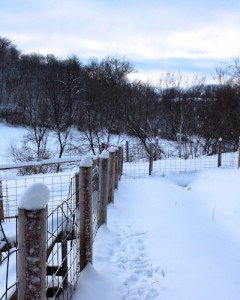
MEANWHILE, back on the farm: Snow snow snow snow. Did I mention it’s snowing? It’s snowed here almost every other day, although yesterday it began as rain. That’s the worst possible weather scenario you can get this time of year: first it gets everything wet and super slippery, then it freezes into ice and then snows on top of it. It makes everything extra dangerous (the hospital emergency rooms were full to the brim from falls), and creates a hard coating of ice between layers of snow. But I’m still happy we are getting the moisture and that we have a real winter this year. I will admit I’m getting a little cabin fever-y, but I’m so glad that the earth is getting back some of the moisture that we missed last year. We were 12 inches down and in “severe drought” through fall, so I hope that all this snow will soak into the ground come mud season. But right now it’s all about the snow. We didn’t get the huge storm that is probably hitting the East coast right now, just got 3-4 inches yesterday, but it’s still basically a white and blue/grey world out there. I love the way the snow tops off the fence posts, like whipped cream on a sundae:


Safe Off Leash?

Friday, January 11th, 2013

Last weekend Jim, Willie, Tootsie and I stayed in a lovely log cabin owned by friends in the woods in eastern Wisconsin. I mention that because for the first time in her nine years of life, Tootsie got to run off leash in an unfenced area off the farm. Wooo Hooo! Some people might not understand what a huge step that was for a little puppy mill dog, but I’m guessing that many of you get it completely. I was over the moon with happiness that I could unsnap the lead, and trust that she would stop when told, come when called, and as importantly, get to sniff and explore with more freedom than she’s ever had in her nine years of life.

The decision I made got me thinking about the issue in general: When IS it safe to let a dog off leash? What do you need to know to evaluate the risk and decide whether to take it? I thought it might be an interesting exercise to list some of my criteria and decision points in regards to Tootsie, and to hear your thoughts and experiences in addition.

I should probably mention here that it is my belief that one of the things dogs want more than anything in the world is a certain amount of autonomy. Some dogs have a ton of it, others almost none, but surely every dog wants to be able to do what she wants to do, when she wants to do it at least some of the time. Being off leash fulfills that to a great extent, but it also puts dogs at the potential of risk. So how does one decide when to unsnap the lead? Here are at least some of the things that need to be considered:

CONTROL: It is something of an irony that the more control we have over our dogs, the more freedom we can give them. Never is that more true when asking if a dog can be safe off leash, and it was the question I asked myself late Friday night when I decided it was 99.999% a sure thing that once off leash and out of the car, Tootsie would sniff around, relieve herself and then immediately come when I called. But how does one know if a dog will come when called in any context?  Ah, you don’t, not 100%, but here’s what I think you need to get to 99.9999%:

STOP ON A DIME: People often assume that all one needs to manage an off leash dog is a good recall, but I’m a big proponent of first teaching a dog to stop on cue. Asking a dog to stop on a dime might be critical for the dog’s safety, and if you think about it, that’s a very different exercise than asking a dog to come back to you. I can’t count the number of times I asked Willie to stop and stand still (I use “Stand,” a cue common in sheep herding that asks a dog to do exactly that: don’t lie down, but stop moving). Perhaps he was starting to sniff beside a partially frozen stream, or I wanted him to wait for me to catch up before he went around a corner on a trail we were walking.

Besides being a handy cue, I’ve learned it is much more effective to ask a dog to stop first before calling him to come back to you, especially if he is moving fast in another direction. Think about it: If a dog is running away from you, in order to back to you she has to 1) stop, 2) turn around and 3) come back to you. That’s three things, right? I’ve found it far more effective, especially with dogs who love to run, to teach them first to stop on cue before asking them to do a recall. It’s not all that hard to do: Just let your dog get a step or two ahead of you and say “Whoa!” or “Stand” and then reinforce with something ridiculously wonderful. Gradually use the cue when the dog is either 1) farther away from you and 2) moving faster. Try to keep those 2 components separate as much as you can, and gradually build up to asking the dog to stop while tearing off in another direction. Manage this carefully though and set your dog up to win: don’t yell “Whoa” when  your beagle is disappearing into the woods after a rabbit if you haven’t gotten full compliance at a much easier level. However, a good stop is not enough…. you also need:

A RIDICULOUSLY GOOD RECALL: Coming when called when there’s no environmental competition simply doesn’t count as a “good enough recall”. One of the reasons I decided to let Tootsie off leash in the woods last weekend is because we have spent several months working on her coming when called while running away from me at a dead run toward something she really, really wanted. I’ve worked on her recall ever since I got her a year and a half ago (if you missed those blogs, she had been a puppy mill brood bitch for 7 years). It took me months to let her off leash at the farm, and then only in specific contexts in which I felt her behavior was completely predictable. But it’s one thing to have a dog come when called in a predictable and consistent context. It’s an entirely different matter to be able to get a dog to come to you when it is already dashing away toward something it wants.

I was lucky here, because the farm provided the perfect set up. First, I have several fenced areas where I could safely let Tootsie off leash and work on her recall. The area around the house and barn is not fenced however, and has a road that runs by about 75 yards from the house, so I was much more cautious about letting her off leash there. In that context I first worked on teaching Tootsie to heel beside me as we walked from the house to the barn. She adores food, and so it didn’t take long to get a reliable response. Then I began asking her to stop or recall when I released her from the heel. I knew she would run straight to the barn, so I had no worries about her safety. I had her favorite food (chicken) in my pocket and asked her to stop the first time when she had just barely left my side. Gradually I began to give the cue when she was farther and farther away from me. Once I could get to her turn on a dime and run back to me even when twenty yards away I began to test it in other contexts. And sure enough, she flipped her little body in mid-air and came running.

CONTEXT: Location, Location, Location. Realtors aren’t the only ones who emphasize the importance of location. There are simply many places I would never let Tootsie off leash. Here’s an example: we went recently to visit a friend who lives in a suburb, with a small lawn between the house and the road. I asked her to potty before we went inside, and never would have considered letting her off leash in that context. Why? Because first, we were just too close to a road for comfort, she could have gotten into the road before I could blurt out a cue. Second, what would be the point? The cost/benefit balance was skewed far to the negative: the risk in no way was worth the pay off. At the cabin however, the closest road was a good 600 yards away,  and the payoff was huge. She got to be a dog off the farm for the first time in her little life, and although I’m sure some people would argue one should never take any risk at all, I’m not one of them. The only 100% guarantee of safety for Tootsie was to live in a cage, and she’d already done that for seven years. Enough is enough.

WHO’S YOUR DOG? If asked to name three things we all needed to consider before letting our dogs off leash, I’d say knowing each dog as a personality is the third. Tootsie spent 7 years in a cage, and didn’t know that the noises people made were meaningful for most of her life. She’s come incredibly far, but she’s still a Cavalier King Charles Spaniel that I got at age 7 who had never been trained to do anything for most of her life. Willie, on the other hand, came with recall software pre-installed. I could just about take him anywhere and let him off leash, although I still don’t take chances, because, really, what’s the point?

NEVER DONE: One last point: Don’t ever stop “training your dog to come.” I still often reinforce Willie for coming when called, sometimes with voice, sometimes with the toss of a toy or letting him chase me as I run away from him.  And I’ll never stop watching Tootsie like a hawk if she is off leash, and reminding her how very, very fun it is to come when called.

Here’s the little girl now, rounding the corner of the barn when I called her back to me from a dead sprint. She looks so serious, doesn’t she? But damn, she sure comes running!

MEANWHILE, back on the farm: A bit of a sad day. We’ve had a doe fawn living in the Orchard Pasture all spring and summer. Something was terribly wrong with her, she clearly wasn’t able to cope with living on her own. She would run smack into the fences at a dead run and was never able to jump them like all the other deer. She did well over the summer when there was a lot of food, but because she stayed in a very small area there was no way she was going to make it through the winter. There was also the concern about coyotes; eventually they would have found her and killed her. And so I contacted a DNR warden who came out, agreed that she was probably blind, and that she would slowly starve over the winter. Deer can’t be captured and re-located (they die of stress, it is horrifically cruel to try to capture and relocate them), and it was inevitable that the coyotes would find and kill her. The warden agreed that she should be put down, and did so humanely with one perfect shot. I know it was the right thing to do, and I know that deer are as common out here as beetles, but oh lordy they are lovely animals, and I’m feeling a big of sadness that such a beautiful thing didn’t make it.

Here she was yesterday:


Play Bows as Meta-Communication

Friday, December 14th, 2012

We all know the signs of imminent danger between two dogs right? Immobile stiff bodies, direct eye contact, round eyes. Except when dogs are playing and then the exact same postures and expressions are nothing but pauses between frolics. That is a perfect example of what’s called meta-communication, or communication about communication.

Here’s a video of Willie and his new friend, Leo–the new pup of Katie Martz here at the office–illustrating meta-communication as well as any two dogs could. I look forward to your comments about it.

First, some background: Yesterday they met for the first time, and it went beautifully. Katie stood 40 feet from the door with Leo as I let Willie out and asked him “Where’s the Dog?” We played tug when he looked at Leo and then back at me. After 2 subsequent “autowatches” in which Willie looked at Leo and looked back at me without prompting (and was reinforced with a tug game for it), I released Willie to go meet Leo. He immediately ran over to Leo, who pilo-erected the fur on a dorsal line from neck to tail a little bit, but stood his ground and allowed Willie to sniff him. After a few short seconds Leo relaxed as Willie sniffed him, and both Katie and I felt sure (we discovered later as we talked about it) that he was about to put his forepaws onto Willie’s back. I wasn’t sure how that would go over with Willie so I said “Go to the barn!” to keep their first greeting positive. It all happened so fast I was acting on gut feeling as much as anything else, having learned with Willie and hundreds of client’s dog to avoid extended greetings between dogs. So Willie dashed off toward the barn and their first encounter went well.

Quickly we moved into a fenced 3 acre pasture, and both dogs got to run together off leash. They played beautifully together, although Leo is too young and small to keep up with grown-up, long-legged Willie. There’s a lot going on in this short video, but first watch how Leo’s long play bows correlate with both dogs standing stock still and staring directly at each other. Those signals, normally signs of trouble are not a problem however, because as meta-communication, play bows signal the other dog that stiff bodies and direct stares are just in fun. Just as a football jersey means a tackle isn’t true aggression (okay, maybe American football is a bad example?!), play bows signal other dogs that any behavior to follow is meant as play. That’s why you see them most often between unfamiliar dogs as they begin to play together.

Watch as Leo does beautiful, clear play bows at second 8, 20 (behind my legs), 118, 126, 148 while he and Willie stand stock-still. I love how both dogs stay still until one does what’s called “start-stop,” that quick little lunge that elicits a reaction. (I do it myself to see what will happen at second 40.) (By the way, YouTube changed its settings–surprise, sigh–so you may see another video after the end of this one. Just ignore until we figure out how to change things around!)

Watch too how Leo runs to me and sits beside my legs at second 30. My interpretation of this behavior is that it’s done by dogs who are a bit intimidated by another. There is a great interaction between the dogs right after that, with Leo doing what looks like an abbreviated muzzle punch at second 33 and then licking Willie’s muzzle.

If you watch the video to the end you’ll see Leo squat and pee, and then turn and look back toward Katie. He’s learned if he pees outside he gets a treat, and boy did he learn that lesson well!

There’s lots going on in this video, I’d love to hear any of your comments about what else you might have observed. If you’d like to read more about play, you might want to go the section in the Reading Room on Play, or check out the Dog Play DVD or Play Together,  Stay Together about play between people and dogs. I’ll look forward to reading your comments, and not to mention welcoming Leo back to play with Willie.

MEANWHILE, back on the farm: What a treat for it to be winter! If it’s going to be dark at night darn it, at least it can be crisp and pretty. And it is. I am loving the snow on the ground, although it is not much and melting fast. But it’s sunny and lovely and fresh and your boots crunch on the snow while the Chickadees call CHICKA-DEE-DEE-DEE from the woods. Time to take Willie boy and Tootsie girl on a walk. I hope you have some weather you can enjoy too.


What’s Happening Here? Here is the Answer!
Monday, August 20th, 2012

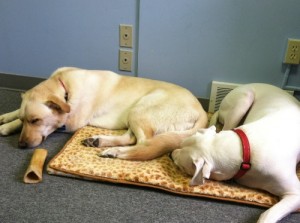
On Friday I asked you what you thought was going on here, at least as best one could tell from a still photograph. I’m the first to agree it’s hard to say much from one brief moment in time, but it’s a great exercise nonetheless. It helps us all focus our attention and generate hypothesis about what might happen next. It would be perfectly reasonable to suggest several different scenarios…

Here’s the story in this case: These two dogs are great friends and play together often. The yellow dog is a 4 yr old GR/Husky cross, Tucker, who has a tendency to nip faces when he plays. The white dog in the red coat is Lily, a 2.5 yr old spayed female Dogo Argentino, owned by Katie Martz  here at McC Publishing.

Lily was responding to what appeared to be an inappropriate play action from Tucker (getting into her face in a way both Katie and I would call “rude.”). Katie’s interpretation of the event is that Lily, the Dogo, was irritated by the yellow dog’s behavior and was correcting him.

Immediately after this photo was taken both dogs paused, sniffed the ground and then resumed chasing and playing after a break. I take this as yet more evidence of the importance of pauses in healthy dog play… a chance to take break, take a breath, and decrease arousal levels.

Many of you were absolutely right on in your guess, good for you! (And to one commenter who bravely made a guess even though she was afraid she’d feel foolish if she was wrong… I love that you said out loud what many of us often feel. Good girl!) This is indeed play, as most of you guessed and Lily is, at least in my and Katie’s opinion, telling Tucker to back off. I think the most important visual signals here are the wrinkling over Lily’s nose and exposed front teeth, forward motion toward Tucker along with ears forward. Thus, I’d say she’s on offense and her wrinkled nose suggests some arousal and potential irritation. Tucker’s head is back and lateral, and his ears are back. He thus looks on defense to me, but note his high tail and hips leaning toward Lily… no shrinking violet here. I agree with some of you that he looks a tad surprised, (I want to say goofy but I suspect that’s not a technical term). It’s interesting that most of the responses on FB said the dogs were playing, but some said Tucker was on offense and some said Lily was. Given that the dogs are both pretty equally matched and that Tucker’s tail was high and he could have been hip slamming her at the time, not a bad guess!

Let me know if you think this is a fun exercise to do every once in a while. We could expand it to video… And I’d like to do some case studies here too. Like the idea?

Do Other Animals Keep Pets?

Friday, August 10th, 2012

A colleague just sent me a link to one of my favorite science and behavior blogs, that of Harold Herzog, the author of  Some We Love, Some We Hate, Some We Eat: Why It’s So Hard to Think  Straight About Animals. I use his book in my University class, The Biology and Philosophy of Human/Animal Relationships,” because the author is thoughtful, knowledgeable and one of those rare scientists who writes beautifully. If you find the topic interesting and haven’t read his book yet, pick up a copy. I highly recommend it.

The book includes a section on pets, and his recent blog addresses that issue as well; in this case, whether a video-gone-viral about “Baboons Keeping Dogs as Pets” accurately depicts the relationship between individuals of these two species. If you haven’t seen it yet, the video is included here, but before you watch it I want to give you an alert. Or a warning. The video begins with a male Hamadryas baboon grabbing a puppy by the tail and dragging it, squealing and screaming, across a bumpy field of rocks. It’s not fun to watch, and if your empathy quotient is set on “super sensitive,” just skip the first two minutes and watch the rest.


There are two issues here that I find especially interesting and thought would be interesting to you as well. One is the obvious question: Do baboons really keep dogs as pets? And even more interesting I’d argue, do any animals other than humans keep dogs as pets? Herzog has gone on record that, in spite of the exceptions of some captive animals like KoKo the gorilla’s pet cat, and the YouTube sensation of a grieving orangutan who formed an inseparable relationship with a hound dog, there are no credible records of any wild animals actually having what we would call a “pet.” If you’re interested in this dialogue, I’d read Herzog’s blog about the baboons first, including the comments, then come back here.

There are a lot of valuable nuggets of information in this article, in part because of Herzog’s dedicated attempt to discover the truth behind the breezy assumptions of the documentary from which the video was taken (Animals Like Us). Because the baboons and some dogs live in association in a garbage dump, and because the baboons sometimes groom the dogs, it is assumed that the baboons “steal” puppies with the intent of keeping them as their pets. But how do we know why the baboons grab puppies? If you watched the beginning of the video, you’ll have noted that the baboon licks the puppy’s anus before releasing it. Why? Familiarizing itself with the pup’s scent? Looking for lunch? Maybe baboons like poop as much as dogs do. And why is it only male baboons that do the “kidnapping?” I find that fact one of the most interesting of all. Usually it’s females that first keep individuals of another species around to comfort and be comforted by.

The question of what is happening in this particular troop of baboons is interesting enough. However, it brings up the larger question that I asked above: Do animals other than humans keep “pets.” First and foremost, I’ll argue, we have to define what we mean by pet, and already the waters get murky. Standard definitions of “pet” are “any domesticated or tamed animal that is kept as a companion and cared for affectionately” (Dictionary.com), and “a domesticated animal kept for pleasure rather than utility” (Merriam-Webster Dictionary). Herzog himself defines a pet as a member of other species that are being kept for an extended period of time, for enjoyment.

Of course, “enjoyment” can mean many things. We call a dog kept in a small kennel in the back of someone’s yard a pet, even if it’s only taken out during hunting season. We call the dogs of others who live in the house, sleep on the couch and have their own acupuncturist pets too, yet their lives, and their “purpose,” are significantly different. On the one hand, both of the animals are being “kept for enjoyment,” one because the hunter presumably enjoys hunting and the other because of a close social connection. On the other hand, the key to “petness” and “non-petness” appears to be “utility” versus pleasure, yet the kenneled hunting dog appears to be kept primarily for utility.  Thus, when asking if other animals keep pets, it’s useful to remember that the concept includes a wide range of relationships in our own species.

Perhaps one perspective when asking if non-human animals (in the wild) ever keep “pets,” is to look at the evolution of pet keeping in our own species. Surely our first, close relationships with other species weren’t for the pure joy of petting their fur. How much was utility and how much pure “pleasure?” I’d guess those things weren’t particularly black and white.  And our relationships still vary widely. In many areas of Africa now, a Masai village for example, dogs live in close association with people, but I doubt they would fit the definition of a pet. The only time I ever saw one “petted” was when tourists asked about the dog, and a Masai grabbed one and posed for a photograph. Believe me, the dogs did not look like they were enjoying themselves. When I asked, the Masai told me they had the dogs because they barked when lions approached the edges of the thorn fence that enclosed the cattle and the tribe at night. When I asked them, one at a time, if it was “their dog,” each individual said yes, it was “their dog,” although none had a name for the dog and the dogs did not come when called.

I’d love to hear your thoughts on this topic. Clearly all I’ve really done here is asked some questions, not answered any. But that’s part of the fun of being a human, right? A few starter questions: What makes a dog a pet? What is the boundary line that makes a dog absolutely not a pet? Have any of you seen anything you’d call “pet ownership” in one of your own dogs? Horses?  (Here’s a key question: What’s the difference between 2 individuals who are socially bonded, and one being the pet of another? Clearly it is something related to autonomy, and who feeds and takes care of who, but how clear is the dividing line?) Here’s another blog post on Primatology to whet your whistle….

MEANWHILE, back on the farm: Rain! More and more of it. Not a lot, about a quarter inch two days in a row on the farm. We’re still a good 8-9 inches behind average, being in a seeming rain shadow and getting significantly less rain than just five miles away. But the grass that wasn’t killed is growing, the sheep are on pasture instead of hay right now, and I’m no longer dragging huge, heavy hoses around every day. Even better, Willie and I are working sheep every day. Last night we drove the flock up into the “high pasture,” and I split out a few to practice driving the sheep in a straight line away from me. (Like any sport, it looks easy when the pro’s do it, but in reality the sheep want to go right, then left, then right… my lines look more like big zig-zaggy zippers than straight lines, which is why I need to practice so much.)

The small group we split out to work on included a lamb who’s mother was in the other field. The draw to mom was much stronger than the pull to the rest of the flock, and lamb-boy kept Willie on his toes, repeatedly trying to dash away and run off to mom. Willie had to turn on the speed to stop him over and over, and yet he never lost his temper and threatened to bust in. Good boy Willie. This morning he had another test: Lady Godiva was not interested in moving where I wanted her, and continually took her two lambs away from the flock and attempted to dash back to the barn through the woods. She wanted to go right, and the rest of the flock wanted to bolt left.  I needed them somewhere in between. When Willie ran around to stop Lady G, he risked losing the rest on the other side. He did a great job of alternating between both sides, good boy again. And now it’s time to get the heck out of the indoors, and go outside with Willie again.

Here’s Willie an hour after I wrote the above, working another group I’ve split off from the bunch. This time it’s a ewe, Butterfinger who wants back to the main flock. In this first photo I’ve sent him around to stop her and bring her back to the group.


Notice how in the photo below she is already shifting her weight back away from Willie? Notice her head, her left foreleg position and her weight shifted backward instead of forward.


Now she’s headed back to the right group. Immediately after I took this Willie turned in toward her. He sometimes stops short, so I was pleased he “covered” her.


And below is the final photo, Butterfinger grudgingly going back to the small group for us to work awhile. Willie is moving faster than I normally would like, but in this case I let him take charge. This exercise puts a lot of pressure on a dog, and I wanted to take the pressure off for a second. Never fear, all the sheep got back together again soon after. As a matter of fact, they’re bawling at me right now… time to give the lambs their handful of grain and the ewes a tiny bit alfalfa hay just to spoil them.


The Ten-Year Anniversary of OEL

Friday, August 3rd, 2012

I was recently reminded that my first national book, The Other End of the Leash, was published in June of 2002, ten years ago (thank you Lisa). Wow. Ten years. It feels like a long time, and it feels like the years have flown by. Time is like that.

There’s something about big blocks of time and anniversaries–10 years, 25 years–that helps us to step out of our busy lives and look at the big picture. This feels especially relevant to me now as I work on a memoir. I find myself asking what parts of the book still resonate most for me, and what aspects of the book most relate to what I want to say in the memoir. At the moment there are two things that stand out the most: how understanding the world as best we can from a dog’s perspective enriches our relationship, and how dogs are such a vital, essential connection to the natural world for so many of us. Here’s how I described that connection in The Other End of the Leash:

“We humans are in such a strange position–we are still animals whose behavior reflects that of our ancestors, yet we are unique–unlike any other animal on earth. Our distinctiveness separates us and makes it easy to forget where we come from. Perhaps dogs help us remember the depth of our roots, reminding us–the animals at the other end of the leash–that we may be special, but we are not alone. No wonder we call them our best friends.”

It’s true that our differences from dogs causes no end of problems, from people mindlessly hugging dogs who perceive it as a threat, from running toward a dog to get him to come to us when in reality it causes him to stop. One of the most gratifying consequences of the publication of The Other End of the Leash is the receipt of notes and emails from all around the world that thank me for helping them to better understand their dog, or to save a run away dog from being hit by a car. (The book, I say sheepishly but unable to stop myself, is now published in 14 languages–or is it 15?–a fact that continues to delight and amaze me.) I still love playing the “contrast and compare” game between dogs and people, asking what is the same and what is different as a way of enriching our relationship, and I being one voice, in a chorus of many, asking dog owners to respect and understand their dogs, rather than dominate and treat them like small, furry  people trying to take over the household if you drop your guard for just a minute.

I also appreciate, even more now I think, the importance of a dog’s ability to link us to rest of the natural world. It’s a tragedy, in a way, that we speak about ourselves and “nature” as different things, as if we moved isolated and above all the rest of creation. We don’t. We still need air and water and food to eat and a place to poop like other mammals. Almost as much as that, our spirits need to see leaves fluttering in the breeze and the sun shine off the water. We need to marvel at the intricacies of a daisy and the jazz riff of a house wren as she sings beside her nest. There is a growing body of evidence that being outside, in the “natural” world is good for you. See, for example, The Children and Nature Network. And what do dogs do? Besides cuddling beside us and licking our faces and acting as if we hung the moon, they get us outside, on the grass, under the trees and in the rain. Bear with me while I repeat myself: No wonder they are our best friends.

Here’s an excerpt, relevant to that point, from what I am writing now. Be forewarned, it will be years before this book comes to light, at least a year before I am done writing it. But here’s something I wrote this morning that feels relevant to the anniversary of the publication of The Other End of the Leash, about a pair of Barn Swallows that nested in my garage, and wreaked no small amount of havoc to my daily routine. It’s yet another example of the importance of a conscious and respectful connection to the natural world.

And then one day, one magical day that I will remember for the rest of my life, I came home to find all five baby birds straining so far out of the nest that I knew their first flight was inevitable. I stood in the garage and watched one bird after another take its first flight. Each bird dove out of the nest flapping crazily, it’s movement uncoordinated and seemingly inadequate to keep them airborne. At the last minute, as they zig-zagged toward the ground, their wings took hold and they managed to stay airborne. They’d fly for a few more seconds, seemingly at the edge of airborne disaster, and then slam into the nearby spruce tree, having as much to learn about landing as flying. But gradually, second by second, flap by flap, the movements of their wings became more coordinated, their paths through the air became straighter, more purposeful and they figured out how to land without smashing head first into a bough.

As the seconds stretched into minutes, they began to learn what was inside of them. They found what they had all along, an innate combination of ability and knowledge that lifted their bodies and directed their flights. They began to dip and turn, faster and faster now, until within just a few minutes I was watching five expert, tiny pilots, zooming right and buzzing left, streaking toward my face and veering off at the last minute. They looked overwhelmed with themselves and the joy of what they were capable of. I was overwhelmed too, with wonder and delight at their transformation from chubby, awkward babies into sleek, skilled flyers. I am still overwhelmed, just writing about it, at what me and five baby birds learned in just a few minutes inside my shabby old garage.

I am grateful for every day that I live on the farm, even when it’s 107 and it almost kills me to haul hoses to try to save the trees or 30 below and the water pipes in the barn are frozen and I’m carrying buckets down an icy hill to the barn cussing like a sailor. I write knowing that not everyone can live on a farm, and that I am a lucky woman. But I spent as many years of my adult life in tiny apartments with moldy showers and dank, stinky corridors as I have on the farm. I shared cans of Alpo with my Saint Bernard because that’s all we could afford, and bought my clothes from Goodwill. And I learned, that no matter where we live, we can all cherish a flower, put up a painting of a lake, sit under a tree in a park and listen to a robin sing to the sky. And if we are very, very lucky, have a dog with whom to share this amazing journey through time and space.

I don’t want this to be soliloquy, I’d love to hear your thoughts about your connection with the natural world, and perhaps your dog’s part in it. I look forward to reading your thoughts…


MEANWHILE, back on the farm: Willie is a happy boy. It’s still hot but not as bad as before, and we’ve been able to work sheep for short periods of time. I’m working on my timing while driving (the sheep away from us), trying to react fast enough to keep them in a straight line instead of zig zagging around the field. Let’s just say I have miles to go before I sleep. Willie isn’t putting a paw wrong on this, this is all my challenge. He needs to work on driving at a distance and staying comfortable letting the sheep get farther and farther away from me (and trusting that he an maintain control), but we can’t practice that on my little, short pasture. Hoping to do that this weekend.

Willie also got a new toy yesterday. It’s one of the new ones for sale on our website in the section named “Toys and Fun Stuff.” The toy is “Ellie the Elephant” and we love her because she is one sturdy pachyderm. I suspect she’ll even stand up to Willie’s tough love for quite awhile. I’ll keep you posted.  I’ll let the photos tell you whether he likes it or not.

Here’s their first introduction. I asked Willie to lie down and stay while I snapped the first photo. Note the elevated hindquarters (that I didn’t notice while taking the picture!)


Willie decides to get acquainted.


Here’s Willie’s impersonation of a rat terrier, as he begins to attempt to shake Ellie back and forth. Good thing he doesn’t know she’s an elephant.


Yup, this is almost as fun as sheep herding!


And finally, after a long play and photo session, Ellie and Willie rest in the grass. Willie looked so contented I half expected him to ask for a cigarette.

Dogs and People Both Achieve the Runner’s High

Friday, June 8th, 2012

We’re happy to introduce Karen London, Ph.D. as a guest blogger for The Other End of the Leash this week!  Enjoy!

If people go running by your home accompanied by their cats, geckos, ferrets, parrots, or rats, then you live in a very different neighborhood, perhaps even a different world, than I do. It’s just not part of our relationship with those species, however close we may be to them. Yet running is something that many of us share with our dogs, to the point that it’s almost cliché for people to swear that their dog is the best running partner they’ve ever had.

There are so many reasons why people choose to run with their dogs beyond just knowing that their dogs need the exercise. Unlike most human running partners, dogs don’t ever have meetings that go late. They wouldn’t rather sleep in. They are always ready to go, and are generally willing to cruise at any pace with equal ease. They don’t complain that the weather is bad so they’d rather skip today’s workout. The chance to go for a run is greeted with enthusiasm by our canine companions. The truth is that dogs typically like running, which is yet another commonality between dogs and humans.

Okay, perhaps not ALL humans. (Trisha, for example, who is one of my very favorite humans, has described running as abusive though she is very active both on her farm and with long walks and hikes, which are great joys to her. She thinks it’s great that I like to run and that it makes me happy. Still, every time we room together at a conference and she sees me head out for my morning run, I can’t help wondering if she’s thinking, “Hey, better you than me!”)

In the last hundred years or so, people have become more sedentary than at any other time in our evolutionary history, and many of our dogs have joined us on the couch. (A small percentage can’t run because of health issues such as changes in structure that make the high aerobic demands of running problematic, as is the case for the brachycephalic breeds such as the Pug, Pekingese, and Bulldog, but most don’t run simply because we don’t give them the opportunity.) Though most dogs are still generally excited about running, the human species, outside of a small percentage of fanatics of the sport (or weirdos as we are sometimes called), isn’t interested in heading out to run each day anymore. As a result, those good feelings we get from running—the runner’s high—are not felt as often by as many of us. Yet, the potential to activate the chemical reactions that cause the runner’s high still exists within us. The ability to experience that rush of good feelings is shared by both dogs and people, even if we aren’t all dipping into the opportunity with the frequency that our long-ago ancestors did.

The runner’s high is caused by endocannabinoids, which are neurotransmitters in our bodies. These chemicals signal the reward centers of our brains, giving us the message that what we are feeling is pleasure. They lessen both pain and anxiety as well as create feelings of well-being. Running results in higher levels of endocannabinoids in our blood, which makes us respond to running by feeling good.

A recent study by researchers at the University of Arizona investigated the production of endocannabinoids in multiple species, including dogs, as a result of running. There are lots of advantages to running, including to capture prey and to avoid being captured by predators, but endurance running is still not likely to happen if it feels bad. These scientists were interested to know whether it’s possible that species that do a lot of long-distance running evolved to like running via the pathway of reward centers in the brain that respond to chemicals produced while running.

The researchers predicted that there would be a different chemical response to running in species with a history of endurance running compared to species whose natural history does not include running. Specifically, they predicted that running would result in chemical reactions in the brain that are associated with pleasure in endurance running species but not in species that don’t typically run long distances.

To investigate this issue, they compared the effects of running on endocannabinoid levels in three species. Two of the species—dogs and humans—come from long lines of endurance runners over the eons. Running has been an integral part of their evolutionary histories, even if not all of individuals of those species regularly run today. The other species, the ferret, is not a running species. Though ferrets can move pretty quickly over short stretches, running for long distances is not a part of their natural history.

The experiment involved training dogs, people, and ferrets to run and walk on a treadmill and taking blood samples from their subjects before and after they ran or walked. (Not surprisingly, it was way easier to train dogs and people to do this than to train the ferrets!) The blood samples taken after running from dogs and people contained highly elevated levels of one particular endocannabinoid, which is called anandamide. The blood samples from ferrets after running on the treadmill did not show elevated levels of anandamide, or any other cannabinoid. None of the species had elevated levels of any cannabinoid after walking.

This study provides evidence that dogs and humans receive a chemical reward for running but that ferrets do not. When I say that dogs receive a “reward”, it’s hard not to think like the dog trainer I am and compare this change in brain chemistry to a treat, since both provide pleasure. It gives our dogs pleasure to eat steak, which is why steak makes such a great reinforcement for training. Dogs are more likely to perform a behavior if doing so makes pieces of steak available. Having the reward center of the brain activated by the chemicals produced while running is a high-quality reinforcement for running, and one that has been acted on by the forces of evolution to reward people and dogs for running. In species that are endurance runners, the changes in our chemistry as a result of running and those effects on the brain help us enjoy running.

The brains of dogs and humans—both natural runners—are hardwired to enjoy running, which may have provided the evolutionary mechanism necessary for us to develop such skill at it. The quirk of brain chemistry that makes both dogs and humans love running is not universal among mammals. Ferrets, for example, derive no pleasure from running.

Simply put, this study shows that dogs and humans, unlike ferrets, achieve a runner’s high. Of course, it also suggests that Trisha is part ferret. (She said I could write that, in case you were wondering.)

So, consider indulging your dogs the next time they are begging to run. It turns out you are just like them—born to run!

I’d love to hear your views on running and dogs, whether you and your dog participate in this activity or not.

Here I am with one of my best running buddies as we share some water during our post-run happiness:

And here’s elite professional runner and dog trainer Emily Harrison with her dog Super Bee, who I often see running around my neighborhood. Besides the fact that I like both Emily and Super Bee personally, I have to share this picture because it seems just plain wrong to write a post on Trisha’s blog and not include a photo of a Border Collie.

Karen B. London, Ph.D. is a Certified Applied Animal Behaviorist and Certified Pet Dog Trainer who specializes in the evaluation of serious behavior problems, including aggression, in dogs.  She is the behavior columnist for The Bark Magazine, writes The London Zoo column in the Arizona Daily Sun, and is the coordinating editor for that same paper’s weekly running column, “High Country Running.” She runs and trains for races with dogs and people, with her favorite training partners being her husband Rich and her old dog Bugsy, who was half Black Lab and half Handsome Stranger. She has co-authored five books on canine behavior and training with Trisha.

See you in Orlando!

Tuesday, November 22nd, 2011

Eeeps, where’d the day go? I was going to write about the emotion of disgust, but it’ll have to wait til tomorrow. But before the day is over I wanted to remind you that the Early Registration for the Jan 7-8 seminar I’m doing with Kathy Sdao is over tonight at midnight. I’m doing a new day-long seminar on Canine Communication: communication of all kinds between dogs, from dogs to people, and from people to dogs. Lots of it is interactive: you’ll be working like a dog searching for scents (sort of!), interpreting visual signals, and translating dog vocalizations.  I’ll be adding in all the new research that relates to communication, so if you want to up your understanding of all things dog, you definitely want to come. It’s in Orlando, Florida too… not a bad place to be in January, and easy to fly to as well if it’s too far to drive.

Kathy Sdao is presenting on Sunday, and I put her in the same category as Ken Ramirez–great speaker, great trainer and an inspiration. If you missed Ken, then don’t miss Kathy, I never, never leave her talks without being energized and inspired.

I’m also doing a second half-day seminar on using your dog in Animal Assisted Therapy and Activities in Naples, Florida on January 12th in Naples, Florida. (More on that on our website soon.) Katie and I just finished taping a great sequence of evaluating 4 dogs, including Willie and Tootsie, as potential therapy dogs. (Our purpose was to illustrate an evaluation procedure, not actually put either of my dogs in a program right away. But, I can tell you: one would have passed, one would not have. You’ll have to guess which til later!) I’m excited about this seminar too, it’s a great opportunity to help people who want to help others through their dogs.

So here’s the plan: Go to Orlando, come to the seminar there, treat yourself to a few days in Disney World (that’s where I’ll be!), and then drive over to Naples and catch the seminar on using dogs for AAT and AAA. It’s a win/win for everyone. Hope to see you there.

MEANWHILE, back on the farm: I’ve gotta go and feed Sushi, dogs and sheep. They are all waiting. The dogs patiently, the cat impatiently, and the sheep, well, they are beginning to bang on the sides of the barn. More tomorrow! But here’s a photo, not from today, and not from the farm, but it’s one of my favorites that I took in New Zealand, so what the heck!

TOOT TOOT TOOTSIE, HELLO!

Wednesday, November 2nd, 2011

Here’s TOOTSIE!

Also known as:

Little Bit, Mini Me and my favorite, Mop of the Woods.

There’s a new kid on the block, or at the farm I should say. Meet Tootsie, a 7 year old King Charles Cavalier who was rescued by Lucky Star Cavalier Rescue from an Amish Puppy Mill, after the owners had used her up. Her mouth and ears were horribly infected; she had twenty teeth extracted.  She also was fat as a tick, so you couldn’t say she was starving. She weighed 22 lbs (now she weighs 15 and is still a bit overweight).

And what, you might ask, is a Cavalier doing at Redstart Farm? Doesn’t every farm need a Cavalier? (What, you think we farmers don’t have laps?)  Seriously, there is logic to all this. Here’s a brief version of the back story:  If you have been following the blog for awhile, you know that after Lassie died I had my heart set on getting back up to 3 dogs–Willie, a little lap dog from a shelter or rescue, and another Border Collie. I had wanted the lap dog first, but then a litter of BCs came along that looked too good to pass up, so last summer we raised Hope, a Border Collie pup with great herding lines.

It’s a long story, as you know if you followed the bouncing ball last year, but it turned out that Hope and Willie brought out the worst in each other, and I decided it was in both of their best interests to place Hope in another home. It was a brutally hard decision for me to make, and I was roundly criticized by some for it, but I did what I believed to be right for both of the dogs, took some deep breaths, and went back to looking for the next dog. If you know Willie’s history (extremely uncomfortable, and at one time aggressive, to unfamiliar dogs) you know that picking the right dog for him was a challenge, and not as easy as it would have been with any other dog I’ve ever had. But early in the year, a dear friend and I found a little fluff-ball-oxytocin pump from a rescue who sounded perfect, and was about to come out to the farm when Willie was badly injured.

And so, the next dog was put on hold for many, long months while we worked through Willie’s injury in February, his surgery in May and his first 5 months of PT. Once Willie was able to have a bit of off-leash time I began looking again. One of the places I looked was at Cavalier rescue, because Willie has had some great experiences with them. One of my sitters has two females who come to the farm often, and Willie gets along beautifully with them. In addition, one of his best friends when he was younger was Brody, a sweet little male Cav, who used to love to wrestle play with Willie on the living room floor.

After consultations with two wonderful women in rescue, Nancy and Leslie, and two super rescue groups, Lucky Star Cavalier Rescue and Greater Chicago Cavalier Rescue, we all agreed that Tootsie might be a great match. She is a small female (least likely to make Willie nervous), quiet (good again), deferential to Willie (good again) and great around cats (and yet again). After a trial period Tootsie became a  permanent member of Redstart Farm and I can’t tell you how happy it makes me. She is great for us–she does need a lot of training, but she’s going to be a good, good little dog, and will fit in well. It also feels good to finally be able to bring a needy little dog to the farm. I’ll talk in a later post about how this adoption relates to my concerns about the problems that occur when breeding dogs for our sake rather than for theirs, but for now, it’s all about integrating Tootsie into the farm.

As you can imagine, Willie’s feelings about all this are paramount to me. I am happy to say that so far things are going well, given how little time has passed. She and Willie are not buddies, and I don’t know that they ever will be. But that’s okay; he can’t have a playmate now because he is still on a great many restrictions, so I couldn’t bring in a dog he wanted to play with. At first he was a bit uncomfortable about her in the house, but less so than he normally would be with a new dog in the house. Willie does well with unfamiliar dogs in the great outdoors (a huge change from his behavior 2-3 years ago) but he is nervous with new dogs inside the house. As expected, he was not 100% comfortable with her in the house at first, although he was still pretty darned polite. Mostly he made what I call “snake face,” hard flat eyes, flattened ears and a sour look that made it clear he wasn’t thrilled with the addition. But he was appropriate, and in very few days he appears to have accepted her presence. He still seems happy and relaxed and seems to think of her as part of the ‘new normal’ of life.

Of course, I’ve worked hard hard hard on counter conditioning him around her getting food and petting, and now he’ll even let her eat out of the same plate when they get snacks after our dinner. Resource guarding was one of my primary concerns with Willie, and that is going extremely well so far. She pushes in between us for petting and he puts up with that too, although he clearly doesn’t like it. Who could blame him? She’s the one who needs work here; she is super pushy and will be learning some manners soon. (Thus the name, Mini Me.)  A good sign I think: he is starting to sneak in sniffs when he can, as if pretending he just happened to find his nose in the area of her belly and groin. “Oh my, did my nose end up under your tail? I have no idea how that happened.”

She, on the other hand, pretends he isn’t there. She is an especially small Cav (her legs are ridiculously short) and he must look like a giant to her. I suspect they will become more and more comfortable together, and who knows, maybe they will learn to be buddies. It’s very very early …;

I’ll write updates about how things are going when I can. Weeks one and two have been all about:

1) House Training: She is a mill dog after all–but Leslie at Lucky Star made a GREAT start. I took her out every 10 min for the first 2 weeks. Seriously. She is still in shock that she gets a treat every times she pees. She’s doing great, but I am still on it all the time.

2) Teaching her to respond when I say Tootsie. That was her name when she was in foster care, but she had no idea what it meant when I said it. Around day 15 she literally had a Helen Keller moment when (I think) she realized that the noises I made meant something. I would give a lot to have had a video of her face when she made the connection.

3) Leash Manners: Not charging away at 20 mph when on a leash. I never trust her off leash now, so we worked hard on teaching her to stay close to me when the leash is on. It’s taken a lot more treats, but she’s making fantastic progress.

4) Barking: I was warned she barked in the morning at 5:30 until she was let out of her crate. Oh my, not good for me and Willie and our super sensitive ears. We’ve worked very  hard on this too (began by setting the alarm for 5 am, then slowly later etc etc.) She does NOT bark in her crate in the morning (the goal is no crate at all, but the house training issue with a mill dog takes priority) YEAH! But she does bark at other times when she wants out, sounding something like a huge, operatic mouse. We’re working on it and she’s making progress on that too.

Best of all? She is super friendly and is much less shy than most mill dogs. She loves people, men and women both. She has some health challenges; a minor heart murmur and subluxated knee (also minor), and of course there’s her heart to worry about given that she’s a Cav. I don’t know how long her life with us will last, she is already seven years old, but she’s found a home at Redstart Farm, and in my heart forever.

Here she is:

And on one of her first walks in the country, my goodness this exercise stuff can tire a girl out!


This is the Video to go Viral!

Friday, April 22nd, 2011

Happy dog, happy baby, happy Easter and spring weekend, everyone: