Welcome to the official Patricia McConnell website. Skip directly to: main content, navigation, search box.

Archive for the ‘positive reinforcement’ Category

New Seminar in August, Chicago, Illinois

Tuesday, February 26th, 2013

Oh boy, what fun. As many of you know, I’m not doing many more full day seminars anymore, but I couldn’t resist pairing up with the Steve White for a two-day seminar outside of Chicago, Illinois on August 10th and 11th of this year. Thanks to a Facebook reader who jumped in with dozens of others with ideas for a title, we are calling the seminar Sense(s) and Sensibility. Thank you Mairi and kisses to your lovely dog, Layla!

On Saturday, I’ll be doing an updated and expanded version of  “Lost in Translation,” or How Dogs use Sight, Sound, Smell and Touch to Communicate. As usual, I’ll take a comparative approach, looking at the way our sensory systems (notice the focus on vision?!) affect the behavior of the animals at both ends of the leash. The day will be full of slides, videos and demonstrations, including the role of smell in dog-dog interactions, the power of touch (both positive and negative), how to use your voicemost effectively when communicating with your dog, and how to improve your ability to “read” visual signals given by dogs.

On Sunday, the incomparable Steve White will present “What’s the Problem, Five Simple Steps to Fixing Any Behavior or Performance Problem.”  Steve’s presentation will build on Saturday’s material, and is sure to send you off inspired to go home and work with your dog. Steve will argue that most behavioral problems are actually skill deficits, and will present fun, and effective training paradigms that change “failure” into reliability.

Special Sunday Lunch: At lunch on  Sunday, Steve and I will talk about the many routes to becoming an animal behaviorist and/or professional dog trainer. We’ll keep it casual and will be happy to answer any questions of the participants as best we can.

The first 100 people to sign up will be entered into a drawing, two of whom will get $100 off their registration. In addition, signing up five or more people results in a 15% discount on the ticket price. And please, please, if you are a blog reader, come up and say hi!

We picked the location because it is easy to both drive or fly to. It is close to Chicago’s O’Hare airport and at the confluence of several highways in Itasca, Illinois. The hotel is dog friendly and has a shuttle service from the airport to the hotel. Hey… we’ve gone to a LOT of seminars, so we are doing all we can to make this one as accessible and enjoyable as possible.

I’m not foolish enough to guarantee that this will be my last full-day seminar in the US, (never say never, right?) but there won’t be many more, so I hope you can come to this one. I’m loving doing evening fund raisers for shelters now, and am focusing on doing more of those in the year(s) to come. But I simply couldn’t resist pairing up with Steve White. I always learn from him, I love his sense of humor and I can barely wait to get home and work my dog at the end of one of his seminars. Steve has a long career with working dogs; he’s the cop you hope shows up when you need one, and has dedicated his life to promoting positive reinforcement in police dog training and to helping people like us find fun and benevolent solutions to canine behavior problems. We are going to have a ball… be there, or be square!

MEANWHILE, back on the blog: Our IT prince has fixed the bugs, so you shouldn’t see any text cut off anymore. We also redesigned the right hand column and added (as requested) the number of comments for all the recent posts listed. Thanks for all your feedback, you’ve been great!) By the way, if you are having the same problems (text cut off, for example), clear your web cache in whatever server you are using (not the one for your entire computer!) and you’ll see the new version.

How Do You Play with Your Dog?

Friday, February 8th, 2013

Surely our mutual love of play is one of the reasons that dogs and people get along so well. As Karen London and I write in Play Together, Stay Together, “Play is powerful stuff. It influences so many things, including development, motivation, emotions, physiology, communication and behavior. Wow! That’s an impressive list.”

After years working as Applied Behaviorists, it was clear to Karen and I that play has the power to strengthen one’s relationship with a dog, or alternatively, to destroy it. You can use play to teach self control and good manners, or to inadvertently teach a lack of frustration tolerance and a lot of rude behavior that ends up getting a dog into trouble. You can use play to allow a dog to release tension, to learn a behavior incompatible with a problematic one, or to become wound up and hyper-reactive. The list goes on and on. Play is so important that one of my favorite seminars is one I did on play (Dog Play DVD), talking about both between dogs and between people and dogs.

So here’s the question, How do YOU play with your dog?

Willie and I have several different ways to play that have become incorporated into our daily routine. After the chores are done (dogs, cats, sheep and birds fed), Willie and I play with one of his favorite toys, usually an old plastic disc. Because of his shoulder we can’t play his favorite game of all, which is a classic run and fetch game (he’d love NOTHING more than to catch the frisbee in the air but those days are long over), so we’ve evolved into either 1) he runs around in silly circles with the frisbee in his mouth while I clap and encourage him, 2) I put him on a stay and throw it and then release him to go get it once it’s landed (but this only if there is a lot of snow on the ground, and only 3 to 4 times at most) or 3) he goes on a stay and then I hide his toy somewhere in the front yard. We always play some hide and seek games, because it gets him running around without stressing his shoulder.

Later in the day we play lots of object-related games in the house. Our favorite are tug games. It’s great exercise for him (and me) and we combine it with lots of exercises in self control like “get back” and “drop.” Then we’ll usually do a round of tricks, also in the evening. Usually earlier we’ll have been on a walk up the hill, and in better weather it might include working him on sheep, but that’s just not possible right now.

As I write this I realize that Willie loves two kinds of play: Object play with me (which he also plays by himself, tossing objects into the air and running around the house) and playing chase games with other dogs. Willie doesn’t like rough and tumble play or any kind of play with lots of contact with other dogs: he wants to run and run and run and run, and sometimes I think nothing in the world makes him happier. I wish I could run as fast as he. If I could, we’d dash around the pasture together like foals in springtime. Alas, I’m built like a sturdy hiker and not a runner, so that’s just never gonna’ happen.

I’m not the only one interested in how you play with your dog. There’s an interesting study ongoing at the The Horowitz Dog Cognition Lab at Columbia University (Barnard College) about how people play with their dogs, and they (and I!) would love it if you would participate. The study, run by Alexandra Horowitz (author of The Inside of a Dog) and Julie Hecht (author of the fantastic blog, dogspies, will investigate interspecific play between people and dogs by collecting videos of people playing with their dogs for future analysis. You can learn more about it by going to a brief description of the study and what you have to do to participate.

I’m going to send in a video of me and Willie playing tug, because we both seem to enjoy it so much. It’s hard to choose though, because we do have so many different ways of playing. By the way, I’m focusing on Willie because Tootsie simply never plays with anything. At all. I don’t worry about it for a moment. She wants food and cuddles (in that order), and loves sniffing around outside now that she’s discovered she’s a spaniel (and eating cat poop now that she’s discovered she’s a dog). It would be lovely if she and Willie would play, but then, it would be lovely if I had arms like Angelina Jolie, and both of those have about equal chances of happening and both Tootsie and I are pretty happy anyway.

Here’s the video I’m sending to the Horowitz lab:


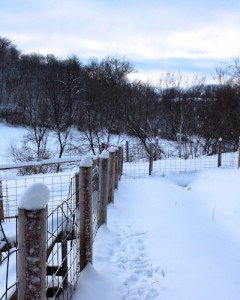
MEANWHILE, back on the farm: Snow snow snow snow. Did I mention it’s snowing? It’s snowed here almost every other day, although yesterday it began as rain. That’s the worst possible weather scenario you can get this time of year: first it gets everything wet and super slippery, then it freezes into ice and then snows on top of it. It makes everything extra dangerous (the hospital emergency rooms were full to the brim from falls), and creates a hard coating of ice between layers of snow. But I’m still happy we are getting the moisture and that we have a real winter this year. I will admit I’m getting a little cabin fever-y, but I’m so glad that the earth is getting back some of the moisture that we missed last year. We were 12 inches down and in “severe drought” through fall, so I hope that all this snow will soak into the ground come mud season. But right now it’s all about the snow. We didn’t get the huge storm that is probably hitting the East coast right now, just got 3-4 inches yesterday, but it’s still basically a white and blue/grey world out there. I love the way the snow tops off the fence posts, like whipped cream on a sundae:


Safe Off Leash?

Friday, January 11th, 2013

Last weekend Jim, Willie, Tootsie and I stayed in a lovely log cabin owned by friends in the woods in eastern Wisconsin. I mention that because for the first time in her nine years of life, Tootsie got to run off leash in an unfenced area off the farm. Wooo Hooo! Some people might not understand what a huge step that was for a little puppy mill dog, but I’m guessing that many of you get it completely. I was over the moon with happiness that I could unsnap the lead, and trust that she would stop when told, come when called, and as importantly, get to sniff and explore with more freedom than she’s ever had in her nine years of life.

The decision I made got me thinking about the issue in general: When IS it safe to let a dog off leash? What do you need to know to evaluate the risk and decide whether to take it? I thought it might be an interesting exercise to list some of my criteria and decision points in regards to Tootsie, and to hear your thoughts and experiences in addition.

I should probably mention here that it is my belief that one of the things dogs want more than anything in the world is a certain amount of autonomy. Some dogs have a ton of it, others almost none, but surely every dog wants to be able to do what she wants to do, when she wants to do it at least some of the time. Being off leash fulfills that to a great extent, but it also puts dogs at the potential of risk. So how does one decide when to unsnap the lead? Here are at least some of the things that need to be considered:

CONTROL: It is something of an irony that the more control we have over our dogs, the more freedom we can give them. Never is that more true when asking if a dog can be safe off leash, and it was the question I asked myself late Friday night when I decided it was 99.999% a sure thing that once off leash and out of the car, Tootsie would sniff around, relieve herself and then immediately come when I called. But how does one know if a dog will come when called in any context?  Ah, you don’t, not 100%, but here’s what I think you need to get to 99.9999%:

STOP ON A DIME: People often assume that all one needs to manage an off leash dog is a good recall, but I’m a big proponent of first teaching a dog to stop on cue. Asking a dog to stop on a dime might be critical for the dog’s safety, and if you think about it, that’s a very different exercise than asking a dog to come back to you. I can’t count the number of times I asked Willie to stop and stand still (I use “Stand,” a cue common in sheep herding that asks a dog to do exactly that: don’t lie down, but stop moving). Perhaps he was starting to sniff beside a partially frozen stream, or I wanted him to wait for me to catch up before he went around a corner on a trail we were walking.

Besides being a handy cue, I’ve learned it is much more effective to ask a dog to stop first before calling him to come back to you, especially if he is moving fast in another direction. Think about it: If a dog is running away from you, in order to back to you she has to 1) stop, 2) turn around and 3) come back to you. That’s three things, right? I’ve found it far more effective, especially with dogs who love to run, to teach them first to stop on cue before asking them to do a recall. It’s not all that hard to do: Just let your dog get a step or two ahead of you and say “Whoa!” or “Stand” and then reinforce with something ridiculously wonderful. Gradually use the cue when the dog is either 1) farther away from you and 2) moving faster. Try to keep those 2 components separate as much as you can, and gradually build up to asking the dog to stop while tearing off in another direction. Manage this carefully though and set your dog up to win: don’t yell “Whoa” when  your beagle is disappearing into the woods after a rabbit if you haven’t gotten full compliance at a much easier level. However, a good stop is not enough…. you also need:

A RIDICULOUSLY GOOD RECALL: Coming when called when there’s no environmental competition simply doesn’t count as a “good enough recall”. One of the reasons I decided to let Tootsie off leash in the woods last weekend is because we have spent several months working on her coming when called while running away from me at a dead run toward something she really, really wanted. I’ve worked on her recall ever since I got her a year and a half ago (if you missed those blogs, she had been a puppy mill brood bitch for 7 years). It took me months to let her off leash at the farm, and then only in specific contexts in which I felt her behavior was completely predictable. But it’s one thing to have a dog come when called in a predictable and consistent context. It’s an entirely different matter to be able to get a dog to come to you when it is already dashing away toward something it wants.

I was lucky here, because the farm provided the perfect set up. First, I have several fenced areas where I could safely let Tootsie off leash and work on her recall. The area around the house and barn is not fenced however, and has a road that runs by about 75 yards from the house, so I was much more cautious about letting her off leash there. In that context I first worked on teaching Tootsie to heel beside me as we walked from the house to the barn. She adores food, and so it didn’t take long to get a reliable response. Then I began asking her to stop or recall when I released her from the heel. I knew she would run straight to the barn, so I had no worries about her safety. I had her favorite food (chicken) in my pocket and asked her to stop the first time when she had just barely left my side. Gradually I began to give the cue when she was farther and farther away from me. Once I could get to her turn on a dime and run back to me even when twenty yards away I began to test it in other contexts. And sure enough, she flipped her little body in mid-air and came running.

CONTEXT: Location, Location, Location. Realtors aren’t the only ones who emphasize the importance of location. There are simply many places I would never let Tootsie off leash. Here’s an example: we went recently to visit a friend who lives in a suburb, with a small lawn between the house and the road. I asked her to potty before we went inside, and never would have considered letting her off leash in that context. Why? Because first, we were just too close to a road for comfort, she could have gotten into the road before I could blurt out a cue. Second, what would be the point? The cost/benefit balance was skewed far to the negative: the risk in no way was worth the pay off. At the cabin however, the closest road was a good 600 yards away,  and the payoff was huge. She got to be a dog off the farm for the first time in her little life, and although I’m sure some people would argue one should never take any risk at all, I’m not one of them. The only 100% guarantee of safety for Tootsie was to live in a cage, and she’d already done that for seven years. Enough is enough.

WHO’S YOUR DOG? If asked to name three things we all needed to consider before letting our dogs off leash, I’d say knowing each dog as a personality is the third. Tootsie spent 7 years in a cage, and didn’t know that the noises people made were meaningful for most of her life. She’s come incredibly far, but she’s still a Cavalier King Charles Spaniel that I got at age 7 who had never been trained to do anything for most of her life. Willie, on the other hand, came with recall software pre-installed. I could just about take him anywhere and let him off leash, although I still don’t take chances, because, really, what’s the point?

NEVER DONE: One last point: Don’t ever stop “training your dog to come.” I still often reinforce Willie for coming when called, sometimes with voice, sometimes with the toss of a toy or letting him chase me as I run away from him.  And I’ll never stop watching Tootsie like a hawk if she is off leash, and reminding her how very, very fun it is to come when called.

Here’s the little girl now, rounding the corner of the barn when I called her back to me from a dead sprint. She looks so serious, doesn’t she? But damn, she sure comes running!

MEANWHILE, back on the farm: A bit of a sad day. We’ve had a doe fawn living in the Orchard Pasture all spring and summer. Something was terribly wrong with her, she clearly wasn’t able to cope with living on her own. She would run smack into the fences at a dead run and was never able to jump them like all the other deer. She did well over the summer when there was a lot of food, but because she stayed in a very small area there was no way she was going to make it through the winter. There was also the concern about coyotes; eventually they would have found her and killed her. And so I contacted a DNR warden who came out, agreed that she was probably blind, and that she would slowly starve over the winter. Deer can’t be captured and re-located (they die of stress, it is horrifically cruel to try to capture and relocate them), and it was inevitable that the coyotes would find and kill her. The warden agreed that she should be put down, and did so humanely with one perfect shot. I know it was the right thing to do, and I know that deer are as common out here as beetles, but oh lordy they are lovely animals, and I’m feeling a big of sadness that such a beautiful thing didn’t make it.

Here she was yesterday:


Favorite “Non-Traditional Cues,” Part II

Thursday, October 18th, 2012

Wow. You all are amazing. So far there have been 165 answers to the question posed two weeks ago, “What’s Your Favorite Non-Traditional Cue?” I’ve read through every one of them with great interest (and often amusement). My plan was to go through all the comments, list every cue mentioned with it definition (some people included as many as 7 or 8), and see if I could  find some patterns.

Several hours later, and less than a fifth through all the cues mentioned, I suspected that a smart person might want to modify the plan. So that’s what I’ve done, whether either out of laziness or wisdom, I couldn’t tell you. I’m using the list I’ve generated so far as a sample, and have re-read all the rest of the comments that have been so thoughtfully provided.

Here’s what I’m seeing so far: First, the most common “non-traditional” cue appears to be “Wait.” It has several variants as to its exact intention, but in all cases the dog is being asked to pause or not move forward. Much more casual and less directive than a stay, I find this an invaluable cue that I myself use every day–at the door, at the car, while walking down a trail, etc. etc. It’s part of the curriculum in Family Friendly Dog Training, so I guess it’s clear that I think it would be good if it moved from “non-traditional” to “traditional.” It’s just so darn handy.

Another category of commonly used cues not often seen in standard dog training is the set of cues telling a dog either that an event is over (“Enough, All Done, All Gone”– ie, no more ball play, no more treats) or to go entertain him or herself (“Settle, Go Settle, Go to Your Place, Chill, Go Pass Out!”) These also seem to me to be incredibly useful cues that all dog owners (and dogs) would profit from knowing.  I use “Enough” several times a day, usually meaning that object play is over, but I as I’m writing this I realized I use a variant, “That’s Enough,” to mean “No more petting.” At first I assumed that Willie didn’t know the distinction, (since I only noticed it while writing this), but perhaps he knew it long before I did?

Notice that, in the variants of Settle, the dog can either decide him or herself to find a place to settle down, or go to a specific area taught in the past. I use Settle myself, meaning go anywhere you want, but for the love of all things good and true, please lie down and chill out for awhile.

The other most common group of cues relate to moving in space: “Turn Around, This Way, Up, Move Over, Back Out, Beep (my favorite!), Go Around,” etc. etc. These strike me as extremely useful as well, although more specific to individual owners and dogs.

One cue, mentioned by a few and one that I have discussed before is “Ready.” I truly wish more people would use this as a way of helping a dog understand what is about to happen. It can be used to prime a dog for action, as it often is in Agility, but also as I use it more often, to let a dog know that something is about to happen, especially if it involves being touched or handled. I use it for Willie when I am about to do something to him, like pick up a paw to dry it off. This gets into another conversation we could have about the balance between keeping cues short and sweet (very valuable at times) and not overwhelming a dog with meaningless chatter AND, at other times, using words to have interchanges with dogs that are more like conversations than a set of “commands.” I’m a fan of both…. Hummm, I’ll have to think about when and why I use different approaches.

While we ponder that, here are some of my favorite cues from the comments about non-traditional cues:

Whoopsie What you just did wasn’t what I wanted, try again.

Who’s a Goof? Roll in the Grass.

Be Bad (Okay, that’s mine, for jump up and put your paws on my chest.)

Who’s a Brave Girl? Go stand between my legs.

Use Your Words or Tell Me Your Story Bark

Sweetheart, can you put your Stagbar on the rug please? Self explanatory!

And What Should You Be Doing? Go lie on your rug

Watch Out for the Panty Hose! 4 on the floor

Chip! Really? As in, did you really just go into the garbage? Dog now puts his paws over his head.

There are a gazillion more, I encourage you to read through them if you haven’t, but it seems appropriate to end on the most unique one I could find:

Gheresh Bede or Farsi for “shake your booty”

MEANWHILE, back on the farm: Two inches of rain last weekend! Amazing! Some people got even more (and northern Wisconsin got snow, lots of it. Oh my.) Everything is so green now it’s hard to imagine it was ever brown. My pasture is still in rough shape, but the front lawn looks like it sprung to life except in a few places. All I can say is that the sheep are very, very happy.

Last Friday Willie was in his last sheepdog trial of the year. I’d say the results were mixed. I purposefully only ran a partial course with him in order to protect his shoulder. I leave tomorrow for a sheepdog training clinic with Patrick Shannahan, and I wanted to be extra sure that Willie was sound enough to work in the clinic. I also wanted him to leave the course wanting more, since the last two trials he was in were exceptionally difficult and stressful for all the dogs. This time his first run didn’t start well: Although he’d appeared to focus on the sheep in previous runs, when we walked to the post he kept looking in the direction of another group of sheep. (Your first job at a trial is ensuring that your dog can find the sheep where they are set out. This is harder than you might think. There are two other groups of sheep, and novice dogs often focus on those rather than the tiny little specks out in the distance.) Willie looked at everything but at the sheep he needed to work, and we messed around for what seemed like forever at the post until I finally just gave up and sent him in the belief that he’d go to the wrong group of sheep.

Nope, he did a perfect outrun to the right group, but by then the sheep had broken away from the dog and handler trying to hold them in place (who must have been cursing me, justifiably, believe me).  Willie didn’t get them back on line until he was pretty close to me, but he did, I stopped him, settled the sheep and said “That’ll Do.” He left the field happy and grinning and his shoulder looked good, so we did our second run a few hours later.

This time I sent him right away, and he did a perfect outrun again. Again the sheep broke from the handler  before he got to them, this time not our fault, but probably not the set out handler’s either: they were extremely flighty sheep. Again, Willie didn’t “cover” them, or flank around them far enough to get them back on line. He had no excuse for that, except his nerves: That’s what you see in dogs without enough confidence to directly confront a flock of sheep dead set on thundering back to the barn. He did get them to me however, pacing nicely as he got closer. We did a little drive which went relatively well, and then on the cross-drive Willie stopped, like a 1960′s civil disobedience protester, and stood still while looking at me and ignoring every signal I sent his way. Honestly, it was almost funny, except I’m quite sure Willie stopped because he was too anxious to continue. The sheep had to be moved directly toward the barn, exactly the direction in which Willie knew the sheep wanted to take off and run to. It’s very scary for dogs to feel in control of sheep if the sheep are moving AWAY from them and from their handler, and it takes guts and courage for dogs to learn to drive unfamiliar sheep on unfamiliar courses at a good distance from their handlers.

Ah, you know how much I love my Willie Boy, but I’m afraid “guts and courage” are not words one would use to describe him. The “Woody Allen of Sheepdogs” would be more like it: brilliant but ridden with angst. We’ll see how the clinic goes this weekend. I don’t want to run Willie in trials if they just distress him, but I would like learn to help him be as good as he could be. Even though his work at the trial had some serious flaws, we did well enough that we didn’t leave feeling badly. He seemed upbeat and happy all day, I had a good time and got some good experience under my belt. I can’t wait for the clinic, it should be lots of fun and very interesting. And to those of you who were there, I still can’t stop singing “Keep rolling, rolling, rolling, keep them doggies rolling, RawHIIIIIIIDE.” Sigh.

Things at the farm are good. It’s still gorgeous even though many of the leaves have fallen. We got another half inch of rain yesterday… will wonders never cease? Tootsie is a happy girl, except for this morning, during which she spent part of the time in the kitchen sink because she had diarrhea all over herself. And me. You all know how that goes. I think it was just a glitch, that she’ll be fine in the future, and am oh so grateful that I can wash her off in the sink. Very handy at 6 am in your bathrobe.

Nellie and Polly are good. Too good. Polly took one look at her momma being put into a carrier crate in order to go to the vet clinic for vaccinations, and darted up a tree. Here she is: Wanna play Find the Kitty? (And don’t worry, she was down the minute we came home and I let her mum out of the crate.)

What’s Your Favorite “Non-Traditional” Cue?

Friday, October 5th, 2012

A few weeks ago I wrote a post on the cue “Get Back,” which is one of my favorites because it is so useful in so many contexts. Katie Martz, Communications Coordinator here at PMcC, video taped Willie getting back in a variety of contexts, and we noticed that every time I said “Get Back” in a context in which he’d rather not, he tongue flicked. That led to a very interesting discussion with readers about why he was tongue flicking, but distracted us from the reason we did the taping: the usefulness of “non-traditional” cues in dog training. Yes, we all need Come, and Sit and Stay; I can’t imagine what I would do without them. But there are a variety of cues that are equally useful, but not as common or well known. I thought it would be fun to canvass readers to learn about their favorite “non-traditional” cues, and perhaps add to the vocabularies of all of us. Here are just a few to get us started:

ENOUGH: Along with “Get Back,” I also love “Enough,” no doubt in part because I have had dogs (and still do) willing to elicit play or petting until all the entire Antarctic ice pack melts and we are all paddling to work. There’s a video of Enough training in the Reading Room on the website, it’s the Second from the Top. I use it when I want to focus on important issues, including whether Castle and Beckett will ever have a relationship like normal people, when I am done playing with toys with Willie, and when I simply can not stroke Tootsie’s adorable little round belly pooch for one more minute.

TAKE IT/DROP IT: I teach Drop It as the flip side of Take It, and I find I use both of them often. As in: Please drop the dead bird you found, or please pick up your toy and bring it back in the house. I know these aren’t especially ‘non-traditional’ but they often aren’t taught in training classes and I wish they were. Far better to teach Drop It as a fun exercise rather than reflexively shouting DROP IT! in an angry voice and teaching your dog to swallow as fast as she can when she hears it. That seems to be the default of most dog owners, an understandable primate-like response, but not a good way to establish a good relationship with your dog.  I’d love to see it as part of dog training curricula and have included it in The Puppy Primer.

READY? This is a standard signal a lot of serious trainers use, but I wish again it was more common place. I love looking at Willie and asking him if he wants to engage with me. The key here is asking. It’s not a command or even a cue really, in the sense that I’m simply asking Willie if he’d like to start training something new or practicing something old. Any answer is acceptable and I have no expectations of his response, except as information. If he doesn’t turn to me, eyes shining, then he’s not ready, and I change my behavior until he is. Because the sound so often leads to working sheep or doing something that elicits treats or play, Willie seems to love the word as much as I do.

OUT: Katie Martz uses this with Lily, her beautiful Dogo. She uses it when she’s chopping vegetables in the kitchen, to prevent Lily the 90 lb white wonder from dancing on the counters in delight. Out means either go to another room or another surface (floor to carpet for example) or, essentially, stop bothering me right now. She taught it by tossing treats into the other room and body blocking her from coming back in. Lily seems to define it the same way Katie does (often rare in training, right?), because she will respond correctly to it in a new house or apartment.

WHAT’S YOURS? This is just a partial list, and I’d love to hear what “Non-Traditional” signals you use with your dogs that you especially love. I envision a very interesting discussion about it, thanks to all our thoughtful readers. I fully expect I’ll be teaching Willie a new cue by the end of the weekend….

MEANWHILE, back on the farm: It’s gorgeous but desperately dry. I am watering the trees in the yard, but who knows what will happen in the woods and the prairies. But it has been stunningly beautiful, one of the prettiest autumns ever. Dry conditions, followed by sunny days and cool nights are apparently ideal for fall color, and that has been the case here to a T. The sheep are doing well, although that’s not the answer you would get if you asked them. They are confined to the pen because the pastures are little better than dirt. It’s sad to see, but I have had excellent advice from a pasture specialist (thank you Laura) and have a plan to rehabilitate starting next spring. I’m taking soil samples in this week to get that part done now anyway, and we are, one by one, ridding the area of the thistles we didn’t get this spring. (Thistles appear to be drought proof apparently, such a shame they are not edible.)

However, thanks to Jim, who is the primary portable fence mover, the sheep are able to get some grass from selected areas in the front of the farm. In the photo below they are eating the lush grasses right alongside the road. This is the best grass on the farm: it’s a low area that gathers rain run off from a culvert, is shaded much of the day and is mowed by the county on a regular basis. There is a tiny bit of grass in other areas of the front lawn, and thanks to Jim, Willie and the portable fencing, the sheep will be able to get some of it. Most of their ration is the hay we purchased for winter, which we are going through at an alarming rate. But it’s good, rich alfalfa and the sheep are actually doing well on it.


Last Sunday we all got out for a lovely fall walk in the fields and woods close to a good friend’s house. Willie’s shoulder has improved enough so that he is now off leash again. When I had to put  him back on leash, both inside and out, he became as depressed as any dog I’ve seen. It was, in a word, heartbreaking. Now that he can run free again he is back to his happy, happy self. We saw his physical therapist on Monday and she strongly advised that we go very, very slowly trying to bring him back to training for competition. It’s clear that his shoulder simply may never be able to handle the wear and tear involved in training for driving on a perfectly straight line, something that requires a tremendous amount of lateral stress on shoulder joints. If he can’t ever trial again I don’t think he’d care at all, as long as he can work sheep at home. It’s me that wants to trial, so although it would be a great disappointment to drop out now that I’ve caught the bug again, if Willie is happy, that’ll be enough for me. I’ll get over it, and Willie will not care one little bit. I’ll see how it goes, going very slowly and carefully.

Here’s the gang on the wooded part of our walk: Willie, Jim, Tootsie, good friend Beth Viney of Great Pyrenees Rescue of Wisconsin and her lovely lady, Tundra. Willie and Tundra did beautifully when they were re-introduced at the beginning of our walk (they had met once before, I have a video of it on my Dog-Dog Reactivity DVD and we all had a grand old time. Tootsie did get carried by me or Jim part of the way, the grasses were pretty high in some places and what was a path to us was a jungle to her. Short of teaching her to use a machete, we picked her up and carried her. But she was a trooper and still did a lot of walking, and we all had a wonderful time. Then Jim and I went back to doing farm chores, worked outside most of the afternoon, and ate a yummy dinner of local, organic pork, roasted root veggies and home made bread. We fell in bed about 9 o’clock and slept as if we’d been drugged. Hopefully there will be more of the same this weekend (the walks, farm chores and good food, we’ll pass on the “as if drugged” part.)


Willie and Tongue Flicks and What it All Means

Monday, September 10th, 2012

As if any of us REALLY knows “what it all means,” right? But thank you for your interesting and thoughtful comments about the previous post’s video of Willie and the “Get Back” signal. They were great.

I’ll cut to the chase about my own interpretation. Here’s the data: Willie tongue flicks when I ask him to back away from somewhere or something he wants to go toward: the outside of the house, into the car, or toward the toy. All of these have been taught using lots and lots of reinforcement with food and play and “life rewards,” like going outside after I say “Get Back” or getting the toy as soon as he backs up (But  I don’t reinforce every single response every single time once he has a cue down pat. That would be unnecessary in my opinion, not to mention completely impractical.) But back to the tongue flicks:

The only time in the video when Willie doesn’t tongue flick after “Get Back” is he is directly facing the sheep, who are backed into a corner. Two highly relevant facts that can help us interpret his behavior are:

One, I’ve never used food to teach it in that context (sheep), I have in all the others. Is it possible that he has a classically conditioned response to the cue because it so often resulted in food? I thought that was an interesting comment from a reader. I think this bears considering, but, see # Two….

Two, (and I think in this case MUCH more relevant) Willie dislikes what is called “contact” with the sheep (not physical, think metaphysical) and is stressed by face-to-face confrontations with them. Did you see how quickly he backed away (see second 120) when I said “Get Back” in that context?  That’s because he is relieved. In this case he’d be likely to tongue flick when I said “Walk Up,” not “Get Back.”

Thus, I am inclined to agree with those who argued that Willie’s tongue flicking is displacement behavior. In all the cases in which he tongue flicked, he wanted to go forward, but couldn’t, so he did something else. What he did could be interpreted as a sign of low-level anxiety, stress or frustration, or as appeasement behavior. I experimented (have you with your own dogs yet?) and looked for tongue flicks in a variety of contexts and after a variety of cues. Lie Down and Sit all got tongue flicks. Come forward and touch my hand, pick up the toy, come to me, find the toy, and high five did not.

Willie appears to tongue flick when he wants to move forward but is asked to do the opposite. Is he stressed? I could well be wrong, but I don’t think so, at least not in the way the term is usually used. “Stressed” on Willie’s face is easy to read, and involves pinched facial muscles, ears flat and a look in his eyes somewhere between Tippi Hedren in Hitchcock’s The Birds and Anthony Hopkins in Silence of the Lambs. Is he thrilled about being asked to back up? Nope.

Notice how immediately before and after the tongue flicks, Willie’s body stays loose, his mouth open and he generally has on what I call his happy face. Would he rather go forward at the door, into the car, toward his toy? Yes. Would I rather eat ALL the chocolate in the cupboard right now? Yes. Am I stressed because I am not allowing myself to do so, with some inner voice firmly saying “Trisha, Get Back?” No. That’s my interpretation. Now that we all know more, what do you think?

A few more points in relation to your comments, and a reminder of what a great exercise these videos can be for us all. Several people commented about Willie, at second 24, sliding under my legs toward Tootsie as I am about to lift her into the car. There were some interesting guesses about what is going on here, but I can tell you with confidence that Willie is taking the opportunity to sniff her butt “under the radar.” He still primarily pretends that she doesn’t exist (and vice versa). They can eat off of the same plate if offered to lick our dinner plates, and she can dance on his head when greeting us and he has no visible reaction. He is remarkably tolerant of her (and her him). But they still do not acknowledge each other, and sneak in sniffs in rare moments, only when the other’s head is busy.

Some of you also commented about Willie’s dash away from the car door after I put Tootsie inside (second 40) and interpreted it as fear. Not a chance in this case, he was running in joy to the barn. Willie has learned that unless other cues have occurred (Tootsie’s car harness on, his travel collar on), Tootsie going into the car crate means we are going to the barn to work sheep.  Even though I think he often finds it stressful, he appears to love working the woolies as much as life itself.

And one last quick comment, just by way of explanation: Willie’s Stay signal means “Stay in place (not posture) until I give you a release.” Willie’s Wait signal means “Pause momentarily and then do what you want.” If he is still not moving once I’m ready for him to move on, I’ll say “Okay” just to get the ball rolling again. But it’s his choice, Wait just means pause. If I want him to not move until I give him a release I say Stay. I find that useful, myself. You?

MEANWHILE, back on the farm: We began last weekend with a rough day on Friday. Willie was entered into our second “big” sheepdog trial on Friday, and did the worst he’s ever done. It was, granted another really tough trial, with a tough course, tough sheep and with wind and rain blowing into my face. Willie improved tremendously on our second run, but I did the worst I’ve ever done and made two ridiculous mistakes. Ah well. But then we gloried in a perfect fall weekend: blue sky, dry air, ideal temperature &light breeze. I’m talking calendar cover weather, here, and boy did we deserve it after such a brutal summer. I planted asters and dug weeds and cooked, Jim cut down tree-sized Ragweed to help my allergies, finished a new wagon to transport the sheep and we generally puttered and watched sports on TV and relaxed. Heaven for us all.


Using Positives to Decrease Negatives

Friday, July 27th, 2012

Here’s something interesting I learned while working on a talk I’ll be giving at the Annual Conference of the Wisconsin Association of Behavior Analysis on August 15th in Madison. My talk is “Creating Harmony Between Dogs and Special Needs Children,” and it involves discussing the benefits to the family of having a dog, but also the risks to the dogs that need to be addressed and minimized as much as possible. As we all know, even parents of typical children sometimes struggle with interactions between their children and their dog, and things can be even harder for parents of children with special needs.

While working on my talk I read a research paper that is relevant to dog training in general, even though the case study was about changing the behavior of a child with Autism Spectrum Disorder, or ASD. A 6-year old boy was “inappropriately touching” the household dogs (grabbing and pinching the dog’s anus, oh dear). Needless to say, this was both unfair to the dogs and dangerous for the child.

The therapist attempted three different types of intervention: 1) a verbal reprimand if the behavior occurred and attempts to physically block the behavior from happening, 2) DRA, or “Differential Reinforcement of Alternative Behavior,” in which the child got a jelly bean for touching the dog appropriately and 3) DRO, or “Diff’l Reinforcement of Other Behavior, in which the therapist gave the child a chance to choose the reinforcer before each session, and then told the child “If you don’t touch the dog’s bottom, when the timer goes off (10 sec), you’ll get X (chosen reinforcer) afterward”. Appropriate touching was verbally reinforced as it was in DRA, and inappropriate touching received a verbal reprimand “No touching. That means no X. Let’s try again.”

No surprise to dog trainers, verbal reprimands had little effect. The DRA method (reinforcing appropriate behavior) resulted in an increase in appropriate touching BUT no decrease in inappropriate touching. However,  DRO (don’t grab dog’s butt for 10 seconds and get a reinforcement of your choice) eliminated inappropriate touching completely. You can read more details in Bergstrom et al, 2011, Research in Autism Spectrum Disorders 5, pg 218-221.

Note that there were at least 2 variables that differed between DRA and DRO: In the latter the child got to choose the  reinforcement (rather than being given one, a jelly bean, that the therapist knew he liked). Second, in DRO the reinforcement came after 10 sec of not doing something, versus getting a reinforcement for performing an alternative action. This makes it a bit difficult to sort out which factor had more influence on the result (remember, this was a case, not an experiment). My guess is that both factors were significant. Certainly it is critical to understand that, just like us, dogs want different things at different times, whether it’s being let out to pee and sniff the sidewalk, get a piece of bacon or get to play ball. One of the key distinctions of good trainers is the understanding that we need to get into our dog’s heads as best we can and guess what it is that the dog wants at any given time. That said, I suspect that reinforcement for the absence of a behavior might also have been significant.

If you’re a learning theory expert then you are well versed in the term Differential Reinforcement, (DR) including DRI (where I = Incompatible behavior) as well as DRA and DRO. Most dog trainers use these concepts all the time, just without the formal labels to them. I bring it up here because so much of family dog training includes stopping a dog from doing something you don’t want it to do as much as teaching it what you do want (which should go hand in hand, right?) I teach incompatible behavior all the time, (sit when greeting people at the door rather than jump up), but we all know that some behaviors in some dogs can be challenging to turn around. I haven’t used DRO as described above very often with my own dogs or with my clients, however I did have good luck with it when Willie was obsessed with herding Sushi. Reinforcing incompatible behavior didn’t help, if anything, it made it worse because everything became a secondary reinforcer. Once I figured that out I could manage it reasonably well, but before Sushi left I had the best success with reinforcing a lack of herding for X amount of time (inspired by a seminar with Ken Ramirez, by the way). It’s not an intuitive method at all, and I suspect it’s best used only in specific circumstances. I’d love to hear your own thoughts about your own experience with it, or with dealing in general with behavior that is difficult to extinguish.

MEANWHILE, back on the farm: Even more rain! Whoopee, almost an inch in the last 2 days. It’s probably too late to save my pasture, it appears to be dead and gone; but maybe not, said Trisha the optimist? Maybe, just maybe, it’ll come back? I’ll give it another week or so before deciding to plow it up. That would be an ouch. I only have one other small pasture and if I replant I’ll have to do it in fall and then keep the sheep off for a long time afterward. Would have to buy lots more hay, and that’s not so easy to find right now.

Speaking of sheep, I realized it’s been awhile since they had the spotlight. About time I’m sure they’d say. Here are two of the ewes I call the “camel sisters:”


They are just visiting, to help me and Willie work flighty sheep.

Here’s a question for you: What’s wrong with the picture below?

Did you guess that sheep shouldn’t be eating hay in Wisconsin in the middle of summer? Yup, you’re right. The flock is eating their winter’s food and has been since late May. Maybe I’ll have to put them on a diet like I am?


Simply Wrong

Friday, July 20th, 2012

I don’t know about you, but anytime I hear a dog training product described as “revolutionary,” I get worried. And for good reason. Have you heard about the new “revolutionary way” to walk your dog? It’s called SimpleLeash, and it is guaranteed to work on “dogs of all sizes and temperaments.”

What’s the revolutionary idea? Your dog gets a shock if he pulls on the leash. Ah, but it’s not called a shock. I couldn’t find the word shock anywhere on their website. No, no shocks here, just a “harmless correction stimulus,” that intensifies the harder your dog pulls. There is simply nothing for the owner to do, the collar automatically does it all! Thus, the SimpleLeash. “You literally don’t do a thing except hold the end of the leash.”

Well, maybe one more thing, like scrap up the puddle flattened on the sidewalk, the one that used to be your dog, and carry it home repeating “I’m so sorry, I’m so sorry,” over and over again, as if it would help.

Speaking of sorry, I apologize for being so blunt. But oh dear, oh dear, will there ever be an end to people making money off of inhumane training methods? Here are some of the things a dog could learn from this collar:

1) Walks are dangerous. I will do all in my power to pee in the back bedroom and never go out again.

2) Every time I pull toward another  dog I am injured. Using my doggy brain and able as I am to associate 2 things together, it is obvious, even to knucklehead here, that other dogs are dangerous. I’d better start growling and barking at them to keep them away.

3) Ooops! I tried to pull toward the hedge to poop in a good place and got shocked. Pooping bad. Okay, I’ll hold it as long as I can. She can walk me for an hour, but by golly, I’m holding it in if it kills me.

On their website, the owners of the business explain that they are dog lovers, ones with some labs (based on the photo) who could not be trained through “professional training, treat training, clickers, choke collars, those collars with spiky things… and the leader that goes over the nose.” Wow. I’ll grant that teaching a dog to walk politely on a leash is harder than things like teaching a sit or a lie down, but my goodness, those must have been remarkably difficult dogs. After working with these virtually impossible dogs, one owner one paired up with a brother-in-law and came up with SimpleLEASH.

Could it ever work to teach a dog not to pull on a leash by shocking her when she does? Sure. Of course. Sometimes. You can stop children from mouthing back by slapping them on the face too, but that’s not where the story ends. Stopping a particular behavior with force, especially one as primal as a shock, usually has a raft of side effects that aren’t so pretty (see above to name a few). This is why it’s a good idea to talk to professional trainers and behaviorists before one promotes a product that can have serious side effects. And why it’s a bit dodgy to say that one “firmly believes in positive reinforcement training” and offer a collar that would give a dog a high level shock for bolting away from you in fear if a car backfired. It also helps, if you are going to refer to Pavlov on your website, that you understand Pavlov’s greatest accomplishment was discovering that the conditioned stimulus (the bell that signals food is coming, or in this case the sound that says a shock is coming) gets the SAME reaction as if the food did come, or the collar did produce a shock.

I just hope that people new to dogs aren’t overwhelmed by the seduction of this “Simple” and “Unbelievable” and “Brilliant” device. It’s a shock collar, and one that can deliver its highest level shock when a dog is terrified of something, under attack by another dog, intent on peeing on the right instead of the left of the light post because that’s where any dog would want to pee but their owner can’t smell anything so has no clue why it’s so important…. and on, and on.

Here are three things we need to teach dogs what we want when they are on a leash. Yes, some dogs are harder than others, but really… it’s not rocket science.

TRAINING: Check out my Teaching a Beginning Heel video to teach a dog to stay by your side. It’s the top video on the page I’ve linked to.  Also, see The Puppy Primer for getting a young dog started, and Family Dog Training for step-by-step exercises to teach a dog to walk beside you on a leash. Does it take some time and some skill. Yup, of course it does. It takes time and some skill to learn to drive your new car, to figure out how to program your DVR and to learn how to talk to Aunt Sally without bringing up the horrible things she said about Uncle Paul that last Christmas. Just do it. If you like being with your dog and you learn the basics, it’s fun. Really fun. You did get a dog to enjoy doing things together, yes?

DEVICES: I’m the first to agree that it takes a while to teach a young dog especially to not pull on a leash. No one walks a young horse through a crowded stable yard with the expectation that he’ll follow along quietly without a halter on while you’re doing your other training. That’s why I used a Sensation Harness on Willie when he was younger when I was walking him in town or to the vet’s. It’s one of the body harnesses that attach in the front — my favorite tool for controlling a dog while you teach him to stay by your side (and walk at the undoubtedly boring-as-death pace of an adult human on a walk.) Another good brand to consider is the Easy Walker by Premier. Some brands fit some dogs better than others, you’ll just have to see what works best for you. These harnesses work very well for small and medium dogs, but if you have an especially large or strong dog, you might consider going to a head collar, like a Gentle Leader or a Snoot Loop.

YOUR HEAD AND YOUR HEART: You can’t teach a dog to walk by your side without engaging these. Your head needs to know that walking side-by-side isn’t something dogs do naturally. Just because us primates do it doesn’t mean our ‘best friends’ understand the concept, or want to play along once they do. Your heart needs to know that your dog is a good dog, really he is, and he is just being a dog if he tries to pull to sniff where the squirrel just peed. He doesn’t need to be hurt and scared just because he wants to sniff something, does he?

AND YOU? What are your tips for people with dogs who pull? With new dog owners with enthusiastic puppies who haul them across the lawn to the neighbor.. the one who hates dogs?

MEANWHILE, back on the farm: Rain! Not much here, but still, I now have faith that it can rain, and that it might sometime again in the future. We actually got very little here, only a half an inch, while friends 6 miles away in one direction got an inch, others the same distance in another direction got 2 and a half. Go figure.  It’s going to be brutally hot and humid this weekend though, so Willie and I are going to take advantage of a slight cooling off today and go up the hill and work sheep. Wheeee! We’ve done it so little I barely remember his whistles. (I actually went to the car to remind myself how to whistle his signals at the trial on Sunday. All of a sudden I felt like, “Wait! What does it feel like to whistle Come Bye?” (Which means go clockwise around the sheep in herding speak.) Barbie, get ready, here we come.

And more good news: no watering necessary today for the first day in… how long? Don’t know, I’ve lost count. I’ve mostly watered the trees and my perennials, it’s really been a kind of a triage operation. Here’s my primary flower garden that I have kept up with watering. It’s starting to fade, but still colorful and brings me so much happiness. The grass right around it is bountiful, the grass farther out is the color of potato chips. The botanists say that much of the grass that is brown isn’t just dormant, it’s might actually be dead. I don’t care so much about the lawn, but I am truly worried about my two acre pasture up the hill. It’s convex (with a hill in the middle and tends to be pretty dry anyway), but only time will tell if our little bit of rain came soon enough.


And here’s Calico, finishing a stretch when I woke her up from a nap:


Dogs and People Both Achieve the Runner’s High

Friday, June 8th, 2012

We’re happy to introduce Karen London, Ph.D. as a guest blogger for The Other End of the Leash this week!  Enjoy!

If people go running by your home accompanied by their cats, geckos, ferrets, parrots, or rats, then you live in a very different neighborhood, perhaps even a different world, than I do. It’s just not part of our relationship with those species, however close we may be to them. Yet running is something that many of us share with our dogs, to the point that it’s almost cliché for people to swear that their dog is the best running partner they’ve ever had.

There are so many reasons why people choose to run with their dogs beyond just knowing that their dogs need the exercise. Unlike most human running partners, dogs don’t ever have meetings that go late. They wouldn’t rather sleep in. They are always ready to go, and are generally willing to cruise at any pace with equal ease. They don’t complain that the weather is bad so they’d rather skip today’s workout. The chance to go for a run is greeted with enthusiasm by our canine companions. The truth is that dogs typically like running, which is yet another commonality between dogs and humans.

Okay, perhaps not ALL humans. (Trisha, for example, who is one of my very favorite humans, has described running as abusive though she is very active both on her farm and with long walks and hikes, which are great joys to her. She thinks it’s great that I like to run and that it makes me happy. Still, every time we room together at a conference and she sees me head out for my morning run, I can’t help wondering if she’s thinking, “Hey, better you than me!”)

In the last hundred years or so, people have become more sedentary than at any other time in our evolutionary history, and many of our dogs have joined us on the couch. (A small percentage can’t run because of health issues such as changes in structure that make the high aerobic demands of running problematic, as is the case for the brachycephalic breeds such as the Pug, Pekingese, and Bulldog, but most don’t run simply because we don’t give them the opportunity.) Though most dogs are still generally excited about running, the human species, outside of a small percentage of fanatics of the sport (or weirdos as we are sometimes called), isn’t interested in heading out to run each day anymore. As a result, those good feelings we get from running—the runner’s high—are not felt as often by as many of us. Yet, the potential to activate the chemical reactions that cause the runner’s high still exists within us. The ability to experience that rush of good feelings is shared by both dogs and people, even if we aren’t all dipping into the opportunity with the frequency that our long-ago ancestors did.

The runner’s high is caused by endocannabinoids, which are neurotransmitters in our bodies. These chemicals signal the reward centers of our brains, giving us the message that what we are feeling is pleasure. They lessen both pain and anxiety as well as create feelings of well-being. Running results in higher levels of endocannabinoids in our blood, which makes us respond to running by feeling good.

A recent study by researchers at the University of Arizona investigated the production of endocannabinoids in multiple species, including dogs, as a result of running. There are lots of advantages to running, including to capture prey and to avoid being captured by predators, but endurance running is still not likely to happen if it feels bad. These scientists were interested to know whether it’s possible that species that do a lot of long-distance running evolved to like running via the pathway of reward centers in the brain that respond to chemicals produced while running.

The researchers predicted that there would be a different chemical response to running in species with a history of endurance running compared to species whose natural history does not include running. Specifically, they predicted that running would result in chemical reactions in the brain that are associated with pleasure in endurance running species but not in species that don’t typically run long distances.

To investigate this issue, they compared the effects of running on endocannabinoid levels in three species. Two of the species—dogs and humans—come from long lines of endurance runners over the eons. Running has been an integral part of their evolutionary histories, even if not all of individuals of those species regularly run today. The other species, the ferret, is not a running species. Though ferrets can move pretty quickly over short stretches, running for long distances is not a part of their natural history.

The experiment involved training dogs, people, and ferrets to run and walk on a treadmill and taking blood samples from their subjects before and after they ran or walked. (Not surprisingly, it was way easier to train dogs and people to do this than to train the ferrets!) The blood samples taken after running from dogs and people contained highly elevated levels of one particular endocannabinoid, which is called anandamide. The blood samples from ferrets after running on the treadmill did not show elevated levels of anandamide, or any other cannabinoid. None of the species had elevated levels of any cannabinoid after walking.

This study provides evidence that dogs and humans receive a chemical reward for running but that ferrets do not. When I say that dogs receive a “reward”, it’s hard not to think like the dog trainer I am and compare this change in brain chemistry to a treat, since both provide pleasure. It gives our dogs pleasure to eat steak, which is why steak makes such a great reinforcement for training. Dogs are more likely to perform a behavior if doing so makes pieces of steak available. Having the reward center of the brain activated by the chemicals produced while running is a high-quality reinforcement for running, and one that has been acted on by the forces of evolution to reward people and dogs for running. In species that are endurance runners, the changes in our chemistry as a result of running and those effects on the brain help us enjoy running.

The brains of dogs and humans—both natural runners—are hardwired to enjoy running, which may have provided the evolutionary mechanism necessary for us to develop such skill at it. The quirk of brain chemistry that makes both dogs and humans love running is not universal among mammals. Ferrets, for example, derive no pleasure from running.

Simply put, this study shows that dogs and humans, unlike ferrets, achieve a runner’s high. Of course, it also suggests that Trisha is part ferret. (She said I could write that, in case you were wondering.)

So, consider indulging your dogs the next time they are begging to run. It turns out you are just like them—born to run!

I’d love to hear your views on running and dogs, whether you and your dog participate in this activity or not.

Here I am with one of my best running buddies as we share some water during our post-run happiness:

And here’s elite professional runner and dog trainer Emily Harrison with her dog Super Bee, who I often see running around my neighborhood. Besides the fact that I like both Emily and Super Bee personally, I have to share this picture because it seems just plain wrong to write a post on Trisha’s blog and not include a photo of a Border Collie.

Karen B. London, Ph.D. is a Certified Applied Animal Behaviorist and Certified Pet Dog Trainer who specializes in the evaluation of serious behavior problems, including aggression, in dogs.  She is the behavior columnist for The Bark Magazine, writes The London Zoo column in the Arizona Daily Sun, and is the coordinating editor for that same paper’s weekly running column, “High Country Running.” She runs and trains for races with dogs and people, with her favorite training partners being her husband Rich and her old dog Bugsy, who was half Black Lab and half Handsome Stranger. She has co-authored five books on canine behavior and training with Trisha.

fMRI on Dogs: Too Wonderful!

Friday, June 1st, 2012

When I was doing my PhD research in the 1980′s I wanted to see how a dog’s brain responded to different types of sounds before and after training. This was in the 1980′s, and the only method available for animals was to do Evoked Potential tests, in which simple, tiny electrical sensors were glued to the scalp. This allowed one to measure activity in the brain in an extremely general way: What kind of brain waves does one see in the Temporal versus the Parietal lobe, for example, after hearing or seeing specific stimuli?

Evoked Potential tests are logistically easy to do on adults: You shave tiny areas of the scalp, glue on the sensors, and ask the subject to stay still for a set period of time. The research subject mustn’t move, because muscles move through electrical stimulation in the brain too, so any movement confounds the brain’s response to external stimuli. But how do you do it on dogs?  How would you keep them still? Absolutely motionless? And here I was in Zoology, not neurobiology, so how would I pull this off?

I felt lucky to be at a large research institution like the University of Wisconsin in Madison, and so I reached out to neurobiologists in other departments. “How does one do Evoked Potential tests on dogs?” I asked. “No problem” I was told. “It’s not that difficult.” “But how do you keep the dogs from moving while you’re doing the test?” I asked. I received a blank face and a silence as an answer. “I don’t understand.” the expert informed me. “What do you mean?” I repeated my question. His answer, after another pause, was “We just don’t bump the tray.”

Slowly, with growing horror, I began to understand why he was confused by my question. I hadn’t asked “How do you do Evoked Potential on live dogs?” The dogs they used for their research weren’t alive; they were killed and the tests were done immediately after their death. Not what I had in mind, needless to say. I left his office and found a researcher (Dennis Molfese at Southern Illinois University) who did Evoked Potential tests on human infants. We did use small dosages of Acepromazine to quiet the dogs, but also did lots of training, and had few problems keeping the dogs still. We ended up with good results that showed dogs paid more attention to short repeated notes when linked with recalls than long, continuous notes.

You can see then, why I am thrilled to read that researchers have now pulled off doing fMRIs on happy, healthy, live dogs. Scientist Berns and others in Atlanta worked with owners to train 2 dogs to sit motionless in an MRI machine for 10 seconds at a time. If you’ve ever had an MRI, you know that this requires far more than just lying still. For reasons once explained to me while I lay frozen with fear in a tight, dark tunnel, the magnetic part of the MRI creates an ear splitting series of pops and bangs and groans that is hard for many people to sit through. And yet, they pulled it off with dogs, and got some interesting results.

“The task was designed to determine which brain circuits differentially respond to human hand signals denoting the presence or absence of a food reward.” And sure enough, when a visual signal was given that meant food was coming (not unlike a clicker stimulus), the ventral straitum of the caudate cluster was more active than when a visual signal meaning “no food coming” was seen by the dogs. Activating the ventral straitum causes the release of dopamine, the “Oh Boy!” neurohormone mediating happy anticipation. It’s the same neurochemistry that occurs when you get your dog’s leash and she begins to dance in anticipation of a walk.

The results are interesting, but not earth shaking, given they were exactly what was expected. What IS earth shaking is that scientists have found a way to study what happens inside a dog’s brain in kind and compassionate ways. This is huge…. the amount of information we could derive from this is immeasurable. I have long said that our relationship with dogs provides us with research opportunities unlike any other, and here’s proof of it.  Stay tuned… the next couple of decades of research and our understanding of other animals are going to be absolutely amazing.

MEANWHILE, back on the farm: The lambs are thriving, the dawn chorus of bird song floods into the farmhouse around 4:30 am, but who could mind such a beautiful way to wake up?

And although the weather has been challenging of late, (hot, cold, wet, no rain, too much rain, you name it), the flowers continue to lift me up and make me happy. Here’s an Iris I planted last year, first time seeing it bloom: