Welcome to the official Patricia McConnell website. Skip directly to: main content, navigation, search box.

Archive for the ‘video’ Category

Play Bows as Meta-Communication

Friday, December 14th, 2012

We all know the signs of imminent danger between two dogs right? Immobile stiff bodies, direct eye contact, round eyes. Except when dogs are playing and then the exact same postures and expressions are nothing but pauses between frolics. That is a perfect example of what’s called meta-communication, or communication about communication.

Here’s a video of Willie and his new friend, Leo–the new pup of Katie Martz here at the office–illustrating meta-communication as well as any two dogs could. I look forward to your comments about it.

First, some background: Yesterday they met for the first time, and it went beautifully. Katie stood 40 feet from the door with Leo as I let Willie out and asked him “Where’s the Dog?” We played tug when he looked at Leo and then back at me. After 2 subsequent “autowatches” in which Willie looked at Leo and looked back at me without prompting (and was reinforced with a tug game for it), I released Willie to go meet Leo. He immediately ran over to Leo, who pilo-erected the fur on a dorsal line from neck to tail a little bit, but stood his ground and allowed Willie to sniff him. After a few short seconds Leo relaxed as Willie sniffed him, and both Katie and I felt sure (we discovered later as we talked about it) that he was about to put his forepaws onto Willie’s back. I wasn’t sure how that would go over with Willie so I said “Go to the barn!” to keep their first greeting positive. It all happened so fast I was acting on gut feeling as much as anything else, having learned with Willie and hundreds of client’s dog to avoid extended greetings between dogs. So Willie dashed off toward the barn and their first encounter went well.

Quickly we moved into a fenced 3 acre pasture, and both dogs got to run together off leash. They played beautifully together, although Leo is too young and small to keep up with grown-up, long-legged Willie. There’s a lot going on in this short video, but first watch how Leo’s long play bows correlate with both dogs standing stock still and staring directly at each other. Those signals, normally signs of trouble are not a problem however, because as meta-communication, play bows signal the other dog that stiff bodies and direct stares are just in fun. Just as a football jersey means a tackle isn’t true aggression (okay, maybe American football is a bad example?!), play bows signal other dogs that any behavior to follow is meant as play. That’s why you see them most often between unfamiliar dogs as they begin to play together.

Watch as Leo does beautiful, clear play bows at second 8, 20 (behind my legs), 118, 126, 148 while he and Willie stand stock-still. I love how both dogs stay still until one does what’s called “start-stop,” that quick little lunge that elicits a reaction. (I do it myself to see what will happen at second 40.) (By the way, YouTube changed its settings–surprise, sigh–so you may see another video after the end of this one. Just ignore until we figure out how to change things around!)

Watch too how Leo runs to me and sits beside my legs at second 30. My interpretation of this behavior is that it’s done by dogs who are a bit intimidated by another. There is a great interaction between the dogs right after that, with Leo doing what looks like an abbreviated muzzle punch at second 33 and then licking Willie’s muzzle.

If you watch the video to the end you’ll see Leo squat and pee, and then turn and look back toward Katie. He’s learned if he pees outside he gets a treat, and boy did he learn that lesson well!

There’s lots going on in this video, I’d love to hear any of your comments about what else you might have observed. If you’d like to read more about play, you might want to go the section in the Reading Room on Play, or check out the Dog Play DVD or Play Together,  Stay Together about play between people and dogs. I’ll look forward to reading your comments, and not to mention welcoming Leo back to play with Willie.

MEANWHILE, back on the farm: What a treat for it to be winter! If it’s going to be dark at night darn it, at least it can be crisp and pretty. And it is. I am loving the snow on the ground, although it is not much and melting fast. But it’s sunny and lovely and fresh and your boots crunch on the snow while the Chickadees call CHICKA-DEE-DEE-DEE from the woods. Time to take Willie boy and Tootsie girl on a walk. I hope you have some weather you can enjoy too.


Willie and Tongue Flicks and What it All Means

Monday, September 10th, 2012

As if any of us REALLY knows “what it all means,” right? But thank you for your interesting and thoughtful comments about the previous post’s video of Willie and the “Get Back” signal. They were great.

I’ll cut to the chase about my own interpretation. Here’s the data: Willie tongue flicks when I ask him to back away from somewhere or something he wants to go toward: the outside of the house, into the car, or toward the toy. All of these have been taught using lots and lots of reinforcement with food and play and “life rewards,” like going outside after I say “Get Back” or getting the toy as soon as he backs up (But  I don’t reinforce every single response every single time once he has a cue down pat. That would be unnecessary in my opinion, not to mention completely impractical.) But back to the tongue flicks:

The only time in the video when Willie doesn’t tongue flick after “Get Back” is he is directly facing the sheep, who are backed into a corner. Two highly relevant facts that can help us interpret his behavior are:

One, I’ve never used food to teach it in that context (sheep), I have in all the others. Is it possible that he has a classically conditioned response to the cue because it so often resulted in food? I thought that was an interesting comment from a reader. I think this bears considering, but, see # Two….

Two, (and I think in this case MUCH more relevant) Willie dislikes what is called “contact” with the sheep (not physical, think metaphysical) and is stressed by face-to-face confrontations with them. Did you see how quickly he backed away (see second 120) when I said “Get Back” in that context?  That’s because he is relieved. In this case he’d be likely to tongue flick when I said “Walk Up,” not “Get Back.”

Thus, I am inclined to agree with those who argued that Willie’s tongue flicking is displacement behavior. In all the cases in which he tongue flicked, he wanted to go forward, but couldn’t, so he did something else. What he did could be interpreted as a sign of low-level anxiety, stress or frustration, or as appeasement behavior. I experimented (have you with your own dogs yet?) and looked for tongue flicks in a variety of contexts and after a variety of cues. Lie Down and Sit all got tongue flicks. Come forward and touch my hand, pick up the toy, come to me, find the toy, and high five did not.

Willie appears to tongue flick when he wants to move forward but is asked to do the opposite. Is he stressed? I could well be wrong, but I don’t think so, at least not in the way the term is usually used. “Stressed” on Willie’s face is easy to read, and involves pinched facial muscles, ears flat and a look in his eyes somewhere between Tippi Hedren in Hitchcock’s The Birds and Anthony Hopkins in Silence of the Lambs. Is he thrilled about being asked to back up? Nope.

Notice how immediately before and after the tongue flicks, Willie’s body stays loose, his mouth open and he generally has on what I call his happy face. Would he rather go forward at the door, into the car, toward his toy? Yes. Would I rather eat ALL the chocolate in the cupboard right now? Yes. Am I stressed because I am not allowing myself to do so, with some inner voice firmly saying “Trisha, Get Back?” No. That’s my interpretation. Now that we all know more, what do you think?

A few more points in relation to your comments, and a reminder of what a great exercise these videos can be for us all. Several people commented about Willie, at second 24, sliding under my legs toward Tootsie as I am about to lift her into the car. There were some interesting guesses about what is going on here, but I can tell you with confidence that Willie is taking the opportunity to sniff her butt “under the radar.” He still primarily pretends that she doesn’t exist (and vice versa). They can eat off of the same plate if offered to lick our dinner plates, and she can dance on his head when greeting us and he has no visible reaction. He is remarkably tolerant of her (and her him). But they still do not acknowledge each other, and sneak in sniffs in rare moments, only when the other’s head is busy.

Some of you also commented about Willie’s dash away from the car door after I put Tootsie inside (second 40) and interpreted it as fear. Not a chance in this case, he was running in joy to the barn. Willie has learned that unless other cues have occurred (Tootsie’s car harness on, his travel collar on), Tootsie going into the car crate means we are going to the barn to work sheep.  Even though I think he often finds it stressful, he appears to love working the woolies as much as life itself.

And one last quick comment, just by way of explanation: Willie’s Stay signal means “Stay in place (not posture) until I give you a release.” Willie’s Wait signal means “Pause momentarily and then do what you want.” If he is still not moving once I’m ready for him to move on, I’ll say “Okay” just to get the ball rolling again. But it’s his choice, Wait just means pause. If I want him to not move until I give him a release I say Stay. I find that useful, myself. You?

MEANWHILE, back on the farm: We began last weekend with a rough day on Friday. Willie was entered into our second “big” sheepdog trial on Friday, and did the worst he’s ever done. It was, granted another really tough trial, with a tough course, tough sheep and with wind and rain blowing into my face. Willie improved tremendously on our second run, but I did the worst I’ve ever done and made two ridiculous mistakes. Ah well. But then we gloried in a perfect fall weekend: blue sky, dry air, ideal temperature &light breeze. I’m talking calendar cover weather, here, and boy did we deserve it after such a brutal summer. I planted asters and dug weeds and cooked, Jim cut down tree-sized Ragweed to help my allergies, finished a new wagon to transport the sheep and we generally puttered and watched sports on TV and relaxed. Heaven for us all.


New DVD on Animal Assisted Therapy!

Wednesday, April 4th, 2012

We just released a DVD of the seminar I did in Naples, Florida on Animal Assisted Therapy and Activities, “Lending a Helping Paw.” I’m excited about it, because it gives me the opportunity to help individuals and organizations who want to help others. It is an example of an activity we can do with our dogs that is a triple win (for us, our dogs, and people who need some oxytocin and/or physical therapy). Because of that, old social worker that I am, it’s near and dear to my heart.

Speaking of hearts, and what fills ours with happiness, the question arises about how effective AAT (Animal Assisted Therapy) and AAA (Animal Assisted Activities) really are. I remember a conference put on by the Delta Society many, many years ago that included a controversial study. It showed that, in this study anyway, the greatest benefit was to the owners of the dogs, not the patients in the facility. Whoops. While the audience greeted the news with a disapproving silence, I was cheering in the wings, because it’s good to examine the issue objectively, rather than just following our hearts in this case.

Indeed, the study was very useful and no doubt had an impact on “best practices” as currently defined. It found that the teams in this case had just walked into people’s rooms without asking permission. No surprise then that the residents weren’t all in favor of the project; they’d already lost so much control in their lives that the last thing they needed was to lose more. That’s why good programs like The Delta Society and TDI emphasize the importance of putting the patient first, and letting them drive the system.

But the question remains: Is AAT and AAA really effective? First, we need to distinguish between AAT and AAA. Much of what people call AAT isn’t truly therapy in the medical sense of the word.  To be labeled as therapy the interactions need to be directed or delivered by health and human service professionals, with goals set, treatment plans written and progress carefully recorded. Animal Assisted Activities, on the other hand, include visits, petting, games and tricks.

Here’s the good news for those of us who want to believe that AAA and AAT are beneficial to the recipients: There is indeed research that shows it’s efficacy in several modalities:  Two studies that I can think of off the top of my head found that visits from dogs decreased the perception of pain after surgery. One study asked children to rate their pain (Robbins et al, J of Holistic Nursing, Vol 24, No 1, 206) and another looked at the amount of pain medication used after joint surgery, which is a good, objective and quantifiable measure (Kaplan, AAT Conference Abstract 2004). A third study found that walking with a dog significantly increased compliance with physical therapy programs and increased ambulation exercise: 28% refused to walk without a dog, only 7.2% with a dog. In addition, steps walked more than doubled once patients did walk (Abate et al J. of Cardio. Nursing 2011).

This is not surprising to those of us who are aware of the impact of dogs on our oxytocin levels, and the impact of oxytocin on pain perception (it decreases), immune responses (it increases) and affect (it tends to make us feel safer and more secure). But we do have to be careful here: Not everyone benefits from visitations or therapy from a companion animals. You have to like dogs to get an oxytocin rush from them. (Most “therapy” animals are dogs, but some programs have cats or rabbits for selected patients. No reports of sheep yet….) Awhile ago I visited a senior center with a good friend and her dog. I’d guess about half the people we saw were interested in interacting. The rest appeared to be either neutral or clearly avoiding an interaction. My friend knows what she is doing, and was careful to not impose her dog onto anyone who wasn’t a dog lover.

This all gets back to one thing I emphasize in the DVD: The patient is the star of the program. Not your dog, not you. As much as we love our dogs, if we do this right we’re doing it for people who aren’t as fortunate as we are, and don’t have the opportunity to interact with dogs as we do. It’s all about them, and keeping that in mind is critical to a program’s success.

Other aspects of AAT and AAA are essential too: The Lending a Helping Paw DVD has an extensive section on what dogs are suited for therapy work, and how to ensure that your dog is really enjoying the process (these are the 2 most common problems that professionals in the field encounter). It discusses organizations that certify teams, what is required to obtain certification and how to work with facilities in a professional and pro-active way.

MEANWHILE, back on the farm: Instead of playing with the lambs or gardening, last night I went to a senior facility outside of Madison and delivered copies of the DVD to one of the stars of the show: Ruth Trameri. She’s the lovely lady on the right of the cover, with my good friend Beth Viney’s (on the left) and her certified therapy dog, Czar. (Czar was an early admirer of my Gr Pyr, Tulip… that’s actually how Beth and I met.) Here they are,  gracing the cover of the new DVD:

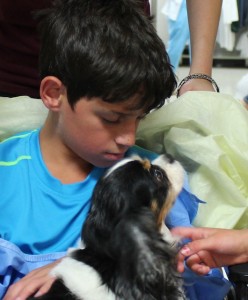
And here’s a video from the DVD of Tootsie’s first visit to a facility. We used her (and Willie and 3 other dogs) to evaluations of  potential therapy dogs. (Tootsie passed, Willie… no surprise here, does not: too enthusiastic). This video segment is testing for one of the most important qualities of a good therapy dog — sociability. Dogs need to be interested in everyone, true social butterflies, but calm and respectful at the same time. Watch how Tootsie tells us where she’d most like to be…. (and feel your oxytocin levels rise?). Thanks to Beth Viney, the Director of Pet Pals in Madison WI, Dr. Linda Sullivan, and Pet Pals volunteer Diane Peltin and Ruth Trameri for helping with the evaluation section of the video, we all had a great time and it resulted in some very instructive (and, I might add, amusing) videos.


Yup, Dogs Can Be Disgusted!

Tuesday, November 29th, 2011

Well, it seems appropriate now to talk about disgust after a weekend of gluttony. (But what fun cooking paprika chicken and pot roast and roasted brussels sprouts and home made bread and pumpkin and cherry/raspberry/rhubarb pie. Not to mention eating all the turkey that others cooked and I ate up as if I was starving.)

It’s been interesting reading about whether dogs people believe that dogs can experience disgust. Recall that 66.2 % of seminar participants said yes, and 78.3% of blog readers who responded said yes (this may have changed as later responses came in, but not significantly). (The Morris research listed only 34% of people responding yes, but a blog reader commented wisely that the question wasn’t “Can your dog…” but “Have you observed your dog experiencing disgust.”)

But here’s the deal. Disgust is perhaps the most basic of all emotions. Disgust, or “an aversion to something offensive,” is seen in all mammals, most often in response to a smell or taste that is aversive for some reason. Our expressions of disgust are similar across species, as Darwin noted in The Expressions of the Emotions in Man and Animals. Here’s is a more current illustration of that from Youtube:


Disgust is registered primarily in the Anterior Insula of the brain, an area that is active both when one feels disgusted and when one views a disgusted expression on the face of another. Because of its close association with the sense of smell, disgust has been postulated to be the “first emotion,” designed to prevent the ingestion of dangerous substances. However, I was surprised to find very little about disgust in Panskepp’s classic book on emotions in animals, Affective Neuroscience. In spite of that, I know of no biologist who argues that other mammals don’t experience disgust on a basic level.

Of course, what is perceived as disgusting is both species specific (the stink of fox poop not being a human favorite) and culturally transmitted. Not surprisingly, this  is especially true of food: for example, some cultures find big, fat juicy insects and their larvae highly palatable and others, not so much. There’s an interesting article in Time Online about the research of Andrea Morales and Gavan Fitzsimons who found that just being next to something perceived as disgusting made an item less attractive (ie, don’t try to sell cookies next to Kitty Litter at the supermarket.)

That brings to mind a seminar I did in Canada in which the host hotel thought it would be a hoot to serve the chocolate pudding desert in the shape of dog feces. Seriously. It looked exactly like poop sitting on a white plate. They were actually surprised that no one ate it, but not as surprised as we were that they did it in the first place. We all laughed, and then looked at each other with somewhat stunned expressions on our faces, and pushed the plate away.

It also reminds me of John Rogerson’s technique of inhibiting dog-dog aggression by throwing a bag of dog feces into the face of the offending dog. I’ve never done it, but I’ll bet it would absolutely get a dog’s attention. Of course, some dogs eat feces, but I doubt they’d enjoy poop-in-the-face. Personally I’d rather not use it as a training technique (pretty negative for the person too), but I have thought it would be a great last ditch tool if you were walking down the street with a bag of poop in your hand and a dog charging at your reactive dog.

This all gets me thinking about the use of ‘disgust’ in behavior modification. You all know I’m a positive trainer, but that doesn’t mean that I wouldn’t suggest someone use something aversive to prevent some behavior problems if the solution is humane. I’m thinking about Bitter Apple for example: I just sprayed a plant with it to prevent Tootsie from chewing on the leaves.  But what about an aversive scent versus taste? Any use for that? I’ve seen commercial products that are supposed to keep dogs out of plants, etc, but frankly I’ve never seen them work very well. You?

Here’s another great example of the expression of disgust, by the way, sent in by a reader from Europe of her Pap at a show after being forced to be in cold, wet grass and then touched by a judge with cold, wet hands. Thank you Ute for sending these photos, they are great!


MEANWHILE, back on the farm: Willie’s shoulder is as good as it’s been since the injury last February. He is allowed to run around outside for brief periods with no hobbles and longer ones with the hobbles. Great news is that my adrenals are now getting used to seeing him running around, so I don’t suffer from cortisol toxicity every time I see him run anymore! He is not a fan of the treadmill now, he came out of it yesterday and sniffed the floor of the room for a full three minutes before acknowledging me or Courtney. But it’s helping him, so I sympathized, gave him lots of cuddles when he did come over and then told him to suck it up.

Tootsie continues to make tremendous strides. I am so proud of her. Her recall is coming along beautifully, and I can now take her up into the pasture and keep her from hysterically and desperately eating as much sheep poop as it is possible to cram into her mouth. She gets lots of more appropriate treats and is actually spend time sniffing around the grass, apparently interested in something besides gobbling up sheep poop as if she was starving to death. And for one brief magical moment, Willie and Tootsie actually sniffed each other at the same time a few days ago. Will wonders never cease?

This is the Video to go Viral!

Friday, April 22nd, 2011

Happy dog, happy baby, happy Easter and spring weekend, everyone:


“Guilty Dog” Viral Video

Thursday, April 14th, 2011

Have you seen it, the viral video of a “guilty” dog? A yellow lab sits hunched in a corner while his owner asks if he’s the one who got into the bag of kitty treats. The dog turns his head away, squints his eyes (not in a happy way I would argue) and after considerable prompting (or pressure), looks “guilty.” Except, the “guilty” look is actually a perfect example of what is called a “submissive grin,” used to appease another higher status individual. Most biologists call this an example of “active submission,” in which an animal is attempting to increase the distance between it and another member of its social unit. (Versus “passive submission” which promotes a decrease in distance; for example, lying down and exposing the anal/genital regions.)

I know that “submission” is not a popular term at the moment, but whether you call it appeasement or submission, surely it’s clear that the dog’s expression has nothing to do with guilt. (I first capitalized “nothing” but then changed it because it looked like I was yelling.  But okay, honestly, I was.)

Is it just me? Am I just being finicky, but I can’t even watch this video to the end. Have you seen it? I’m so curious to hear what you think. Here it is:

MEANWHILE, back on the farm: Spring!  I have to cherish it in small, tiny moments, but they are exquisite ones. I can’t find the words to express what it feels like to see color after a long winter of black, brown and white. And Spot had her lamb, a beautiful, white ewe lamb. (But just a single? Jeez, Spot, you are fat as a tick! I was sure there were at least 2 in there, and now I see you’re just fat!)

Here’s some oh-so-welcome color:

Willie’s Exercises & Honoring Your Dog

Wednesday, April 6th, 2011

This video tape of me and Willie doing his exercises reminds me how important it is to “honor your dog.” (I think that is originally Kathy Sdao’s phrase, and I just love it.) The video shows us doing two exercises, “Flex” and “Paw,” both designed to strengthen his shoulders before the surgery. We first began doing one set of 10 reps each with very short durations, about 2 seconds max, and have worked our way up to 10 seconds duration for the first set and 5-6 seconds for the second set. But the therapist warned me to watch for signs that we were pushing it too far, and those showed up recently, which we caught on video.  Watch the video first, then I’ll tell you more about it. It’s a little under three minutes. We cut out about 30 seconds just to keep it short, I’ll describe more about what is happening after you watch:

Now, watch it again, paying attention to how he holds his leg back at second 34.  I wondered if that was random, but also whether it was a sign he was becoming uncomfortable. So when, at second 48, he refused to “Flex,” I felt sure he was trying to tell me something. (I should mention that he has seemingly enjoyed these exercises and offered lovely “flexes” over and over again a few days earlier.) So I asked for it again, but decreased the duration considerably, giving him little breaks in between as well. At second 125 he raised his paw (our next exercise) when I asked for a Flex, which I’ve learned to interpret as “Can we move on?” I suspect it is not because he’s bored (a possibility though), but because his shoulder is hurting. So we did one more very short one, and then quit. You’ll notice an edit at second 146; all we cut out was one more 2 second flex (as well as some later “paw raises,” just to keep the video from being too long.)

MEANWHILE, back on the farm: Eight lambs and counting! All the ewes are late, but Dorothy had twin girls Monday night, and today Lady Godiva and Brittany had their lambs (Lady G twin girls and Brittany one little boy–still wondering if there is one more in there, come on, Brittany, have twins!).  That makes 7 ewe lambs and one little boy. Gonna have some slumber parties for the girls… are there sheepy chick flicks?!

Willie and I just visited his physical therapist (Courtney Arnoldy at UW Madison Vet School, fantastic woman) and we have an entirely new set of exercises to do. Gotta go get some equipment before we can get started, but I’ll do that tomorrow…. And just when we were mastering the other ones (but they will come in handy, it’ll be great to be able to ask him to pick up each paw… boy is training making his exercises easier! Especially useful are Wait, Get Back, Paw, Touch. (He knew “Take a Bow” but Flex is new, is different than a bow.). Now if someone would just make me do my exercises . . .

Dogs, Devotion and Japan

Friday, March 18th, 2011

Many of you have seen the video below, but for those of you who haven’t, here is a reminder that it is not just the people of Japan who are suffering. I don’t want to break your hearts, and don’t pretend that this is easy to watch, but I hope it does inspire some to do what they can to contribute to aid and rescue efforts in this horrific disaster.

Even as Jim and I have been in New York City, and now Chicago, enjoying, almost guiltily, the stimulation and ridiculously easy access to amazing food, I have been obsessed with information about the disaster in Japan, and can’t seem to tear myself away from the news channels. There is so much to think about here, but one of the things, related to this blog, that comes to mind is the progression of reporting, in disasters like this, from a focus on people and their suffering to including that of non-human animals. It makes all the sense in the world to focus first on people–I do the same myself and can’t  imagine it any other way. But I have to admit, that as soon as we heard about the earthquake and tsunami, I thought oh god, how many thousands, tens of thousands (millions?) of animals died, and how many are left now and are suffering?

I remember watching the news about Katrina, and wondering when the first story about the suffering of non-humans would show up. If I remember right, it was somewhere around day three. So far, the only report I’ve seen about animals in Japan is the now famous video below, but I am sure that’s not all that is out there, and I suspect that the nuclear crisis, which has us all on pins and needles, is dominating the news. Somewhere here there is an interesting issue about our devotion to and relation to all living things around us, but right now, all I want to do is hope and pray, send what help I can and keep the people and animals of Japan in my heart every moment.

I can’t write much now (no internet where I’m staying right now in Chicago), but here are some sources for donations if you are able in any way to help. I have read that donations are relatively low compared to other disasters, perhaps because people see the Japanese as so self-sufficient, but I can tell you that without a doubt this disaster is beyond the means of any one country. If you can contribute, I hope you would consider giving donations for both the people and non-human animals of Japan. Here’s a good source for animals, with 6 different sites listed:

Six ways to help animals in Japan.

And for people you could consider: Mercy  Corps Save the Children or the Red Cross Japan.

And here’s a link to the video, get out your hanky. It’s on Steve Dale’s blog, a good one to check out.

Dogs in Japan

[One additional note: As a scientist, I have to say there are several explanations of why the healthy dog is staying with the injured one, but I'm leaving that for a later discussion. Here's the good news: the dogs were rescued. Here's hoping their humans are alive and well, and that they are re-united or find a new, good home.]

We All Need a Laugh

Saturday, March 12th, 2011

I’ll grant this is as much for me as it is for you all, but I imagine I’m not the only one who could use a good laugh around now. You may have seen this already, and you may have mixed feelings about putting animals in the place of humans . . . but, oh, oh, did I laugh at this video!

Anyone know much about it? Meanwhile, enjoy! (I tried to upload the video itself, but the file is too big, so I’m stuck with just providing a link… (although on preview the video played directly, hope you can see it!)

It does bring up an interesting issue which we’ve been discussing in my UW class: that of putting animals in the place of humans for the sake of humor (or making ourselves feel superior?). I’m normally not a fan of such practices, it just doesn’t make me laugh at best, and sometimes it is offensive (sunglasses on Orca whales for example), but the video above had me in stitches.

MEANWHILE, back on the farm. We had a typical March snow a few days ago, the kind I always enjoy because they are so pretty and melt fast. The weather has warmed up a lot since then, and it’s beginning to seem possible that there really might be such a thing as spring. Hard to imagine right now.

Willie is beginning week 4 of life in the crate or on a leash. I won’t belabor it, but it’s no fun for anyone. Hardest on me and Jim, besides feeling heart sick that we can’t explain to him why his life has become so boring, is trying to avoid any movement that might stress his shoulder. Those of you who have been there understand. Some dogs are easier to restrain than others, and I’m afraid Willie is about as hard as a dog can get. But we have our UW appt in a week and a half, all paws crossed, and our house sitter is a vet student, super reliable and dedicated. Whew.

Jim and I get a break, lucky us, we’re going to New York City for a few days. Whee! I have a few meetings, but mostly we’ll be acting like tourists with some good friends. Then it’s back to Chicago for Clicker Expo, which I’m truly looking forward to. I’m speaking Saturday night after the banquet and giving the closing talk Sunday afternoon. On Saturday I talk about Canine Cognition, and on Sunday I’ll be talking about emotional, and why we love dogs so much . I’ll have to get out my own hanky, cuz I’m feeling pretty gooey about Willie right now.

Here’s a photo of the snow from a few days ago:

Pictures of Cardinals in the snow are so trite, but if you’ve been living in black and white for 5 months, I can’t tell you how gorgeous they look!

The Model-Rival Method

Wednesday, January 26th, 2011

I mentioned “The Model-Rival Method” earlier when talking about training dogs to associate words with objects, and I thought it’d be fun to illustrate what I was talking about. The video at the bottom of the post is an example of this method, famously used by Dr. Irene Pepperberg to train Alex the African Grey Parrot to label a large number of objects, materials, colors, etc. It was originated by the European scientist Todt, in contrast to the “Skinner Box” kind of training in which a parrot got a food treat from a mechanized box for vocalizing something similar to the sounds being played by loud speaker. Using that method, American behaviorists had concluded that parrots “can’t be taught language,” but Todt noted that it had little relationship to how our own children learn language. He criticized such a model as being a less than conclusive test of the cognitive abilities of parrots and suggested what he called the “Model-Rival” method. Dr. Pepperberg was intrigued by his argument, and set up training sessions using this method.

The training included 2 people and Alex, with one person being the ‘trainer’ and one being the ‘model’ as well as the ‘rival.’ I’ll describe a sample session as including Irene, Alex the parrot and a woman named Julie (I made that name up.) The term model is used to describe the technique because one person models what they want to parrot to do. In Alex’s case, the goal is to get him to say the word. For example, Irene would hold up an object and say  “Julie, what’s this?” and Julie would answer “Crayon.” Irene then handed the object to Julie, who got to handle and play with it (thus, the human trainee is also a rival of Alex’s, because they got to play with the object but Alex did not.)

Last year I tried using a standard operant conditioning paradigm with Willie to teach him to label objects, putting down 2 toys and clicking and treating if he went over and nosed the ‘correct’ one. Willie not only was NOT able to make the distinction between the sounds I was making and the 2 objects, he became so stressed (presumably) about  not knowing what he was supposed to do, he shut down. I quit after a few weeks because we were getting nowhere and Willie looked too miserable to continue. He seemed to want very much to get the game, but he couldn’t figure it out.

After reading about Chaser and his 1022 labels for objects (see my post on January 11th, 2011) I decided to try to teach Willie the names of objects in a more natural way. For about a week Jim and I used the word Scorch for his scorpion toy (a favorite, and still, amazingly, in perfect shape after how many years?). We’d toss it around, hold it up, saying Scorch as often as seemed possible. But after awhile I started thinking about the Model-Rival system, and have starting giving it a try. I’d love to tell you, after about 10 days of training, that Willie has it down pat, but he doesn’t, at least not once we added in a second name for a second toy. After about 5 days he would reliably go get the scorpion when we said Scorch 100% of the time, even if there were several other toys around , but once we added in a second toy his response fell apart. That’s not surprising, and that’s what we’re working on now, understanding that Scorch means scorpion, but Pony means the stuffed pony. You can see where we are in the video below (in which Willie boy is extremely distracted by a parked car outside and the camera especially).

By the way, out of curiosity I checked online and there is a published paper that compares the model-rival method and operant conditioning method for training domestic dogs that came out in 2003 in Applied Animal Behavior Science (by McKinley and Young). There are some pretty significant issues with the methods: they ask the dog to label any of 3 red objects as “socks” and any of the 3 yellow objects as “cross.” I’d then argue that the test is not about labeling an ‘object’ but a color (and red is not a color dogs see well). That’s a very different exercise than matching a word to an object, but granted their intent was to compare the efficacy of training methods, not so much what was being trained. Their conclusion was that the model-rival method was as effective as operant conditioning, and their conclusion is that this is a method that might be used more in dog training. The sample was small and I think there are some confounding factors, but still, very interesting stuff.

Note: You’ll notice that once I introduce Pony I say this is a “test” but then switch to saying this is “training.” I’m trying to use the same kind of method we’d use with a child, so once Willie doesn’t do what is expected (and doesn’t ‘pass the test’), I help him to do the right thing. And I’ll talk later about another issue, the potential that I, or anyone, could be inadvertently cuing their dog to the correct object…., but for now, my objective was to illustrate Willie’s progress and demonstrate the Model-Rival Method.