Welcome to the official Patricia McConnell website. Skip directly to: main content, navigation, search box.

Archive for the ‘why we love dogs’ Category

The Black Dog Syndrome – Fact or Fiction?
Friday, January 18th, 2013

We all know about the “Black Dog Syndrome,” the belief that all black dogs are harder to place from shelters and rescues than dogs of other colorations. I’ll admit that when I first heard about it I didn’t question whether it was true. For one thing, when I bred Border Collie puppies I saw a strong bias for pups with white on them and against all black pups. Every once in a while a buyer would tell me that they especially loved the looks of the “plain,” all black pup, but they were the exception, not the rule. The second reason I assumed the Black Dog syndrome was true was that so many people in shelters told me they experienced it at their facility, that indeed, in their experience, all black dogs were harder to place than others.

However, I just read an interesting blog on the ASPCA site about the issue, written by Dr. Emily Weiss. In it she recounts the result of a study done by PhD psychologist Lucinda Woodward et al, and published in Society and Animals in early 2012. In summary, they found that breed had a significant effect on participant’s perception of the dogs, but color did not. As a matter of fact, in a study looking at breed versus color effect, black labs were rated as significantly more friendly, less dominant and more submissive dogs of dogs of seven other breeds, with only the Golden retriever rated more highly. (The breeds were: Border collie, Boxer, German shepherd, Golden retriever, Black Lab, Pit bull, Standard Poodle and Rottweiler.)

This is not surprising when you think of it, given that black labs are the most popular breed in the U.S. last I looked. (Which in itself should give us all pause about the “black dog syndrome.”)

In addition, in a related study that focused on color and size in just one breed, all black poodles were judged to be friendlier than all white ones (and small white poodles were categorized as the least friendly!). These results suggest that color might not be as important a factor as we have assumed. Rather, the fact that so many black dogs hang out for long periods in shelters may be attributed to the fact that there are simply more of them.

Clearly we need a lot more research on this topic. Although this study is interesting, and I would argue important, in that it gets us into a conversation about what makes dogs attractive to people (which could help shelters place more dogs), it is just one study. It’s conclusions are indirect: just because a group of people rated some dogs as more friendly than others doesn’t mean they would necessarily adopt them from a shelter. But it is a good start.

I have two questions I’d love to ask of you: One is directed to shelter and rescue workers: What is your own experience? Think hard about the relationship between breed, size and color, related to the number of dogs that enter your care and the number that go out. I’d love to hear your thoughts. Secondly, what about you? I’m getting personal here: Do you have certain colors of fur that you like better? I do, although it feels almost shameful to admit it. I hereby admit to liking some colors better than others. For example, I was hoping for a Blenheim Cavalier when working with Cav rescue groups, and I admit to really, really wanting one. I just love looking at that particular color pattern. And then Tootsie showed up and was friendly, and sweet and cuddly and no one else seemed to want her and how could I possibly pass her up because she didn’t look exactly like I wanted her to? Of course I did adopt her, and I’m glad every day that I did. This morning I laughed out loud watching her ears flying as she ran to the barn. But I still admit that some  colors make my eyes happier than others. Anyone else willing to admit to same?

MEANWHILE, back on the farm: Most of the snow is gone now, and what remains is patchy, frozen solid and difficult to walk on. It’s not very pretty, but more than that, the snow that remains resembles slippery cement more than anything else, and I worry about Willie’s shoulder on a daily basis. His “slow down” cue comes in handy here and I probably use it 20 times a day. Then again, I expect I’ll be asking Willie to slow down until the day he dies.

The good part about the snow having partially disappeared is that the upper pasture, which is in full sun all day, is now completely clear, so Willie and I got to work sheep for the first time since November. We had great fun, but I found I needed to remind myself to tell Willie if he was right or wrong, rather than telling him what to do. Old habits die hard, hey? The bad part about the snow melt is that it is supposed to get bitter cold in a few days, which will be hard on the plants without an insulating cover of snow. Not to mention that my desire to be outside wanes as the thermometer goes below zero Fahrenheit.

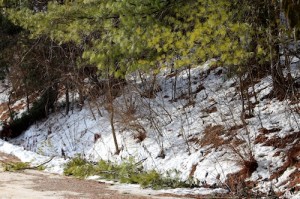
Here’s an area beside the driveway that gets some sun during the day, but only a few hours worth. Not especially scenic, but then, it’s not always a calendar cover out in the country.


I played a bit with my new camera this morning. Here’s Mr. Willie helping me out. I changed the auto focus to focus only on the center point, and not to average all the focal points as most cameras do unless you set them differently. I like the results, although it looks to me as though I focused more on the middle of his face rather than his eyes. Gotta work on that.


By the way, speaking of pictures… check out Facebook next week when we post the 5 finalists for the “Take the Pledge” contest. Here’s Willie taking the pledge to be a good, good dog in 2013!

Helping a Dog Through a Loss

Tuesday, August 28th, 2012

This is Part II of our case study about helping a dog after a loss (see August 24th blog for Part I). As usual, many of you came up with  insightful and helpful comments. I benefit from your thoughtfulness every day, and I thank you for it. If you are interested in this topic, either personally or professionally, I encourage you to read the first post about Dogs Grieving as well as the comments.

Here are some of my thoughts and comments about the most important things to do if a dog is behaving as though he is grieving a loss:

1. ACCEPTANCE. Easiest to say, hardest to do. By “acceptance” I mean accepting that you couldn’t prevent the death or disappearance of another, and that you can’t ‘fix’ the pain that your living dog may be going through. If your dog is truly grieving (and I think some do, more on that later), it helps greatly to understand that you can’t really ‘fix’ it, anymore than someone else can make your pain go away when you are grieving. Yes, others can help ease the pain, and soothe and support, but no one can do what the griever wants–which is getting their friend back. What does help many of us is acknowledgement that the pain is there, and I suspect that might also be true of dogs. I realize that some do not agree, but my experiences suggest that some dogs really do grieve a loss in ways similar to humans, and perhaps finding some way to acknowledge that, without trying to ‘fix’ it might be helpful.

Now I suspect that some of you really are going to think I’m crazy, but one way to acknowledge it is to talk about it. Will your dog understand what you are saying? Nope, not in the sense that a person would, but just saying the words has an impact on your behavior and emotions and perhaps that has an impact of our dogs. I’ve heard many stories of dogs changing their behavior after someone sat down with them and said “Chief is gone and won’t be coming back. I am very sad about it and I think you may be too.” I know, I know, I can see folks shaking their heads, but I don’t think it matters that much that your dog understands the words, or even the concept of death. There’s just something about giving voice to an emotion that, just perhaps, might help a dog sort out his or her own confusion over what’s happening.

2. ALLOW YOURSELF TO GRIEVE: I agree wholeheartedly with many of the comments that if you are sad your dog will know it, and I don’t think it’s good to try to hide your grief from your dog. That said, I did ask Cin about how much she’d been crying around Sleeve, because I’ve had clients whose dogs appeared to be overwhelmed with their owner’s grief. This is a very tricky line to walk… not trying to hide your own sadness around your dog, but being aware that, perhaps like children, dogs can be extremely sensitive to your suffering and feel powerless to ‘fix’ it themselves. For myself, for what it’s worth, I’ve found that for the first few days after losing a dog I am not capable of taking care of much of anything. I’ll spend time alone, time with closest friends and time with my remaining dogs, usually very quiet and in a kind of a shock. I think dogs need something similar to what we need, gentleness, caring concern and time time time.

3. STICK WITH ROUTINE OR CHANGE IT UP? I suspect that time is the answer to the question of which is better, “Keep things the same,” or “do new things”? Reader’s comments from last week, as one of you so observantly noted, were about equally split between “keep up the usual routine” and “add new things into your dog’s repertoire.” Early on (the definition of which is, of course, extremely variable depending on the dog), I think it’s important to keep things the same as much as you can. Perhaps for the first 3 days, or 3 weeks…? Let your dog grieve, be kind and gentle and as “there” for your dog as you are capable of. However, at some point I’ve found it very helpful to create new routines. Do things with your dog that aren’t triggers for “But where’s Chief?” Surely every context and activity that used to include the deceased dog is a reminder that he or she isn’t there anymore. So I’ve advised clients to take walks in new places (if the dog enjoys them), teach new tricks, perhaps meet new doggy friends if that is something your dog might enjoy. I always like to add Nose Work in for any needy dog, given that it’s the nose that defines a dog’s understanding of the world, and their way of finding their place in it. Many dogs seemed to be thrilled that we have caught on to their ability and want to play too, or at least that we are giving them a chance. And it’s something you can do with dogs of any age, even if they are geriatric and slow moving.

I make this recommendation in the belief that it’s important to be aware how powerful classical conditioning is, and how our emotions & expectations can be influenced by environments and actions. I remember flying for the first time after my father had died. It had been many months, closer to a year, and I frankly hadn’t thought about him in quite awhile. And then I got on the plane and began to cry, because every time I’d ever been on a plane my father had been alive. Flying had nothing to do with him directly: I didn’t fly with him or associate him with planes in any way. It was just the confluence of two events that hit my emotional brain like a rock. These systems are profoundly primitive, and there’s every reason to believe they function in dogs in similar ways to the way they function in us.

4. EXPECT ANYTHING OR EVERYTHING. I’ve seen dogs react to the death of others in just about every way possible. Lassie sniffed Mist’s body and walked away as if she’d sniffed an old shoe. But when Tulip died, she paced around her body in circles, finally lying down beside Tulip with her head on the ground. Lassie’s father, Luke, paid no attention to another dog’s death at all. When I finally encouraged him to sniff the body of Misty, he snorted and startled backward like a frightened horse. I’ve seen and heard about dogs who seemed to pay no attention to either the absence of a dog or its body. I’ve seen and heard about dogs who reacted by not eating for days, sometimes weeks. There are a few things to keep in mind here: a) just because a dog doesn’t visibly react doesn’t mean we know they are not ‘reacting’ emotionally and b) not only is every dog different, but his or her relationship to any other dog varies greatly. Lassie was truly relieved when Misty died, appeared to be distraught when Tulip died and devastated for months when her father died.

What’s important to remember is that there is no “right” in how your dog responds. Accept it (ah, there’s that word again!) and go from there.

5) WHAT IF MY DOG WONT’ SNAP OUT OF IT? If a dog stays quieter than usual, has little appetite and/or has no interest in social interaction or play after several weeks, it is probably time to make an effort to change his emotional state. Long walks are truly therapeutic for dogs as well as people, off leash ones, if they are safe, are absolutely best. New experiences, as mentioned earlier, can be very helpful, as well as new play partners or companions.  Don’t get a new dog for your own home if you don’t want one yourself, but there’s a long list of dogs who perked up when some playful little cutie entered the house. (And a list of dogs who hated it, so be sure you know your dog!)

You are always wise to consult a veterinarian if your dog seems listless for an extended period of time. It is possible that the change in behavior is correlated in time with the death of another, but not due to it. If there is not treatable medical or physical cause, you might consider adjunctive medicine if there is a well-trained practioner in your area.

6) LAST BUT NEVER LEAST: Take care of yourself as if you have just had surgery. Your brain thinks you have. See my post Love, Guilt & Putting Dogs Down for more information about how your brain processes pain and grief as similar things. Once I understood that fact (thanks to the brilliant neurobiologist Jaak Panskepp), I’ve learned to treat loss as if it was a serious injury–with gentleness, care, compassion, and the understanding that time is the best healer of all. Good advice for our dogs too, yes?

And what do we do for people who have had surgery? We bring them food and flowers. Since I can’t deliver strawberry/blueberry pie to all 24,000 of you, here are some flowers. I think I’ve already posted this picture, but it made me happy to look at it. I hope it does you too.


First Case Study – A Grieving Dog

Friday, August 24th, 2012

Lots of you liked the idea of doing some case studies, as well as reviewing and discussing photos and videos. I think it’s a great idea, so here goes our first one:

Here’s Sleeves on the left, and Patch on the right. I’m sad to report that Patch died just last week and her sister Michaela died only a month ago. All three of them, “Boonie” dogs–or mixed-breed dogs as they are called on Guam where they were born, were raised together and were litter mates. The litter lost their mother at 4 weeks, and owner Cin bottle fed them and raised them together.

Brother Sleeve appears to be devastated at the lost of both of his litter mates in such a short period of time (not to mention poor Cin, the owner).

Sleeve appears to be grieving, and is described as “so sad” by Cin. Usually this means that the dog is atypically quiet, inactive, and has what we think of as a sad expression on its face.  I don’t know if he’s eating well, but I’ve had several cases where dogs lost their appetite after the death of a buddy. I have no doubt that Sleeve is indeed struggling with this profound change in his life. Cin has told me she has tried to do her crying away from Sleeve, but is sure he is aware that she is grieving terribly herself. It is, of course, hard to know how much of Sleeve’s behavior is a response to Cin’s grief and how much is his own directly, but the latter seems to be key, given how bonded he was to the other two dogs.

Cin describes Patch as a “determined and confident spirit” who “took care of everyone.” When Michaela died Patch stayed with Sleeve and refused to leave him, not in the sense that she needed him, but that he needed her. She was always in charge, always active, smart and funny. Without her Sleeve appears to be lost. (Cin admits to feeling the same way: Patch was her “heart dog.” Poor Cin, my own heart goes out to her.)

Here is Cin’s question and my question to you: What can she do to help Sleeve? How does any of us help a “lost” and grieving dog? I’ll add my answers to your comments on Monday, but will start by saying there is some advice that is generic to all situations, and some that requires more information from an owner. If you agree, what more would you want to know from Cin? You can ask her in the comment section.

I’ve chosen this as a case study because it is a relatively common question that we get here at the office. Besides helping Cin (who graciously agreed for me to use her dogs as a case study), we can help many other dog owners too.

MEANWHILE, back on the farm: Hot and dry again, in spite of some of the recent rain, we’re still classified as in a severe drought, and you can see it easily in the crops and pastures. It’s time to start watering in the yard. Argh.  Even the trees look stressed, and it’s terrible for them to go into winter in bad condition. The pasture was coming back a bit, but it looks rough again and I am keeping the sheep off of it for now. Back to feeding hay.

Willie and I had a heavenly time at a friend’s on Tuesday night working sheep in a huge, perfect field, with a backdrop of woods, fields and a break-your-heart sunset. We’re getting ready for our first “big” trial coming up, where the outrun will be a 200-300 yards and the drive panels a dauntingly long way away. The fact is we truly aren’t competitive at this level yet, but I think Willie is far enough along that that the trial won’t set him back. I may have to crawl away from the post because of bad handling, using rapid fire whistles to keep the sheep straight on a cross drive is truly beyond my skill set right now. My ability to handle a dog on a cross-drive is, uh, low and there’s just so much practicing I can do. My friends said it didn’t look as bad as it felt…seemed to me that the sheep zig zagged around the course like drunken monkeys. But it’ll be harder in a real competition. I’ll ask Jim to tape us when we run if you promise to laugh at us quietly and gently.

Tootsie is in heaven because the wild plum trees are dropping fruit. The ones lower in the valley have little fruit because of the warm spell and subsequent deep freeze, but one tree higher behind the house is prolific. Tootsie thinks finding little squishy plums in the grass is like manna raining from heaven. Obviously, there’s just so many I allow her to eat, but for brief moments of gobbling she thinks she’s gone to heaven.

Here’s heaven for me: Our CSA allows members to come pick 10 lbs of Roma tomatoes which we and guests did on a cool, sweet Saturday morning. I sliced them in half, drizzled on olive oil, sprinkled them with fresh Basil and cooked them at 325 F for about 2 hours. They condensed down into a sweet, intense tomato-ness that is amazing in pasta, quiches or even as a side dish all by themselves. I freeze them in layers and take them out all winter when needed. They go a long way toward brightening up a cold, bleak winter’s day!

Here’s what they look like before they go in the oven:


Here’s what they look like when I take them out. They are super sweet, intensely flavored and add a wonderful kick to just about anything, except maybe a chocolate bar. You can’t really tell from the photo, but they are now very thin and flat, probably have lost about 2/3 of their mass, mostly from moisture no doubt.


Do Other Animals Keep Pets?

Friday, August 10th, 2012

A colleague just sent me a link to one of my favorite science and behavior blogs, that of Harold Herzog, the author of  Some We Love, Some We Hate, Some We Eat: Why It’s So Hard to Think  Straight About Animals. I use his book in my University class, The Biology and Philosophy of Human/Animal Relationships,” because the author is thoughtful, knowledgeable and one of those rare scientists who writes beautifully. If you find the topic interesting and haven’t read his book yet, pick up a copy. I highly recommend it.

The book includes a section on pets, and his recent blog addresses that issue as well; in this case, whether a video-gone-viral about “Baboons Keeping Dogs as Pets” accurately depicts the relationship between individuals of these two species. If you haven’t seen it yet, the video is included here, but before you watch it I want to give you an alert. Or a warning. The video begins with a male Hamadryas baboon grabbing a puppy by the tail and dragging it, squealing and screaming, across a bumpy field of rocks. It’s not fun to watch, and if your empathy quotient is set on “super sensitive,” just skip the first two minutes and watch the rest.


There are two issues here that I find especially interesting and thought would be interesting to you as well. One is the obvious question: Do baboons really keep dogs as pets? And even more interesting I’d argue, do any animals other than humans keep dogs as pets? Herzog has gone on record that, in spite of the exceptions of some captive animals like KoKo the gorilla’s pet cat, and the YouTube sensation of a grieving orangutan who formed an inseparable relationship with a hound dog, there are no credible records of any wild animals actually having what we would call a “pet.” If you’re interested in this dialogue, I’d read Herzog’s blog about the baboons first, including the comments, then come back here.

There are a lot of valuable nuggets of information in this article, in part because of Herzog’s dedicated attempt to discover the truth behind the breezy assumptions of the documentary from which the video was taken (Animals Like Us). Because the baboons and some dogs live in association in a garbage dump, and because the baboons sometimes groom the dogs, it is assumed that the baboons “steal” puppies with the intent of keeping them as their pets. But how do we know why the baboons grab puppies? If you watched the beginning of the video, you’ll have noted that the baboon licks the puppy’s anus before releasing it. Why? Familiarizing itself with the pup’s scent? Looking for lunch? Maybe baboons like poop as much as dogs do. And why is it only male baboons that do the “kidnapping?” I find that fact one of the most interesting of all. Usually it’s females that first keep individuals of another species around to comfort and be comforted by.

The question of what is happening in this particular troop of baboons is interesting enough. However, it brings up the larger question that I asked above: Do animals other than humans keep “pets.” First and foremost, I’ll argue, we have to define what we mean by pet, and already the waters get murky. Standard definitions of “pet” are “any domesticated or tamed animal that is kept as a companion and cared for affectionately” (Dictionary.com), and “a domesticated animal kept for pleasure rather than utility” (Merriam-Webster Dictionary). Herzog himself defines a pet as a member of other species that are being kept for an extended period of time, for enjoyment.

Of course, “enjoyment” can mean many things. We call a dog kept in a small kennel in the back of someone’s yard a pet, even if it’s only taken out during hunting season. We call the dogs of others who live in the house, sleep on the couch and have their own acupuncturist pets too, yet their lives, and their “purpose,” are significantly different. On the one hand, both of the animals are being “kept for enjoyment,” one because the hunter presumably enjoys hunting and the other because of a close social connection. On the other hand, the key to “petness” and “non-petness” appears to be “utility” versus pleasure, yet the kenneled hunting dog appears to be kept primarily for utility.  Thus, when asking if other animals keep pets, it’s useful to remember that the concept includes a wide range of relationships in our own species.

Perhaps one perspective when asking if non-human animals (in the wild) ever keep “pets,” is to look at the evolution of pet keeping in our own species. Surely our first, close relationships with other species weren’t for the pure joy of petting their fur. How much was utility and how much pure “pleasure?” I’d guess those things weren’t particularly black and white.  And our relationships still vary widely. In many areas of Africa now, a Masai village for example, dogs live in close association with people, but I doubt they would fit the definition of a pet. The only time I ever saw one “petted” was when tourists asked about the dog, and a Masai grabbed one and posed for a photograph. Believe me, the dogs did not look like they were enjoying themselves. When I asked, the Masai told me they had the dogs because they barked when lions approached the edges of the thorn fence that enclosed the cattle and the tribe at night. When I asked them, one at a time, if it was “their dog,” each individual said yes, it was “their dog,” although none had a name for the dog and the dogs did not come when called.

I’d love to hear your thoughts on this topic. Clearly all I’ve really done here is asked some questions, not answered any. But that’s part of the fun of being a human, right? A few starter questions: What makes a dog a pet? What is the boundary line that makes a dog absolutely not a pet? Have any of you seen anything you’d call “pet ownership” in one of your own dogs? Horses?  (Here’s a key question: What’s the difference between 2 individuals who are socially bonded, and one being the pet of another? Clearly it is something related to autonomy, and who feeds and takes care of who, but how clear is the dividing line?) Here’s another blog post on Primatology to whet your whistle….

MEANWHILE, back on the farm: Rain! More and more of it. Not a lot, about a quarter inch two days in a row on the farm. We’re still a good 8-9 inches behind average, being in a seeming rain shadow and getting significantly less rain than just five miles away. But the grass that wasn’t killed is growing, the sheep are on pasture instead of hay right now, and I’m no longer dragging huge, heavy hoses around every day. Even better, Willie and I are working sheep every day. Last night we drove the flock up into the “high pasture,” and I split out a few to practice driving the sheep in a straight line away from me. (Like any sport, it looks easy when the pro’s do it, but in reality the sheep want to go right, then left, then right… my lines look more like big zig-zaggy zippers than straight lines, which is why I need to practice so much.)

The small group we split out to work on included a lamb who’s mother was in the other field. The draw to mom was much stronger than the pull to the rest of the flock, and lamb-boy kept Willie on his toes, repeatedly trying to dash away and run off to mom. Willie had to turn on the speed to stop him over and over, and yet he never lost his temper and threatened to bust in. Good boy Willie. This morning he had another test: Lady Godiva was not interested in moving where I wanted her, and continually took her two lambs away from the flock and attempted to dash back to the barn through the woods. She wanted to go right, and the rest of the flock wanted to bolt left.  I needed them somewhere in between. When Willie ran around to stop Lady G, he risked losing the rest on the other side. He did a great job of alternating between both sides, good boy again. And now it’s time to get the heck out of the indoors, and go outside with Willie again.

Here’s Willie an hour after I wrote the above, working another group I’ve split off from the bunch. This time it’s a ewe, Butterfinger who wants back to the main flock. In this first photo I’ve sent him around to stop her and bring her back to the group.


Notice how in the photo below she is already shifting her weight back away from Willie? Notice her head, her left foreleg position and her weight shifted backward instead of forward.


Now she’s headed back to the right group. Immediately after I took this Willie turned in toward her. He sometimes stops short, so I was pleased he “covered” her.


And below is the final photo, Butterfinger grudgingly going back to the small group for us to work awhile. Willie is moving faster than I normally would like, but in this case I let him take charge. This exercise puts a lot of pressure on a dog, and I wanted to take the pressure off for a second. Never fear, all the sheep got back together again soon after. As a matter of fact, they’re bawling at me right now… time to give the lambs their handful of grain and the ewes a tiny bit alfalfa hay just to spoil them.


The Ten-Year Anniversary of OEL

Friday, August 3rd, 2012

I was recently reminded that my first national book, The Other End of the Leash, was published in June of 2002, ten years ago (thank you Lisa). Wow. Ten years. It feels like a long time, and it feels like the years have flown by. Time is like that.

There’s something about big blocks of time and anniversaries–10 years, 25 years–that helps us to step out of our busy lives and look at the big picture. This feels especially relevant to me now as I work on a memoir. I find myself asking what parts of the book still resonate most for me, and what aspects of the book most relate to what I want to say in the memoir. At the moment there are two things that stand out the most: how understanding the world as best we can from a dog’s perspective enriches our relationship, and how dogs are such a vital, essential connection to the natural world for so many of us. Here’s how I described that connection in The Other End of the Leash:

“We humans are in such a strange position–we are still animals whose behavior reflects that of our ancestors, yet we are unique–unlike any other animal on earth. Our distinctiveness separates us and makes it easy to forget where we come from. Perhaps dogs help us remember the depth of our roots, reminding us–the animals at the other end of the leash–that we may be special, but we are not alone. No wonder we call them our best friends.”

It’s true that our differences from dogs causes no end of problems, from people mindlessly hugging dogs who perceive it as a threat, from running toward a dog to get him to come to us when in reality it causes him to stop. One of the most gratifying consequences of the publication of The Other End of the Leash is the receipt of notes and emails from all around the world that thank me for helping them to better understand their dog, or to save a run away dog from being hit by a car. (The book, I say sheepishly but unable to stop myself, is now published in 14 languages–or is it 15?–a fact that continues to delight and amaze me.) I still love playing the “contrast and compare” game between dogs and people, asking what is the same and what is different as a way of enriching our relationship, and I being one voice, in a chorus of many, asking dog owners to respect and understand their dogs, rather than dominate and treat them like small, furry  people trying to take over the household if you drop your guard for just a minute.

I also appreciate, even more now I think, the importance of a dog’s ability to link us to rest of the natural world. It’s a tragedy, in a way, that we speak about ourselves and “nature” as different things, as if we moved isolated and above all the rest of creation. We don’t. We still need air and water and food to eat and a place to poop like other mammals. Almost as much as that, our spirits need to see leaves fluttering in the breeze and the sun shine off the water. We need to marvel at the intricacies of a daisy and the jazz riff of a house wren as she sings beside her nest. There is a growing body of evidence that being outside, in the “natural” world is good for you. See, for example, The Children and Nature Network. And what do dogs do? Besides cuddling beside us and licking our faces and acting as if we hung the moon, they get us outside, on the grass, under the trees and in the rain. Bear with me while I repeat myself: No wonder they are our best friends.

Here’s an excerpt, relevant to that point, from what I am writing now. Be forewarned, it will be years before this book comes to light, at least a year before I am done writing it. But here’s something I wrote this morning that feels relevant to the anniversary of the publication of The Other End of the Leash, about a pair of Barn Swallows that nested in my garage, and wreaked no small amount of havoc to my daily routine. It’s yet another example of the importance of a conscious and respectful connection to the natural world.

And then one day, one magical day that I will remember for the rest of my life, I came home to find all five baby birds straining so far out of the nest that I knew their first flight was inevitable. I stood in the garage and watched one bird after another take its first flight. Each bird dove out of the nest flapping crazily, it’s movement uncoordinated and seemingly inadequate to keep them airborne. At the last minute, as they zig-zagged toward the ground, their wings took hold and they managed to stay airborne. They’d fly for a few more seconds, seemingly at the edge of airborne disaster, and then slam into the nearby spruce tree, having as much to learn about landing as flying. But gradually, second by second, flap by flap, the movements of their wings became more coordinated, their paths through the air became straighter, more purposeful and they figured out how to land without smashing head first into a bough.

As the seconds stretched into minutes, they began to learn what was inside of them. They found what they had all along, an innate combination of ability and knowledge that lifted their bodies and directed their flights. They began to dip and turn, faster and faster now, until within just a few minutes I was watching five expert, tiny pilots, zooming right and buzzing left, streaking toward my face and veering off at the last minute. They looked overwhelmed with themselves and the joy of what they were capable of. I was overwhelmed too, with wonder and delight at their transformation from chubby, awkward babies into sleek, skilled flyers. I am still overwhelmed, just writing about it, at what me and five baby birds learned in just a few minutes inside my shabby old garage.

I am grateful for every day that I live on the farm, even when it’s 107 and it almost kills me to haul hoses to try to save the trees or 30 below and the water pipes in the barn are frozen and I’m carrying buckets down an icy hill to the barn cussing like a sailor. I write knowing that not everyone can live on a farm, and that I am a lucky woman. But I spent as many years of my adult life in tiny apartments with moldy showers and dank, stinky corridors as I have on the farm. I shared cans of Alpo with my Saint Bernard because that’s all we could afford, and bought my clothes from Goodwill. And I learned, that no matter where we live, we can all cherish a flower, put up a painting of a lake, sit under a tree in a park and listen to a robin sing to the sky. And if we are very, very lucky, have a dog with whom to share this amazing journey through time and space.

I don’t want this to be soliloquy, I’d love to hear your thoughts about your connection with the natural world, and perhaps your dog’s part in it. I look forward to reading your thoughts…


MEANWHILE, back on the farm: Willie is a happy boy. It’s still hot but not as bad as before, and we’ve been able to work sheep for short periods of time. I’m working on my timing while driving (the sheep away from us), trying to react fast enough to keep them in a straight line instead of zig zagging around the field. Let’s just say I have miles to go before I sleep. Willie isn’t putting a paw wrong on this, this is all my challenge. He needs to work on driving at a distance and staying comfortable letting the sheep get farther and farther away from me (and trusting that he an maintain control), but we can’t practice that on my little, short pasture. Hoping to do that this weekend.

Willie also got a new toy yesterday. It’s one of the new ones for sale on our website in the section named “Toys and Fun Stuff.” The toy is “Ellie the Elephant” and we love her because she is one sturdy pachyderm. I suspect she’ll even stand up to Willie’s tough love for quite awhile. I’ll keep you posted.  I’ll let the photos tell you whether he likes it or not.

Here’s their first introduction. I asked Willie to lie down and stay while I snapped the first photo. Note the elevated hindquarters (that I didn’t notice while taking the picture!)


Willie decides to get acquainted.


Here’s Willie’s impersonation of a rat terrier, as he begins to attempt to shake Ellie back and forth. Good thing he doesn’t know she’s an elephant.


Yup, this is almost as fun as sheep herding!


And finally, after a long play and photo session, Ellie and Willie rest in the grass. Willie looked so contented I half expected him to ask for a cigarette.

Dogs and People Both Achieve the Runner’s High

Friday, June 8th, 2012

We’re happy to introduce Karen London, Ph.D. as a guest blogger for The Other End of the Leash this week!  Enjoy!

If people go running by your home accompanied by their cats, geckos, ferrets, parrots, or rats, then you live in a very different neighborhood, perhaps even a different world, than I do. It’s just not part of our relationship with those species, however close we may be to them. Yet running is something that many of us share with our dogs, to the point that it’s almost cliché for people to swear that their dog is the best running partner they’ve ever had.

There are so many reasons why people choose to run with their dogs beyond just knowing that their dogs need the exercise. Unlike most human running partners, dogs don’t ever have meetings that go late. They wouldn’t rather sleep in. They are always ready to go, and are generally willing to cruise at any pace with equal ease. They don’t complain that the weather is bad so they’d rather skip today’s workout. The chance to go for a run is greeted with enthusiasm by our canine companions. The truth is that dogs typically like running, which is yet another commonality between dogs and humans.

Okay, perhaps not ALL humans. (Trisha, for example, who is one of my very favorite humans, has described running as abusive though she is very active both on her farm and with long walks and hikes, which are great joys to her. She thinks it’s great that I like to run and that it makes me happy. Still, every time we room together at a conference and she sees me head out for my morning run, I can’t help wondering if she’s thinking, “Hey, better you than me!”)

In the last hundred years or so, people have become more sedentary than at any other time in our evolutionary history, and many of our dogs have joined us on the couch. (A small percentage can’t run because of health issues such as changes in structure that make the high aerobic demands of running problematic, as is the case for the brachycephalic breeds such as the Pug, Pekingese, and Bulldog, but most don’t run simply because we don’t give them the opportunity.) Though most dogs are still generally excited about running, the human species, outside of a small percentage of fanatics of the sport (or weirdos as we are sometimes called), isn’t interested in heading out to run each day anymore. As a result, those good feelings we get from running—the runner’s high—are not felt as often by as many of us. Yet, the potential to activate the chemical reactions that cause the runner’s high still exists within us. The ability to experience that rush of good feelings is shared by both dogs and people, even if we aren’t all dipping into the opportunity with the frequency that our long-ago ancestors did.

The runner’s high is caused by endocannabinoids, which are neurotransmitters in our bodies. These chemicals signal the reward centers of our brains, giving us the message that what we are feeling is pleasure. They lessen both pain and anxiety as well as create feelings of well-being. Running results in higher levels of endocannabinoids in our blood, which makes us respond to running by feeling good.

A recent study by researchers at the University of Arizona investigated the production of endocannabinoids in multiple species, including dogs, as a result of running. There are lots of advantages to running, including to capture prey and to avoid being captured by predators, but endurance running is still not likely to happen if it feels bad. These scientists were interested to know whether it’s possible that species that do a lot of long-distance running evolved to like running via the pathway of reward centers in the brain that respond to chemicals produced while running.

The researchers predicted that there would be a different chemical response to running in species with a history of endurance running compared to species whose natural history does not include running. Specifically, they predicted that running would result in chemical reactions in the brain that are associated with pleasure in endurance running species but not in species that don’t typically run long distances.

To investigate this issue, they compared the effects of running on endocannabinoid levels in three species. Two of the species—dogs and humans—come from long lines of endurance runners over the eons. Running has been an integral part of their evolutionary histories, even if not all of individuals of those species regularly run today. The other species, the ferret, is not a running species. Though ferrets can move pretty quickly over short stretches, running for long distances is not a part of their natural history.

The experiment involved training dogs, people, and ferrets to run and walk on a treadmill and taking blood samples from their subjects before and after they ran or walked. (Not surprisingly, it was way easier to train dogs and people to do this than to train the ferrets!) The blood samples taken after running from dogs and people contained highly elevated levels of one particular endocannabinoid, which is called anandamide. The blood samples from ferrets after running on the treadmill did not show elevated levels of anandamide, or any other cannabinoid. None of the species had elevated levels of any cannabinoid after walking.

This study provides evidence that dogs and humans receive a chemical reward for running but that ferrets do not. When I say that dogs receive a “reward”, it’s hard not to think like the dog trainer I am and compare this change in brain chemistry to a treat, since both provide pleasure. It gives our dogs pleasure to eat steak, which is why steak makes such a great reinforcement for training. Dogs are more likely to perform a behavior if doing so makes pieces of steak available. Having the reward center of the brain activated by the chemicals produced while running is a high-quality reinforcement for running, and one that has been acted on by the forces of evolution to reward people and dogs for running. In species that are endurance runners, the changes in our chemistry as a result of running and those effects on the brain help us enjoy running.

The brains of dogs and humans—both natural runners—are hardwired to enjoy running, which may have provided the evolutionary mechanism necessary for us to develop such skill at it. The quirk of brain chemistry that makes both dogs and humans love running is not universal among mammals. Ferrets, for example, derive no pleasure from running.

Simply put, this study shows that dogs and humans, unlike ferrets, achieve a runner’s high. Of course, it also suggests that Trisha is part ferret. (She said I could write that, in case you were wondering.)

So, consider indulging your dogs the next time they are begging to run. It turns out you are just like them—born to run!

I’d love to hear your views on running and dogs, whether you and your dog participate in this activity or not.

Here I am with one of my best running buddies as we share some water during our post-run happiness:

And here’s elite professional runner and dog trainer Emily Harrison with her dog Super Bee, who I often see running around my neighborhood. Besides the fact that I like both Emily and Super Bee personally, I have to share this picture because it seems just plain wrong to write a post on Trisha’s blog and not include a photo of a Border Collie.

Karen B. London, Ph.D. is a Certified Applied Animal Behaviorist and Certified Pet Dog Trainer who specializes in the evaluation of serious behavior problems, including aggression, in dogs.  She is the behavior columnist for The Bark Magazine, writes The London Zoo column in the Arizona Daily Sun, and is the coordinating editor for that same paper’s weekly running column, “High Country Running.” She runs and trains for races with dogs and people, with her favorite training partners being her husband Rich and her old dog Bugsy, who was half Black Lab and half Handsome Stranger. She has co-authored five books on canine behavior and training with Trisha.

You’ve Got a Friend?

Friday, February 17th, 2012

If you’ve been following last week’s blog and the comments, you know that there’s been an active discussion about whether dogs can (or can’t) form “true” friendships. This was motivated by an article in Time Magazine by Carl Zimmer that discussed the evidence of friendship in several species of mammals, including dolphins, baboons and horses. In spite of the irony of a cover photo that includes two dogs (and the photographer saying: “I actually had to make sure that the dogs coming in were actually friends.”), the article states “… most scientists think they [relationships between dogs] fall well short of true friendship.” I’m curious who the ‘most’ scientists are…

I suggested to the author that he might want to talk to scientists who study dogs like Barbara Smuts & Camille Ward. Barbara and Camille wrote an article in Bark magazine (Summer 2010) in which they summarize their research that makes it clear that dogs can form friendships. Keep in mind the Barbara Smuts is a well respected scientist whose work on baboons was essential in convincing other scientists that animals can form friendships. She defines friendships as relationships in which individuals choose to spend a lot of time together and engage in friendly, affiliative behaviors. Do we see that in dogs? Of course! So absolutely, I continue to go on record as believing that yes, dogs can form “true friendships.” Here’s some more of my arguments related to that belief.

First, we have to distinguish between intra and interspecific relationships; social relationships between individuals of the same species and those between members of 2 different species. I absolutely agree that, as interspecific relationships, our social bonds with dogs are more complicated than those between dogs. As thoughtfully mentioned in the comments, most of our domestic dogs are completely dependent upon us. We control their food intake, their elimination, who they play with, etc. Thus, the question is a good one as to whether a dog could consider us anything but “keepers” or “guardians,” but not true friends.

Certainly a balance of power does have a profound effect on a relationship, but I would argue that it is still possible to form a friendship with an individual who holds more of the cards than you do. After all, the scientific paper that Zimmer uses to base much of his article on argues that friendship most probably evolved from close relationships between mothers and their young. Even after the young mature, their mothers (in apes, for example), still have more power than their grown young do. But scientists call their close social bonds one of “friendship” nonetheless.

Second, I would argue that, in many cases, dogs may see themselves as having a tremendous amount of power. “Paw her and she’ll pet my head.” “Whine and she’ll give me a treat.” We could argue on and on about who has more power and when, and certainly it’s true that in most cases we control a dog’s access to food, etc, but the power differential isn’t always as black and white as one might think. As mentioned in the comments, our relationship with dogs is an example of a “symbiotic” relationship, but of a specific kind: a “mutualistic” relationship in which both parties receive benefits. (Parasitism is also a symbiotic relationship, but in that case only one member benefits.)

Third, if you look at the paper Zimmer uses as the basis for his article (Seyfarth and Cheney, “The Evolutionary Origins of Friendship.” Annu. Rev. Psychol. 2012. 63:153-177.), the authors define friendship as “enduring social bonds not directly related to mating.”  In most species, that includes grooming, play,  maintenance of proximity, and the formation of coalitions. If you look at the literature, time spent in proximity is the most universal feature of how “friendship” is defined. And although it’s true that there are many reasons a dog may choose to spend time close to one of his or her “humans,” including insecurity or the Stockholm effect, surely most of us have known dogs who happily and cheerfully chose to spend their time next to a particular person, and sought that person out from all others in a crowd.

Whether dogs can form “true” friendships with other dogs is another matter (although, of course, they are related). And here, again, I’ll argue that good science supports that contention. Zimmer states that “scientists don’t see friendships in wolf packs,” but I’d like to see what that is based upon. Show me the data, please. One argument Zimmer and others make is that most friendships seen in non-human animals are in species in which individuals have life-long relationships (dolphins, apes, etc.). The argument is then made that wolves disperse from their natal packs, and thus dogs have not evolved from a species predisposed to form friendships. But what of the huge packs that are found in Yellowstone Nat’l Park? As I understand it, most large packs are found to be made up of related individuals, exactly the same genetic make up of chimpanzee and dolphin groups. We can’t have it 2 ways here.

And again, (she says with a sigh), dogs are not wolves. They do not automatically attempt to rip the throat out of any canid that enters their territory, for example. Wolves and dogs both are, however, exceptionally social. Unlike most mammals, they live in groups, often defer reproduction to others, often raise the young of others cooperatively (this is often true in dogs, even if the feral males don’t provision their young; “Aunting” behavior is very common in dogs, my Pippy helped to raise all of Lassie’s puppies) and in wolves anyway, hunt together as a cooperative group.

Here’s a behavior not mentioned in Time or Seyfarth and Cheney’s article, but it could (and should) be a subject of study: Greeting behavior. One of the reason I argue so strongly that dogs can form friendships is the extreme variation seen in inter and intra specific greetings. As mentioned in the comments, there are endless examples of dogs who greet another dog or a person with an “over the moon, over the top” enthusiasm only seen to that particular individual. I once saw 2 dogs greet each other who had been apart for over six years and the dogs were border-line hysterical. The frequency and intensity of their whining, licking, leaping etc was several magnitudes their usual behavior. This canine equivalent of hugging, crying and kissing is universally understood as joy, and I would argue it is not anthropomorphic to presume that the emotions being experienced are exactly what we think they are.

This is not to say that friendship between people and dogs is exactly the same, and yes yes yes we need more research on the topic. But scientists are trained to that the simplest explanation should be the first one employed to explain a phenomenon (Occam’s razor), and I would argue that the simplest explanation to what looks like friendship in dogs is exactly that… friendship. That doesn’t mean that all dogs are friends, or that all dogs are friends with their humans. If that’s what we observed (all dogs treating all other dogs the same way), it would actually be evidence against friendship in dogs; the whole point of the concept is that it is a ‘special’ relationship above and beyond the other normal, social relationships, so we should expect to see it only between some individuals.

A last comment about friendships: Here’s a rather lovely saying about it I found while working on this topic: “Love is blind. Friendships tries not to notice.” Anonymous. Love it.

MEANWHILE, back on the farm: I’d love to tell you that Willie and Tootsie are friends, but they still pretend the other isn’t there, even when their heads are smashed together when they greet us or ask for petting. But they both gave us over the moon receptions when we returned from the Dog Writer’s Association of America in New York. (Love Has No Age Limit won two awards, very gratifying!) I’ve got 2 heavenly weekends at home, then off to Phoenix one weekend (invited talk at the Interdisciplinary Forum on Applied Animal Behavior, not open to the public I’m afraid) and Tucson for the Tucson Book Festival the next weekend in early March. If you’re in southern Arizona, come to the book festival March 10-11th!

Here’s a photo I snapped last Saturday from the Empire State Building. I’ve been to NYC several times, but never made it up to the observation deck, and in spite of a brutally cold wind, it was truly fun. I rented the audio tour and learned all kinds of great things about the city, and loved being able to see a complete view of Manhattan. This is me on the observation tower: Brrrr. Wow!  Brrrr. Wow!  Brrrr. Wow! (etc.)

I love visiting the Big Apple, but always soooo good to get back to the farm!


A Great Laugh: Dogs Finding Nirvana

Saturday, April 2nd, 2011

My posts will be a bit shorter and perhaps less frequent in the next few weeks, but I couldn’t resist passing on a blog post from Bark Magazine that gave me the best laugh of the week. It’s about a reported (so yes, this is a story about a story about a story) who read that a dog sold in China for 1.5 millions dollars and reminded us that the dog, a Tibetan Mastiff, is believed to be the reincarnation of a Tibetan monk. I suspect I laughed especially loudly because, like many, I can get truly silly when I’m tired and 2) I go on and off the meditation wagon like a five-week old puppy in and out of a whelping pen (I’m currently back on it, but someone better tie me up to keep me there).

The Bark blog was written by my colleague (and co-author); here it is: Karen London’s Bark Blog.

MEANWHILE, back on the farm. Yesterday it snowed, today it is sunny and warm and tomorrow it is supposed to snow again. Ah, April in Wisconsin. Jim is up north, but this weekend I am staying  home to work and hopefully, deliver lambs. I have 3 ewes due to lamb (Spot was due Wednesday), but none of them have read that particular chapter. This morning I spent some time cleaning out the barn (still needs lots more work, so maybe it’s good the ewes are waiting for me) and went up the hill to pen up the sheep before the truck comes to fertilize the pasture (which needs to be done before a good rain if at all possible). So there we were: me, Wilie and the flock, all staring at each other in the bright sun and blue sky, and I lost my head, and yes, yes, I did it, I said “Go Away” and let Willie run around counter clockwise and gather them to me. His shoulder is doing well, we’ve done his exercises religiously, the surgery is coming up in May, and I decided that one brief moment of joy wasn’t going to hurt anything. I wish I could have taped it: watching him run in a huge circle, back lit by the sun and the sky, to gather up my girls made my heart sing, and judging by his demeanor when he came back, his too. Ooooh, I miss herding with him so much, I can barely describe it. We’ll be good again until the surgery, as good as we can be anyway, but I’m glad we had our little moment. Sometimes you just have to take care of your soul as well as your body.  Meanwhile, patience, Trisha, patience.

Here are 2 of the triplets: (And no, they don’t have blue eyes, that’s just the tapetum reflecting the flash. You can’t ‘fix’ it with the ‘red-eye’ function and I didn’t have time to mess with it, even thought it was sort of cute.)

Here’s Barbie, climbing the fence in hopes it will get her the grain I’m giving the mom with triplets. We call Barbie Explodo Ewe every year around this time. For good reason.

Who Do You See When You Look at Your Dog?

Thursday, March 24th, 2011

See the dog, not the story. This is a quote from one of your colleagues, a blog reader who sent this in as a comment about dogs in rescue. (And who I should credit, but because I’m in a time crisis, I can’t right now, but THANKS! and I will find your name when I can get more time.). I was reminded of the value of that saying by Kathy Sdao at Clicker Expo last weekend. She did a presentation on being a truly good observer of your dog, something we all know the value of, but she made it special for me by suggesting that we toss away our ‘stories’ about our dogs, and work with who we have. I truly took that to heart. I have a story about Willie, about how he was such a mess when he was young, about how he had projectile diarrhea and was pathologically afraid of other dogs and so sound sensitive I couldn’t socialize him, etc etc etc. There’s value in knowing that history, and in acknowledging how far we have come together.

But there is also value in being able to let it go, to look at who is standing or sitting right in front of you, right now. Not the dog as a container of all he or she has been, but simply who he or she is now.  I’ve been doing that with Willie these last few days, and I can’t report any clear and obvious change in our relationship, but it does feel like there is a subtle shift in my perception of him. It’s almost as though I feel a little bit lighter, in some vague, hard to describe kind of way. I think I have to mull on this a few more days to be able to articulate what I’m feeling.

And so, as I so often do, I’m reaching out to you to ask what you think of this, what “looking at the dog, not the story” might do for you. I’ll be off line quite a bit in the next 4 days, spending time with family during a difficult time, but will check when I can, and am extremely interested in what you have to say. I suspect many readers will be interested as well . . .

MEANWHILE, back on the farm: Scrambled all last night to find a house sitter so that Jim and I could leave town. I have 5 possibles on a list and all five are out of town. What are the odds? But at the last minute I found a wonderful couple to sit, and I’m simplifying things for them by bringing Willie with us. He’ll spend a lot of time in the crate in the car, no way around it. Last I checked most hospitals aren’t going to welcome him into their ICU. Another dear friend will check on Rosebud. She is the ewe due to lamb on Friday, that is if Rosebud has read the chapters on when she should deliver.

Here’s a photo, that I snapped in New York with one of those throw away cameras (having forgotten my own) on the edge of Central Park. [And here was a fun surprise: I knew lots of people in NY had dogs, but dogs were EVERYWHERE!]. But here’s a shot of one of the horse drawn carts, during a quiet moment on a sunny day.

Bad News! Dogs are Dangerous. Good News: Madison Mag Rocks.

Friday, January 21st, 2011

As is often the case with all of us, my agenda for today changed after a phone call that got my attention. A reporter for CNN called, and asked what I thought about an article that just came out in Emerging Infectious Diseases (the journal of the Center for Disease Control). Titled “Zoonoses in the Bedroom,” the article by B.B. Chomel and B. Sun provides a list of anecdotes and a few studies that link sleeping with pet dogs and cats with serious diseases. The same connection is made with kissing pets, and being licked by them.  They conclude by saying that “Our review suggests that persons, especially young children or immunocompromised persons, should be discouraged from sharing their bed with their pets or regularly kissing their pets. Any area licked by a pet, especially for young children or immunocompromised persons or an open wound, should be immediately washed with soap and water.”

Before I write any more, I should mention that a 100 pound dog just finished slathering my face with her saliva as her and her owner left the office for their weekend at home together. When I return home, I will let Willie kiss my face, will kiss him back repeatedly, and will later lay down on the rug with him, cuddling like spoons, while Jim and I watch the next installment of Castle.

But I can be objective about this issue, and I’m addressing it here today because I think it’s an important one. The press is all over this new study from the CDC, (see an article in the Chicago Tribune) and I’m concerned that some parents and pet owners will over react. Most of the cases mentioned are simply stories of people who became ill and who also were licked by or who slept with their pets. That’s called a correlation, not proof of a cause. And some of the cases mentioned are, uh, a tad out of the range of common sense, like the child who came down with the plague after sleeping with a flea-infested cat in the middle of an outbreak of bubonic plague in New Mexico in 1974. Perhaps the headline should read: “Don’t sleep with a flea-infested cat in the middle of an outbreak of bubonic plague! Especially if you live in New Mexico and it’s still 1974!”

Overall, a careful reading of the study suggests that it is heavy on anecdote and a bit light on rigorous research. For example: “In 1985, a case of meningitis caused by P. multiocida in a 60-year old housewife living in the United Kingdom was reported. She admitted to regularly kissing the family dog.” Did she also admit to kissing the family husband? The family children? The gardener? (No wait, sorry, that’s a different issue.) However, there are studies in the article that do suggest that in some cases, admittedly rare, there is a link between disease and close contact with pets. it is important for pet lovers to acknowledge that there can be risks associated with living with, and loving, our companion animals.

But there is an important point to be made here, that I stressed when I spoke with a woman named Madison Parks who will be writing an article on CNN.com sometime today. And that is that that ALL social interactions with ALL animals include a host of costs and benefits. Those risks need to be understood, and then we each need to find a way to create the best balance we can, depending upon our health and our own personal needs. Dogs and cats, birds, horses, pet rats, etc etc, can bite, can cause injuries indirectly (by tripping, for example), can create health problems related to allergies (see me raising my hand here), and act as vectors for pathogens that can cause serious health problems. Companion animals, on the other hand, have been shown in rigorous studies to boost our immune system, decrease allergies in children raised with a pet in the household, increase oxytocin levels which leads to decreased heart rates, blood pressure and levels of cortisol in the body. Those physiological changes are not minor; they can act to increase health and life span in a significant way.

But as I said earlier, ALL social interactions come with risks. If I wanted to be safer, I would get rid of my dog, cat and sheep, kick Jim out of bed and live in a sterile bubble, isolated from allergens and viral particles. But then, I’d either go crazy or shoot myself, so that doesn’t really sound so safe after all. Yes, of course, those especially whose health is compromised need to be especially careful about social interactions with their pets, but didn’t we already know that? We also need to be careful about stairs, bedroom slippers (a common cause of injury), falling off ladders, and, in my case yesterday, slamming my arthritic wrist into the corner of a table while enthusiastically illustrating to my UW class the flexibility of the human shoulder joint.  I’m a tad concerned that the article, and the press about it, will cause healthy people to worry needlessly, and worse, will cause some parents to get rid of a beloved pet and take it to a shelter while their child’s heart is broken.

Okay, you know I’m going to ask: do you sleep with, cuddle with your dog? Do you let him/her kiss you?

Madison Magazine: Here’s the good news. Madison Magazine just came out with a feature story on me and … most importantly, I do NOT have to die of shame about the photo on the cover. Remember when I mentioned that I’d just finished a studio photo shoot and how uncomfortable I am in that context? Well, the photo is okay… of course I don’t look like I want to (who ever does?) but at least I am not cringing and hey, Willie looks great!  Here’s the article and cover. The article is lovely, beautifully written,  I am grateful to them for the time and attention. The only thing I’d change if I could is that Jim is never mentioned and he’s such an important part of my life. (Not to mention Willie’s. Willie worships the ground Jim walks on. I do too, but don’t ever tell him.) But I can mention Jim when I do a live web chat for Madison Magazine on February 2nd. Send in your questions before then to Katie Vaughn at kvaughn@madisonmagazine.com and I’ll get to as many as I can.

And here’s a photo of me and my two-legged guy. I call him and Willie “my guys” and “da boys” and if the two of them could ever get out of the house to play pool together, I expect they would. This is me and Jim in New Zealand, looking like cooked lobsters after being in the sun all day.

Here’s one of the photos from the Madison magazine article, taken from the web so it’s not as crisp as it should be, but I couldn’t resist. It was taken by professional photographer, Dan Bishop, who was an absolute joy to work with. He’d taken a class at Dog’s Best Friend and was unrelentingly thoughtful and courteous to Willie. I love the simplicity and clean look in this shot.


MEANWHILE, back on the farm: It was 16 below this morning at 7 am when I thought to look at the thermometer. Temperature is such a relative thing: that’s cold for here, but I know that’s not news in Fairbanks, Alaska. Little white guy seemed fine, he wasn’t shivering at all, but he was a happy boy to get his grain. We won’t be doing much outside this weekend beside exercising Willie and doing the chores. I’ve a bit of a cold and the weather is a tad below my comfort zone. But Jim and I going to play with our thousands of photographs. We both just got Mac’s version of PhotoShop, Aperature. Heaven help us. I only have over 7,500 photos to organize, and Jim has as many or more. Oh my.