
Here's one of world's greatest descriptions of a dog: "[Gander looks like] ... the canine version of a forgetful old literature professor in a corduroy jacket with patches at the elbows." I've never met Gander, but the photos of him remind me of a grown-up, bachelor party version of Little Orphan Annie's dog, Sandy. With muscle and gravitas. Sort of a "Sandy joined the Marine Corps but still plays with marbles" kind of dog. And Sandy is a hero, there's no doubt about it. Gander is the dog that Freedom Service Dogs placed with a man named Lonnie, who suffered from PTSD and autoimmune issues that can make mobility almost impossible some days. Lonnie sums it up simply: "Gander saved my life." Before he got Gander, Lonnie rarely slept and had paralyzing panic attacks several times a day. Read More
New DVD on Animal Assisted Therapy!
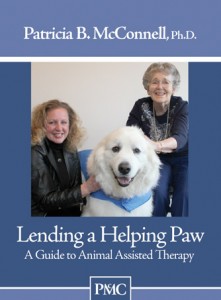
We just released a DVD of the seminar I did in Naples, Florida on Animal Assisted Therapy and Activities, "Lending a Helping Paw." I'm excited about it, because it gives me the opportunity to help individuals and organizations who want to help others. It is an example of an activity we can do with our dogs that is a triple win (for us, our dogs, and people who need some oxytocin and/or physical therapy). Because of that, old social worker that I am, it's near and dear to my heart. Speaking of hearts, and what fills ours with happiness, the question arises about how effective AAT (Animal Assisted Therapy) and AAA (Animal Assisted Activities) really are. I remember a conference put on by the Delta Society many, many years ago that included a controversial study. It showed that, in this Read More
Therapy Dogs – Born or Made?
As many of you know I recently presented a seminar on animal assisted therapy in Naples Florida. (Yes, it'll be out as a DVD later this winter. Happy Dance!) One of the motivations for doing the seminar was the number of clients I had who wanted me to help them prepare their dog for therapy work. Sometimes it was like swimming downstream on a warm, cozy river. Their dog was a perfect fit and ended up doing wonderful work in the community. Other times... well, it was reminiscent of trying to paddle up a cold, frothy waterfall. The fact is, therapy work can be hard work, and it takes a special kind of dog to be both good at it and to enjoy it. The directors of AAA and AAT (AAActivities and AATherapy) will tell you that one of their greatest challenges is working with people who want to Read More
Tree of Life

Home Sweet Home!! Florida was great is so many ways (thank you everyone!), but I have to admit I am sooo happy to be home. Willie and Tootsie are great, Sushi and the sheep too, the snow (finally!) didn't delay our planes and it is heaven to be back in Wisconsin. I'm planning on 2 blogs next week on 1) the results of our survey in Orlando about the emotional state of the dog in Michelle Wan's video and 2) what kind of dog is most qualified to do AAA and AAT work. And then there's so much I want to talk about from Kathy Sdao's seminar on Sunday on Orlando... And then there's talking about my BFF from graduate school, Disney World's Sr Conservation Biologist Anne Savage, who is doing kick ass research/economic enrichment in Columbia as well as other places... so many topics, so little Read More
See you in Orlando!

Eeeps, where'd the day go? I was going to write about the emotion of disgust, but it'll have to wait til tomorrow. But before the day is over I wanted to remind you that the Early Registration for the Jan 7-8 seminar I'm doing with Kathy Sdao is over tonight at midnight. I'm doing a new day-long seminar on Canine Communication: communication of all kinds between dogs, from dogs to people, and from people to dogs. Lots of it is interactive: you'll be working like a dog searching for scents (sort of!), interpreting visual signals, and translating dog vocalizations. I'll be adding in all the new research that relates to communication, so if you want to up your understanding of all things dog, you definitely want to come. It's in Orlando, Florida too... not a bad place to be in January, and Read More