Welcome to the official Patricia McConnell website. Skip directly to: main content, navigation, search box.

Posts Tagged ‘dog training’

Favorite “Non-Traditional Cues,” Part II
Thursday, October 18th, 2012

Wow. You all are amazing. So far there have been 165 answers to the question posed two weeks ago, “What’s Your Favorite Non-Traditional Cue?” I’ve read through every one of them with great interest (and often amusement). My plan was to go through all the comments, list every cue mentioned with it definition (some people included as many as 7 or 8), and see if I could  find some patterns.

Several hours later, and less than a fifth through all the cues mentioned, I suspected that a smart person might want to modify the plan. So that’s what I’ve done, whether either out of laziness or wisdom, I couldn’t tell you. I’m using the list I’ve generated so far as a sample, and have re-read all the rest of the comments that have been so thoughtfully provided.

Here’s what I’m seeing so far: First, the most common “non-traditional” cue appears to be “Wait.” It has several variants as to its exact intention, but in all cases the dog is being asked to pause or not move forward. Much more casual and less directive than a stay, I find this an invaluable cue that I myself use every day–at the door, at the car, while walking down a trail, etc. etc. It’s part of the curriculum in Family Friendly Dog Training, so I guess it’s clear that I think it would be good if it moved from “non-traditional” to “traditional.” It’s just so darn handy.

Another category of commonly used cues not often seen in standard dog training is the set of cues telling a dog either that an event is over (“Enough, All Done, All Gone”– ie, no more ball play, no more treats) or to go entertain him or herself (“Settle, Go Settle, Go to Your Place, Chill, Go Pass Out!”) These also seem to me to be incredibly useful cues that all dog owners (and dogs) would profit from knowing.  I use “Enough” several times a day, usually meaning that object play is over, but I as I’m writing this I realized I use a variant, “That’s Enough,” to mean “No more petting.” At first I assumed that Willie didn’t know the distinction, (since I only noticed it while writing this), but perhaps he knew it long before I did?

Notice that, in the variants of Settle, the dog can either decide him or herself to find a place to settle down, or go to a specific area taught in the past. I use Settle myself, meaning go anywhere you want, but for the love of all things good and true, please lie down and chill out for awhile.

The other most common group of cues relate to moving in space: “Turn Around, This Way, Up, Move Over, Back Out, Beep (my favorite!), Go Around,” etc. etc. These strike me as extremely useful as well, although more specific to individual owners and dogs.

One cue, mentioned by a few and one that I have discussed before is “Ready.” I truly wish more people would use this as a way of helping a dog understand what is about to happen. It can be used to prime a dog for action, as it often is in Agility, but also as I use it more often, to let a dog know that something is about to happen, especially if it involves being touched or handled. I use it for Willie when I am about to do something to him, like pick up a paw to dry it off. This gets into another conversation we could have about the balance between keeping cues short and sweet (very valuable at times) and not overwhelming a dog with meaningless chatter AND, at other times, using words to have interchanges with dogs that are more like conversations than a set of “commands.” I’m a fan of both…. Hummm, I’ll have to think about when and why I use different approaches.

While we ponder that, here are some of my favorite cues from the comments about non-traditional cues:

Whoopsie What you just did wasn’t what I wanted, try again.

Who’s a Goof? Roll in the Grass.

Be Bad (Okay, that’s mine, for jump up and put your paws on my chest.)

Who’s a Brave Girl? Go stand between my legs.

Use Your Words or Tell Me Your Story Bark

Sweetheart, can you put your Stagbar on the rug please? Self explanatory!

And What Should You Be Doing? Go lie on your rug

Watch Out for the Panty Hose! 4 on the floor

Chip! Really? As in, did you really just go into the garbage? Dog now puts his paws over his head.

There are a gazillion more, I encourage you to read through them if you haven’t, but it seems appropriate to end on the most unique one I could find:

Gheresh Bede or Farsi for “shake your booty”

MEANWHILE, back on the farm: Two inches of rain last weekend! Amazing! Some people got even more (and northern Wisconsin got snow, lots of it. Oh my.) Everything is so green now it’s hard to imagine it was ever brown. My pasture is still in rough shape, but the front lawn looks like it sprung to life except in a few places. All I can say is that the sheep are very, very happy.

Last Friday Willie was in his last sheepdog trial of the year. I’d say the results were mixed. I purposefully only ran a partial course with him in order to protect his shoulder. I leave tomorrow for a sheepdog training clinic with Patrick Shannahan, and I wanted to be extra sure that Willie was sound enough to work in the clinic. I also wanted him to leave the course wanting more, since the last two trials he was in were exceptionally difficult and stressful for all the dogs. This time his first run didn’t start well: Although he’d appeared to focus on the sheep in previous runs, when we walked to the post he kept looking in the direction of another group of sheep. (Your first job at a trial is ensuring that your dog can find the sheep where they are set out. This is harder than you might think. There are two other groups of sheep, and novice dogs often focus on those rather than the tiny little specks out in the distance.) Willie looked at everything but at the sheep he needed to work, and we messed around for what seemed like forever at the post until I finally just gave up and sent him in the belief that he’d go to the wrong group of sheep.

Nope, he did a perfect outrun to the right group, but by then the sheep had broken away from the dog and handler trying to hold them in place (who must have been cursing me, justifiably, believe me).  Willie didn’t get them back on line until he was pretty close to me, but he did, I stopped him, settled the sheep and said “That’ll Do.” He left the field happy and grinning and his shoulder looked good, so we did our second run a few hours later.

This time I sent him right away, and he did a perfect outrun again. Again the sheep broke from the handler  before he got to them, this time not our fault, but probably not the set out handler’s either: they were extremely flighty sheep. Again, Willie didn’t “cover” them, or flank around them far enough to get them back on line. He had no excuse for that, except his nerves: That’s what you see in dogs without enough confidence to directly confront a flock of sheep dead set on thundering back to the barn. He did get them to me however, pacing nicely as he got closer. We did a little drive which went relatively well, and then on the cross-drive Willie stopped, like a 1960′s civil disobedience protester, and stood still while looking at me and ignoring every signal I sent his way. Honestly, it was almost funny, except I’m quite sure Willie stopped because he was too anxious to continue. The sheep had to be moved directly toward the barn, exactly the direction in which Willie knew the sheep wanted to take off and run to. It’s very scary for dogs to feel in control of sheep if the sheep are moving AWAY from them and from their handler, and it takes guts and courage for dogs to learn to drive unfamiliar sheep on unfamiliar courses at a good distance from their handlers.

Ah, you know how much I love my Willie Boy, but I’m afraid “guts and courage” are not words one would use to describe him. The “Woody Allen of Sheepdogs” would be more like it: brilliant but ridden with angst. We’ll see how the clinic goes this weekend. I don’t want to run Willie in trials if they just distress him, but I would like learn to help him be as good as he could be. Even though his work at the trial had some serious flaws, we did well enough that we didn’t leave feeling badly. He seemed upbeat and happy all day, I had a good time and got some good experience under my belt. I can’t wait for the clinic, it should be lots of fun and very interesting. And to those of you who were there, I still can’t stop singing “Keep rolling, rolling, rolling, keep them doggies rolling, RawHIIIIIIIDE.” Sigh.

Things at the farm are good. It’s still gorgeous even though many of the leaves have fallen. We got another half inch of rain yesterday… will wonders never cease? Tootsie is a happy girl, except for this morning, during which she spent part of the time in the kitchen sink because she had diarrhea all over herself. And me. You all know how that goes. I think it was just a glitch, that she’ll be fine in the future, and am oh so grateful that I can wash her off in the sink. Very handy at 6 am in your bathrobe.

Nellie and Polly are good. Too good. Polly took one look at her momma being put into a carrier crate in order to go to the vet clinic for vaccinations, and darted up a tree. Here she is: Wanna play Find the Kitty? (And don’t worry, she was down the minute we came home and I let her mum out of the crate.)

What’s Your Favorite “Non-Traditional” Cue?
Friday, October 5th, 2012

A few weeks ago I wrote a post on the cue “Get Back,” which is one of my favorites because it is so useful in so many contexts. Katie Martz, Communications Coordinator here at PMcC, video taped Willie getting back in a variety of contexts, and we noticed that every time I said “Get Back” in a context in which he’d rather not, he tongue flicked. That led to a very interesting discussion with readers about why he was tongue flicking, but distracted us from the reason we did the taping: the usefulness of “non-traditional” cues in dog training. Yes, we all need Come, and Sit and Stay; I can’t imagine what I would do without them. But there are a variety of cues that are equally useful, but not as common or well known. I thought it would be fun to canvass readers to learn about their favorite “non-traditional” cues, and perhaps add to the vocabularies of all of us. Here are just a few to get us started:

ENOUGH: Along with “Get Back,” I also love “Enough,” no doubt in part because I have had dogs (and still do) willing to elicit play or petting until all the entire Antarctic ice pack melts and we are all paddling to work. There’s a video of Enough training in the Reading Room on the website, it’s the Second from the Top. I use it when I want to focus on important issues, including whether Castle and Beckett will ever have a relationship like normal people, when I am done playing with toys with Willie, and when I simply can not stroke Tootsie’s adorable little round belly pooch for one more minute.

TAKE IT/DROP IT: I teach Drop It as the flip side of Take It, and I find I use both of them often. As in: Please drop the dead bird you found, or please pick up your toy and bring it back in the house. I know these aren’t especially ‘non-traditional’ but they often aren’t taught in training classes and I wish they were. Far better to teach Drop It as a fun exercise rather than reflexively shouting DROP IT! in an angry voice and teaching your dog to swallow as fast as she can when she hears it. That seems to be the default of most dog owners, an understandable primate-like response, but not a good way to establish a good relationship with your dog.  I’d love to see it as part of dog training curricula and have included it in The Puppy Primer.

READY? This is a standard signal a lot of serious trainers use, but I wish again it was more common place. I love looking at Willie and asking him if he wants to engage with me. The key here is asking. It’s not a command or even a cue really, in the sense that I’m simply asking Willie if he’d like to start training something new or practicing something old. Any answer is acceptable and I have no expectations of his response, except as information. If he doesn’t turn to me, eyes shining, then he’s not ready, and I change my behavior until he is. Because the sound so often leads to working sheep or doing something that elicits treats or play, Willie seems to love the word as much as I do.

OUT: Katie Martz uses this with Lily, her beautiful Dogo. She uses it when she’s chopping vegetables in the kitchen, to prevent Lily the 90 lb white wonder from dancing on the counters in delight. Out means either go to another room or another surface (floor to carpet for example) or, essentially, stop bothering me right now. She taught it by tossing treats into the other room and body blocking her from coming back in. Lily seems to define it the same way Katie does (often rare in training, right?), because she will respond correctly to it in a new house or apartment.

WHAT’S YOURS? This is just a partial list, and I’d love to hear what “Non-Traditional” signals you use with your dogs that you especially love. I envision a very interesting discussion about it, thanks to all our thoughtful readers. I fully expect I’ll be teaching Willie a new cue by the end of the weekend….

MEANWHILE, back on the farm: It’s gorgeous but desperately dry. I am watering the trees in the yard, but who knows what will happen in the woods and the prairies. But it has been stunningly beautiful, one of the prettiest autumns ever. Dry conditions, followed by sunny days and cool nights are apparently ideal for fall color, and that has been the case here to a T. The sheep are doing well, although that’s not the answer you would get if you asked them. They are confined to the pen because the pastures are little better than dirt. It’s sad to see, but I have had excellent advice from a pasture specialist (thank you Laura) and have a plan to rehabilitate starting next spring. I’m taking soil samples in this week to get that part done now anyway, and we are, one by one, ridding the area of the thistles we didn’t get this spring. (Thistles appear to be drought proof apparently, such a shame they are not edible.)

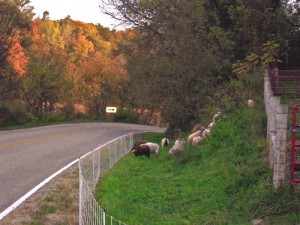
However, thanks to Jim, who is the primary portable fence mover, the sheep are able to get some grass from selected areas in the front of the farm. In the photo below they are eating the lush grasses right alongside the road. This is the best grass on the farm: it’s a low area that gathers rain run off from a culvert, is shaded much of the day and is mowed by the county on a regular basis. There is a tiny bit of grass in other areas of the front lawn, and thanks to Jim, Willie and the portable fencing, the sheep will be able to get some of it. Most of their ration is the hay we purchased for winter, which we are going through at an alarming rate. But it’s good, rich alfalfa and the sheep are actually doing well on it.


Last Sunday we all got out for a lovely fall walk in the fields and woods close to a good friend’s house. Willie’s shoulder has improved enough so that he is now off leash again. When I had to put  him back on leash, both inside and out, he became as depressed as any dog I’ve seen. It was, in a word, heartbreaking. Now that he can run free again he is back to his happy, happy self. We saw his physical therapist on Monday and she strongly advised that we go very, very slowly trying to bring him back to training for competition. It’s clear that his shoulder simply may never be able to handle the wear and tear involved in training for driving on a perfectly straight line, something that requires a tremendous amount of lateral stress on shoulder joints. If he can’t ever trial again I don’t think he’d care at all, as long as he can work sheep at home. It’s me that wants to trial, so although it would be a great disappointment to drop out now that I’ve caught the bug again, if Willie is happy, that’ll be enough for me. I’ll get over it, and Willie will not care one little bit. I’ll see how it goes, going very slowly and carefully.

Here’s the gang on the wooded part of our walk: Willie, Jim, Tootsie, good friend Beth Viney of Great Pyrenees Rescue of Wisconsin and her lovely lady, Tundra. Willie and Tundra did beautifully when they were re-introduced at the beginning of our walk (they had met once before, I have a video of it on my Dog-Dog Reactivity DVD and we all had a grand old time. Tootsie did get carried by me or Jim part of the way, the grasses were pretty high in some places and what was a path to us was a jungle to her. Short of teaching her to use a machete, we picked her up and carried her. But she was a trooper and still did a lot of walking, and we all had a wonderful time. Then Jim and I went back to doing farm chores, worked outside most of the afternoon, and ate a yummy dinner of local, organic pork, roasted root veggies and home made bread. We fell in bed about 9 o’clock and slept as if we’d been drugged. Hopefully there will be more of the same this weekend (the walks, farm chores and good food, we’ll pass on the “as if drugged” part.)


Willie and Tongue Flicks and What it All Means

Monday, September 10th, 2012

As if any of us REALLY knows “what it all means,” right? But thank you for your interesting and thoughtful comments about the previous post’s video of Willie and the “Get Back” signal. They were great.

I’ll cut to the chase about my own interpretation. Here’s the data: Willie tongue flicks when I ask him to back away from somewhere or something he wants to go toward: the outside of the house, into the car, or toward the toy. All of these have been taught using lots and lots of reinforcement with food and play and “life rewards,” like going outside after I say “Get Back” or getting the toy as soon as he backs up (But  I don’t reinforce every single response every single time once he has a cue down pat. That would be unnecessary in my opinion, not to mention completely impractical.) But back to the tongue flicks:

The only time in the video when Willie doesn’t tongue flick after “Get Back” is he is directly facing the sheep, who are backed into a corner. Two highly relevant facts that can help us interpret his behavior are:

One, I’ve never used food to teach it in that context (sheep), I have in all the others. Is it possible that he has a classically conditioned response to the cue because it so often resulted in food? I thought that was an interesting comment from a reader. I think this bears considering, but, see # Two….

Two, (and I think in this case MUCH more relevant) Willie dislikes what is called “contact” with the sheep (not physical, think metaphysical) and is stressed by face-to-face confrontations with them. Did you see how quickly he backed away (see second 120) when I said “Get Back” in that context?  That’s because he is relieved. In this case he’d be likely to tongue flick when I said “Walk Up,” not “Get Back.”

Thus, I am inclined to agree with those who argued that Willie’s tongue flicking is displacement behavior. In all the cases in which he tongue flicked, he wanted to go forward, but couldn’t, so he did something else. What he did could be interpreted as a sign of low-level anxiety, stress or frustration, or as appeasement behavior. I experimented (have you with your own dogs yet?) and looked for tongue flicks in a variety of contexts and after a variety of cues. Lie Down and Sit all got tongue flicks. Come forward and touch my hand, pick up the toy, come to me, find the toy, and high five did not.

Willie appears to tongue flick when he wants to move forward but is asked to do the opposite. Is he stressed? I could well be wrong, but I don’t think so, at least not in the way the term is usually used. “Stressed” on Willie’s face is easy to read, and involves pinched facial muscles, ears flat and a look in his eyes somewhere between Tippi Hedren in Hitchcock’s The Birds and Anthony Hopkins in Silence of the Lambs. Is he thrilled about being asked to back up? Nope.

Notice how immediately before and after the tongue flicks, Willie’s body stays loose, his mouth open and he generally has on what I call his happy face. Would he rather go forward at the door, into the car, toward his toy? Yes. Would I rather eat ALL the chocolate in the cupboard right now? Yes. Am I stressed because I am not allowing myself to do so, with some inner voice firmly saying “Trisha, Get Back?” No. That’s my interpretation. Now that we all know more, what do you think?

A few more points in relation to your comments, and a reminder of what a great exercise these videos can be for us all. Several people commented about Willie, at second 24, sliding under my legs toward Tootsie as I am about to lift her into the car. There were some interesting guesses about what is going on here, but I can tell you with confidence that Willie is taking the opportunity to sniff her butt “under the radar.” He still primarily pretends that she doesn’t exist (and vice versa). They can eat off of the same plate if offered to lick our dinner plates, and she can dance on his head when greeting us and he has no visible reaction. He is remarkably tolerant of her (and her him). But they still do not acknowledge each other, and sneak in sniffs in rare moments, only when the other’s head is busy.

Some of you also commented about Willie’s dash away from the car door after I put Tootsie inside (second 40) and interpreted it as fear. Not a chance in this case, he was running in joy to the barn. Willie has learned that unless other cues have occurred (Tootsie’s car harness on, his travel collar on), Tootsie going into the car crate means we are going to the barn to work sheep.  Even though I think he often finds it stressful, he appears to love working the woolies as much as life itself.

And one last quick comment, just by way of explanation: Willie’s Stay signal means “Stay in place (not posture) until I give you a release.” Willie’s Wait signal means “Pause momentarily and then do what you want.” If he is still not moving once I’m ready for him to move on, I’ll say “Okay” just to get the ball rolling again. But it’s his choice, Wait just means pause. If I want him to not move until I give him a release I say Stay. I find that useful, myself. You?

MEANWHILE, back on the farm: We began last weekend with a rough day on Friday. Willie was entered into our second “big” sheepdog trial on Friday, and did the worst he’s ever done. It was, granted another really tough trial, with a tough course, tough sheep and with wind and rain blowing into my face. Willie improved tremendously on our second run, but I did the worst I’ve ever done and made two ridiculous mistakes. Ah well. But then we gloried in a perfect fall weekend: blue sky, dry air, ideal temperature &light breeze. I’m talking calendar cover weather, here, and boy did we deserve it after such a brutal summer. I planted asters and dug weeds and cooked, Jim cut down tree-sized Ragweed to help my allergies, finished a new wagon to transport the sheep and we generally puttered and watched sports on TV and relaxed. Heaven for us all.


Video Analysis: What’s Up with Willie?

Friday, September 7th, 2012

Here’s an interesting video for you to analyze. Katie and I were taping one of my favorite signals, “Get Back.” I use it in a variety of contexts, and can’t imagine life without it. You can see some of the ways I use the cue on the video below, and I’ll talk more later, if you’d like, about why I love the cue so very much.

After we taped, Katie and I were watching the video and I said “Oh wow, did you see how he [---] right after [---] happens? (Fill in the blanks!)

And so, that’s your assignment (should you decide to accept it Agent 99): Watch this video and tell us what we might have found interesting in it. I’m giving no more instructions than that… Who knows then what you might find that we didn’t! I’ll jump in early next week (and will answer comments sooner) about what we found so interesting, and as importantly, what we think it might mean. I’m guessing that this could lead to a very interesting discussion!

MEANWHILE, back on the farm: Willie clearly lost some confidence after working the almost immovable sheep at the trial last weekend, so I’ve been working on building it up. I’ve been encouraging him to come up, come on, keep them doggies moving… (This is where you burst into song, singing “Raw-hiiiiiiide” at the top of your lungs.) I’ll let you know how it’s going. Poor Mr. Willie boy, you know how much I love him; and that includes knowing who he really is: A slightly crazy, people-loving, hyper-reactive, sound-sensitive, fun-loving creature who lacks confidence in a variety of settings. I’ve always known he’ll never be a national level sheepdog trial competitor, but I love him more than I can say, and love him even more than that for trying so hard.


Here’s a photo of me and Willie a friend took (thanks Rich!) several years ago when we were at a sheepdog clinic (the first time I was able to let Willie greet unfamiliar dogs.. what a huge step that was for him!) It’s hard to imagine that he was out of the game for over a year and a half since then!


Using Positives to Decrease Negatives

Friday, July 27th, 2012

Here’s something interesting I learned while working on a talk I’ll be giving at the Annual Conference of the Wisconsin Association of Behavior Analysis on August 15th in Madison. My talk is “Creating Harmony Between Dogs and Special Needs Children,” and it involves discussing the benefits to the family of having a dog, but also the risks to the dogs that need to be addressed and minimized as much as possible. As we all know, even parents of typical children sometimes struggle with interactions between their children and their dog, and things can be even harder for parents of children with special needs.

While working on my talk I read a research paper that is relevant to dog training in general, even though the case study was about changing the behavior of a child with Autism Spectrum Disorder, or ASD. A 6-year old boy was “inappropriately touching” the household dogs (grabbing and pinching the dog’s anus, oh dear). Needless to say, this was both unfair to the dogs and dangerous for the child.

The therapist attempted three different types of intervention: 1) a verbal reprimand if the behavior occurred and attempts to physically block the behavior from happening, 2) DRA, or “Differential Reinforcement of Alternative Behavior,” in which the child got a jelly bean for touching the dog appropriately and 3) DRO, or “Diff’l Reinforcement of Other Behavior, in which the therapist gave the child a chance to choose the reinforcer before each session, and then told the child “If you don’t touch the dog’s bottom, when the timer goes off (10 sec), you’ll get X (chosen reinforcer) afterward”. Appropriate touching was verbally reinforced as it was in DRA, and inappropriate touching received a verbal reprimand “No touching. That means no X. Let’s try again.”

No surprise to dog trainers, verbal reprimands had little effect. The DRA method (reinforcing appropriate behavior) resulted in an increase in appropriate touching BUT no decrease in inappropriate touching. However,  DRO (don’t grab dog’s butt for 10 seconds and get a reinforcement of your choice) eliminated inappropriate touching completely. You can read more details in Bergstrom et al, 2011, Research in Autism Spectrum Disorders 5, pg 218-221.

Note that there were at least 2 variables that differed between DRA and DRO: In the latter the child got to choose the  reinforcement (rather than being given one, a jelly bean, that the therapist knew he liked). Second, in DRO the reinforcement came after 10 sec of not doing something, versus getting a reinforcement for performing an alternative action. This makes it a bit difficult to sort out which factor had more influence on the result (remember, this was a case, not an experiment). My guess is that both factors were significant. Certainly it is critical to understand that, just like us, dogs want different things at different times, whether it’s being let out to pee and sniff the sidewalk, get a piece of bacon or get to play ball. One of the key distinctions of good trainers is the understanding that we need to get into our dog’s heads as best we can and guess what it is that the dog wants at any given time. That said, I suspect that reinforcement for the absence of a behavior might also have been significant.

If you’re a learning theory expert then you are well versed in the term Differential Reinforcement, (DR) including DRI (where I = Incompatible behavior) as well as DRA and DRO. Most dog trainers use these concepts all the time, just without the formal labels to them. I bring it up here because so much of family dog training includes stopping a dog from doing something you don’t want it to do as much as teaching it what you do want (which should go hand in hand, right?) I teach incompatible behavior all the time, (sit when greeting people at the door rather than jump up), but we all know that some behaviors in some dogs can be challenging to turn around. I haven’t used DRO as described above very often with my own dogs or with my clients, however I did have good luck with it when Willie was obsessed with herding Sushi. Reinforcing incompatible behavior didn’t help, if anything, it made it worse because everything became a secondary reinforcer. Once I figured that out I could manage it reasonably well, but before Sushi left I had the best success with reinforcing a lack of herding for X amount of time (inspired by a seminar with Ken Ramirez, by the way). It’s not an intuitive method at all, and I suspect it’s best used only in specific circumstances. I’d love to hear your own thoughts about your own experience with it, or with dealing in general with behavior that is difficult to extinguish.

MEANWHILE, back on the farm: Even more rain! Whoopee, almost an inch in the last 2 days. It’s probably too late to save my pasture, it appears to be dead and gone; but maybe not, said Trisha the optimist? Maybe, just maybe, it’ll come back? I’ll give it another week or so before deciding to plow it up. That would be an ouch. I only have one other small pasture and if I replant I’ll have to do it in fall and then keep the sheep off for a long time afterward. Would have to buy lots more hay, and that’s not so easy to find right now.

Speaking of sheep, I realized it’s been awhile since they had the spotlight. About time I’m sure they’d say. Here are two of the ewes I call the “camel sisters:”


They are just visiting, to help me and Willie work flighty sheep.

Here’s a question for you: What’s wrong with the picture below?

Did you guess that sheep shouldn’t be eating hay in Wisconsin in the middle of summer? Yup, you’re right. The flock is eating their winter’s food and has been since late May. Maybe I’ll have to put them on a diet like I am?


Simply Wrong

Friday, July 20th, 2012

I don’t know about you, but anytime I hear a dog training product described as “revolutionary,” I get worried. And for good reason. Have you heard about the new “revolutionary way” to walk your dog? It’s called SimpleLeash, and it is guaranteed to work on “dogs of all sizes and temperaments.”

What’s the revolutionary idea? Your dog gets a shock if he pulls on the leash. Ah, but it’s not called a shock. I couldn’t find the word shock anywhere on their website. No, no shocks here, just a “harmless correction stimulus,” that intensifies the harder your dog pulls. There is simply nothing for the owner to do, the collar automatically does it all! Thus, the SimpleLeash. “You literally don’t do a thing except hold the end of the leash.”

Well, maybe one more thing, like scrap up the puddle flattened on the sidewalk, the one that used to be your dog, and carry it home repeating “I’m so sorry, I’m so sorry,” over and over again, as if it would help.

Speaking of sorry, I apologize for being so blunt. But oh dear, oh dear, will there ever be an end to people making money off of inhumane training methods? Here are some of the things a dog could learn from this collar:

1) Walks are dangerous. I will do all in my power to pee in the back bedroom and never go out again.

2) Every time I pull toward another  dog I am injured. Using my doggy brain and able as I am to associate 2 things together, it is obvious, even to knucklehead here, that other dogs are dangerous. I’d better start growling and barking at them to keep them away.

3) Ooops! I tried to pull toward the hedge to poop in a good place and got shocked. Pooping bad. Okay, I’ll hold it as long as I can. She can walk me for an hour, but by golly, I’m holding it in if it kills me.

On their website, the owners of the business explain that they are dog lovers, ones with some labs (based on the photo) who could not be trained through “professional training, treat training, clickers, choke collars, those collars with spiky things… and the leader that goes over the nose.” Wow. I’ll grant that teaching a dog to walk politely on a leash is harder than things like teaching a sit or a lie down, but my goodness, those must have been remarkably difficult dogs. After working with these virtually impossible dogs, one owner one paired up with a brother-in-law and came up with SimpleLEASH.

Could it ever work to teach a dog not to pull on a leash by shocking her when she does? Sure. Of course. Sometimes. You can stop children from mouthing back by slapping them on the face too, but that’s not where the story ends. Stopping a particular behavior with force, especially one as primal as a shock, usually has a raft of side effects that aren’t so pretty (see above to name a few). This is why it’s a good idea to talk to professional trainers and behaviorists before one promotes a product that can have serious side effects. And why it’s a bit dodgy to say that one “firmly believes in positive reinforcement training” and offer a collar that would give a dog a high level shock for bolting away from you in fear if a car backfired. It also helps, if you are going to refer to Pavlov on your website, that you understand Pavlov’s greatest accomplishment was discovering that the conditioned stimulus (the bell that signals food is coming, or in this case the sound that says a shock is coming) gets the SAME reaction as if the food did come, or the collar did produce a shock.

I just hope that people new to dogs aren’t overwhelmed by the seduction of this “Simple” and “Unbelievable” and “Brilliant” device. It’s a shock collar, and one that can deliver its highest level shock when a dog is terrified of something, under attack by another dog, intent on peeing on the right instead of the left of the light post because that’s where any dog would want to pee but their owner can’t smell anything so has no clue why it’s so important…. and on, and on.

Here are three things we need to teach dogs what we want when they are on a leash. Yes, some dogs are harder than others, but really… it’s not rocket science.

TRAINING: Check out my Teaching a Beginning Heel video to teach a dog to stay by your side. It’s the top video on the page I’ve linked to.  Also, see The Puppy Primer for getting a young dog started, and Family Dog Training for step-by-step exercises to teach a dog to walk beside you on a leash. Does it take some time and some skill. Yup, of course it does. It takes time and some skill to learn to drive your new car, to figure out how to program your DVR and to learn how to talk to Aunt Sally without bringing up the horrible things she said about Uncle Paul that last Christmas. Just do it. If you like being with your dog and you learn the basics, it’s fun. Really fun. You did get a dog to enjoy doing things together, yes?

DEVICES: I’m the first to agree that it takes a while to teach a young dog especially to not pull on a leash. No one walks a young horse through a crowded stable yard with the expectation that he’ll follow along quietly without a halter on while you’re doing your other training. That’s why I used a Sensation Harness on Willie when he was younger when I was walking him in town or to the vet’s. It’s one of the body harnesses that attach in the front — my favorite tool for controlling a dog while you teach him to stay by your side (and walk at the undoubtedly boring-as-death pace of an adult human on a walk.) Another good brand to consider is the Easy Walker by Premier. Some brands fit some dogs better than others, you’ll just have to see what works best for you. These harnesses work very well for small and medium dogs, but if you have an especially large or strong dog, you might consider going to a head collar, like a Gentle Leader or a Snoot Loop.

YOUR HEAD AND YOUR HEART: You can’t teach a dog to walk by your side without engaging these. Your head needs to know that walking side-by-side isn’t something dogs do naturally. Just because us primates do it doesn’t mean our ‘best friends’ understand the concept, or want to play along once they do. Your heart needs to know that your dog is a good dog, really he is, and he is just being a dog if he tries to pull to sniff where the squirrel just peed. He doesn’t need to be hurt and scared just because he wants to sniff something, does he?

AND YOU? What are your tips for people with dogs who pull? With new dog owners with enthusiastic puppies who haul them across the lawn to the neighbor.. the one who hates dogs?

MEANWHILE, back on the farm: Rain! Not much here, but still, I now have faith that it can rain, and that it might sometime again in the future. We actually got very little here, only a half an inch, while friends 6 miles away in one direction got an inch, others the same distance in another direction got 2 and a half. Go figure.  It’s going to be brutally hot and humid this weekend though, so Willie and I are going to take advantage of a slight cooling off today and go up the hill and work sheep. Wheeee! We’ve done it so little I barely remember his whistles. (I actually went to the car to remind myself how to whistle his signals at the trial on Sunday. All of a sudden I felt like, “Wait! What does it feel like to whistle Come Bye?” (Which means go clockwise around the sheep in herding speak.) Barbie, get ready, here we come.

And more good news: no watering necessary today for the first day in… how long? Don’t know, I’ve lost count. I’ve mostly watered the trees and my perennials, it’s really been a kind of a triage operation. Here’s my primary flower garden that I have kept up with watering. It’s starting to fade, but still colorful and brings me so much happiness. The grass right around it is bountiful, the grass farther out is the color of potato chips. The botanists say that much of the grass that is brown isn’t just dormant, it’s might actually be dead. I don’t care so much about the lawn, but I am truly worried about my two acre pasture up the hill. It’s convex (with a hill in the middle and tends to be pretty dry anyway), but only time will tell if our little bit of rain came soon enough.


And here’s Calico, finishing a stretch when I woke her up from a nap:


Don’t waste calories!

Friday, March 30th, 2012

Well, this could be a blog about my as-yet-to-be-successful attempts to lose 10 pounds, but more on point, it’s a discussion about the value of a dog’s dinner in training and behavior modification. I am inspired to write this after seeing Kathy Sdao’s seminar last January in Orlando, and reading her new book, Plenty in Life is Free. It’s a really good book, in which her primary point is that the so-often-recommended “NILIF” (Nothing in Life is Free) programs recommended are based on a flawed assumption, and should be replaced with using Operant Conditioning to teach the behavior we want.

I say “Here Here!” to that. It’s just another version of dominance theory, and as Kathy argues, it can have a negative effect on the relationship between a dog and its owner. What I especially like about the book (besides perhaps the most endearing cover to a book imaginable) is its focus on teaching a dog what you DO want him or her to do, and how to use what she calls “Get SMART” to do so. SMART = See, Mark and Reward Training. In other words, first you focus your attention on your dog, paying attention to when he does something that you like. You Mark it with a clicker or a verbal marker, and then Reinforce it with food, play or touch.  No “commands,” just watch, look and listen… and use your increased awareness to reinforce your dog for behavior that you like.

Here’s a short list of some of the many things we can notice and reinforce (she recommends 50 times a day!): looking at your face, walking by your side, relaxing quietly while you work, staying in the crate. Besides being attentive, the key here is to use the dog’s dinner to reinforce the behavior you want. The example from Redstart Farm is Tootsie heeling when we walk to the barn. There’s no fence around the front yard and the driveway leads to a county highway. But I want Tootsie to be safe off leash in the yard, so without using any cue at all, I’ve taken part of her breakfast and dinner with me every time we walk past the driveway to the barn. She gets a treat every time she is in heel position on my right side. (Willie is trained to the left, so I thought I switch sides so that someday we can all walk together.)

She now walks with me from the house to the barn like an obedience trial champion, about 65 yards or so, in a kick-butt, eyes glued to my face, head and tail up, with a big grin on her face. Would it work in other contexts? Not yet, but on our walks anywhere I wait for her to choose that position and reinforce her for it. It makes her dinner bowl pretty sparse indeed, because she’s gotten so many treats during the day for training, but it works, it works and she still gets some good food every morning and night in a bowl, so we’re all happy.

What about you? How much do you use your dog’s dinner throughout the day? What behaviors have you found best to watch for, mark and reward? And have you seen Kathy’s book yet? It would be a great addition to anyone’s library. As always, I look forward to your thoughts….

Now, would someone please monitor the food in my bowl every meal? It would help if I hadn’t learned to make crusty-on-the-outside and creamy-on-the-inside French bread and if I do say so myself, the best berry pie you’ve ever had. Sigh.

MEANWHILE, back on the farm: Whew, I am sure that some of my friends will roll their eyes, but it’s cool and rainy and I’m so relieved. Now all the beautiful flowers will stay around awhile rather than burning up in a day or two, you can work sheep without overheating them or your dog, and the grass is so green it almost hurts your eyes. The storm last night brought cool temperatures and needed moisture, but poor Tootsie is seriously thunder phobic, so we’re all running on very little sleep right now. But the rain was good for many reasons, and the sheep held off from having their lambs in a downpour before I got them into the barn.  (I told them to wait until the weekend to lamb, so far they’ve been very obedient.) Even though it rained so hard last night you couldn’t have slept through it even if there hadn’t been thunder, the flowers seemed to have come through it without too much damage. Now we just have to cross our paws and hope for no killing frosts.

Here’s that green I was talking about. Yup, honest, it really is that green out here. The green strip you see if alfalfa, which has the most intense green of just about anything that grows in spring.

And here are the blossoms of our wild plum trees. More probably I should call them “feral,” not sure where they really came from, but I’m trying to help them spread because their fruits are fantastic. I combine them with wild apples and make Apple Plum Butter Sauce. Uh oh, there I go talking about food again. Bad Trisha, bad Trisha.

The Value of Basic Training Skills

Tuesday, March 22nd, 2011

Here’s one of the great lessons Ken Ramirez had for us at the Clicker Expo in Chicago last weekend: The basics aren’t really all that basic after all. In his experience, one of the most common mistakes he sees in even experienced trainers is forgetting the importance of some of the basics. Here are some of the reminders he shared, and believe me, I am taking them all to heart.

Precision: Yes, we all know it, timing is everything, but no matter how obvious it is, it is often forgotten. This is relevant whether you are using a marker (like a clicker or ‘yes’) or not, often because we don’t do the following:

Clean Delivery: Ken reminded us that dropping the treat on the ground or fumbling the delivery can be very aversive to our dogs. Say we are on a roll, clicking and treating at a good pace, and then we drop the treat on the ground. The dog has to sniff around and find it, and that might not be so much fun for him. At worst he may feel frustrated, and at best he has completely forgotten what he got the treat for by the time he found it. Not a crisis, of course, but a little bit of frustration can have a lot of effect. Ken reminds us to practice delivery WITHOUT our dogs around (supporting my belief that dog training is a science, a sport and an art.)

Where Reinforce? Are you thoughtful where you reinforce your dog? Do you do it where the behavior occurs (say your dog lies down, so you move the treat down to her on the ground) or, in a location set up for the next repetition. There is no right answer, it depends completely on what you are doing, what’s important is to be thoughtful about your goal and consciously choose where to reinforce your dog rather than doing it randomly.

Stationing: If working with two or more dogs, also be thoughtful about who is stationed where. You can avoid a lot of trouble between dogs if you always set them up to work with one on left, other on right for example. Or take a trick from prof’l performance trainers, and teach each dog to go to a station to work. That avoids the potential of competition or veiled threats from one dog to the other.

Fairness: If working multiple dogs, you must recognize how each animal perceives the session. Is each getting her fair share? What if you have two dogs sitting looking at you, and you ask one to lie down. Who do you reinforce? Just the one who lay down? But the other also did what you ask (stayed in place), why not reinforce him too?

These are just a few of things I pondered on the way home, and that made me glad I was able to catch some of the talks at Clicker Expo in between my own. I’d love to hear your thoughts on this… what are the basics that you think you’d be wise to review?

Such great food for thought. If we could all just live on Ken’s shoulder for a week we’d all be better trainers, I’m sure of it. Check out his website, he really is a great resource. I’m even more excited than ever now about him coming to Madison this October.

MEANWHILE, back on the farm: Here’s the good news — we know what’s wrong with Willie’s shoulder. Besides an inflamed bicepital tendon, his has a bone chip floating around in his shoulder, probably from an earlier injury when part of the tendon was torn and pulled a piece of the bone away. Here’s the bad news — he will need surgery, but I’ve put it off until May because this time of year is the worst possible time imaginable for me to have a dog recovering from surgery, and Dr. Susan Schafer at UW  (who is just as wonderful as everyone told me she is), said the surgery wasn’t urgent in any way. The timing is especially relevant because we got some painfully bad news the morning we arrived home. Jim’s sister has been in a valiant battle with Stage 4 Ovarian cancer and it looked a few weeks ago like she might come out the victor.  But things changed fast while we were gone, and she’s not doing well at all. Jim will be up with her as much as he can in the weeks to come, as will I, although I’ll have to stay home more because of lambing, teaching, etc.

So May it is for Willie’s surgery. Dr. Schafer will take out the bone chip, sever the tendon, drill a hole in the bone and screw the tendon back into place. (She has gone back to this method, as have several other experts, after finding that truly athletic dogs don’t do as well with a simple severing, which is commonly done now.) This is the same exact surgery that Jim had about the same exact time last year. Good grief. That means all trialing is out for this year, we won’t really be able to work sheep until August or September. But it does mean he can be off leash a bit, no herding or hard play, but at least some freedom after five weeks of no fun at all.

Here’s Mr. Will, with his shaved shoulders, a mohawk down his chest and still slightly sedated goofy look. This morning I got to take his leash off! Ahhhhhhhhhhhh.

The Model-Rival Method

Wednesday, January 26th, 2011

I mentioned “The Model-Rival Method” earlier when talking about training dogs to associate words with objects, and I thought it’d be fun to illustrate what I was talking about. The video at the bottom of the post is an example of this method, famously used by Dr. Irene Pepperberg to train Alex the African Grey Parrot to label a large number of objects, materials, colors, etc. It was originated by the European scientist Todt, in contrast to the “Skinner Box” kind of training in which a parrot got a food treat from a mechanized box for vocalizing something similar to the sounds being played by loud speaker. Using that method, American behaviorists had concluded that parrots “can’t be taught language,” but Todt noted that it had little relationship to how our own children learn language. He criticized such a model as being a less than conclusive test of the cognitive abilities of parrots and suggested what he called the “Model-Rival” method. Dr. Pepperberg was intrigued by his argument, and set up training sessions using this method.

The training included 2 people and Alex, with one person being the ‘trainer’ and one being the ‘model’ as well as the ‘rival.’ I’ll describe a sample session as including Irene, Alex the parrot and a woman named Julie (I made that name up.) The term model is used to describe the technique because one person models what they want to parrot to do. In Alex’s case, the goal is to get him to say the word. For example, Irene would hold up an object and say  “Julie, what’s this?” and Julie would answer “Crayon.” Irene then handed the object to Julie, who got to handle and play with it (thus, the human trainee is also a rival of Alex’s, because they got to play with the object but Alex did not.)

Last year I tried using a standard operant conditioning paradigm with Willie to teach him to label objects, putting down 2 toys and clicking and treating if he went over and nosed the ‘correct’ one. Willie not only was NOT able to make the distinction between the sounds I was making and the 2 objects, he became so stressed (presumably) about  not knowing what he was supposed to do, he shut down. I quit after a few weeks because we were getting nowhere and Willie looked too miserable to continue. He seemed to want very much to get the game, but he couldn’t figure it out.

After reading about Chaser and his 1022 labels for objects (see my post on January 11th, 2011) I decided to try to teach Willie the names of objects in a more natural way. For about a week Jim and I used the word Scorch for his scorpion toy (a favorite, and still, amazingly, in perfect shape after how many years?). We’d toss it around, hold it up, saying Scorch as often as seemed possible. But after awhile I started thinking about the Model-Rival system, and have starting giving it a try. I’d love to tell you, after about 10 days of training, that Willie has it down pat, but he doesn’t, at least not once we added in a second name for a second toy. After about 5 days he would reliably go get the scorpion when we said Scorch 100% of the time, even if there were several other toys around , but once we added in a second toy his response fell apart. That’s not surprising, and that’s what we’re working on now, understanding that Scorch means scorpion, but Pony means the stuffed pony. You can see where we are in the video below (in which Willie boy is extremely distracted by a parked car outside and the camera especially).

By the way, out of curiosity I checked online and there is a published paper that compares the model-rival method and operant conditioning method for training domestic dogs that came out in 2003 in Applied Animal Behavior Science (by McKinley and Young). There are some pretty significant issues with the methods: they ask the dog to label any of 3 red objects as “socks” and any of the 3 yellow objects as “cross.” I’d then argue that the test is not about labeling an ‘object’ but a color (and red is not a color dogs see well). That’s a very different exercise than matching a word to an object, but granted their intent was to compare the efficacy of training methods, not so much what was being trained. Their conclusion was that the model-rival method was as effective as operant conditioning, and their conclusion is that this is a method that might be used more in dog training. The sample was small and I think there are some confounding factors, but still, very interesting stuff.

Note: You’ll notice that once I introduce Pony I say this is a “test” but then switch to saying this is “training.” I’m trying to use the same kind of method we’d use with a child, so once Willie doesn’t do what is expected (and doesn’t ‘pass the test’), I help him to do the right thing. And I’ll talk later about another issue, the potential that I, or anyone, could be inadvertently cuing their dog to the correct object…., but for now, my objective was to illustrate Willie’s progress and demonstrate the Model-Rival Method.

What IS “training,” anyway?

Friday, January 7th, 2011

My last post raised the question “when should one start training a dog,” and we’ve had a lively and interesting discussion about it in the comment section. Our conversation has raised, as good conversations often do, another issue that I think deserves attention: How do you define training?

Many comments have said that we are training our dogs the second we bring them home, which closely reflects my perspective. However, others have said that they “don’t start training until the dog is older, they just teach them “manners” (which is closer to Kelly’s perspective). One commenter said that her dog knew sit, leave it, polite leash walking, etc, but she didn’t start “serious training” until the dog was older.  What a perfect example of how we are all define “training” in our own way.

On reflection, I find that I define “training” broadly, inclusive of all of our efforts to influence a dog’s behavior. Good training, to me, means all interactions that influence behavior, from actively teaching a dog to sit to managing an environment to prevent behavioral problems from starting. Others define it more narrowly, to mean the point in time in which one starts increasing their expectations of a dog, perhaps putting more pressure on him or her to perform correctly, and if I read between the lines correctly, using punishment if a dog doesn’t ‘behave.’

It occurs to me while thinking about this that “dog training classes” must carry an equal potential for confusion to the general public. This is not a new perception, look at how many puppy classes are called “puppy socialization” classes.  And note the change from “Obedience classes” to “Training classes” from 20 years ago. (When I began in this field, they were ALL “obedience classes.” I remember deciding with my partner, Nancy Rafetto, to call the classes “Family Dog Training  Classes,” and how radical that seemed at the time.)

And what then, is a “trained” dog? If we define “training” differently, we must be equally inconsistent about what we expect of a “trained dog.”  Perhaps this is a good reminder to think some more about how and when we use specific words. I use the word “training’” often, but also use “teach” frequently, and like the lighter quality that I associate with “teaching” rather than “training.” And I suspect that I have a conditioned association to the word “obedience.” I hear that term and I think about the dogs in my first “obedience” classes being jerked around on choke chains and hearing people shout NO! in the dogs’ faces. And yet . . . I do expect Willie to be obedient when I use certain cues, otherwise he could never be off leash in the country, and I know plenty of people who have nothing but positive associations with that word.

What about you? What does “training” mean to you? Have you changed the way you talk about how you have “trained/taught” your dog? What does “obedience” mean to you?

MEANWHILE, back on the farm: Still cold, will be around zero (F) tonight and windy besides. Most of the snow is gone so Willie and I can’t play frisbee, but that means we can work sheep as long as I can keep my fingers warm enough. We’ll be going to a friend’s farm this weekend to work on cross drives at the edge of his comfort zone (remember my 2011 commitment!). We’ve been working on it at home, but I don’t have enough land with the right characteristics to work him past 80 to 90 yards.

Soon we’re going to let the lambs out with the main flock. In order to do that I need to spray Truffles and Dorothy with perfume… they began fighting like Bighorn rams when I tried them back together a few days ago and I’m afraid the lambs will get smished between them. (If you were reading the blog this spring, you’ll recall that spritzing them with a strong scent eliminating fighting after they had been shorn.) The lambs need out though, so Dorothy and Truffles are just going to have to work it out. The lambs have been in the barn for 5 weeks now, and they need to get those little legs moving . And I won’t mind not having to fill water buckets 3 times a day after smashing out the ice. (The fun part is when the water splashes out onto your face when it’s wind chill of 10 below.) But mostly I want to watch those little lambs get to stretch and frolic. As long as they get enough food they’ll be fine in the cold, and both moms are giving lots of milk now. I will have to train the rest of the flock to stay outside while I let the momma ewes into a pen to get extra food, but that’s easy to do: “if you stay outside, you’ll get “extra food” too (just a LOT less!)

Here’s Jenna, a young mix (herding?) who is being fostered by a dear friend of mine, and is looking for a new home. She came over to play with Willie and I got this photo of her in the snow, all black and white like life is now, outside of the warm, yellow glow of the barn lights when the evening light fades and the sky and snow turn ocean blue.