Welcome to the official Patricia McConnell website. Skip directly to: main content, navigation, search box.

Posts Tagged ‘Karen London’

How Do You Play with Your Dog?

Friday, February 8th, 2013

Surely our mutual love of play is one of the reasons that dogs and people get along so well. As Karen London and I write in Play Together, Stay Together, “Play is powerful stuff. It influences so many things, including development, motivation, emotions, physiology, communication and behavior. Wow! That’s an impressive list.”

After years working as Applied Behaviorists, it was clear to Karen and I that play has the power to strengthen one’s relationship with a dog, or alternatively, to destroy it. You can use play to teach self control and good manners, or to inadvertently teach a lack of frustration tolerance and a lot of rude behavior that ends up getting a dog into trouble. You can use play to allow a dog to release tension, to learn a behavior incompatible with a problematic one, or to become wound up and hyper-reactive. The list goes on and on. Play is so important that one of my favorite seminars is one I did on play (Dog Play DVD), talking about both between dogs and between people and dogs.

So here’s the question, How do YOU play with your dog?

Willie and I have several different ways to play that have become incorporated into our daily routine. After the chores are done (dogs, cats, sheep and birds fed), Willie and I play with one of his favorite toys, usually an old plastic disc. Because of his shoulder we can’t play his favorite game of all, which is a classic run and fetch game (he’d love NOTHING more than to catch the frisbee in the air but those days are long over), so we’ve evolved into either 1) he runs around in silly circles with the frisbee in his mouth while I clap and encourage him, 2) I put him on a stay and throw it and then release him to go get it once it’s landed (but this only if there is a lot of snow on the ground, and only 3 to 4 times at most) or 3) he goes on a stay and then I hide his toy somewhere in the front yard. We always play some hide and seek games, because it gets him running around without stressing his shoulder.

Later in the day we play lots of object-related games in the house. Our favorite are tug games. It’s great exercise for him (and me) and we combine it with lots of exercises in self control like “get back” and “drop.” Then we’ll usually do a round of tricks, also in the evening. Usually earlier we’ll have been on a walk up the hill, and in better weather it might include working him on sheep, but that’s just not possible right now.

As I write this I realize that Willie loves two kinds of play: Object play with me (which he also plays by himself, tossing objects into the air and running around the house) and playing chase games with other dogs. Willie doesn’t like rough and tumble play or any kind of play with lots of contact with other dogs: he wants to run and run and run and run, and sometimes I think nothing in the world makes him happier. I wish I could run as fast as he. If I could, we’d dash around the pasture together like foals in springtime. Alas, I’m built like a sturdy hiker and not a runner, so that’s just never gonna’ happen.

I’m not the only one interested in how you play with your dog. There’s an interesting study ongoing at the The Horowitz Dog Cognition Lab at Columbia University (Barnard College) about how people play with their dogs, and they (and I!) would love it if you would participate. The study, run by Alexandra Horowitz (author of The Inside of a Dog) and Julie Hecht (author of the fantastic blog, dogspies, will investigate interspecific play between people and dogs by collecting videos of people playing with their dogs for future analysis. You can learn more about it by going to a brief description of the study and what you have to do to participate.

I’m going to send in a video of me and Willie playing tug, because we both seem to enjoy it so much. It’s hard to choose though, because we do have so many different ways of playing. By the way, I’m focusing on Willie because Tootsie simply never plays with anything. At all. I don’t worry about it for a moment. She wants food and cuddles (in that order), and loves sniffing around outside now that she’s discovered she’s a spaniel (and eating cat poop now that she’s discovered she’s a dog). It would be lovely if she and Willie would play, but then, it would be lovely if I had arms like Angelina Jolie, and both of those have about equal chances of happening and both Tootsie and I are pretty happy anyway.

Here’s the video I’m sending to the Horowitz lab:


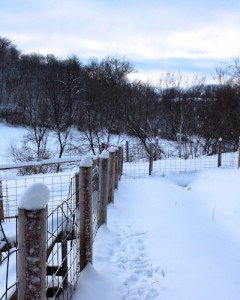
MEANWHILE, back on the farm: Snow snow snow snow. Did I mention it’s snowing? It’s snowed here almost every other day, although yesterday it began as rain. That’s the worst possible weather scenario you can get this time of year: first it gets everything wet and super slippery, then it freezes into ice and then snows on top of it. It makes everything extra dangerous (the hospital emergency rooms were full to the brim from falls), and creates a hard coating of ice between layers of snow. But I’m still happy we are getting the moisture and that we have a real winter this year. I will admit I’m getting a little cabin fever-y, but I’m so glad that the earth is getting back some of the moisture that we missed last year. We were 12 inches down and in “severe drought” through fall, so I hope that all this snow will soak into the ground come mud season. But right now it’s all about the snow. We didn’t get the huge storm that is probably hitting the East coast right now, just got 3-4 inches yesterday, but it’s still basically a white and blue/grey world out there. I love the way the snow tops off the fence posts, like whipped cream on a sundae:


Expectations: Adults versus Puppies

Wednesday, April 20th, 2011

Karen London and I are working on our edits to the new booklet on adopting adolescent and older dogs, and something hit me as I was writing that I thought was worth talking about. After considering my own experiences bringing “non-puppies” into my home, talking with folks in rescues and shelters, and working with clients for so many years, it strikes me that one of the biggest problems people have when they adopt an “older” dog (not old, but not puppy either) relate to unrealistic expectations.

I don’t mean that in the usual sense, say, for example, expecting a dog to behave perfectly on day one, but more in the sense that we have certain expectations of adults that we don’t have with puppies. Take house training, for example. Everyone expects puppies to have “accidents” in the house for a few weeks or so, but people are often shocked and angered when an adult dog urinates on the rug just hours after arriving. But of course, most dogs aren’t “house trained” in the sense that we define it (always go outside, never inside) but are trained not to go in a particular place. That doesn’t mean that they can generalize what “house” means, given that they don’t have access to our brains and can’t download the way we see the world.

In my experience people don’t realize how important basic house training is for the first few days when an adopted dogs enters the home. This is especially important for dogs who haven’t had much experience in a variety of houses. If they were taught to potty in one specific backyard and not in a specific living room, why would they generalize that to another location? The fact is, some do and some don’t, so it’s job one to pay attention when you first bring a new home dog. This doesn’t seem like rocket science, but I think it’s not intuitive, and I suspect that our reactions to an adult dog urinating in our houses are more like those we’d have if an adult human peed on our living room carpet. (Yuck, what an image, sorry!).

Staying close by and coming when called seem to present a similar disconnect between “puppy versus non-puppy.” Young puppies have an inherent follow response, and we don’t need to do much when we bring them home to keep them close by. Of course, we’re wise to start recall training right away, but it’s seductive to forget that and imagine your pup will follow you everywhere forever. All this relates to one of the biggest problems that I see owners, shelters and rescue group deal with: dogs who are either let outside off leash intentionally, or escape out the front door or through a hole in the fence and can’t be called back. I’m sure I don’t need to tell you that this causes no end of grief for the dogs, the fosters and the new families. Yet, it seems ever so common to expect an adopted dog to behave like a puppy and follow you everywhere, leashes be damned.

I’d love to hear your thoughts on this: What did you find surprising, or important to remember if and when you brought home an adopted dog who was well beyond puppy hood? I’m sure your stories will be helpful to us all.

MEANWHILE, back on the farm: Brrrr. Snow, sleet, hail, thunder and a ridiculous amount of stuff in between fell yesterday, but at least we escaped the damaging storms that plagued so much of the country. I hope you and yours are all safe and sound. Anyone out there need some sympathy?

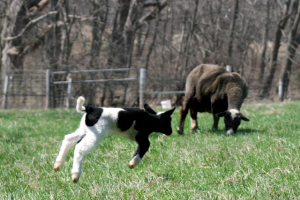
This weekend some dear friends came to help with the sheep chores, and then we all got reinforced by being able to let the lambs out of the barn and go up the hill for the first time in their little lives. The day was warm and sunny (very rare this spring!), and we soaked up the breeze, the sun and the green grass like sponges. As you can see, the lambs seemed to like it too.

xx

A Great Laugh: Dogs Finding Nirvana

Saturday, April 2nd, 2011

My posts will be a bit shorter and perhaps less frequent in the next few weeks, but I couldn’t resist passing on a blog post from Bark Magazine that gave me the best laugh of the week. It’s about a reported (so yes, this is a story about a story about a story) who read that a dog sold in China for 1.5 millions dollars and reminded us that the dog, a Tibetan Mastiff, is believed to be the reincarnation of a Tibetan monk. I suspect I laughed especially loudly because, like many, I can get truly silly when I’m tired and 2) I go on and off the meditation wagon like a five-week old puppy in and out of a whelping pen (I’m currently back on it, but someone better tie me up to keep me there).

The Bark blog was written by my colleague (and co-author); here it is: Karen London’s Bark Blog.

MEANWHILE, back on the farm. Yesterday it snowed, today it is sunny and warm and tomorrow it is supposed to snow again. Ah, April in Wisconsin. Jim is up north, but this weekend I am staying  home to work and hopefully, deliver lambs. I have 3 ewes due to lamb (Spot was due Wednesday), but none of them have read that particular chapter. This morning I spent some time cleaning out the barn (still needs lots more work, so maybe it’s good the ewes are waiting for me) and went up the hill to pen up the sheep before the truck comes to fertilize the pasture (which needs to be done before a good rain if at all possible). So there we were: me, Wilie and the flock, all staring at each other in the bright sun and blue sky, and I lost my head, and yes, yes, I did it, I said “Go Away” and let Willie run around counter clockwise and gather them to me. His shoulder is doing well, we’ve done his exercises religiously, the surgery is coming up in May, and I decided that one brief moment of joy wasn’t going to hurt anything. I wish I could have taped it: watching him run in a huge circle, back lit by the sun and the sky, to gather up my girls made my heart sing, and judging by his demeanor when he came back, his too. Ooooh, I miss herding with him so much, I can barely describe it. We’ll be good again until the surgery, as good as we can be anyway, but I’m glad we had our little moment. Sometimes you just have to take care of your soul as well as your body.  Meanwhile, patience, Trisha, patience.

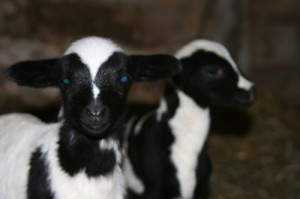
Here are 2 of the triplets: (And no, they don’t have blue eyes, that’s just the tapetum reflecting the flash. You can’t ‘fix’ it with the ‘red-eye’ function and I didn’t have time to mess with it, even thought it was sort of cute.)

Here’s Barbie, climbing the fence in hopes it will get her the grain I’m giving the mom with triplets. We call Barbie Explodo Ewe every year around this time. For good reason.

And the Winner Is!

Wednesday, March 30th, 2011

As many of you know, we asked for photographs of dogs to grace the cover of our new booklet on welcoming an adopted dog into your home. Karen London and I are working hard on the text right now (too short?! no, too long!? rinse and repeat . . . ) but I can tell you that the official title is Love Has No Age Limit and after looking at over 700 photographs (wow!) we have settled on the photograph you see below.

So here he is: A dog named Theo, who like many of the dogs whose photos were submitted, came with an amazing story. He was found running loose along a highway in New Jersey, and sat in a shelter for 3 months before Kimberly Wang of Eardog Productions in New York found his picture on Petfinder. Kimberly spent three hours with him at the shelter, and was entranced by his eagerness to learn and his “natural tendency to make sustained, relaxed eye contact,” in spite of being an untrained, goofy adolescent. She brought him home and now he is an accomplished photo model, a Licensed Service and Therapy dog, and a friend to all he meets.  I love that he is named after Theo Van Gogh, the painter’s brother who devoted his life to supporting others, just as Theo the dog is doing today.

But, wait, there’s more . . . So many great photographs came in that we are going to use lots more of them by putting another photo on the back cover and starting every section with a picture. We’re also going to put a selection of photos, and the stories that came with them, on a page on the website, once we get then selected and approved by their owners. That’ll take us a few weeks perhaps, but stayed tuned, we’ll let you know as soon as it’s up.

Here’s Theo:


MEANWHILE, back on the farm: Triplets! Rosebud had the first lambs of the spring, 3 little ewe lambs who are terminally cute. (Check out their photo on Facebook!) More than that, bless them for having full bellies when I discovered them in the morning. I had said that I hoped Rosebud would continue her history of having healthy lambs all by herself, producing just the right quantities of creamy, colostrum-rich milk and being an attentive mom to two healthy lambs.  She did all that but went one better, by having triplets. I shouldn’t be surprised, she had triplets last year too. What a girl.  Next up is Spot (due today, but this line seems to be later than the woolly breeds by 2-4 days, Rosebud was actually due last Friday) and then the noble Dorothy and the piggy ewe, Brittany, who are both due on Saturday.)

Willie is thrilled to be off leash right now, although still no playing outside and no herding. The herding restriction is hard for both of us; it’s great weather, the ground is dry and it would be good for the sheep to move around. We’ll just have to be patient, surgery is scheduled for May 14th. I’d do it sooner but Jim’s family comes first. Willie’s is doing his exercises 3 times a day (with a few exceptions during family crisis days) and he is getting visibly stronger on both shoulders. We’ll post a video of his exercises as soon as we can get them.

Lastly, thank you to everyone who sent best wishes to my family. Jim’s sister is finally back in her own home, under hospice care. We are also incredibly lucky to have a family member who is a nurse, and she is there pretty much 24/7. Jim and I will go up to visit as often as we can. One day at a time . . . a good reminder to all of  us to live one day, one minute, one moment at a time.

Your Dog on A Book Cover?

Tuesday, March 15th, 2011

As many of you know, Karen London and I are writing a booklet for people who have adopted an adolescent or adult dog. We’re hoping it will be useful not just for individuals, but also for shelters and rescue groups, and ultimately for the dogs themselves. Right now our first draft is out to readers, looking for feedback about how to make it as good as it can be, and we’re working on the cover.

That’s where you come in. We’ve been looking at commercial photographs, trying to find just the right one, and so far nothing has struck us as THE picture. And then I thought of you  . . .I know that many of the blog’s readers have dogs they’ve adopted as adolescents or adults, and how cool would it be if we could put one of YOUR dogs on the cover? So here’s the deal:

If you think you have a cover-worthy photo of a dog you adopted, send it to photos@patriciamcconnell.com, paying careful attention to the following criteria: Because the photo is for print, it needs to be higher quality than something that you can send over the internet or your cell phone. The photos need to be at least 300 dpi (dots per inch).  (I first typed ‘dogs per inch,’ apparently if my fingers start with ‘d-o-’ they can’t stop adding a ‘g’). The size should be no smaller than 1500 by 2100 pixels (that’s a 5″ x 7″ equivalent in print photos). The images should be in .jpg or .tif files.  Please, absolutely only 3 photos from any one person of any one dog. Of course, if we select your photo, you’ll have to sign a release for us to be able to use it and please, don’t send any photos that you do not have the rights to (basically, best if you’ve taken them yourself or a good friend took). Please send any photos by Sunday, March 20th.

What are we looking for? Well, our first vision was of a dog’s head, looking straight at the camera. I suspect that might be the best photo for the booklet cover, but if you have a photo that is different, maybe a full shot of your dog, or something special with you and your dog, go ahead and send it. Warning: Any formal kind of picture of a person posing with a dog–the kind in which person and dog sit shoulder to shoulder looking at the camera is NOT what we are looking for, so don’t bother sending one like that.

MEANWHILE, back on the farm: Well, I’m not there, I’m in New York City, talking to literary agents and editors about a new book. I thought I’d be thrilled to leave, and to get a break from all the restrictions on Willie, but it turned out to be ridiculously hard to go. Willie, Jim and I have all adapted (the 3 week rule strikes again) and although Willie’s life is boring and ours is stressful trying to keep him from using his shoulder, we’ve all gotten used to our new life. He does his exercises 3 x a day, and of course that is now part of his fun (although standing on 3 legs, one of his exercises, clearly bothers him so we only do 7 reps instead of 10). He’s given up trying to play with his toys (breaks my heart to write that) and we’ve all adapted to a new routine. But oh, it was hard to go; I’ve been micro-managing his life now for a month, and it’s hard to let go. Must be like having kids! But my house sitter is amazing, she’ll be fantastic I  know and Katie from the office is also being a huge help, going over every day and letting him out to potty during the day. So he’s in great hands, I know. But, still. You know . . .

We are enjoying New York though, and it’ll get even better soon. Meeting with my literary agent for lunch, going to Peter Luger’s for dinner with some great friends we met on the last African safari, going to a Broadway play tomorrow (only been once, and never with Jim,  can’t wait) and getting to visit with Leslie Meredith, the amazing editor of The Other End of the Leash. She taught me so much about writing, is a total dog lover (she has Corgis) and an all around delightful person. It’ll be great fun to catch up with her.  We ate the best pizza I’ve ever had last night (sorry Chicago, you totally lose the pizza wars!). All this is damped down by the heartbreaking news from Japan; I am holding everyone there in my heart and don’t go a minute without hoping for some good news. (And of course, that’s not enough, we’ll donate what we can, as we did for the NZ earthquake.)

Here are some photos of mine, just some images that might get you thinking about the photo you’d like to send in!

Helping Puppy Mill Dogs

Tuesday, March 8th, 2011

This weekend I visited a wonderful woman doing rescue for small breeds, mostly bichons from puppy mills. I had somewhat randomly discovered that she lived close to me, and went to visit in hopes I could help out a bit. I also had a selfish motivation: as many of you know, Karen London and I are writing a booklet on adopting an adolescent or adult dog, and we are always looking for input from people in shelters and rescues.

There were 4 or 5 dogs from puppy mills that were terrifically shy; so much so that they ran  away from people, even after being there for a very long time. Obviously, this is a very common problem in dogs who grew up in almost total isolation, and was one of the challenges she was facing I hoped I could help with. We had one session, and it looked like it might be very helpful to use the methods described in The Cautious Canine. We put all the dogs away except 2 of the cautious ones, and I sat on the floor and tossed treats toward the dogs, who started a good 15 ft away from me. At the end of 20 minutes, the dogs were within 3 or 4 feet, and most encouragingly, they followed behind me when I got up and moved toward the door. Of course, this is going to take a long time, but we were both encouraged at how well they responded.

In my experience, how the dogs ultimately respond depends on their genetics. All of them have had no socialization (at best, at worst been abused by people) and how they cope with a new environment is mediated by their genetics. If they are naturally shy they are probably never going to be comfortable around strangers, but could learn to be comfortable around their ‘family.’ If they are naturally a bit bolder, who knows how far they can go?

The key to getting this to work is to not go too far at any one time. I never leaned toward the dogs, never tried to pet them, and never threw the food too close to me. If they had to stretch to get the food, back legs planted and body ready to bolt, the food was too close and I’d be careful to throw it further away the next time.

I suspect it also helped to have 2 dogs there at once, acting as a bit of competition, and perhaps also as a bit of a role model. As one dog would come closer, it encouraged the other to do the same. Too many dogs would probably end up causing trouble, and of course you’d want to avoid 2 dogs who were aggressive over food, but I like the “model/rival” aspects of this. We’ll go back when we get back from NY and Chicago (Clicker Exp, oh boy!) and keep it up.

I’d love to hear your stories about helping dogs from neglectful or abusive situations: Besides patience (we mention that so often in the draft of our booklet we are afraid people will lose patience with us….), what did you find most helpful?

MEANWHILE, back on the farm: Willie got to be off leash a bit on the weekend; based on the vet’s instructions to let him move a bit more before his appt at UW on Monday. Oooooh, what a joy to see him finally free, eyes shining, body spinning and mouth happy. But all that ended after our PT appt on Monday: the PT was able (yeah for her) to see him favor his left leg and she advised that he go back on leash for a long time. We still don’t know what’s wrong, so I am getting a second opinion from UW’s orthopedic shoulder specialist (oh yes, I am very very lucky to have all these resources close by!) That appt is for March 21, so we’ll have to wait til then to see if the condition is surgical or not in her opinion. Even if it’s not, best estimate is it’ll be 3-4 months before Willie is recovered, and lots and lots of leash restrictions until then. If surgical, could be longer.

Tough news for Willie, he looked absolutely miserable when he came back to the house and had to stay on leash. Tough news for me; I don’t need to tell you how hard it is to not be able to explain to your dog why you are taking away all his fun. And I had entered him in a wonderful herding dog trial (the Bluegrass) in KY in May. Been wanting to enter that with my own dog for 20 years. No chance for that, looks like trialing is pretty much out for the season. And Jim and I have agreed to start fostering again; we actually had a dog lined up to come to the farm any day. (No, not from the place I mentioned above, but who knows someday? Every farm needs a Bichon? But for right now, that’s out too.)

Yes, you bet, we’ll play lots of games with Willie and I’ll figure out new tricks to teach him, but his greatest loves in life are 1) to run, 2) to play with toys (which he does so vigorously that we have no choice but to take them away, and 3) to work sheep. Ah, I know that soooo many of you have been through this; we did this for 5 weeks when Willie was 10 months. We’ll get through it. But ouch. So, it’s on leash and PT, acupuncture, chiro, supplements and meds (western and eastern) for 2 weeks, then hopefully we can at least figure out what we are dealing with.

Here’s good news though: Saturday was great fun. 10 students from the UW Small Ruminant Club came out and learned how to use ultrasound to do pregnancy checks on ewes. The shearer also came out, so they also got to help with that, along with hoof trimming and vaccinating. The ewes are all well along (first one due 3/25)  so it wasn’t a mystery that they were bred, but still there was lots for the students to see. (Me too, it’s a fascinating technology.)

Here’s Lady Godiva being ultrasounded, and illustrating something related to the fearful puppy mill dogs discussed above. In person she actually looked quite  ‘relaxed,’ which is typical for sheep in this position. As did she, they often stay still on their own, relax their forelegs and heads and look almost sleepy. But outward appearance isn’t always a good indication of internal state, and research at UC Davis found that sheep in this position are flooded with cortisol, suggesting that they are in ‘tonic immobility’ rather than relaxed. That can also be true of our dogs; they seem ‘calm’ but are actually frozen with fear. Very typical of puppy mill dogs I’m sad to say.

Booklet For Dogs from Shelters or Rescues

Wednesday, October 6th, 2010

Karen London and I are planning on writing a booklet for people who adopt dogs from shelters or rescue groups. We’re both aware that often it can be intimidating to sit in your living room with a new family member, whose background you may not even know. Over the many years that we’ve worked with people who have adopted dogs, and with our own dogs that we have taken in from difficult circumstances (5 between us), we know that these dogs can present challenges, and generate questions that are not often answered by standard training books.

We have our own ideas about what to include in the booklet, we’ve already written an outline, but we’d love to hear from you too. If you have a dog that you obtained from a shelter or rescue group, or adopted an adult dog who might have had a difficult past, what did you want to know when you brought the dog home? What do you think are the most important things for adopters to know? Keep in mind that we are envisioning a relatively concise booklet, not a full-length book. Pat Miller has written a good full-length book on the topic, Do Over Dogs, and it’s a great resource. We’d like to create an affordable booklet for rescues and shelters to hand out to adopters that hits the highlights and emphasizes what is most important. We both know already that the challenge is going to be keeping it short, but we’d still love to hear what you think should be included. The readers of this blog have a vast amount of knowledge, and what a great thing it would be to share it . . .

MEANWHILE, back on the farm: Willie and I just got back from a long walk, working our way up to the Milford Trek in New Zealand. I still can’t imagine walking 13 miles with a full pack yet, but I’m getting a tad closer anyway. We walked for about an hour, as fast as I could, with a pack about half full. That was fine, but then when I came home we trucked up the steep hill behind the house and I was, uh, tuckered. Willie worked the sheep, which involved some good, fast runs, brought the sheep down to the grass in the front yard and worked with me to keep them there, safely out of the road, and then came inside, picked up his current favorite toy and begged to play fetch. Maybe he should go to NZ and do the hiking?

Here’s one of my favorite and easiest fall recipes; I got it from some dear friends who love good food as much as I do: Cut Roma tomatoes in half, drizzle with Olive Oil and sprinkle with Basil, put in oven on 300 til soft and condensed. They should shrink to at least half their original size. It can take up to 2 hours. Use right away or freeze, they last all winter in the freezer.  I use them in pasta, (Linguini with homemade Pesto–made that too last weekend–with braised greens & melted tomatoes, yummmmm) or as a side dish, etc etc. They are like concentrated tomato-ness; I think of them as Tomato Haiku. (The green on the side is basil I added after cooking just to make the photo pretty.)

And here’s one of my favorite prairie grasses, Little Bluestem, shining in the sun in the park where Willie and I walked.

Have an Example of a Creative Reinforcement?

Tuesday, June 8th, 2010

I’m working on a column for Bark magazine about positive reinforcement. It’s such a simple concept once you get it, but it’s a bit like riding a bicycle . . . it takes awhile to be able to do it comfortably and effectively. In the column, I want to stress that it is the receiver who defines what is “positive reinforcement,” not the giver. I find that to be one of the biggest mistakes that we humans make: doing things we think our dogs like, that they actually define as aversive (and therefore act as positive punishment, exactly the reverse of reinforcement!).

The most common example of this mis-communication is when people praise and pet their dogs either in ways the dog does not enjoy (especially patting on top of the head) or at a time that the dog doesn’t want to be petted  (while playing with other dogs for example).

One of my goals for the column is to broaden people’s definitions of “positive reinforcement,” and I’m going to provide some examples of things we humans might not think of off the top of our head. Here are my two favorite examples. One is from Karen London, Ph.D.. CAAB, (who writes a great blog for Bark by the way). She was out in the country with her newly acquired lab cross when they flushed a deer. She called Bugsy to come just before he sprang off in pursuit, and to her joy and amazement he turned and ran back to her. Alas, she had mistakenly left her treats in a different jacket and had no treats with which to reward him. She couldn’t even take off running to let him chase her because she was in cross country skis in cross country ski tracks, facing the wrong way. But, ever the quick thinker, Karen reached into her pocket and took out a used tissue and gave it to Bugsy when he arrived. Voila! Her dog was thrilled at this acquisition, and Karen’s creative thinking laid a foundation for a solid recall for years to come.

My second favorite story, (continuing along the lines of “yucky things that dogs love”), was at my farm when I had an Advanced Outdoor Training Class. One of the students had a hunting dog who had no interest in anything but sniffing out wild birds and eating sheep poop. Now, if you’re not familiar with sheep, sheep poop comes in piles of small, dry pellets that producers call “berries.” And it’s just grass, after all, albeit a bit recycled. But that explains why I suggested my student just pick up a handful of sheep berries, put them in her pocket and use them as reinforcements. There were no parasites in them that could harm a dog, and although one wouldn’t want to give too much to a dog at one time, they were the perfect reinforcement for this dog at that particular time. Jokes  have been made that if times get tough I could package the stuff and sell it . . . but as effective as it was (it IS what the dog wanted, after all!), I don’t think I’ll find a market for it.

Here’s my question for you: Do you have an example of a creative reinforcement? Something your dog loved that is beyond the usual dog treat-exuberant praise-click & treat menu that we all know and love? I’ll bet many of you do, and I sure would love to hear it. If you send it in, I might use it in the column, so no secrets!

Meanwhile, back on the farm: Rain rain rain. Sure is green here, looks like Ireland. Life in general has been a tad challenging, what with a young puppy and Jim’s arm in a brace and my injured knee (but good news — no surgery.. yeah!  It’s supposed to be as good as new in two months, phew.). Hope and Will played much of the day  yesterday, so good to see. Will gets tired though, and so today he seemed like he needed a rest. I am quick to let him go upstairs when he looks like he needs a break. I sympathize!

Hope shows no signs of wanting to stalk Sushi, but boy does he want to play with her! What an irresistible play bow.


Unless, of course, you are a cat:


But here’s a highlight: we’ve been working on coming away from the cat when called, and bless his furry little heart, Hope came off right away when I said “That’ll do.” Good boy. Of course, we’re working on not bothering the cat in the first place, but hey, it’s only been 3 weeks. In the photo below I’ve just called him, he is just turning away and is starting to come toward me. Jackpot . . . that was worth 10 treats in a row from the treat bag. (and do you love the look on Sushi’s face?)


Feisty Fido, Second Edition

Thursday, July 23rd, 2009

At the risk of being self-serving, I wanted to let you know that the Second Edition of Feisty Fido is now available. Little did Karen London and I know, when we took a look at the first version before reprinting it, how much time we’d end up spending revising it. True confession: when a few months ago I re-read the first version, written in 2001, I thought, “Oh my, it is truly time to revise this!.” (Karen had the same response that I did, and, as usual, we were “on the same page” about it, so to speak.) I do think that the booklet has helped a lot of people and a lot of dogs, and that makes me happy, but I am even happier to have an updated, revised, updated and lovingly, tweaked new version available.

For those of you who know the book, here are the primary differences:

1) There is a new section on equipment, that includes front-attachment harnesses and our experiences with harnesses versus head halters.

2) We dropped the release word from the end of the Watch cue. We found that owners and dogs quickly learned that Watch means “turn your head and look at me” but struggled with the “look at me until I release you” aspect of the cue. It seems that letting a dog look at you and then turn back and look at the other dog again isn’t a problem with many dogs, indeed it gives you another chance to say Watch again. We do discuss the exceptions: for example, dogs who are so aroused when they look at another dog that they are unable to contain themselves, even at a distance. Some of these dogs do seem to improve the most if they are asked to maintain the Watch until they are released. But they are by far the exceptions, not the rule and I really like dropping the release aspect of the cue for the sake of expediency. (Note that several readers concurred when I brought this up in an earlier post.)

3) We revised and expanded the section on “Where’s the Dog?,” agreeing with Leslie McDevitt (Control Unleashed) that teaching a dog to look at another dog on cue can be just as useful as teaching them to turn away. Which cue is best, as usual, depends on the dog, and we discuss that in more depth in the new version. By the way, if I haven’t mentioned this before, I used Watch on Willie when he was at his worst with unfamiliar dogs (and “worst” was pretty bad, believe me), then switched to “Where’s the Dog” (which is what I use now, and he goes all gooey and waggy as soon as I say it.) Not surprisingly, I like having both cues in your pocket, but I don’t think that’s necessary for all dogs. I am interested in the fact that both Watch and Where’s the Dog result in the same operant behavior (look at dog, look at owner) and the same classically conditioned response (look at dog, feel good).

4) We include brief discussions of alternatives like Abandonment Training and C.A.P. and the situations in which we find them most useful.

5) We revised the resource section at the end.

6) We both thought the writing in the first version needing some tweaking, so we wrote, like, sorta better throughout the booklet.

We, as always, would love feedback, so let us know, through the blog or emails, what you think. Before we know it, it’ll be time to reprint it again!  You can also reach Karen, by the way, through her own blog at Bark Magazine’s Blog Site.

Meanwhile, back at the farm: Will and I worked on picking sheep off a fence when another group was beside the fence on the other side. It went well, but it was clear that Will found it stressful. I stopped and let him do an easy, open outrun to end on a relaxing note, and then played lots of tug later that night. Good boy Willie, good boy. (Uh, have I said that before?)

Feisty Fido, Prompts and Lures in Dog Training, Advanced Canine Behavior DVD

Thursday, June 18th, 2009

Karen London and I are revising Feisty Fido: Help for the Leash Aggressive Dog, and I find myself fascinated by how perspectives and techniques change over time. We’re not changing the essence of the booklet, far from it, but there are a few things that are being modified because of our experiences and gains in knowledge since we wrote it.

Most of the booklet will remain the same–especially the emphasis on teaching an incompatible behavior when a dog barks, lunges or behaves problematically toward another dog while on a walk. But we are modifying some of the advice, and I’m interested in your experiences related to our recommendations.

First off, we are putting less emphasis on the importance of teaching “Watch” to mean “turn and look at me UNTIL I RELEASE YOU.” For those of you not familiar with the booklet, the first step in a Feisty Fido program is teaching a dog to turn his head toward you and look at your face when you say “Watch.” Once this is mastered in an area with few distractions, the owner tells the dog to Watch every time he sees another dog, working up to a dog who “AutoWatches” every time he sees another dog on a walk in the neighborhood. This not only teaches an incompatible response to the sight of another of the same species, it classically conditions a dog to feel relaxed and happy at the sight of another dog (changing “Oh NO!” into “Oh boy!”).

Over the years we’ve found that most owners have more trouble with the release than the cue Watch itself, and most importantly, that most dogs don’t need to stay fixated onto their owner’s faces until they hear “okay.” After all, if they turn and look away from the approaching dog and get reinforced, what’s the problem with looking back at the other dog and providing another reinforcement opportunity when Watch is said again? Granted, there are some dogs who need to keep their eyes on their owner’s faces–the ones whose response to the sight of another dog is totally out of control for example, but most dogs do just fine if you teach them that the sight of an unfamiliar dog is the cue to look toward your owners and get a tasty treat or a session of play.

The other modification of the booklet is an emphasis on dropping out prompts or lures early on, in order to avoid a smooch or a hand movement from becoming the cue (instead of the word Watch). We wrote Feisty Fido in 2003, six years ago, and since then we’ve become much more cautious about owners inadvertently teaching a dog that the cue to turn your head is a smooch or a movement, rather than the word watch or an approaching dog itself. It’s so easy to say “Watch” and encourage what you want with a smooch or a movement and end up undermining the power of the cue you want to use. In the new version of Feisty Fido, we advise people to see first if their dog will turn his head just to the sound of the word itself. If that isn’t effective, we suggest prompting (with a smooch to get the dog’s attention for example) or luring (by moving food a few inches from the dog’s nose and luring it toward your face) three times in a row, and then saying “Watch” all by itself and waiting at least 3 seconds for the dog to turn toward you (and then JACKPOT if he does!) This is effective for all but the most distractable of dogs (note one is doing this at the first stage of training in an area with no or few distractions, and never around another dog!).

Those of you operant trainers know that in a ‘purely’ operant modality one would not use a prompt or lure at all, and merely wait for the dog to turn his head toward the owner. In my experience, this requires far too much time and patience for most people (okay, you’re right, ‘most people’ includes me), and that doing something to help the dog get reinforced early on is productive. However, as I learn and grow, it is increasingly clear how careful we must be to not let prompts or lures become the cue themselves. When I read what we wrote in 2003, I can’t help but want to revise it.

Of course, I want to revise just about everything I write as soon as it comes from the printer. I am lucky in that early on in my career, I heard Terry Ryan say that every author has to be prepared to disagree with something she wrote as soon as the ink dries. Oh my was she right. I’ve gone back and looked at things I wrote twenty years ago and… well, never mind.

Speaking of a long time ago, we’ve had a sale on the Advanced Canine Behavior Seminar DVD and it flew off the shelves. It was recorded in 2001, and I have to admit I’m curious about what’s on it! I swear I don’t remember… If anyone has watched it and wondered: “Does she do that anymore….” or something similar, don’t hesitate to ask in a comment. Someday I’ll get the nerve up to watch it myself.

Meanwhile, back at the farm, it’s summer now, humid but still rainy, green and lush and fertile. The peony flowers are falling apart, looking like blousy ‘ladies of the evening,’ with too much make up on. The daisies are rioting white and yellow and the wild black raspberry bushes are full of tiny fruit buds. Willie and Lassie were so glad to see me when I got home Tuesday night from Maine that I’m still all oxytocin-y about it. Martha the older ewe still isn’t right, even with a different anti-biotic and wormer, but her lamb is thriving, as are all the lambs, who doubled in size for the five days that I was gone. Okay, maybe not quite that much. Jim finished the carport beside the garage, and it looks stupendous. What a guy. I may be able to turn around a problem dog, but anyone who can build an entire wooden structure that doesn’t fall apart in a few days is a miracle worker in my opinion.

After all that I should send you photos of the farm, but I haven’t taken any since I got back. Here are two photos from New Hampshire, one of Squam Lake (of “Golden Pond” fame) and one a typical forest stream that feeds the lake. They make me smile just to look at them, remembering how peaceful they are in person. What is it about water that is so relaxing?