Welcome to the official Patricia McConnell website. Skip directly to: main content, navigation, search box.

Posts Tagged ‘Ken Ramirez’

Hi from the Madison Seminar

Monday, October 31st, 2011


Wow. What an amazing experience for me, and I hope for the 250 participants in the Madison Seminar. We spent the weekend immersed in hot-off-the-press research on canine behavior, (I was worried it would be too wonky but apparently I’m not the only one starved for intellectual stimulation about dog behavior!), and Ken Ramirez’s inspiring wisdom about training, well illustrated by compelling videos and stories. You just can’t listen to this man talk and not be a better trainer for it. We were even honored by the presence of David Wroblewski, the author of the deservedly best-selling and instant American Classic, The Story of Edgar Sawtelle.

I’m basically brain dead today, able only to mumble monosyllabic nonsense, but I’m looking forward to lots of posts inspired by the weekend, from articles about some of the research I talked about, to some of things we learned from Ken, to answering some of the many questions I was unable to answer, and even to posting some data from an experiment we did on Saturday. But here are some photos from the weekend.

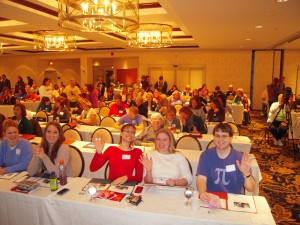
Here’s just some of the participants before we got started after lunch on Saturday.


Here I am torturing Meeka, one of our cover dogs from Love Has No Age Limit. Like all the dogs in the book she was rescued (found as a stray in this case) and adopted by Shannon who brought her to the seminar. What a treat for me to meet her.


And here I am with Ken, attempting to have his training skills flow into me in some kind of magical transfer… I’ll let you know if it works.

Early Bird Seminar Registration Almost Over
Wednesday, September 28th, 2011

My eagle-eyed conference coordinator, Katie, asked me to remind you all the early bird pricing (about 10% off) for the Madison Seminar on October 29 and 30th is over at midnight on Friday, September 30th.  The host hotel also has a special conference rate that expires on Friday too, and space for the seminar is limited (and registrations are pouring in, wheee!) so if you are thinking about coming, now’s the time to act. As always, if you are a blog reader please, please come up and say hi. I always love to meet readers in person. I also should mention that you can get up to 20% for groups of 10 and over, 10% off for 5 to 9.

I’m having a ball getting back to working on the seminar now that we are back from Scotland. Have I mentioned how much great research has been done on dog behavior lately (finally)? Did you know, for example, that ambidextrous dogs have higher levels of noise phobias than left-pawed dogs? (About the same percentage of dogs are left-pawed as people are right-handed. Cool, hey?) I’m working on genetics and behavior right now, and trying to figure out how not to spend the entire day on it. Don’t worry, I won’t. Too much to talk about regarding developmental effects on behavior, learning, communication, social systems, etc. I’ll be talking about all that on Saturday and soaking up Ken Ramirez’s practical advice, inspiration and amazing videos on Sunday. It’s coming soon. Oh boy and Eeeeeps! Get to work Trisha.

MEANWHILE, back on the farm: Willie and I went on a 35 minute walk yesterday in one of our favorite places, a county park of prairie and woods that was flaming with bright red sumac and soft purple asters. Although it was still on leash, it was our longest walk since February, and it was one of the first times I felt like maybe life will someday get back to normal. What a treat. We’ve started on the Hobbles for brief periods off-leash in the house, by next week he can be off leash in the Hobbles outside for a few minutes at a time. Ooooooooh, can barely wait.

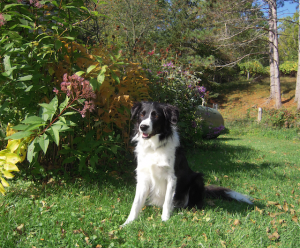
Here’s Mr. Will this morning, leash attached (but hidden, not on purpose) and on a Sit/Stay for the camera.


The Value of Basic Training Skills

Tuesday, March 22nd, 2011

Here’s one of the great lessons Ken Ramirez had for us at the Clicker Expo in Chicago last weekend: The basics aren’t really all that basic after all. In his experience, one of the most common mistakes he sees in even experienced trainers is forgetting the importance of some of the basics. Here are some of the reminders he shared, and believe me, I am taking them all to heart.

Precision: Yes, we all know it, timing is everything, but no matter how obvious it is, it is often forgotten. This is relevant whether you are using a marker (like a clicker or ‘yes’) or not, often because we don’t do the following:

Clean Delivery: Ken reminded us that dropping the treat on the ground or fumbling the delivery can be very aversive to our dogs. Say we are on a roll, clicking and treating at a good pace, and then we drop the treat on the ground. The dog has to sniff around and find it, and that might not be so much fun for him. At worst he may feel frustrated, and at best he has completely forgotten what he got the treat for by the time he found it. Not a crisis, of course, but a little bit of frustration can have a lot of effect. Ken reminds us to practice delivery WITHOUT our dogs around (supporting my belief that dog training is a science, a sport and an art.)

Where Reinforce? Are you thoughtful where you reinforce your dog? Do you do it where the behavior occurs (say your dog lies down, so you move the treat down to her on the ground) or, in a location set up for the next repetition. There is no right answer, it depends completely on what you are doing, what’s important is to be thoughtful about your goal and consciously choose where to reinforce your dog rather than doing it randomly.

Stationing: If working with two or more dogs, also be thoughtful about who is stationed where. You can avoid a lot of trouble between dogs if you always set them up to work with one on left, other on right for example. Or take a trick from prof’l performance trainers, and teach each dog to go to a station to work. That avoids the potential of competition or veiled threats from one dog to the other.

Fairness: If working multiple dogs, you must recognize how each animal perceives the session. Is each getting her fair share? What if you have two dogs sitting looking at you, and you ask one to lie down. Who do you reinforce? Just the one who lay down? But the other also did what you ask (stayed in place), why not reinforce him too?

These are just a few of things I pondered on the way home, and that made me glad I was able to catch some of the talks at Clicker Expo in between my own. I’d love to hear your thoughts on this… what are the basics that you think you’d be wise to review?

Such great food for thought. If we could all just live on Ken’s shoulder for a week we’d all be better trainers, I’m sure of it. Check out his website, he really is a great resource. I’m even more excited than ever now about him coming to Madison this October.

MEANWHILE, back on the farm: Here’s the good news — we know what’s wrong with Willie’s shoulder. Besides an inflamed bicepital tendon, his has a bone chip floating around in his shoulder, probably from an earlier injury when part of the tendon was torn and pulled a piece of the bone away. Here’s the bad news — he will need surgery, but I’ve put it off until May because this time of year is the worst possible time imaginable for me to have a dog recovering from surgery, and Dr. Susan Schafer at UW  (who is just as wonderful as everyone told me she is), said the surgery wasn’t urgent in any way. The timing is especially relevant because we got some painfully bad news the morning we arrived home. Jim’s sister has been in a valiant battle with Stage 4 Ovarian cancer and it looked a few weeks ago like she might come out the victor.  But things changed fast while we were gone, and she’s not doing well at all. Jim will be up with her as much as he can in the weeks to come, as will I, although I’ll have to stay home more because of lambing, teaching, etc.

So May it is for Willie’s surgery. Dr. Schafer will take out the bone chip, sever the tendon, drill a hole in the bone and screw the tendon back into place. (She has gone back to this method, as have several other experts, after finding that truly athletic dogs don’t do as well with a simple severing, which is commonly done now.) This is the same exact surgery that Jim had about the same exact time last year. Good grief. That means all trialing is out for this year, we won’t really be able to work sheep until August or September. But it does mean he can be off leash a bit, no herding or hard play, but at least some freedom after five weeks of no fun at all.

Here’s Mr. Will, with his shaved shoulders, a mohawk down his chest and still slightly sedated goofy look. This morning I got to take his leash off! Ahhhhhhhhhhhh.

Seminar Registration Open!

Tuesday, February 15th, 2011

With virtually no objectivity what so ever, I’m excited to announce that registration is open for a completely new seminar, to be held in Madison, WI on October 29th & 30th. I’ll be working much of the summer on creating an up-to-the-minute summary of what we know about canine behavior and cognition for Saturday, and Ken Ramirez, simply the best animal trainer I know, will knock your socks off with his presentation on Sunday about how to solve training problems and use reinforcements in a way you’ve probably never thought of before. Last summer I left his seminar motivated to train anything that breathed before I could get home to Willie. (I can report that it does not work on TV remote controls in hotel rooms, and okay, granted, remote controls can’t breathe, but I was unable to stop myself from trying.)

I know, I’m not an objective source (I’m doing the presenting on Saturday), but I’m already looking forward to both days. After being frustrated for almost twenty years about how little research was being done on dogs, FINALLY dogs are hot in science and there’s some great new information out there about training, behavior and cognition. I’m not the only one who is excited. We’ve already gotten registrations from as far away as Arizona and it’s only been announced for two days. I truly hope you can join us. If you do, promise to come up and say hello and introduce yourself as a blog reader.

MEANWHILE, back on the farm: Willie, Jim, Brittany, Dorothy and Barbie and I actually left the farm today to do a herding demonstration for my University class. The ewes Brittany, Dorothy and Barbie did not exactly volunteer for this assignment, but they’ve all done it before and weren’t particularly stressed about it. Dorothy and Barbie ran right up the ramp, bless their hearts, but hefty Brittany (she somehow manages to eat twice as much as every other ewe at the farm) had absolutely no intention of getting into the truck. I don’t like letting dogs bite my sheep, so even though Willie was in back sending out “Let me at her!” thought bubbles, Jim kindly pushed and prodded Brittany’s huge frame up the ramp and into the truck.

Brittany, by the way, came to the farm with her sister, Paris (yes, you’re getting the connection here). I named them when they were quite young, before I could have predicted that Brittany would be, uh, with child as a teenager, and Paris never got pregnant after 3 years. Needing my ewes to produce as I do, Paris has moved on to other pastures, while Brittany pumps out lambs like a factory. Maybe if I taught her some dance moves she’d lose some weight.

Willie was a super boy at the demo, I was very proud of him. It’s his third time there (he’s 4 now), and it’s fun to watch him each year as he matures. The first year he was very nervous, and I didn’t let him do much, relying on a dear friend to do most of the demo’s with another dog. Last year he performed well, but was clearly still more nervous than at home,but this year he worked pretty much like Willie at the farm. This was especially nice  because we were doing well with our 2011 commitment to work Willie off the farm until the snows came, but for the last six weeks we’ve been shut down by deep snow. It was fun to finally be able to work him on sheep, even if it was in a small arena. At the end some folks from Animal Sciences brought in a horse and did a great natural horsemanship demo. Was just lovely (thanks Liv and Fawn!).

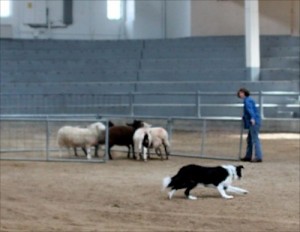
We didn’t get any photos today, but here are some from the same place from last year.

Save the Date! Oct 29-30 Madison WI 2011
Friday, December 17th, 2010

Oh boy oh boy. We’ve just finalized arrangements to hold a seminar in Madison Wisconsin on October 29-30, 2011. Inspired by the seminar I did in New Zealand, I’m going to give a completely updated version of  Advanced  Canine Behavior on Saturday. The day will include state of the art research on cognition, play and development, and its practical implications to owners and trainers. Ken Ramirez of the Shedd Acquarium will present on Sunday, and will focus on raising the bar on your training techniques. I heard him give this talk in Massachusetts last summer, and left so inspired that I began attempting to train my pencil. Seriously, this man is fantastic.

We are totally jazzed about this seminar, and will have details about registration up on the website soon. We’re just finalizing some last details and will get information about how to sign up on the website as soon as we can…  maybe a few weeks or so. I’ll let you know when we can start taking registrations, but save the date now, it’s gonna be a great weekend.

MEANWHILE, back on the farm. Oh man, I have not yet adjusted to living in a freezer. It’s gorgeous, truly, and was even a balmy 18 F recently, but I’m still not used to it. Tomorrow the high is supposed to be 10 F, which is close to my cut off for long walks outside. Willie and I went snow shoeing (okay, only I had on snow shoes) two days in a row, but it was over 10 degrees. Once it’s in the single digits, I get wussy. (And Willie learns new tricks!)

The lambs don’t seem to mind in the least. Truffles’ twins are getting goat milk three times a day, and are growing like weeds. I tried to get a picture of them for you yesterday, but I can’t get them away from me to get a photo! We’ll get some this weekend when Jim can  help out.  But here’s a great photo of house sitter Danielle and Hans Solo, Snicker’s lamb, taken by her husband Mike . Mike and Danielle did an amazing job taking care of things, and they are great photographers too. (The photo of Willie in the last post was also taken by them.)  Get ready for an oxytocin rush . . .

Markers and Secondary Reinforcers

Friday, July 23rd, 2010

We’ve been talking about secondary reinforcers and markers, and the good question has come up about the difference between them. On the one hand, we know that a click or a “yes” can be used to communicate to a dog that a specific behavior is what is about to be reinforced. Clicking or saying “yes” at exactly the right moment is incredibly powerful in that it is a precise way of communicating to an animal exactly what it was doing that will elicit the reinforcement (clicks are more precise than words, by the way).

However, you could also call a click or “yes” a 2ndary reinforcer, since to be effective it is paired with a primary reinforcer like food, and the animal learns to associate the click/marker with the treat, right? So which is it? Ah, you gotta love the English language: sometimes it helps us understand things, sometimes it makes things more confusing.

Let me answer that question from a different perspective. Ethology, the study of animal behavior in its natural environment, spends a lot of time studying communication. One of the traditional ways at looking at communication is to distinguish between the Message and the Meaning. The Message can be thought of as what the sender is trying to convey, whether intentionally or not. The Meaning, on the other hand, is the information the receiver gets from the signal. As every human who has ever been in a relationship knows, those aren’t always the same thing. So in this case, the Message  of a click or other marker is clear: “THAT, what you JUST did, is what will get you a treat!” [I first inadvertently wrote "meaning," thanks to an alert reader for noticing the mistake! Jeez]

At the other side of the signal, we  don’t know what the receiver makes of it–do they have any idea that we are intentionally ‘marking’ a behavior?  Are they consciously aware that the click/yes leads to a treat if they do that exact, specific thing again? (They don’t have to be to perform brilliantly, as a matter of fact we’ve all seen animals perform perfectly and then have it all fall apart, often when they start thinking about what they are doing!) Are they simultaneously or uniquely becoming classically conditioned to the sound of a marker (I think they are being CC’d, no matter what else is going on)… It seems reasonable that our dogs, if we could talk to them, would define the Message of a marker as both a marker AND as a 2ndary reinforcer. Perhaps what is most important from our perspective is how we define it, because that is what drives how we use it.Does this make sense? I have to admit sometimes I worry less about labels and more about actual behavior, but still, it’s a fun intellectual inquiry.

Question for you: I’m curious: How many of you use markers, of any kind, at all? Did you consciously decide to use a marker and follow it up with praise (sometimes, as a 2ndary)…? If you use a marker in the strict sense of the word, what do you use? Click from a clicker? A word?

MEANWHILE, back on the farm: Over 6 inches in the last 24 hours. No kidding. Another 1 to 3 today. Eeeeeps. Last night there were many small tornadoes reported in the area, one not far at all from the farm. I take these babies very seriously, the infamous Barneveld tornado (9 people killed, the town 90% destroyed) freight-trained just one valley away from my farm, less than a 1/2 mile away, and I will never forget the impact of the first view I had of a close neighbor’s farm, metal roofing blown over a 1/2 mile into tree trunks, 5 buildings destroyed, the ground littered with siding and bricks and fertilizer and corn and thousands of things in tiny pieces too small to identify.

I was in town with friends during the worst of it, and we were all happy to return home to find the structures still standing, the dogs, cats, sheep, etc. fine. Sorry, no pictures yet, it was raining, again, so hard this morning when I left that I didn’t want to take the camera outside.

But here’s Hopey-boy (don’t you love knicknames?), a  helpless victim of Sherman the Sheep, who somehow developed a wound in his neck and is attempting to blame it all on an innocent little puppy. Tall two-leg female is not upset, however. Sherman has been played with, tugged upon, bitten, and thrown around every day for a long time, and has shown an impressive amount of stamina. Besides, we just got in Polly the Pig (seriously) to sell on the website, and Tall Two-Leg is forced to take her home for the dogs to try out. Poor dogs.

Using Secondary Reinforcers – Wisdom from Ken Ramirez

Tuesday, July 20th, 2010

I wish the world could have seen Ken’s seminar on Sunday in Worcester MA, it was fantastic. For those of you who don’t know his name, he is the Training Director and Senior Trainer at the Shedd Acquarim, has trained exotic animals for over 30 years, and could train just about anyone to do anything. I left inspired and crazed to train something, anything, and had to stop myself from trying to teach the flight attendant to scratch her head on cue.

When I got home, close to midnight, I sat down with Hope and taught him to flip his hips sideways while lying down to “Settle” before I even walked upstairs. Took five minutes. Scary easy, and extra fun because of being inspired by Ken.

However, in order to get home Sunday night, I had to miss the last hour of Ken’s videos. I heard they were great… anyone care to tell us what I missed?

Here’s what I didn’t miss: some excellent points about what are often called “Secondary Reinforcers.” [Note to training geeks: there are some details about terminology that Ken went into that I found fascinating, but it would take a couple of posts to explain them, and you're better off going to see Ken in person if you are interested in terminology.] But here is a summary of points that I think are  relevant to all of us:

First, many of you know that “Primary Reinforcers” are things that are inherently reinforcing (that automatically cause an animal to increase the frequency of a behavior). Strictly speaking, they are things that an animal needs to survive: food, water, etc. When you give your dog a treat for sitting on cue, you are using a primary reinforcer.

Secondary reinforcers are things that are learned by an animal to be associated with Primary Reinforcers, and thus eventually elicit a similar response through classical conditioning. For example, if you repeat “Good Dog” and follow up it with a treat enough times, eventually your dog will work to hear you say it. But here’s what I learned from Ken:

It is critical to continue to link a secondary with a primary  part of the time, no matter how long you’ve been using it. In his experience with his animals (who have to perform perfectly in shows and when being treated medically), even if the animal inherently enjoys the secondary reinforcement, it has to be maintained with a primary if you want a totally reliable behavior. That’s true even if the animal loves the secondary reinforcement. For example, at the Shedd, Beluga Whales love having their tongues rubbed, it clearly feels good to them and they seek it out. However, Ken considers it still a secondary reinforcement, and is very careful not to over use it.

He advises that you condition ALL secondary behaviors as if they were a behavior. In other words, rub tongue, give treat. Rub dog’s belly, give treat. Even if your dog likes it inherently, initially reinforce it with food if your dog likes food. That makes it much more powerful in the long run.

Once your dog is clearly thrilled with what you are doing, then begin to use it as reinforcement by asking for a simple behavior, then use your 2ndary R, and follow with the primary R. After that, for a long time, use the 2ndary by itself only twice in a session, and never in a row. Gradually increase the use of the 2ndary, but be very careful not to overuse it. (By the way, he is NOT talking about a click for those of you who are clicker trainers. He considers that a marker, not a reinforcer.) Clearly there is a lot to talk about here, but this is enough for now to get us all thinking about the issue.

MEANWHILE, back on the farm, I had a chance to think especially  hard about all this the day after the seminar. I loaded up the dogs, the plastic bags, the treats, the water, the camera and the leashes and drove over to a wonderful place to walk the dogs. Hope has been there off leash 5 times before, but I am very careful because in the beginning it is close to a road. In the past he’s gotten lots and lots of food treats for coming when called, and for checking in with me on his own.

When we arrived I looked for my bait bag and discovered I’d left it on the counter in the house. Whoops, no food. No primary reinforcer for a young pup who was going to be off leash for 45 minutes. I pondered keeping him on leash the entire time (I always start with him on leash) and thus him getting less exercise, but decided to forge ahead because 1) the path has a natural boundary of high grasses 2) Hope tends to follow Will, who always stays on the path 3) Hope has had 5 lessons there and had done very well and 4) I DID have a primary reinforcer: water. It was hot, and I knew the dogs would be thirsty after not very long. So I decided to risk it, but here’s what I did:

1. Unlike our other trips, during which I called him back to me often for training purposes, I decided to call him back only when absolutely necessary. I knew he wouldn’t always be thirsty, and wanted to have the water retain its power. I ended up calling him to come five times in 45 minutes. Every time he came he got water, but I didn’t let him drink his fill. The last time he drank one quick lap and moved away, so I immediately leashed him up. We were close to the end anyway, and at a place I have always put him back on leash, because it gets close to the road.

2. I used Willie to move Hope around in space, calling Willie (by name “Willie Willie!). This helped a lot and meant I only had to call Hope 5 times total. I also used clapping to get the dogs to come. Clapping is not trained as a recall, but is used to motivate the dogs to speed up, sometimes when they are playing with each other, sometimes when running to me. I could use it without polluting my “Hope, That’ll Do!” cue.

3. I managed to keep my hands to myself and never pet Hope when he came back, because he behaves as though he hates it when he is active. He only likes petting when he is sleepy and tired. Petting would have been punishment. Most relevant to Ken’s talk, I didn’t fool myself that “Good Dog” or any other 2ndary R was going to be effective, at least not for long. And I didn’t want to take away its power, so I said “Good Dog” only twice before he started to drink, and kept my mouth shut the rest of the time. Please send chocolate, this is not easy for me.

4. I was ready at any second to bail and put him on leash if I saw the slightest sign that he was going to get himself into trouble. Most of the walk was a long, long away from the road, and there were plenty of scents and sounds to keep him occupied. If he had put his head up and started air sniffing, or completely ignored any signals from me, I would have leashed him up in a microsecond.

Here he is, coming when called, Goooooooooooood Boy!

And here I am Saturday night in Masssachusetts, after a lovely dinner with our host Dana Crevling from Dogs of Course!, another trainer Carolyn whose last name I have rudely forgotten, Ken Ramirez and Karen Pryor (how great that she was there too for the entire weekend!). We ate at a restaurant with a giant crab balloon on its roof. Seriously. And I only had one Corona for dinner,  honest.