Welcome to the official Patricia McConnell website. Skip directly to: main content, navigation, search box.

Posts Tagged ‘positive reinforcement training’

Favorite “Non-Traditional Cues,” Part II

Thursday, October 18th, 2012

Wow. You all are amazing. So far there have been 165 answers to the question posed two weeks ago, “What’s Your Favorite Non-Traditional Cue?” I’ve read through every one of them with great interest (and often amusement). My plan was to go through all the comments, list every cue mentioned with it definition (some people included as many as 7 or 8), and see if I could  find some patterns.

Several hours later, and less than a fifth through all the cues mentioned, I suspected that a smart person might want to modify the plan. So that’s what I’ve done, whether either out of laziness or wisdom, I couldn’t tell you. I’m using the list I’ve generated so far as a sample, and have re-read all the rest of the comments that have been so thoughtfully provided.

Here’s what I’m seeing so far: First, the most common “non-traditional” cue appears to be “Wait.” It has several variants as to its exact intention, but in all cases the dog is being asked to pause or not move forward. Much more casual and less directive than a stay, I find this an invaluable cue that I myself use every day–at the door, at the car, while walking down a trail, etc. etc. It’s part of the curriculum in Family Friendly Dog Training, so I guess it’s clear that I think it would be good if it moved from “non-traditional” to “traditional.” It’s just so darn handy.

Another category of commonly used cues not often seen in standard dog training is the set of cues telling a dog either that an event is over (“Enough, All Done, All Gone”– ie, no more ball play, no more treats) or to go entertain him or herself (“Settle, Go Settle, Go to Your Place, Chill, Go Pass Out!”) These also seem to me to be incredibly useful cues that all dog owners (and dogs) would profit from knowing.  I use “Enough” several times a day, usually meaning that object play is over, but I as I’m writing this I realized I use a variant, “That’s Enough,” to mean “No more petting.” At first I assumed that Willie didn’t know the distinction, (since I only noticed it while writing this), but perhaps he knew it long before I did?

Notice that, in the variants of Settle, the dog can either decide him or herself to find a place to settle down, or go to a specific area taught in the past. I use Settle myself, meaning go anywhere you want, but for the love of all things good and true, please lie down and chill out for awhile.

The other most common group of cues relate to moving in space: “Turn Around, This Way, Up, Move Over, Back Out, Beep (my favorite!), Go Around,” etc. etc. These strike me as extremely useful as well, although more specific to individual owners and dogs.

One cue, mentioned by a few and one that I have discussed before is “Ready.” I truly wish more people would use this as a way of helping a dog understand what is about to happen. It can be used to prime a dog for action, as it often is in Agility, but also as I use it more often, to let a dog know that something is about to happen, especially if it involves being touched or handled. I use it for Willie when I am about to do something to him, like pick up a paw to dry it off. This gets into another conversation we could have about the balance between keeping cues short and sweet (very valuable at times) and not overwhelming a dog with meaningless chatter AND, at other times, using words to have interchanges with dogs that are more like conversations than a set of “commands.” I’m a fan of both…. Hummm, I’ll have to think about when and why I use different approaches.

While we ponder that, here are some of my favorite cues from the comments about non-traditional cues:

Whoopsie What you just did wasn’t what I wanted, try again.

Who’s a Goof? Roll in the Grass.

Be Bad (Okay, that’s mine, for jump up and put your paws on my chest.)

Who’s a Brave Girl? Go stand between my legs.

Use Your Words or Tell Me Your Story Bark

Sweetheart, can you put your Stagbar on the rug please? Self explanatory!

And What Should You Be Doing? Go lie on your rug

Watch Out for the Panty Hose! 4 on the floor

Chip! Really? As in, did you really just go into the garbage? Dog now puts his paws over his head.

There are a gazillion more, I encourage you to read through them if you haven’t, but it seems appropriate to end on the most unique one I could find:

Gheresh Bede or Farsi for “shake your booty”

MEANWHILE, back on the farm: Two inches of rain last weekend! Amazing! Some people got even more (and northern Wisconsin got snow, lots of it. Oh my.) Everything is so green now it’s hard to imagine it was ever brown. My pasture is still in rough shape, but the front lawn looks like it sprung to life except in a few places. All I can say is that the sheep are very, very happy.

Last Friday Willie was in his last sheepdog trial of the year. I’d say the results were mixed. I purposefully only ran a partial course with him in order to protect his shoulder. I leave tomorrow for a sheepdog training clinic with Patrick Shannahan, and I wanted to be extra sure that Willie was sound enough to work in the clinic. I also wanted him to leave the course wanting more, since the last two trials he was in were exceptionally difficult and stressful for all the dogs. This time his first run didn’t start well: Although he’d appeared to focus on the sheep in previous runs, when we walked to the post he kept looking in the direction of another group of sheep. (Your first job at a trial is ensuring that your dog can find the sheep where they are set out. This is harder than you might think. There are two other groups of sheep, and novice dogs often focus on those rather than the tiny little specks out in the distance.) Willie looked at everything but at the sheep he needed to work, and we messed around for what seemed like forever at the post until I finally just gave up and sent him in the belief that he’d go to the wrong group of sheep.

Nope, he did a perfect outrun to the right group, but by then the sheep had broken away from the dog and handler trying to hold them in place (who must have been cursing me, justifiably, believe me).  Willie didn’t get them back on line until he was pretty close to me, but he did, I stopped him, settled the sheep and said “That’ll Do.” He left the field happy and grinning and his shoulder looked good, so we did our second run a few hours later.

This time I sent him right away, and he did a perfect outrun again. Again the sheep broke from the handler  before he got to them, this time not our fault, but probably not the set out handler’s either: they were extremely flighty sheep. Again, Willie didn’t “cover” them, or flank around them far enough to get them back on line. He had no excuse for that, except his nerves: That’s what you see in dogs without enough confidence to directly confront a flock of sheep dead set on thundering back to the barn. He did get them to me however, pacing nicely as he got closer. We did a little drive which went relatively well, and then on the cross-drive Willie stopped, like a 1960′s civil disobedience protester, and stood still while looking at me and ignoring every signal I sent his way. Honestly, it was almost funny, except I’m quite sure Willie stopped because he was too anxious to continue. The sheep had to be moved directly toward the barn, exactly the direction in which Willie knew the sheep wanted to take off and run to. It’s very scary for dogs to feel in control of sheep if the sheep are moving AWAY from them and from their handler, and it takes guts and courage for dogs to learn to drive unfamiliar sheep on unfamiliar courses at a good distance from their handlers.

Ah, you know how much I love my Willie Boy, but I’m afraid “guts and courage” are not words one would use to describe him. The “Woody Allen of Sheepdogs” would be more like it: brilliant but ridden with angst. We’ll see how the clinic goes this weekend. I don’t want to run Willie in trials if they just distress him, but I would like learn to help him be as good as he could be. Even though his work at the trial had some serious flaws, we did well enough that we didn’t leave feeling badly. He seemed upbeat and happy all day, I had a good time and got some good experience under my belt. I can’t wait for the clinic, it should be lots of fun and very interesting. And to those of you who were there, I still can’t stop singing “Keep rolling, rolling, rolling, keep them doggies rolling, RawHIIIIIIIDE.” Sigh.

Things at the farm are good. It’s still gorgeous even though many of the leaves have fallen. We got another half inch of rain yesterday… will wonders never cease? Tootsie is a happy girl, except for this morning, during which she spent part of the time in the kitchen sink because she had diarrhea all over herself. And me. You all know how that goes. I think it was just a glitch, that she’ll be fine in the future, and am oh so grateful that I can wash her off in the sink. Very handy at 6 am in your bathrobe.

Nellie and Polly are good. Too good. Polly took one look at her momma being put into a carrier crate in order to go to the vet clinic for vaccinations, and darted up a tree. Here she is: Wanna play Find the Kitty? (And don’t worry, she was down the minute we came home and I let her mum out of the crate.)

What’s Your Favorite “Non-Traditional” Cue?
Friday, October 5th, 2012

A few weeks ago I wrote a post on the cue “Get Back,” which is one of my favorites because it is so useful in so many contexts. Katie Martz, Communications Coordinator here at PMcC, video taped Willie getting back in a variety of contexts, and we noticed that every time I said “Get Back” in a context in which he’d rather not, he tongue flicked. That led to a very interesting discussion with readers about why he was tongue flicking, but distracted us from the reason we did the taping: the usefulness of “non-traditional” cues in dog training. Yes, we all need Come, and Sit and Stay; I can’t imagine what I would do without them. But there are a variety of cues that are equally useful, but not as common or well known. I thought it would be fun to canvass readers to learn about their favorite “non-traditional” cues, and perhaps add to the vocabularies of all of us. Here are just a few to get us started:

ENOUGH: Along with “Get Back,” I also love “Enough,” no doubt in part because I have had dogs (and still do) willing to elicit play or petting until all the entire Antarctic ice pack melts and we are all paddling to work. There’s a video of Enough training in the Reading Room on the website, it’s the Second from the Top. I use it when I want to focus on important issues, including whether Castle and Beckett will ever have a relationship like normal people, when I am done playing with toys with Willie, and when I simply can not stroke Tootsie’s adorable little round belly pooch for one more minute.

TAKE IT/DROP IT: I teach Drop It as the flip side of Take It, and I find I use both of them often. As in: Please drop the dead bird you found, or please pick up your toy and bring it back in the house. I know these aren’t especially ‘non-traditional’ but they often aren’t taught in training classes and I wish they were. Far better to teach Drop It as a fun exercise rather than reflexively shouting DROP IT! in an angry voice and teaching your dog to swallow as fast as she can when she hears it. That seems to be the default of most dog owners, an understandable primate-like response, but not a good way to establish a good relationship with your dog.  I’d love to see it as part of dog training curricula and have included it in The Puppy Primer.

READY? This is a standard signal a lot of serious trainers use, but I wish again it was more common place. I love looking at Willie and asking him if he wants to engage with me. The key here is asking. It’s not a command or even a cue really, in the sense that I’m simply asking Willie if he’d like to start training something new or practicing something old. Any answer is acceptable and I have no expectations of his response, except as information. If he doesn’t turn to me, eyes shining, then he’s not ready, and I change my behavior until he is. Because the sound so often leads to working sheep or doing something that elicits treats or play, Willie seems to love the word as much as I do.

OUT: Katie Martz uses this with Lily, her beautiful Dogo. She uses it when she’s chopping vegetables in the kitchen, to prevent Lily the 90 lb white wonder from dancing on the counters in delight. Out means either go to another room or another surface (floor to carpet for example) or, essentially, stop bothering me right now. She taught it by tossing treats into the other room and body blocking her from coming back in. Lily seems to define it the same way Katie does (often rare in training, right?), because she will respond correctly to it in a new house or apartment.

WHAT’S YOURS? This is just a partial list, and I’d love to hear what “Non-Traditional” signals you use with your dogs that you especially love. I envision a very interesting discussion about it, thanks to all our thoughtful readers. I fully expect I’ll be teaching Willie a new cue by the end of the weekend….

MEANWHILE, back on the farm: It’s gorgeous but desperately dry. I am watering the trees in the yard, but who knows what will happen in the woods and the prairies. But it has been stunningly beautiful, one of the prettiest autumns ever. Dry conditions, followed by sunny days and cool nights are apparently ideal for fall color, and that has been the case here to a T. The sheep are doing well, although that’s not the answer you would get if you asked them. They are confined to the pen because the pastures are little better than dirt. It’s sad to see, but I have had excellent advice from a pasture specialist (thank you Laura) and have a plan to rehabilitate starting next spring. I’m taking soil samples in this week to get that part done now anyway, and we are, one by one, ridding the area of the thistles we didn’t get this spring. (Thistles appear to be drought proof apparently, such a shame they are not edible.)

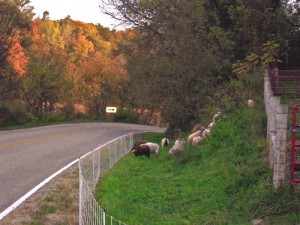
However, thanks to Jim, who is the primary portable fence mover, the sheep are able to get some grass from selected areas in the front of the farm. In the photo below they are eating the lush grasses right alongside the road. This is the best grass on the farm: it’s a low area that gathers rain run off from a culvert, is shaded much of the day and is mowed by the county on a regular basis. There is a tiny bit of grass in other areas of the front lawn, and thanks to Jim, Willie and the portable fencing, the sheep will be able to get some of it. Most of their ration is the hay we purchased for winter, which we are going through at an alarming rate. But it’s good, rich alfalfa and the sheep are actually doing well on it.


Last Sunday we all got out for a lovely fall walk in the fields and woods close to a good friend’s house. Willie’s shoulder has improved enough so that he is now off leash again. When I had to put  him back on leash, both inside and out, he became as depressed as any dog I’ve seen. It was, in a word, heartbreaking. Now that he can run free again he is back to his happy, happy self. We saw his physical therapist on Monday and she strongly advised that we go very, very slowly trying to bring him back to training for competition. It’s clear that his shoulder simply may never be able to handle the wear and tear involved in training for driving on a perfectly straight line, something that requires a tremendous amount of lateral stress on shoulder joints. If he can’t ever trial again I don’t think he’d care at all, as long as he can work sheep at home. It’s me that wants to trial, so although it would be a great disappointment to drop out now that I’ve caught the bug again, if Willie is happy, that’ll be enough for me. I’ll get over it, and Willie will not care one little bit. I’ll see how it goes, going very slowly and carefully.

Here’s the gang on the wooded part of our walk: Willie, Jim, Tootsie, good friend Beth Viney of Great Pyrenees Rescue of Wisconsin and her lovely lady, Tundra. Willie and Tundra did beautifully when they were re-introduced at the beginning of our walk (they had met once before, I have a video of it on my Dog-Dog Reactivity DVD and we all had a grand old time. Tootsie did get carried by me or Jim part of the way, the grasses were pretty high in some places and what was a path to us was a jungle to her. Short of teaching her to use a machete, we picked her up and carried her. But she was a trooper and still did a lot of walking, and we all had a wonderful time. Then Jim and I went back to doing farm chores, worked outside most of the afternoon, and ate a yummy dinner of local, organic pork, roasted root veggies and home made bread. We fell in bed about 9 o’clock and slept as if we’d been drugged. Hopefully there will be more of the same this weekend (the walks, farm chores and good food, we’ll pass on the “as if drugged” part.)


Positives of Negatives & Negatives of Positives

Tuesday, February 22nd, 2011

Thanks to all who have commented so far in answer to the questions “Are you a 100 % positive trainer?” and “Would you sign a pledge to only use positive reinforcement and never use punishment?” I appreciate the thoughtful discussion that the questions have generated. I’ll jump in now, with the caveat that this topic deserves an all day seminar (at least) and I can’t begin to say all I’d like to in one post. I’ll start however, by summarizing some of my thoughts on the issue.

Let me start by saying that I consider myself to be an overwhelmingly “positive” trainer.  I would imagine that those who have seen me work would agree that I am a kind and gentle trainer, and primarily use positive reinforcement when working with dogs. That said, I’d never sign a pledge saying I’ll only “use positive reinforcement” in all my dealings with dogs. I wouldn’t consider it for a moment. Here’s why:

1. As most of us are well aware, the word “punishment” itself refers to two completely different concepts, depending on whether you are talking to the public or to professionals in animal training or psychology. I virtually never use the word when talking to the general public or a client, unless I define it first in operant conditioning terms. That’s because the public and generic dog owner usually defines “punishment” as something inherently aversive, and often as something involving pain or fear. But in operant terms, punishment simply means anything that decreases the frequency of a behavior, and that should be well understood by any professional group involved in dog training. If someone in the dog training field asked me to sign a pledge that I’d never use “punishment,” I’d assume they were aware of its precise meaning, and decline, being unable to say “I’d never do anything to decrease the frequency of a behavior.”

2. I love “Negative Punishment.” What? Trisha loves “negative” and “punishment?” Oh my, say it isn’t so. But remember: in learning theory terms, “negative” means to take something away and “punishment” means to decrease the frequency of a behavior. Period, that’s all. Nothing about aversive, or even “good” or “bad” for that matter.

Here’s an example: Say I’ve been working with a young dog for six months on sitting when asked. We’ve proofed the behavior in a million contexts, and Fido has gotten 10 gazillion pieces of chicken and 5 gazillion other times he’s got to run and play with another dog when he did as asked. Now we’re at home, there’s little going on, but Fido didn’t sit when I gave the cue. I’m as sure as one can be without speaking ‘dog” that there’s nothing physically bothering him, he just seems more interested in ignoring me and going somewhere else to sniff. I’ll take a piece of said chicken, let him sniff it and then withdraw it, saying, melodramatically, “Too bad…. ” and possibly, depending on the state of the chicken and my stomach, “Mmmm, this sure is good! Too bad you don’t get any.”

That’s “negative punishment:” I took something away (food) to decrease a behavior (ignoring my cue). I didn’t learn this technique until I’d been in the business for quite awhile, but I use it, in the right context, and have found it to be really and truly effective. (Leslie Nelson, for her great Reliable Recalls, uses a similar technique in which one dog ends up watching other dogs get treats when he didn’t come when called.) In the example above, once I’d withdrawn the food, I ask for a sit again, and then I’d back up so that my feet don’t get squished by the dog’s hindquarters hitting the ground. That’s how effective it is. I only use this once a dog has received positive reinforcement literally over and over and over again, and when I feel confident that he understands the exercise and is capable of performing it (not feeling poorly that day, not overwhelmed by a new environment, for example). But let’s be clear: it’s punishment, if you are going to use the term correctly.

3. What’s Positive for the Trainer may not be Positive for the Dog: As the opposite of “Punishment,” “Reinforcement,”is something that increases a behavior, period. If it’s “positive” (I’ll use +R here for Positive Reinforcement) then you have added something to the system, if it’s negative (-R), you’ve taken something away. In either case, you are looking for a behavior to increase. So how would you evaluate these  scenarios:

Scenario One is, regrettably, astoundingly common: A shy dog is greeted by a person, whether it’s a vet tech or a neighbor, with shrieks of joy and looming hugs and/or kisses to the nose. The person is being “positive” in their eyes, but the dog is being punished for its very existence, terrified as it is by the rude and overwhelming approach by the stranger. A perfect of example of +P to the dog  and +R to the human.

In Scenario Two, a trainer is waiting for a dog to raise it’s paw so that she can use +R and give it a treat, on her way to shaping a “high five.” The dog, having no clue what the trainer wants, tries sitting, circling, and lying down. The trainer stays still and quiet, an atypical posture for her, and turns her head away very slightly. She has just used +P to communicate to the dog, adding in an unnatural posture and an obvious turn of the head (obvious to the dog anyway) to decrease the frequency of the dog’s response in that context.

4. Positive Punishment (in which something is added to decrease the frequency of a behavior) isn’t always aversive. For example, after watching herding dogs influence the behavior of sheep without touching them, I took a page from their lesson plan and began using what I called “Body Blocks.”  For example, while teaching Stay, I’ll give a dog infinite quantities of treats for staying still when asked, but also move forward to block her movement if she starts to get up. “Taking the space” I’ve called it, and I’ve found it to be incredibly useful in helping dogs understand what you want. (This is similar to the Psych study one commenter noted, in which students were “trained” to perform a new behavior by either 1) only being told “Yes” when they did right, 2) only being told “No” when they did wrong or, 3) being told both “Yes” and “No.” The students who were told both what was right and what was wrong learned fastest.)

I realize that some people consider Body Blocks to be highly aversive to dogs, and don’t use them. One commenter noted that she never used Body Blocks, feeling that they were too aversive to use on her dogs. Two things come to mind here: one is that I’ve done Body Blocks on one or two dogs now (or maybe 5,000), and can tell you that they respond in a myriad of ways. Some field-bred Labradors seem to think it’s the best game in town, and try their best to beat you, eyes shining, until they figure out soon enough that something even better happens if they just stay still for a moment. They behave as though, if they could, they’d say “That was fun! Got any more cool games up your sleeve?” However, super soft dogs, let’s imagine a melty little Shetland Sheepdog, need a quiet little forward lean to be influenced, and if someone moved too fast and too abruptly they could indeed scare them. This is a perfect example of how important it is for a trainer to be able to ‘read’ a dog,  no matter what method they are using I would argue, and adjust their behavior based on the personality of the dog him or herself.

5. However, this does raise the question, the elephant in the room really, of using “aversives.” Are “Aversives” always bad? Ah, here’s where the rubber hits the road, isn’t it? We can all debate about what is +P and -P and +R and -R to our heart’s content, but isn’t the issue really “Is it ever acceptable to purposefully respond to a dog’s behavior with something that they perceive as aversive?” My own answer is another reason why I’d never sign a pledge to never use punishment, even as defined by the public. Life is just too complicated to be summed up in simple categories of black and white.

Do I think that we have a responsibility to be kind and gentle to our dogs? Yes.

Do I think that Positive Reinforcement is overwhelmingly the most effective method of training? Yes.

Do I use it 99.99% of the time? Yes.

Have I ever done something to a dog that I knew he would think was aversive to get him to stop doing something? Yes. Would I again? Yes.

Here’s an example:

When Willie first started working sheep, he had a bad habit of dashing into the flock and scattering them as if he was playing pool. Alisdair McRae, a brilliant trainer and teacher, explained that I simply had to prevent it from happening during the early stages of training, because there was nothing I could do that was more reinforcing to Willie. Not only did he get to watch the sheep bolt away (look what I can do!) and then chase them (wow is this fun!), he got to disperse the tension inside of his own body (and boy do I feel better!). So I set up practice after practice in which I was between him and the sheep, and just my presence was enough for him to stay back where he should when working. But once I had to move back away from the flock to begin short outruns, he began doing it again. We went back to working in closer, but every time I backed away far enough he’d eventually dash in, scatter the sheep and turn around, body relaxed, eyes shining, mouth open, having gotten the best reinforcement he could possibly get.

I began walking him away in response: you bolt in, session over. This helped a great deal, but not enough. Eventually, after several months of work, Willie charged in, for what I believed to be the simple joy of it. I responded a gruff voice (“Cut it out!”) and a fast and direct march toward him. I stopped a long way away but looked directly at him and said again, in no uncertain terms “You cut that out!” Willie, an extremely biddable dog, backed up and looked absolutely shocked . . . and didn’t do it again. He now has the most gorgeous outrun you can imagine, and he works right on balance 99.99% of the time.  Every once in a while, when he’s very tense, he’ll begin to dash in and I’ll say his name low and quiet, and he’ll curve back out again. Do I feel badly about raising my voice in that context years ago? No, not at all. Does that mean I use aversives often in training? Not at all. I quite literally never use them in any trick or “obedience” training, and primarily use +P and “Premack principle” methods to solve behavioral problems. (For example, Willie learned to lie down while working sheep because lying down on cue became the window to getting to work more.)

I’ll talk more next week about what’s critical to do or not do IF one is going to use punishment, but right now it’s time to go let Willie out to pee. No doubt relieving his bladder will be +R for him!

MEANWHLE, back on the farm: We’re pretty much at storm central here, being pummeled by ice and sleet at the same time that the politics of the area are swirling around in a social and legislative blizzard of epic proportions. (I’m right outside of Madison WI, and teach at the University, which is pretty much the eye of the storm here. FYI, for those of you out of the country, there is a huge political debate going on here, involving almost 70,000 protesters at our state capitol over the weekend. Enough said about that, except that everyone I’ve talked to agrees that the energy of the entire area is palpable, and not so much in a good way. I wonder if the dogs can sense it?)

Poor Willie injured his left foreleg again on Friday, darn. He’s been on leash restriction since then and he’s improving nicely, but not enough to let him off leash yet. If it’s not better in a day or so I’ll take him in to my sports medicine specialist vet. So Willie is bored and Sushi is disgusted–last week the warmer weather had her happily outside for hours at a time, now she’s sitting at the window slashing her tail. After I slide my way to the barn and feed the sheep we’ll do a bunch of trick training tonight a perfect time to exercise their brains instead of their bodies!

Here are some lovely clouds from a few mornings ago:

Are You “All Positive?”

Friday, February 18th, 2011

Recently there have been some debates and discussions about whether it is possible to be a “100% positive” trainer. This has become an issue because some seminar hosts have policies that they will not hire anyone for a seminar unless they only use positive reinforcement and “never use punishment or aversives.” Some people are being asked to sign pledges that they will never use punishment as a trainer.

I’m curious what you think. Are you a “100% positive trainer?” Do you ever use “punishment?”  Do you use what some people call “aversives”? Ever? If so, what kind and when? I’ll weigh in on this debate next week, (as you can guess I have a few opinions about the matter) but I’d love to hear what YOU think.

MEANWHILE, back on the farm: The snow is melting! It’s been well over freezing during the day all week, and as a result 1) we can actually see bare ground in some places, 2) the snow that’s left re-freezes every night so walking most places involves either teetering on a mouse-size mountain range of ice peaks and valleys, sinking into ankle deep mud, or having your boot fall through a foot of snow with a thin cover of ice on it. Let’s just say the footing is highly variable. There’s enough open ground that it’s muddy paw time here now, and I am reminded of how valuable it is to cue your dog when you are about to lift his feet. I’ve been saying “Ready” before I pick up each of Willie’s paws (I also do them in the same order) and he now lifts up 3 of his 4 paws for me when I say the word. It’s always the same one that he doesn’t pick up himself, and I suspect that it is because it is harder for him to do so. We are always working on some problems he has in his left shoulder and right hip, so I go especially slowly picking up his right hind paw, and wipe it off as fast as I can. Willie’s behavior is a great reminder to us all to be observant and thoughtful about our dog’s responses.

Besides the discovery of lots of dog poop (a universal sign of spring in snow country), I discovered something far more interesting today. I found a dead hawk below the pines lining the driveway, clearly one who had died recently. I believe it is an immature Red Tail, (Buteo jamaicensis) the most common hawk in the area.  There’s a pair that nests less than 100 yards from the farm house every year, and I wonder if it was one of their young from last year. Egg laying begins in late winter, in March or April, but I often have seen courtship begin in late February. I don’t know why the hawk died, it has no superficial injuries. The best guess (and it is only a guess) is that it starved to death. As I explained to my UW students recently, deep snow favors small rodents who can move through tunnels under the snow while staying out of sight of predators, and disfavors aerial predators like Red Tails. I wonder if the snow is melting just a few days or weeks too late for this one. I’m sorry that it died, but grateful to have a chance to appreciate its beautiful feathers.

Are Clicks Better Markers than Words?

Tuesday, July 27th, 2010

We’ve been talking about markers and secondary reinforcers, and there have been some great comments about using clickers in some contexts and not in others. Like many readers, I use clickers for some training, and not for others. Your comments got me thinking about why I use them sometimes, why I don’t use them others, and the physics of why clicks can be such a powerful marker (and/or reinforcement).

First, I don’t use clickers for all training. This is partly because I am a classic “absent minded professor” and there are just too many times in the world in which I forget everything but my head. I also admit that I am always happiest when it is just me and a dog–no clicker, no leash and as soon as practical, no food as reinforcement.

However, I’ve always used clickers for trick training. As I thought about what’s different between training tricks and other behaviors, I realized that tricks are often asking a dog to do something she doesn’t normally do, and so the precision of a clicker when you are shaping a new behavior is invaluable. To me (and this is very much just as matter of individual preference) that kind of precision isn’t necessary when training a dog to perform a behavior on cue that she normally does anyway. Teaching Sit and Lie Down is so darn easy that the precision of a clicker isn’t as important as it is when teaching something that requires shaping.

THE BENEFITS OF CLICKS There is no question that clicks have many advantages over words as markers. For one thing, they are short, usually only 100-200 milliseconds or so, while even a one syllable word is going to be at least twice as long. That’s part of why clicks are more precise. In addition, clicks are what are called “broad band” sounds, meaning that the sound contains energy in a broad range of frequencies, from high to low. That’s an advantage when ‘talking’ to mammals. We have what’s called a “tonotopic’ acoustic receptor system, meaning that each cell in the brain that receives sound is programmed to respond to a narrow range of frequencies. Some cells are stimulated most readily at 500 Hz, others at 1,000 Hz. That means that “broad band” sounds like clicks, which have energy in a large range of frequencies, light up lots of cells at the same time, like a busy switchboard, while “narrow band” sounds like words have energy in a smaller range of frequencies.

In addition, clicks are what are called “instant onset/offset,” so that the energy in the sound begins at full force, rather than gradually increasing in amplitude. That creates what looks like a “wall of sound” that stimulates cells that look for ‘edges.’ Make sense? [I remember there is some research that supports clicks being more effective training markers, but I don't have time to look it up. I'll bet it's on Karen Pryor's website....]

Here’s a not-so-great image from my dissertation that illustrates a “picture” of short, broad band sounds… look at the vertical bands in the top left.Clicks are very much like those tall vertical bands, whereas speech is far messier and less precise.

That said, I still don’t use the clicker all the time, and for the last few years have used “yes” as a verbal marker. But that’s a sloppy word, very hard to say with precision (“yesssssssss”). You need a nice, clipped stop consonant at the end.  I messed around the last few days with just making a tongue click, but for some reason my brain and mouth don’t want to do that. I’ve thought about “Yep!” but I’m concerned about it sound like “Hope.” Hummmm, still pondering. Would love to hear what you all use besides “yes” and tongue clicks! (Which are a great idea, but my brain just wants to use speech, sloppy as it is).

MEANWHILE, back on the farm: We had a lovely, relaxing Sunday morning at a good friend’s, Hope playing with an 8 month old BC, Willie and I getting to work sheep in a big, open field.  We’ve worked so little this summer I didn’t know what to expect, but Will did great, listening beautifully and slowing his pace nicely when asked. Boy is four years old different than two or three! Notice that the sheep are moving at just the right speed… not too fast to get panicked, not too slowly to end up turning and challenging the dog.

Here’s Hope and his buddy Hap. Hope looks oh-so-serious  here (and doesn’t he look grown up for a 5 month old dog?), but the two of them played beautifully, lots of loose body, open mouth puppy play. Was fun to watch.

(more…)

“Ready?” Using meta-communication to help your dog

Thursday, April 29th, 2010

A short post today, but I hope a helpful one. It’s inspired by the “mud luscious and puddle wonderful” nature of spring, and the need to wipe off Will’s paws as we enter the house when it’s wet outside. As I was drying Willie’s paws a few days ago, I thought about how much easier it is now that I say “Ready?” right before I pick up each leg. Since I started communicating my intention (“now I am going to pick up this paw”), he is beginning, on occasion, to pick up a paw himself, but more often he will shift his weight so that it is less awkward for him. (Yep, I could train him to pick up each paw on cue… also a potential solution, but keep reading for some potential benefits of a more generalized cue.)

Keep in mind that this is the dog who, as an adolescent, growled at me  when I picked up a paw to dry off the mud. That was 3 years ago, and I remember saying something like “Oh, don’t be silly” and continuing what I was doing. He growled one or two more times, but we worked through it and I haven’t heard him growl at anything in years. However, he doesn’t enjoy his paws being cleaned, as most dogs don’t, and the process got me thinking about how little control a dog has over having his/her body moved around, even gently, without any say in the matter. That’s especially difficult if there is any pain involved in putting more weight than usual on one limb. I’ve always been aware of Will’s bad shoulder, and have always been extra careful about picking up the other paw, but a few months ago I started saying “Ready?” right before I picked up a paw, giving him a chance to shift his weight himself.

It’s made a difference to both of us. I lean down and put my hand close to a paw and say “Ready?” and he either shifts his weight or picks it up. Paw cleaning is not only faster, it feels like Will and I are moving down the same path, instead of trying to go in opposite directions. This is a cue that has so many applications; Will’s structural troubles require acupuncture and chiropracty, and he’s not the kind of hail-fellow-well-met who takes being handled lightly. I would bet the farm (and, hey, I have one) that handling Will with force and punishment would have created a severe aggression problem within a few months. In both cases, we give Will lots of options, using patience and communication during the treatments. He adores both practitioners, but he literally hides behind me when the greetings are over and it’s time for treatments. But we work through it, sort of like a dance; sometimes asking, sometimes quietly insisting, but always with an awareness that Will desperately needs to have some say in what is happening to him.

I know many others use cues like “Ready” for a variety of reasons. I’ve heard similar cues most often in obedience, meaning “Okay, time to start working together”. But I’ll bet there are many examples from your own experience of using a cue to communicate your intentions to a dog. I’d love to hear them. I think we’d all learn something from hearing about all the ways that concept can be used. (By the way, signals like “Ready” are called “meta-communication,” meaning “communication about communication.” A play bow is an example in dogs, meaning “Everything that happens next is in play, don’t take these bites and growls seriously!”

Meanwhile, back on the farm: The new fence is working beautifully (more on Will and the fence soon), the bottle lambs have learned to use the self feeder, though they still mug me relentlessly for more, and Snickers has stopped looking for her 3rd lamb, the one I had to take to a friend because 1/2 of Snicker’s bag dried up. The tulips and blossoming trees are in full bloom. Here are Tulip’s tulips, the flowers I planted over my Great Pyrenees grave, her body deep in the soil, nestled onto a bed of of hundreds of tulips, warm and safe in the small hill in front of the house, where she’d stand strong and tall, and bark out her great, white presence to the world.

Silo Sadness & Sister Happy

Monday, April 26th, 2010

Good news and bad news:

Best and wonderful news for me is that my sister, Dr. Wendy Barker, is coming to do a reading for her new book, Nothing Between Us, this Thursday night at UW. (Come one come all!) Her book has not a darn thing to do with dogs, but it’s pure and simply brilliant and I can’t wait for her reading. (For those of you who are interested in a novel in “prose/poetry” form about a multi-racial affair and life in the 60′s in Berkeley, California, the talk is in Helen C. White, Room 66191, 7 pm, Thursday the 29th). Full disclosure: Yup, she is my sister and so my objectivity might be a tad, uh, challenged? But I’m not the only one raving about this book… everyone I know who has read it loves it…

Sad news is about the farm. It might sound strange, but I have to have my silo taken down this Friday, and I’m grieving the loss.  It’s stands as a wonderful bridge to the past, and as a structure that adds complexity and depth to the farm. I’ve let ivy grow up it and in summer it’s quite the picture. However, it has to go. The huge storm we had a few weeks ago undermined it’s foundation, and either it comes down in a controlled way, or it comes down sometime in the future on its own. It could land on the barn, on the sheep or on Willie. None of those things are likely, but then, how much of life actually turns out to be? In addition, there is now about 2-3 feet of air, instead of ground, on one side, the side that all of us walk by several times a day. If an animal fell in, they’d slide down to the bottom of the empty silo, about 15-12 feet, and it would end up one of those feature stories on the local news, in which 3 fire departments spend all day rescuing a trapped dog/cat/raccoon while the owner stands in the background wringing her hands. We have the hole covered with plywood and straw bales right now (in back of the silo, out of sight in this photo) . . . but still. Stuff happens.  Here how it looked this morning after taking the sheep up the hill . . .


Here’s a good addition to the farm: The fence in the foreground in the photo below is a new portable, electric fence. It will allow us to make much better use of the pasture, by doing controlled grazing and forcing the sheep to eat in the areas that they tend to avoid. Right now they are in an area that they usually avoid because although it has great grass, it’s in a dip between the woods and a slight hill to the right. That makes them less able to spot danger from a distance, and even on little farms they are predisposed to spend their time where it is safest. Also, they like to graze uphill (less work on their necks) and because of that they always end up overgrazing the top of the hill and wasting good grass in other areas. With 9 adults and 19 lambs, I need all the pasture I can get this year.

Of course, electric fences like this have their disadvantages: If they turn off an animal can get a head stuck and, worst case, die, they are labor intensive and they don’t work as well if it’s super dry and hard to get the stakes and the ground rod into the ground. My biggest worry isn’t any of the above though: it’s that Willie gets hit by the fence when he’s close to me, and associates it with me, or with working sheep. At some point he’s just going to have to learn, but I have to think about how to set it up so that it happens without him making the wrong association. Meanwhile, all is peaceful now!

Could Breeders and Shelters Work Together?

Friday, April 23rd, 2010

Thank you so much for all your insightful comments about overpopulated shelters and whether responsible breeders could help reduce the number of dogs who enter shelters in the first place. Here are a few, admittedly somewhat random, thoughts about the issue.

One: Boy would I like to see more collaborative efforts between good breeders, shelters and rescue groups. I know that already occurs in some areas, and Here Here! to that, but I wish somehow we could more often use the energy and commitment of these groups to 1) publicize a universally understood definition of “responsible breeder” so that the public understands what that really means 2) create more, affordable support systems to help people when they need help with training and behavioral problems. (FYI, I too have heard a common reason given for a surrender is “owner moving,” a far more socially acceptable reason for giving up a dog than “I don’t want him anymore because he has become a pain in the ass…..”. We should remember though, if I recall it correctly, that one of Patronek’s studies found that most people gave up a dog only after many months of struggle, that they did not make the decision lightly and that most of them were distressed about having to give up the dog. I know that’s not true in all cases, and that some people think of dogs as furniture, but there are still many who would much rather not take a dog to the shelter.)

Two: Influence breed clubs to add behavioral stability to a criteria in shows. It is indeed true, as some of the comments have mentioned, that many clubs in Europe require animals to be carefully screened by vets, and are given behavioral and soundness tests before they can be registered. I visited a Warmblood stud farm in the Netherlands once, and was told that the club had decided only 12 studs could be registered that year, and the farm’s drop-dead gorgeous and bomb-proof stallion had been rated “number 13.” No foals for him, at least not that year. Wow. That would never fly over here in the land of the free, but at least we could start advocating that breed clubs add more to a championship than conforming to a structural standard and having a perfect gait. I know many competitors argue that just being in a dog show is proof enough of a dog’s disposition (me own mum used to make this argument to me), but you know . . . it’s not.

Three: Legislation? I don’t know. I am torn about this myself. On the one hand I agree with the argument that the ‘commercial’ facilities will be the least affected by this. Right now in Wisconsin we finally got a “Puppy Mill bill” passed, but the language says that breeders must adhere to standards that “are to be determined.” Last I heard the make up of the committee deciding on the standards had no behaviorist, no trainers, and lots of you guessed it, large scale breeders. (I’ll find out more about this in the weeks to come….it’s on my “To Do” list when I catch my breath from UW.) On the other hand, perhaps licensing will really will have the effect of 1) improving large scale breeders and 2) educating the public about what they should, at a minimum, expect.

Four: Helping breeders and rescue groups to be realistic: There were several comments from people who felt that some breeders or groups set their standards for a new home unrealistically high.  I have heard this complaint from quite a few people, including a dear friend and veterinarian with a long history of taking in special needs dogs and going to the mat for them. She finally gave up after waiting for 6 months to adopt an older, needy dog from the same group who had adopted her her first dog. She went so far beyond the call of duty with this dog that she deserved to be sainted, and yet the rescue club couldn’t decide if she was worthy of another one. How do we help breeders and groups be more realistic about good homes? Oh dear, I don’t know, but I do think we need to collectively work on it.

I might have a better idea of how to solve these problems if I wasn’t so damned hung over. Last night I had a total of one and a half glasses of red wine and I was a happy girl. Not so happy this morning though. It took me a few hours to figure out why I felt so crummy, and when I did, I actually ran into Andrea’s office and said “Oh good grief! Maybe I feel so crappy ‘cuz I’m hung over! Do you think?”).  I guess it is clear that this is not a common occurrence in my life.

Meanwhile, back on the farm: Willie is much better about the bedroom, but we’re not done yet. I did figure out that it’s all about the bedside table. If I even turn toward it to take a sip of water he’ll get up and slip out of the room. I am guessing it’s about the drawer, the one I open to get my reading glasses. It has a low, growly sound when it is being opened. But he’s better: a few nights ago he never left the room at all, (and then regressed the next night), and he now comes back in soon after I turn out the light (also on the bedside table.) One step at a time. I have to confess I have done no counter-conditioning, no DAP (which, fyi, I have found to be useful in some cases). This is out of pure laziness and nothing else. By the time I walk up the stairs at night I consider washing my face and brushing my teeth a significant effort.

It’s been gorgeous, just plain and simply gorgeous. The warmth we are experiencing is 2-3 weeks early, and a big worry to those of us who worry about the plants and the environment. It is also just a tad unsettling to see things happening when we don’t expect them, but the tulips and many of the trees are now in bloom. Here’s Willie lying in front of Tulip’s grave site, where she used to stand and broadcast her presence to the coyotes across the road.

And here’s a fuzzy photo of the bottle lambs. Granted the only thing in focus is my chubby little hand, but I included it because what you see is pretty much what I usually see: a black and white milk shake of lambs jockeying for position.

“Responsible Breeding” an Oxymoron?

Tuesday, April 20th, 2010

I’m working on a column for Bark magazine, in which I’m going to talk about one way to decrease the number of dogs needing adoption from shelters and rescues. Right now the two primary efforts to decrease the number of dogs killed in shelters are 1) encourage spay/neuter & discourage breeding and 2) encourage adoptions of dogs from shelters and rescue groups. I say Here! Here! in general to both of those, and it is heartening how successful both of those efforts have been.

However, there is one important aspect of this issue that is missing, and that is encouraging responsible breeding. Ah, some would say, responsible breeding?! Isn’t that an oxymoron? Breeding is a dirty word in some circles. After all, aren’t there too many dogs out there already? How could anyone justify breeding a litter when so many dogs in shelters and rescues need homes? But if you look at the data, the picture becomes a tad less black and white. Based on the extensive research of Gary Patronek & Andrew Rowan, there are about 7.3 million dogs acquired by households in the U.S. each year and about 6.2 million puppies produced every year by breeders, amateurs and puppy mills. Hmmmm…. Interesting math here, yes? So where do those 1.8 to 2.1 million dogs killed in shelters every year come from?  They estimate that about 4 + million dogs enter shelters every year, 400,000 from amateur breeders who don’t find a home for the litter, 2,2 million strays (.6 million are reclaimed) and 1.8 million owner surrenders.

There is little controversy about the fact that most dogs end up in shelters because of what owners describe as “behavioral problems.” Many of these problems could be easily handled if owners in the first place acquired the right dog for their households, and had someone to act as a coach as their dog matured. And that is why, I would argue, we need a third leg of prevention efforts to keep dogs from dying in shelters, which is based on keeping dogs out of shelters in the first place. And that’s where responsible breeders come in. I don’t think we have a good communal idea of what responsible breeding means, and I think we need one as a country.

Many members of the general public have no idea what a responsible breeder would look like. I can’t tell you how many clients I’ve had who said things like: “Oh, I can’t tell you about the behavior of the father, because we couldn’t get anywhere near him.” (Oh my, this is a dog who was bred?) I’ve had clients who competed in Conformation who wanted me to help get them a title on a dog who was insecure, shy, or behaviorally unstable ever since youth. They wanted the title so that they could breed the dog.

If I was queen, we would have a universal understanding of what a responsible breeder is, and reinforce them for their good work. As someone who bred BCs years ago (Lassie had 2 litters), I can tell you that doing it right is very, very hard work. If you carefully select a mating based on genetics, physical and behavioral health, care for the dam and the litter as they should be cared for, provide an enriched environment for the maturing pups, sell only to the best of homes and act as a resource (and possible home) for the rest of the dog’s life… well, that’s a huge commitment. And yet, when doing all that years ago, I’ve had people treat me as if I was a social pariah.  Breeders, even the really good ones, tend to be castigated in this country, and yet, shouldn’t we be reinforcing responsible ones?  A truly responsible breeder maintains responsibility for every pup he or she raises, which means that the number of dogs going into rescues or shelters would drop so significantly that they would have to redefine their job. (And wouldn’t that be great!)

I’d love to hear what you think about all this. It’s true that I’m not completely objective, having bred litters from 4 females in the past, and am considering getting another BC from a breeder sometime in the future. (Criteria = “bomb proof” thank you very much. One Willie is enough!) But it saddens me that truly responsible breeders are so often castigated (while the irresponsible ones don’t care), and that so many dogs enter shelters and rescues because no one was there to help the owners solve what are often minor behavioral problems, or direct them to the right dog in the first place.

Meanwhile, back on the farm: Babies everywhere, there’s just no getting around it. My bottle babies from Truffles are getting more milk from her (yeah!), but not enough for triplets, so Jim and I visited Ann Topham of Fantome Farm fame (her goat milk is internationally known, and for good reason) and picked up 5 gallons of goat milk. It took 2 refrigerators to hold it, but it should last the babies a good long time. When I was at Ann’s earlier, I stumbled on her own birthing drama.  Here’s a doe who was 2 days late and was clearly in labor. When they start looking at their own bellies, you know something is up!

Ann called our mutual vet, the good Dr. Jeff Kunart, who came out and helped the doe deliver two HUGE twins while I was there. Here you can see the two front hooves just starting out. The nose was right behind, and once the shoulders were through, the kid flowed out like water.

Here he is, just seconds after being born.

Leadership and Frolicking Lambs

Friday, April 16th, 2010

One last comment, for now, about our relationships with our dogs.  I had mentioned in the last post that I believe that dogs do better if they see us as what I call “benevolent leaders,” in the sense of good parents or good teachers. Here’s my thinking:

Dogs are dependent upon us, granted some more than others, but most of our dogs have no control over when and what they eat, where they spend their time and who they spend it with. They can’t open the door to go outside, they can’t leave their social group to go find another one that they like better, and they can’t provision themselves with their preferred food. They have to know, at some level, that we hold most of the cards. We are able to open doors, we are the ones who can open the cabinets and get out the dog food and we decide who makes up the “pack.”

Because of that, at least in part, dogs know that we have more “social freedom” than they do, and much of their life is dependent on how we use it. Let me be anthropomorphic for a moment . . .not always a good thing, true, but sometimes useful. If you were dependent upon someone else, how would you like them to behave? Think of a great boss, or a great teacher or ideal parent. Wouldn’t they be a person who 1) was clear and consistent, 2) established clear and reasonable boundaries  and 3) saw you for who you really are, and acted in ways to bring out the best of you and inhibit your dark side?

I think that insecure dogs especially are in need of people who teach them to be patient and polite, who help them learn to inhibit impulsive behavior, and to establish boundaries in a fair and clear way so that everyone knows what to expect. We know that part of what makes a social animal nervous and insecure is a lack of ability to predict what is going to happen to them. And more than that, I think insecure dogs need a sense that their human is someone that they can count on, to take charge and get them out of trouble when necessary, and to create clear and fair boundaries that help them learn emotional control.

I have seen so many dogs in my office whose owners adored them, but who were afraid to deny them anything. No boundaries, no rules beyond “please don’t pee in the house.” I had one client whose dog began to growl at her because she didn’t get up out of her chair and go across the room to pick up a toy for the dog. This particular dog had taught his human, literally, to fetch for him, and if she didn’t pick up on his cues fast enough to pick up his toy and hand it to him, he began to growl and threaten her. And yet, I got no sense that this was a happy dog. You might think that he was in heaven, living in some kind of canine fantasy with a person who waited on him hand and foot.  But he was nervous and insecure, and after we started using positive reinforcement to teach him other ways to behave, and decided on some reasonable boundaries, he not only stopped bullying  his owner, he seemed like a much happier dog.

And so, although I have concerns about what the word means to some people, I still use the term “benevolent leader,” in the belief that most dogs are relieved to be able to count on their human to, as one dictionary defines “to lead,” to “guide something along the way.” That’s not a bad thing to do for the animals who are so dependent upon us. We just need to do it with love, patience, benevolence and most of all–a good sense of humor.

Meanwhile, back on the farm: It’s exquisite spring weather, 60′s and sunny and all emerald green grass and liquid bird song. Here are 2 of the 3 bottle lambs that Truffles doesn’t make enough milk for. They are just starting to frolic after getting their bellies full of goat milk.

And here are the 3 ewes who lambed most recently. The rest of the flock has dashed up the hill for 2 acres of clover and grasses, while these 3 stay closer to the barn. That’s Truffles, the ewe with the problem udder, on the left. Her 3 lambs are the ones on the left too, although the one with the most black is in the foreground. Dorothy is in the middle with her twin lambs, while Snickers is on the right with her all white triplets. Snickers and Dorothy are especially cautious about leaving the safety of the barn. Dorothy is so cautious that I have to feed her separately because she is hesitant to leave the barn to feed with the others. Her lambs are tiny, tiny tiny tiny, but their little bellies are full when I check on them. I gave Dorothy extra grain last night because I’m a tad worried that she isn’t getting enough food.

As I write this they are all at the top of the hill on an Irish green pasture. I can almost hear them tearing the tips of the grass off as I write . . .