Welcome to the official Patricia McConnell website. Skip directly to: main content, navigation, search box.

Posts Tagged ‘puppy training’

What IS “training,” anyway?

Friday, January 7th, 2011

My last post raised the question “when should one start training a dog,” and we’ve had a lively and interesting discussion about it in the comment section. Our conversation has raised, as good conversations often do, another issue that I think deserves attention: How do you define training?

Many comments have said that we are training our dogs the second we bring them home, which closely reflects my perspective. However, others have said that they “don’t start training until the dog is older, they just teach them “manners” (which is closer to Kelly’s perspective). One commenter said that her dog knew sit, leave it, polite leash walking, etc, but she didn’t start “serious training” until the dog was older.  What a perfect example of how we are all define “training” in our own way.

On reflection, I find that I define “training” broadly, inclusive of all of our efforts to influence a dog’s behavior. Good training, to me, means all interactions that influence behavior, from actively teaching a dog to sit to managing an environment to prevent behavioral problems from starting. Others define it more narrowly, to mean the point in time in which one starts increasing their expectations of a dog, perhaps putting more pressure on him or her to perform correctly, and if I read between the lines correctly, using punishment if a dog doesn’t ‘behave.’

It occurs to me while thinking about this that “dog training classes” must carry an equal potential for confusion to the general public. This is not a new perception, look at how many puppy classes are called “puppy socialization” classes.  And note the change from “Obedience classes” to “Training classes” from 20 years ago. (When I began in this field, they were ALL “obedience classes.” I remember deciding with my partner, Nancy Rafetto, to call the classes “Family Dog Training  Classes,” and how radical that seemed at the time.)

And what then, is a “trained” dog? If we define “training” differently, we must be equally inconsistent about what we expect of a “trained dog.”  Perhaps this is a good reminder to think some more about how and when we use specific words. I use the word “training’” often, but also use “teach” frequently, and like the lighter quality that I associate with “teaching” rather than “training.” And I suspect that I have a conditioned association to the word “obedience.” I hear that term and I think about the dogs in my first “obedience” classes being jerked around on choke chains and hearing people shout NO! in the dogs’ faces. And yet . . . I do expect Willie to be obedient when I use certain cues, otherwise he could never be off leash in the country, and I know plenty of people who have nothing but positive associations with that word.

What about you? What does “training” mean to you? Have you changed the way you talk about how you have “trained/taught” your dog? What does “obedience” mean to you?

MEANWHILE, back on the farm: Still cold, will be around zero (F) tonight and windy besides. Most of the snow is gone so Willie and I can’t play frisbee, but that means we can work sheep as long as I can keep my fingers warm enough. We’ll be going to a friend’s farm this weekend to work on cross drives at the edge of his comfort zone (remember my 2011 commitment!). We’ve been working on it at home, but I don’t have enough land with the right characteristics to work him past 80 to 90 yards.

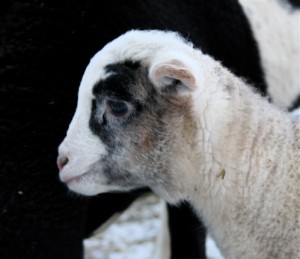
Soon we’re going to let the lambs out with the main flock. In order to do that I need to spray Truffles and Dorothy with perfume… they began fighting like Bighorn rams when I tried them back together a few days ago and I’m afraid the lambs will get smished between them. (If you were reading the blog this spring, you’ll recall that spritzing them with a strong scent eliminating fighting after they had been shorn.) The lambs need out though, so Dorothy and Truffles are just going to have to work it out. The lambs have been in the barn for 5 weeks now, and they need to get those little legs moving . And I won’t mind not having to fill water buckets 3 times a day after smashing out the ice. (The fun part is when the water splashes out onto your face when it’s wind chill of 10 below.) But mostly I want to watch those little lambs get to stretch and frolic. As long as they get enough food they’ll be fine in the cold, and both moms are giving lots of milk now. I will have to train the rest of the flock to stay outside while I let the momma ewes into a pen to get extra food, but that’s easy to do: “if you stay outside, you’ll get “extra food” too (just a LOT less!)

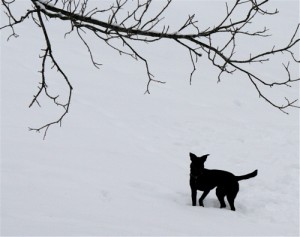
Here’s Jenna, a young mix (herding?) who is being fostered by a dear friend of mine, and is looking for a new home. She came over to play with Willie and I got this photo of her in the snow, all black and white like life is now, outside of the warm, yellow glow of the barn lights when the evening light fades and the sky and snow turn ocean blue.

No Training ’til 7-8 months?

Tuesday, January 4th, 2011

Oh my. An alert reader sent me an blog from Psychology Today’s website. The essay is by Lee Charles Kelly, and argues that “dog training is no longer working that well” because we start “obedience” training too soon. The quote is actually attributed to Ian Dunbar, and Kelly uses that comment, and suggestions from psychologists that we shouldn’t push young children into cognitive tasks too soon, to argue that we have no business training puppies until they are adolescents. Ironically, he suggests that Ian himself is responsible for the “problem,” because he has encouraged people to take their pups to puppy socialization classes.

Could I disagree more? It would be hard … at least, if you define “training” the way I do. I’m talking about teaching a pup to associate coming when called to feeling happy happy happy, to learn it’s fun to be with you, that what you say has meaning and that there are ways to behave that makes life so very, very nice. I’m not talking about tossing a pup into a mosh pit of uncontrolled dogs, or forcing young pups with no ability to inhibit themselves for long periods of time to sit/stay for three minutes.

There are 2 assumptions in the Kelly’s article, one being that dogs are less well-behaved than they were in the past. Leaving aside the question of what that means (10 years? 20 years?), I’ve seen no evidence myself that that is true. I see people coming out of GOOD puppy classes and family dog training classes with amazingly great dogs. The dog Willie and I went on a walk with last week is 9 months old, was off leash for 45 minutes in the woods where we followed a trail of bloody snow and ended up at a deer carcass. Mico came when called every time, even when called away from a dead deer and and basically did every single thing he was asked the entire time we were together, off leash, in a highly distracting environment. Young Mico had a great time. And he’s has been through a series of good training classes, ever since he was a young pup.

The other assumption in Kelly’s blog is that young dogs aren’t capable of learning what we ask of them until they are adolescents. And here, god is in the details.  Should we be asking 10 week old puppies to sit/stay for 3 minutes? Of course not. Do people sometimes ask too much of young dogs? Yes they do. But that’s part of what good classes and books are for: to help people be realistic about the capability of young dogs, and to understand what dogs can learn and perform at what age.  That was a significant goal of Aimee Moore and I when we wrote Family Dog Training and Puppy Primer — to help owners understand what dogs can and can’t do at what age.

Bottom line: I just don’t see Kelly’s argument. When I first started in training and behavior (1988), all the classes were standard “obedience” classes, and were forced-based. The standard advice at that time was not to put your dog into classes until they were 7-9 months old, (because they couldn’t handle being corrected so harshly until they were adolescents). But that was then, not now. Are those the methods Kelly is talking about? I hope not: leash jerks and yelling NO are lousy methods, and shouldn’t ever be a part of training any dog, no matter how old. As Mico, and Willie showed, countless dogs who started “training” the day they went to their new homes, have lives of much more happiness and freedom than many dogs did before.

My general impression is that people who 1) use positive reinforcement with an understanding of how to make it work and 2) take their dogs to good classes, have dogs who are significantly more ‘obedient’ than the dogs I first saw 23 years ago when I first started in the business.

That said, I do think there are some cautions: Puppy socialization classes need to be highly monitored by experienced people or they create the problems they are supposed to prevent. Puppies and dogs do indeed need lots of free time to play and explore, and can be tired and constrained by over training. But avoid classes until your dog is eight months old? Oh my.

What do you think? Do you think dogs are less well-behaved than before? (you decide what ‘before’ means!). Should we wait til 7-8 months to take dogs to class? Here’s a tough one, and perhaps the most useful: is there something you tried to teach, or did teach your dog that you think you should have waited on? I’m all ears. . .

MEANWHILE, back on the farm. The good news is that much of the snow melted last week, and so Willie and I have been able to work the sheep up in the hill pasture for the last few days. Wheee! The bad news is that the snow still on the trail to the hill pasture first melted then froze solid and is now structured like frosting made out of cement. Imagine walking on ice that is uneven, full of dips and holes, and ridges and basically makes walking like having your feet beaten with baseball bats. I limped down the hill wishing I had dog paws, they seem to do much better on this weird surface we’re left with.

By the way, old buddies (who hadn’t met in many months) Mico and Willie did beautifully together last week, although I don’t think that would have been true if they both weren’t well-trained and responsive. There was what looked like a lot of competition between them (“I’m first on the trail and if you try to get ahead of me I’ll body slam you into a stop” – Willie. “And then I’ll throw my forelegs around your neck and attempt to stand on top of you.” – Mico). When they began to look too aroused, one of us simply gave them a cue: “Let’s go on a walk,” or a recall, or a “leave it”… both instantly obeyed and a good time was had by all. Good boys, good boys.

The lambs continue to do well. I’ve taken the twins off supplemental milk to see how they do. They bawl as if starving when I walk in the barn (okay, it’s hard to ignore them) but their bellies are full and Truffles seems to be giving lots of milk. We weighed them the last 2 weekends, we’ll do it in a week to see how they are doing.

Here’s Hans Solo:

And here’s Clementine, a spitting image of her momma, Truffles, and the white ram lamb Franklin in the back:

The Puppy Chronicles: Chapter 3 — Puppy Tests Revisited

Saturday, May 15th, 2010

I’m about to take a week’s vacation and wallow in puppy breath, flowers, and friends. Jim’s surgery next week isn’t quite what we planned, but at least we didn’t have anything else scheduled besides enjoying spring and being together. I’m going to take a blog/email break and concentrate on my Jim, Will and Pup for the entire week, but I wanted to close out the chapter on the puppy tests, at least for now.

As you may know, I do the puppy tests, but am never sure how much to make of them. So far, I am impressed with their predictive value (but it is VERY early in the game, so this question needs to be revisited in 12, 24 and 36 months). The standard tests that I did ask how a pup relates to an unfamiliar person and the environment. Mick was only 1 of 2 pups who followed me, unafraid of loud noise and happy to leave the litter to follow an unfamiliar person. “New pup” ran back to the litter, clearly frightened. Mick brought the paper back immediately, New pup followed it, didn’t bring it back the first time but did the second. Mick startled and investigated when I threw something, seemingly quite bold, while New pup seemed so soft and easily frightened that I didn’t do the test. (I didn’t skip it as one reader asked because of his looks, in spite of my rude comments about his face!, I didn’t do it on the soft female either.) Overall, the tests suggested that Mick was super affiliative with people and relatively bold overall. Great dog to train as a performance dog. New pup tested as being a tad soft, sound sensitive and a bit more independent.

The ‘standard’ tests don’t tell you anything about how a dog will react to other dogs, which is why I asked for an adult dog to be let out to greet the pups. I remember thinking I’d give anything to have Luke, Lassie or Pippy Tay with me, I would trust their reaction totally. But Will’s reaction could have been based on so many things–being nervous around barking dogs, seeing puppies for the first time, so I left him home. You may recall that all the pups ran to the fence, but as soon as the adult began to race around, Mick ran as far away as he could, and looked extremely stressed. He eventually went and found a place to hide while the other pups were still trying to get to the adult dog. As I mentioned in my first post, it was a big red flag for me, and a big worry. I told Jim and the breeder that I was truly concerned about it, and thought for a long time, trying to figure out what it meant. Afraid of unfamiliar dogs? Afraid of lots of motion and commotion, nothing to do with other dogs? I decided that there was only one way to find out: take him home.

Both pups have been consistent so far, New pup more fearful of new things, more sound sensitive and a tad bit more independent. If I was choosing just for myself, Mick would be the better choice. But it took Mick a long time to warm up to Will, and his very grown up adult male dog behavior seemed like it might be a problem. New pup was all over Will immediately, thrilled to meet him and ear-flat submissive.

I promise you that there is simply no way to know who this little pup will be when he gets older. Some dogs who look super submissive seem to be alpha-wanna-be’s in disguise. I have always told people that if you can’t afford to take a risk, don’t get a puppy. Older dogs obtained from shelters, breeders or rescues are often less of a question mark, and although you may not know what you got until you get them home, you’ll know a lot sooner than waiting for 3 years for a pup to grow up! Speaking of pups . . .

Time for me to help my new pup grow up, give the poor thing a name, and spend a week with my boys. Your comments will be posted regularly, and I probably won’t be able to resist checking in, but no promises of comments back until I return.

Meanwhile, back on the farm: the poppies are blooming:

And Pup’s ears are standing up like blossoms reaching for the sun. Comical and adorable all at the same time:

Explaining “Step by Step” Training, Step by Step

Monday, March 1st, 2010

One of the great comments on my post about the new Puppy Book reminded me that training “step by step” is not intuitive. Someone may know that there are multiple steps between a dog sitting on cue when asked in the kitchen at dinner time, versus being asked to sit when barking at the visitors at the front door. But what are those steps? And how do you know when to move on to the next one?

I thought it would be helpful to give a few examples. However, I would love it if some of the experienced readers would add an example of their own. My favorite part of writing this blog is the wealth of knowledge of its readers, and I am sure that many of the readers would benefit greatly from hearing a range of examples.

Here’s an example, using the dog sitting on cue when it’s easy for him to comply and when it’s hard (in kitchen, no distractions versus at door, company ringing door bell): Note that this is only one way to get to Step 25: There are many paths to the top of a mountain…

Step 1: Teach the dog to sit (I use the Lure/Reward method to get it started quickly) when holding a treat as a lure, with as few distractions as possible. Use food as lure, do not say “sit” yet.

Step 2: Once dog will sit as you move your hand through its ears and toward its tail, say “sit” before you move your hand.

Step 3: Modify your hand movement so that it is less of a lure and more of a hand signal, sweeping your hand upward toward your face. (This could be in session 1, 2 or 3, depending on how well things are going)

Step 4: 3 times in a row, use your visual signal (hand movement) and reinforce with the treat. The 4th time, immediately after the first 3 (assuming they were successful), say “sit” and don’t move at all. Wait for the dog to respond just to your voice.

Step 5-8: Practice using either the VISUAL or the VERBAL cue one at a time, being careful to only use one or the other.

Step 9-12: Begin to ask your dog to sit when there are MILD distractions. For example, try it outside in the yard when it’s relatively quiet or in the house when someone else is making some noise. Be sure to practice in many different places, not just the kitchen. Begin to give a food reinforcement when asking during mild distractions, and substitute other reinforcements for times when it is easier. For example, you could clap, say GOOD! (I also teach people to condition an association between a praise word and a food treat) and let your dog chase you as a game. Or throw a toy, or rub a belly….

Step 13: Start asking your dog to sit when you are by the front door, or whatever door company comes in through.

Step 14-18: Have all family members ask the dog to sit when they are greeting the dog. Put treats by the entry door so that all family members can easily reinforce the dog for sitting while greeting. Get in the habit of ringing the bell or knocking before you enter your own house, then ask for the sit. Once you’ve given the treat, squat down to greet your dog so that he or she doesn’t have to jump up to get to your face.

Step 19: Have good friends who are dog lovers AND who will listen to you (the hardest part!) start helping you teach your dog ‘door manners.’ Have only one person come at a time. Ask them to ring the bell or knock, and immediately ask your dog to sit (using BOTH the verbal and visual signals) as soon as you open the door. They ask for the sit, but YOU reinforce the dog (because you are the one with the best timing, right?!). If the dog doesn’t sit, close the door and have the person try again. Repeat 3-5 times in a row if you can.

Step 20: (Can be during the same time period as Step 19) When people come over who aren’t part of training, get the best food treat imaginable, and ask your dog to sit (not sit and stay, too hard for now!) before you open the door. Give copious treats for any positive response. If your dog tends to jump up a lot, even after a first greeting, just lure him away from the door with pieces of chicken and put him in a crate, or give him a stuffed toy once he’s made an initial greeting.

Step 21: Once your dog is sitting well when your friends come over and ask for a sit, try it with two or three people coming together (even more exciting and distracting!).  Have each of them ask for a sit, and be ready to give out lots of food as fast as you can!

Step 22: Assuming again, that all is going well (at least 80% compliance), ask for a sit before you open the door when ‘regular’ visitors come over, but this time don’t have a food treat in your hand. Explain through the door that you’ll be right with them (I always say “Just a minute! I’m training my dog to be polite to visitors!”), ask your dog to sit and if you get compliance, praise liberally and run to the kitchen and give your dog a great treat.

Step 23: As above, with anyone, but this time use your praise word and skip any primary reinforcement.

Step 24: Continue alternating primary reinforcements (especially food or toys if dog is toy motivated) with a praise word that you have conditioned.

All this can easily take nine to ten months! (Hey, it’s hard for a dog to control his or her emotions and excitement when people come over. I can relate.)

Step 25: Dog becomes an adolescent. Go back to Step 9, rinse and repeat.

I know that sitting at the front door isn’t a serious behavioral problem for many people, but trust me, for some it really is. I’ve seen so many families whose dogs were out of control at the door, which has resulted in dogs being yelled at, kicked, or stashed in crates for too long. I’ve also met lots of people who have just simply stopped having visitors because they are embarrassed about their dog’s behavior. It can be very stressful to have a dog misbehaving around company (like you didn’t know that.) Of course, there are many alternatives to problems related to greeting visitors (my favorites are training to run into another room when the bell rings, or going to a designated place, see the Manners Minder that Sophia Yin designed.)

Of course, this is just one tiny example… (and I’ve SURE I’ve actually skipped some steps, I reserve the right to modify later!) I’d love to hear from you if you’d like to tackle a description.

Meanwhile, back on the farm: On Sunday, the University of Wisconsin Vet Students interested in small ruminants came out to do pregnancy checks under the supervision of Dr. Harry Momont (standing in back on the left). That’s my girl Rosebud on her butt, getting an ultrasound through her lower belly. We didn’t get a shot of the screen, but the lambs are far enough along that the students could see beating hearts, backbones and other bones of the lambs, all due within 4 to 6 weeks. The ewes didn’t exactly volunteer, but everyone was very gentle and I doubt that any of the sheep were unduly stressed. Jim took the photographs, (thanks hon!), because I had gone up to the house, a tad under the weather and wanting to get out the raspberry/cherry/strawberry pies I’d made for everyone. Ahhh, a little bit of summer in the middle of a snowy day goes a long way!

New Puppy Primer

Friday, February 26th, 2010

Wheeee! I’ve been working on an updated version of the Puppy Primer for six months now, and it feels SO good to finally hold the finished product in my hot little paws. In it, co-author Brenda Scidmore and I emphasize the benefits of positive reinforcement, of letting dogs initiate the correct action themselves when possible, the importance of realistic expectations and of going step-by-step in training. That last issue is such a big one to me: so many of the problems I see people having with their dogs relate to them jumping from Step 1 to Step 25, without knowing that there should be many steps in between. For example,  there’s (Step 1) sitting on cue in the kitchen while holding a dinner bowl and (Step 25) sitting on cue when 5 people come to the door and there are 3 other dogs barking their heads off….  Don’t you think that one of the most important things you’ve learned (or are learning!) is how many steps there are in between?

I’m also happy about how the book is divided into 1) Special Topics, 2) New Exercises and 3) Practice Makes Perfect, because it helps people understand that you’re not ‘done’ with training once your dog will sit in a training class when you’re holding treats in your hand, and gets them started on a building a foundation for years to come.

The special topics include: Socialization, Positive Reinforcement, House Training, Crate Training, Handling/Collar Touch, Stopping Unwanted Behavior (so often not mentioned and such a common problem!), Helping Puppies conquer their Fears, How to Play (and how Not to), and What to Expect in Adolescence.

The exercises taught are: Sit, Down, Stand, Come on Cue, No Jumping Up, Walking Side by Side, lots of games like Fetch, Find the Toy etc, Take It/Drop It, Puppy Pause (as a foundation for Stay).

We worked really hard to keep the book user friendly and easy to read, but thorough enough to cover the most important information needed to get a puppy started out right. But, I would LOVE your feedback. There’s always a second printing . . .

Is it perfect? Oh heaven’s no. I already decided that the title to Chapter 2 is just stupid (this morning I noticed that and said “Who wrote this anyway?), and I’m sure I’ll find more that I want to change, but in general, just between us, I’m pretty excited about it. Truth be told, she says sheepishly, I am in particular a total mush bucket about the cover.

Intro Sale: I like to keep business separate from the blog, but I think some of you might like to know that the book is on sale for a week at a special introductory price. Just check out The Puppy Primer on my website. Thanks for bearing with me on this, the new book might not be of interest to some of you, but it’s really fun for all of us to have the finished product delivered from the printers.

Meanwhile, back on the farm: Still living as if on the top of a wedding cake with white frosting, snow snow snow everywhere. This Sunday a group of Univ of Wisconsin students are coming out to learn how to do pregnancy checks on sheep (not from me, I couldn’t read a sonogram if my life depended on it; I still think they are making it up when they point to something and say “See! See the grey area there.. that’s a …”. ). I’m also getting straw delivered; if I’m lucky it’ll come when the students are there and we can fill up the barn in just a few minutes! Nothing like lots of strong backs on a farm!  This all is reminding me I’d better get my lambing supply orders in. Can barely believe they are due in a month. Shearing happens next week too; it’ll be interesting to see which ewes take each other on afterward (there always seems to be a challenge between two ewes after shearing, I’ll try to get it on tape again as I did last year.)

Willie and I are loving having lots of time together, and working on some new tricks, but oh I miss having another dog around for Willie to play with. Even in the last weeks of Lassie’s life she and Will would play together a little, and I am sure that he misses it. Going to borrow some dogs from friends this weekend!

Trouble Brewing, II

Friday, November 20th, 2009

A few days ago I wrote a post on how to handle signs of impending trouble if you see it in someone else’s dog (Please Believe Me, Trouble Brewing!) I asked for comments from other pro’s on how they handle this situation, and from owners on how they would like it handled. The comments sent in response have been so helpful and interesting I thought this topic deserved another post.

Here is an admittedly brief summary of how readers responded (see the original post for their complete comments and suggestions):

PLEASE TELL US! Several people wrote in with sad stories of clear problems that trainers or vets never mentioned when the dog was younger. Many people wished that someone had said something to them sooner. The trick is how and when you say it (read on!)

KINDNESS Oh please please please remember how fragile and vulnerable we are about our dogs. Expressing empathy and concern goes a long way toward having any comment you might make about someone’s dog be heard.

OFFER SOLUTIONS I cringed reading comments about trainers who said things like “You need to get your dog under control!” and kept walking. Isn’t that, uh, what we trainers are for? Don’t people come to us to learn how to do that? The comments made it crystal clear how unhelpful it is for someone to tell you that you have a problem, and then offer no solution–what good is it to know that you have a serious problem if the person who brings it up offers no help or potential solutions? This might be a brief discussion, an appointment, or a referral to other resources, but “Boy do you have a problem!”–without any help attached is, in my mind, nothing less than an act of indirect aggression.

GET PERSONAL It helps tremendously to bring up a similar situation or dog that you yourself have had. I didn’t mention this in my first post, but I realized while reading the comments that I do it all the time. It helps people see that the “problem” is not their fault, that these things happen to experienced trainers, and that there are solutions/potentials for the future that someone can guide you through.

PROVE IT & BE SPECIFIC It’s not enough to say “Boy are you going to have trouble with that dog!” Carefully explain exactly what it is that you are seeing that needs to be attended to and why someone should listen to what you have to say. (“Do you see how the corners of her mouth are retracted while she’s barking at me, and she is actually backing up as she does so? Those are often signs of fear in young dogs, and after 20 + years in the business I’ve seen so many fearful puppies become adult dogs who get into trouble when visitors come. The good news is that this is almost always a treatable problem. I have a dog right now who was just like that when he was an adolescent, and I had visitors throw treats for him every time they came over. Now he is ….” etc etc etc.)

DON’T EXAGGERATE I like the the suggestion of presenting the “best and worst case” scenario. This is an important way to be realistic, and avoid people from dismissing what you have to say. “It may turn out just fine, but I’ve seen so many dogs like this who ended up in trouble… why gamble with a dog who might be that “one in a million” dog that you talk to your grandchildren about!” It’s a tricky line, I admit–saying enough to get someone’s attention, without overstating the issue such that you lose them completely. But, then, isn’t life often about walking on those thin lines between helpful and tiresome?

CUSTOMIZE If this is a client, it is critical to customize your advice. Every case is different, and cookie-cutter solutions to even common problems often don’t work. Every client needs to feel special, because they are. Every case is different, because it is. People desperately need to feel they’ve been listened to, and that your advice is truly something that can work for them. I often start out by saying “Ideally, we’d do X and Y, but then, there’s real life (and your spouse and five kids to acknowledge).” I always ask if they think my suggestions could work for them, and pay lots of attention to body language that says one thing, and a verbal response that says another.

UNDERSTAND THAT CONTEXT IS EVERYTHING This is especially for non-trainers, because most trainers are well aware that a dog can behave one way in one context and another way in a different setting. A word to the wise: I can not tell you how many times I’ve heard clients complain that their vets won’t listen to them about their behavioral problem because the dog is so good in the clinic. Dogs can behave one way to one person, and be a different dog to someone else. They can be docile and loving at the vet clinic and a terror at home. Etc Etc. If people tell you they have a problem, then they have a problem. It may be a slightly different one than they perceive it to be, but if it’s a problem to your client, then it’s a problem. That said, kukos and body wags to all the veterinarians and vet techs out there who work so hard to educate their clients and work to prevent behavioral problems. All behaviorists and trainers send our appreciation (and our sympathy). It’s tough sometimes. Thus, the next point:

ACCEPT OUR LIMITS No matter how good any trainer, vet, behaviorist or friend, there are times that people simply aren’t going to listen to us. In many cases, it is natural to dismiss something the first time you hear it. (Don’t you do that yourself sometimes?) It’s not until the second or third time that we are ready to hear what’s being said. That’s one reason why maintaining a relationship can be so important, as well as finding a way to stay involved if it is appropriate.

And sometimes, no matter what, we’re just not going to get the response we want. We need to let it go. This isn’t easy for people who spend at least part of their lives learning how to influence and manage the behavior of another (!), but it’s a critical skill that we all need to nurture. Let it go. It’s okay. As James Herriot quoted his mentor in “All Creatures Great and Small,” “Don’t worry son, you can’t kill ‘em all.” And we can’t save ‘em all, either. Neither can vets or physicians. Let it go. Breath. Move on.

One of the ways we all do that is focus on our own animals. And so, . . .

. . . Meanwhile, back at the farm: It is still absurdly warm here, in the 50′s most days, low 30′s at night. Two years ago we had well over foot of snow by now. Does that mean I’m all caught up on the “preparing for winter chores?” Not even close. (All of you who live in warm climates might want to smile now.) There are still hoses to flush and put away, water heaters in stock tanks to check, roses to mulch, and garages to clean out. And the food! Oh my my my. This time of year there is food piling up around us like a nutritious, tasty tsunami. I have a winter share at my local CSA (Vermont Valley Community Farm), and now have enough potatoes and carrots to feed small armies. In addition, I gleaned the fields and now have 12 packages of “extra” broccoli in the freezer. This weekend I’ll be out hacking down left over brussel sprout trees, slicing the tiny cabbage-like morsels off of the stalk and then freezing them after a brief trip into boiling water.

But there’s a ram to get to my friend’s (Redford having done his job at my farm), new gates to buy for the new pens inside the barn that Jim is building, and a meditation retreat on Sunday. Oooooh, I love weekends at home!

Here’s some broccoli, cleaned and trimmed, waiting to be processed for freezing. It’s a little more mature than what you’d want to buy in a store, but it’s still yummy and nutritious.

And here’s my Lassie girl, all 15 years and 11 months of her, bringing back the dilapidated disc. It’s not a great photo, a little fuzzy, but then, it’s my old Lassie girl and I’m an absolute sop over pictures of her. especially when she’s being active and playful.