Welcome to the official Patricia McConnell website. Skip directly to: main content, navigation, search box.

Posts Tagged ‘animal assisted activities’

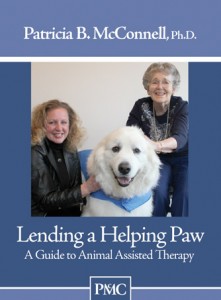
New DVD on Animal Assisted Therapy!

Wednesday, April 4th, 2012

We just released a DVD of the seminar I did in Naples, Florida on Animal Assisted Therapy and Activities, “Lending a Helping Paw.” I’m excited about it, because it gives me the opportunity to help individuals and organizations who want to help others. It is an example of an activity we can do with our dogs that is a triple win (for us, our dogs, and people who need some oxytocin and/or physical therapy). Because of that, old social worker that I am, it’s near and dear to my heart.

Speaking of hearts, and what fills ours with happiness, the question arises about how effective AAT (Animal Assisted Therapy) and AAA (Animal Assisted Activities) really are. I remember a conference put on by the Delta Society many, many years ago that included a controversial study. It showed that, in this study anyway, the greatest benefit was to the owners of the dogs, not the patients in the facility. Whoops. While the audience greeted the news with a disapproving silence, I was cheering in the wings, because it’s good to examine the issue objectively, rather than just following our hearts in this case.

Indeed, the study was very useful and no doubt had an impact on “best practices” as currently defined. It found that the teams in this case had just walked into people’s rooms without asking permission. No surprise then that the residents weren’t all in favor of the project; they’d already lost so much control in their lives that the last thing they needed was to lose more. That’s why good programs like The Delta Society and TDI emphasize the importance of putting the patient first, and letting them drive the system.

But the question remains: Is AAT and AAA really effective? First, we need to distinguish between AAT and AAA. Much of what people call AAT isn’t truly therapy in the medical sense of the word.  To be labeled as therapy the interactions need to be directed or delivered by health and human service professionals, with goals set, treatment plans written and progress carefully recorded. Animal Assisted Activities, on the other hand, include visits, petting, games and tricks.

Here’s the good news for those of us who want to believe that AAA and AAT are beneficial to the recipients: There is indeed research that shows it’s efficacy in several modalities:  Two studies that I can think of off the top of my head found that visits from dogs decreased the perception of pain after surgery. One study asked children to rate their pain (Robbins et al, J of Holistic Nursing, Vol 24, No 1, 206) and another looked at the amount of pain medication used after joint surgery, which is a good, objective and quantifiable measure (Kaplan, AAT Conference Abstract 2004). A third study found that walking with a dog significantly increased compliance with physical therapy programs and increased ambulation exercise: 28% refused to walk without a dog, only 7.2% with a dog. In addition, steps walked more than doubled once patients did walk (Abate et al J. of Cardio. Nursing 2011).

This is not surprising to those of us who are aware of the impact of dogs on our oxytocin levels, and the impact of oxytocin on pain perception (it decreases), immune responses (it increases) and affect (it tends to make us feel safer and more secure). But we do have to be careful here: Not everyone benefits from visitations or therapy from a companion animals. You have to like dogs to get an oxytocin rush from them. (Most “therapy” animals are dogs, but some programs have cats or rabbits for selected patients. No reports of sheep yet….) Awhile ago I visited a senior center with a good friend and her dog. I’d guess about half the people we saw were interested in interacting. The rest appeared to be either neutral or clearly avoiding an interaction. My friend knows what she is doing, and was careful to not impose her dog onto anyone who wasn’t a dog lover.

This all gets back to one thing I emphasize in the DVD: The patient is the star of the program. Not your dog, not you. As much as we love our dogs, if we do this right we’re doing it for people who aren’t as fortunate as we are, and don’t have the opportunity to interact with dogs as we do. It’s all about them, and keeping that in mind is critical to a program’s success.

Other aspects of AAT and AAA are essential too: The Lending a Helping Paw DVD has an extensive section on what dogs are suited for therapy work, and how to ensure that your dog is really enjoying the process (these are the 2 most common problems that professionals in the field encounter). It discusses organizations that certify teams, what is required to obtain certification and how to work with facilities in a professional and pro-active way.

MEANWHILE, back on the farm: Instead of playing with the lambs or gardening, last night I went to a senior facility outside of Madison and delivered copies of the DVD to one of the stars of the show: Ruth Trameri. She’s the lovely lady on the right of the cover, with my good friend Beth Viney’s (on the left) and her certified therapy dog, Czar. (Czar was an early admirer of my Gr Pyr, Tulip… that’s actually how Beth and I met.) Here they are,  gracing the cover of the new DVD:

And here’s a video from the DVD of Tootsie’s first visit to a facility. We used her (and Willie and 3 other dogs) to evaluations of  potential therapy dogs. (Tootsie passed, Willie… no surprise here, does not: too enthusiastic). This video segment is testing for one of the most important qualities of a good therapy dog — sociability. Dogs need to be interested in everyone, true social butterflies, but calm and respectful at the same time. Watch how Tootsie tells us where she’d most like to be…. (and feel your oxytocin levels rise?). Thanks to Beth Viney, the Director of Pet Pals in Madison WI, Dr. Linda Sullivan, and Pet Pals volunteer Diane Peltin and Ruth Trameri for helping with the evaluation section of the video, we all had a great time and it resulted in some very instructive (and, I might add, amusing) videos.


Therapy Dogs – Born or Made?

Thursday, January 19th, 2012

As many of you know I recently presented a seminar on animal assisted therapy in Naples Florida. (Yes, it’ll be out as a DVD later this winter. Happy Dance!) One of the motivations for doing the seminar was the number of clients I had who wanted me to help them prepare their dog for therapy work. Sometimes it was like swimming downstream on a warm, cozy river. Their dog was a perfect fit and ended up doing wonderful work in the community. Other times… well,  it was reminiscent of trying to paddle up a cold, frothy waterfall. The fact is, therapy work can be hard work, and it takes a special kind of dog to be both good at it and to enjoy it. The directors of AAA and AAT (AAActivities and AATherapy) will tell you that one of their greatest challenges is working with people who want to volunteer but whose dogs just don’t qualify. Here’s a summary of the characteristics of a good therapy dog prospect, in hopes it will be helpful for those who are interested in doing this wonderful work:

Affiliative: This seems like a no-brainer, but the fact is that many dogs are presented for therapy work who really don’t like strangers all that much. They love their owners and good friends, but aren’t all that interested in other people. Good therapy dogs need to be the kind of dogs who ADORE people, all people, and want nothing more than to connect with them. It is, after all, the emotional connection that is often the therapeutic part of AAA and AAT.  It seems to me that dogs sort into 4 categories: 1) adore people, care little for other dogs, 2) adore dogs, care little for unfamiliar people, 3) adore members of both species and are thrilled to meet new ones and 4) adore neither dogs or people, except maybe their owner. Needless to say, only categories 1 and 3 are good therapy prospects.

Physically Calm: Many of the dogs who think all people hung the moon regrettably don’t fit into this category. Leaping, licking, pawing and body slamming just don’t work in senior centers and hospitals. This is why so many dogs don’t qualify when they are young, but could be great prospects when they are older. I wrote a chapter with Aubrey Fine for his great book The Handbook of Animal Assisted Therapy, and we had a long discussion about how many dogs would be GREAT for therapy work when they are six. Or eight. Or ten, but their owners get them evaluated at the age of two, the dogs are not “passed” and their owners never try again.

Psychologically Sound and Non-reactive: It doesn’t matter how much training or conditioning you do, therapy dogs need a certain level of rock solid soundness to be good prospects. Of course, the context does matter: some dogs are great in senior centers but are uncomfortable around children and would be disasters in a children’s hospital. It’s important to remember that AAA and AAT include a vast range of experiences, so every dog must be evaluated based on what they are going to be doing.  But it’s still essential to keep in mind that although your job is in part to protect your dog, once you are inside a facility you will have limited control over what happens. And what can happen (someone grabbing your dog, weird noisy medical equipment coming on, a medical crisis that results in tremendous chaos) is sometimes enough to terrify a sensitive dog.

Included in this category, although albeit somewhat different conceptually, is the state of being “emotionally mature” or able to handle frustration and deal with the world with a calm, measured demeanor. Again, just as in people, sometimes this takes several years to master.

Ridiculously clean and healthy: Unless you work in health care facilities it is easy to forget how differently sanitation needs to be handled in facilities and hospitals than it does in your own home. Pet Pals here in Madison, which organizes visits to the Children’s Hospital through the UW Vet School, requires that all dogs in the program go through extensive veterinary evaluations twice a year. This includes an entire day of testing for a vast range of diseases, from salmonella to MRSA. In this case the dogs are visiting children who are often immune compromised, and so their requirements are more stringent than some, but any facility, from a senior center to a hospital, is a very, very different place than your home. Germs love the kind of places that therapy dogs go to visit, and they can move around like wild-fire within very vulnerable populations.

Aware of their Job? This is gravy, pure gravy, but the fact is that some dogs do more than happily sit with strangers or participate in structured therapy treatment plans, as beneficial as that can be to some people. These dogs seem to sense why they are there, and seek out people who are especially needy, and make an emotional connection with them that changes their life. These connections happen, and hearing about them is enough to make you all gooey-eyed. Special stuff indeed.

I’ll leave the training and evaluations required to be a registered therapy team for another blog, but I thought it’d be interesting to ask all of you to add to this list–specifically, what type of personality do you think a therapy dog needs to be successful? If you’ve either had a working AAA or AAT dog, or been the beneficiary of one, I’d love to hear what criteria you’d put on the list. FYI, I’ll write another time about what the handler at the other end of the leash needs (a list too often ignored!), and some good books for people interested in getting involved, but right now I’d like to think about the dogs themselves. Aside from training for specific cues and conditioning to things like medical equipment, what traits do you think good therapy dogs need?

MEANWHILE, back on the farm: It was eight below (Fahrenheit) when I got up yesterday morning, three below today. I think the high is expected to be around eight or so, and we’re expecting 2 to 7 inches of snow tomorrow (2 to 7? that’s a big difference!).  I wish I didn’t have to drive to town to get ready to start teaching at the university (“The Biology and Philosophy of Human/Animal Relationships”), but still it’ll be sort of fun to get the snow. If it had been snowing all winter I’d be tired of it, but we’ve hardly had any winter at all til now, so it feels sort of good in some strange, possibly masochistic kind of way.

The great news is that Tootsie, who began her life here explaining to me that her paws did not participate in wet or cold, now trots happily outside in the worst of weather, does her business and then runs, ears flapping and tongue lolling, back into the garage. When we got her as a puppy mill dog she understandably had no concept of going outside and eliminating on cue right away, and then going right back in if the weather was inclement. She’d stand at the end of the garage and look plaintive and miserable, but refuse to go out. And even in great weather, once out she’d sniff and sniff and sniff and sniff… you get the idea.  What a great reminder of how handy it is to put peeing and pooping on cue.

And now you should see her! Out she runs, does her business and then runs back in… while Willie stays outside and looks at me like “WHAT? Go back inside now? Whatever for?” So Tootsie goes back inside and Willie and I play outside for awhile. I should tell you though that yesterday there was one time, during the coldest part of the morning, when she did refuse to go out. But she’d been outside to pee recently, and I took it as “Truly, I don’t have to go at all, and it’s really, really cold. Would it work for you if I stayed inside this time?” And indeed it did. Honor your dog, right? The next time I took her out her bladder was fuller, and out she went, did her business and ran to me for her treat. Now, I just have to work on her barking if she sees me and Willie outside through the window… One thing at a time!

Willie is good good good. His shoulder seems good (almost afraid to write that) and he’s loving everyone he meets lately. He still isn’t buddies with Tootsie. They STILL ignore each other, it’s a bit strange sometimes, but he is very tolerant of her and the only sign of problems I see is when I come home she has taken over our greeting rituals. Rather than being all over me, Willie runs to get a toy and lets her get the first attention. I’m not liking that, I think he is a bit frustrated, but doesn’t like competing with Tootsie for attention, and unwilling to get into any conflict about it… I’ll be working on that in the near future too. Never a dull moment with dogs, hey?

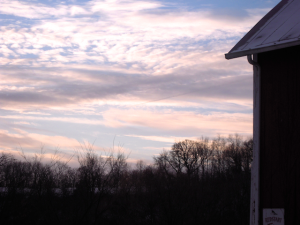
Why do I live in a place that can be colder in the winter than the inside of your freezer? Here’s the reason: Sunrise yesterday.  Eight below. And a sky simply too beautiful for words…


BOOKS BOOKS BOOKS

Thursday, December 29th, 2011

So many books, so little time! Here are a few I’m enjoying:

Magnificent Mind at Any Age by Daniel Amen. This is a fascinating book by a psychiatrist who began doing SPECT scans of his patients brains and discovered how many psychological/behavioral problems related to brain function. It’s an inspiring book for anyone looking to improve their health and behavior, and besides being motivated to exercise more and stop drinking diet soda (I know, I know), I find myself thinking about dog behavior on every page. Daniel relates multiple cases of people with behavioral problems (fear, depression, anger, impulsivity) that are improved through diet, exercise, supplements and medications that specifically work on areas of the brain related to those problems. Anyone out there see any dogs who are fearful, impulsive, etc etc…?)

Your Dog’s Best Health by Nancy Kay: The subtitle of this compact, highly readable book is “A dozen reasonable things to expect from your vet.” This book is a great summary of how to have the relationship you’d like with your veterinarian, written by a vet herself. Just as the book above can be extended to our dog’s health, I’d say this book could also be expanded to our relationships with our physicians. This book is short, sweet and full of useful information.

There’s a Dog in the House by Nancy Chwiecko and Amy Fernandez. “A practical guide for creating today’s dog friendly home,” this has got to be the only book out there that looks at your home from your dog’s perspective, advises on dog-proof but attractive furniture, has a chapter on helping dogs with special needs and how to repair the wall that your dog with SA chewed through.

I also just finished Therapy Dogs Today, which I read as part of my preparation for the seminar I’m doing in Naples on January 12 on AAA and AAT. By Kris Butler, this is by far the best book I’ve read on the subject, far superior to anything else I’ve seen. What I like about is especially is her focus on the patient’s and the dog’s needs, (owner/handler–your job is to present your dog and get out of the way) and her understanding that real ‘therapy’ can only occur if a true relationship has been formed between the dog and the receiver. She also emphasizes the importance of observing your dog carefully for signs of stress or discomfort, a common problem I’m sorry to say that I’ve seen often in my experience. If you are interested in ever doing this work with your dog, this is a great book to get.

What are you reading? I always love to hear . . .

MEANWHILE, back on the farm:

Great news about Willie. I’ve put him back on a strict diet w/ no chicken or lamb, increased his greens, got him acupuncture, increased his mental exercise, carefully managed Sushi in a way relaxing to us all and put his hobbles back on when we are out or he is meeting unfamiliar men. I speculated that the hobbles acted almost like an anxiety wrap or thunder shirt, and that taking them off (as I have in the last few weeks) when he was free and off leash was at least one factor in his regression. Think of prisoner let out of jail with not enough time to adapt to freedom. It’s only been a week since I made all those changes, but he’s met several guys (all dog savvy and carefully coached), and Willie has showed no signs of fear or anxiety. He ran right up to all the guys like they were his best friends. Yeah!

The first guys Willie met were all off the farm, then the next ones met him outside the house first before coming inside. Tonight a dog savvy friend (yeah Justin!) is coming over. They met on Monday first outside, but this time I’m going to have him meet Willie inside the house (where Willie was first shocked by the presence of a guy several weeks ago.). It will also be at night, and most fearful dogs are more easily frightened at night than during the daytime. So I’ll go slowly and carefully. I’ll keep you posted. It’s very early in the process, so I’d never say that we are “done,” but I am encouraged at how things are going. I should add that, with dogs like Willie, one is never really ‘done.’ They slide out of balance so easily that one has to always be on the look out for regressions. If you want to read more about my speculations about what’s going on, go back to the earlier post and read my comments.

It continues to be warm and gloriously sunny, although snow is predicted for tonight. What a change that will be! Poor Tootsie is going to have to wear her coat when we go out again. Willie will love the cold weather; he doesn’t seem phased until it’s below 10 F, and it doesn’t look like we’ll get anywhere near that. We’ll have a lovely New Year’s dinner with friends at the farm, and then it’s all about getting ready for the seminars I’m doing in Orlando and Naples.

Here’s Tootsie, showing off her hair extensions (We are developing a story about a poor 5 year old beauty contestant, whose mother bought her hair extensions and elaborate costumes, but was unable to cover up her Andy Rooney eyebrows. Thus, her career was doomed from the start — judges being unlikely to award blue ribbons to little girls who look pissed off all the time.) (She’s not. Tootsie, that is. She just needs a stylist who does eyebrows.)

See you in Orlando!

Tuesday, November 22nd, 2011

Eeeps, where’d the day go? I was going to write about the emotion of disgust, but it’ll have to wait til tomorrow. But before the day is over I wanted to remind you that the Early Registration for the Jan 7-8 seminar I’m doing with Kathy Sdao is over tonight at midnight. I’m doing a new day-long seminar on Canine Communication: communication of all kinds between dogs, from dogs to people, and from people to dogs. Lots of it is interactive: you’ll be working like a dog searching for scents (sort of!), interpreting visual signals, and translating dog vocalizations.  I’ll be adding in all the new research that relates to communication, so if you want to up your understanding of all things dog, you definitely want to come. It’s in Orlando, Florida too… not a bad place to be in January, and easy to fly to as well if it’s too far to drive.

Kathy Sdao is presenting on Sunday, and I put her in the same category as Ken Ramirez–great speaker, great trainer and an inspiration. If you missed Ken, then don’t miss Kathy, I never, never leave her talks without being energized and inspired.

I’m also doing a second half-day seminar on using your dog in Animal Assisted Therapy and Activities in Naples, Florida on January 12th in Naples, Florida. (More on that on our website soon.) Katie and I just finished taping a great sequence of evaluating 4 dogs, including Willie and Tootsie, as potential therapy dogs. (Our purpose was to illustrate an evaluation procedure, not actually put either of my dogs in a program right away. But, I can tell you: one would have passed, one would not have. You’ll have to guess which til later!) I’m excited about this seminar too, it’s a great opportunity to help people who want to help others through their dogs.

So here’s the plan: Go to Orlando, come to the seminar there, treat yourself to a few days in Disney World (that’s where I’ll be!), and then drive over to Naples and catch the seminar on using dogs for AAT and AAA. It’s a win/win for everyone. Hope to see you there.

MEANWHILE, back on the farm: I’ve gotta go and feed Sushi, dogs and sheep. They are all waiting. The dogs patiently, the cat impatiently, and the sheep, well, they are beginning to bang on the sides of the barn. More tomorrow! But here’s a photo, not from today, and not from the farm, but it’s one of my favorites that I took in New Zealand, so what the heck!

Animal Assisted Therapy Through the Ages

Tuesday, September 28th, 2010

Aubrey Fine’s new book on AAT just came out, Handbook on Animal-Assisted Therapy, and I am pleasantly surprised at how much of general interest is in it. If you’ve been reading the blog for awhile you might remember that Aubrey and I wrote a chapter for it together on “what therapists need to understand about their co-therapists.” I loved working with Aubrey, he and I share so many beliefs and perspectives, and in addition he is such a kind and generous man to work with. We both agreed, as we say in the chapter, that great therapy dogs are often older dogs, who have had a chance to mature and mellow a bit.

As I mature (so to speak) I look forward to being semi-retired and  having the time to do AAT or AAA (animal assisted activities). With Willie? Not sure, too soon to say. He is sooo cuddly; last night I got lazy and spend several hours on the living room floor watching TV, spooning with Willie and giving him a two hour belly rub. He loves to lie next to people, his head on your chest, but then, one is required to stroke and rub or a paw comes up to remind you to get back to business….

My pleasant surprise about the new book relate to its sections on the human-animal bond in general and on historical aspects of using animals to improve human health. James Serpell has a fascinating chapter on “Animal-assisted interventions” through history, including animal souls, animism and animals in medieval times as agents of healing. The book, as well as being the ‘must-have’ reference for anyone interested in a AAT or AAA, turns out to be a treasure trove of references and information about people, animals, our social bond and mutual health benefits.Warning: it’s not cheap. It sells for $56 on  Amazon, which is more than reasonable given its size (588 pages) and the amount of information in it, and its not beach reading either. But if you’re interested in the topic, it would be a great book to have.

I’d love to hear your AAA or AAT experiences. I know we talked about it last year, but I’d especially like to hear from people who also would like to do it but haven’t yet. Perhaps your questions could be addressed by the pro’s out there? I know lots of you reading this do therapy with your dogs.. your advice for people who would like to get started?

And, oh yeah, I promise not to mention any more books for awhile. Until I do. Sorry, I am a book groupie, (as if it hasn’t been obvious.)

Right now I wish I had more time to read. I’ve been giving talks right and left, have a fun one tonight at the Verona library and next week at the Humane Animal Welfare Society of Waukesha. Working hard on my APDT talk, not to mention my two-day seminar in New Zealand. One day of that is the Advanced Dog Behavior Seminar, which I haven’t done for awhile so will need lots and lots of updating. Doing lots of writing too… finishing an article with Pia Silvani on Dog-Dog  Reactivity, recently finished an article for NIH on kids and dogs (that one dragged on forever!), just finished my new column for Bark’s Nov/Dec issue on the mental life of dogs.

Humm, better stop writing this and get back to business . . .

MEANWHILE, back at the farm: It’s blue sky and cool and crisp and you just wanna take the entire week off and gather apples and make cider and pick the last of the basil before the first frost (coming later this week) and mash it into pesto. Willie and the sheep (and I) are loving this weather. 65 F for a high, high 30′s or low 40′s at night. Perfection. But it’s getting dark so early; and now I have to choose between gardening (way behind), practicing with Willie on our driving straight lines or taking a long hike for general health of both me and Willie and to get ready for NZ and the Milford Trek.

Request: Send more hours in the day. Will pay premium price for ones with low humidity, cool temperatures and soft sunlight on fall colors.

The bird feeders are getting busy again. Here’s a Goldfinch and Nuthatch getting a snack of black oil sunflower seeds and thistle seed. . .

And here’s some sunflowers themselves….