Welcome to the official Patricia McConnell website. Skip directly to: main content, navigation, search box.

Posts Tagged ‘Love Has No Age Limit’

You’ve Got a Friend?

Friday, February 17th, 2012

If you’ve been following last week’s blog and the comments, you know that there’s been an active discussion about whether dogs can (or can’t) form “true” friendships. This was motivated by an article in Time Magazine by Carl Zimmer that discussed the evidence of friendship in several species of mammals, including dolphins, baboons and horses. In spite of the irony of a cover photo that includes two dogs (and the photographer saying: “I actually had to make sure that the dogs coming in were actually friends.”), the article states “… most scientists think they [relationships between dogs] fall well short of true friendship.” I’m curious who the ‘most’ scientists are…

I suggested to the author that he might want to talk to scientists who study dogs like Barbara Smuts & Camille Ward. Barbara and Camille wrote an article in Bark magazine (Summer 2010) in which they summarize their research that makes it clear that dogs can form friendships. Keep in mind the Barbara Smuts is a well respected scientist whose work on baboons was essential in convincing other scientists that animals can form friendships. She defines friendships as relationships in which individuals choose to spend a lot of time together and engage in friendly, affiliative behaviors. Do we see that in dogs? Of course! So absolutely, I continue to go on record as believing that yes, dogs can form “true friendships.” Here’s some more of my arguments related to that belief.

First, we have to distinguish between intra and interspecific relationships; social relationships between individuals of the same species and those between members of 2 different species. I absolutely agree that, as interspecific relationships, our social bonds with dogs are more complicated than those between dogs. As thoughtfully mentioned in the comments, most of our domestic dogs are completely dependent upon us. We control their food intake, their elimination, who they play with, etc. Thus, the question is a good one as to whether a dog could consider us anything but “keepers” or “guardians,” but not true friends.

Certainly a balance of power does have a profound effect on a relationship, but I would argue that it is still possible to form a friendship with an individual who holds more of the cards than you do. After all, the scientific paper that Zimmer uses to base much of his article on argues that friendship most probably evolved from close relationships between mothers and their young. Even after the young mature, their mothers (in apes, for example), still have more power than their grown young do. But scientists call their close social bonds one of “friendship” nonetheless.

Second, I would argue that, in many cases, dogs may see themselves as having a tremendous amount of power. “Paw her and she’ll pet my head.” “Whine and she’ll give me a treat.” We could argue on and on about who has more power and when, and certainly it’s true that in most cases we control a dog’s access to food, etc, but the power differential isn’t always as black and white as one might think. As mentioned in the comments, our relationship with dogs is an example of a “symbiotic” relationship, but of a specific kind: a “mutualistic” relationship in which both parties receive benefits. (Parasitism is also a symbiotic relationship, but in that case only one member benefits.)

Third, if you look at the paper Zimmer uses as the basis for his article (Seyfarth and Cheney, “The Evolutionary Origins of Friendship.” Annu. Rev. Psychol. 2012. 63:153-177.), the authors define friendship as “enduring social bonds not directly related to mating.”  In most species, that includes grooming, play,  maintenance of proximity, and the formation of coalitions. If you look at the literature, time spent in proximity is the most universal feature of how “friendship” is defined. And although it’s true that there are many reasons a dog may choose to spend time close to one of his or her “humans,” including insecurity or the Stockholm effect, surely most of us have known dogs who happily and cheerfully chose to spend their time next to a particular person, and sought that person out from all others in a crowd.

Whether dogs can form “true” friendships with other dogs is another matter (although, of course, they are related). And here, again, I’ll argue that good science supports that contention. Zimmer states that “scientists don’t see friendships in wolf packs,” but I’d like to see what that is based upon. Show me the data, please. One argument Zimmer and others make is that most friendships seen in non-human animals are in species in which individuals have life-long relationships (dolphins, apes, etc.). The argument is then made that wolves disperse from their natal packs, and thus dogs have not evolved from a species predisposed to form friendships. But what of the huge packs that are found in Yellowstone Nat’l Park? As I understand it, most large packs are found to be made up of related individuals, exactly the same genetic make up of chimpanzee and dolphin groups. We can’t have it 2 ways here.

And again, (she says with a sigh), dogs are not wolves. They do not automatically attempt to rip the throat out of any canid that enters their territory, for example. Wolves and dogs both are, however, exceptionally social. Unlike most mammals, they live in groups, often defer reproduction to others, often raise the young of others cooperatively (this is often true in dogs, even if the feral males don’t provision their young; “Aunting” behavior is very common in dogs, my Pippy helped to raise all of Lassie’s puppies) and in wolves anyway, hunt together as a cooperative group.

Here’s a behavior not mentioned in Time or Seyfarth and Cheney’s article, but it could (and should) be a subject of study: Greeting behavior. One of the reason I argue so strongly that dogs can form friendships is the extreme variation seen in inter and intra specific greetings. As mentioned in the comments, there are endless examples of dogs who greet another dog or a person with an “over the moon, over the top” enthusiasm only seen to that particular individual. I once saw 2 dogs greet each other who had been apart for over six years and the dogs were border-line hysterical. The frequency and intensity of their whining, licking, leaping etc was several magnitudes their usual behavior. This canine equivalent of hugging, crying and kissing is universally understood as joy, and I would argue it is not anthropomorphic to presume that the emotions being experienced are exactly what we think they are.

This is not to say that friendship between people and dogs is exactly the same, and yes yes yes we need more research on the topic. But scientists are trained to that the simplest explanation should be the first one employed to explain a phenomenon (Occam’s razor), and I would argue that the simplest explanation to what looks like friendship in dogs is exactly that… friendship. That doesn’t mean that all dogs are friends, or that all dogs are friends with their humans. If that’s what we observed (all dogs treating all other dogs the same way), it would actually be evidence against friendship in dogs; the whole point of the concept is that it is a ‘special’ relationship above and beyond the other normal, social relationships, so we should expect to see it only between some individuals.

A last comment about friendships: Here’s a rather lovely saying about it I found while working on this topic: “Love is blind. Friendships tries not to notice.” Anonymous. Love it.

MEANWHILE, back on the farm: I’d love to tell you that Willie and Tootsie are friends, but they still pretend the other isn’t there, even when their heads are smashed together when they greet us or ask for petting. But they both gave us over the moon receptions when we returned from the Dog Writer’s Association of America in New York. (Love Has No Age Limit won two awards, very gratifying!) I’ve got 2 heavenly weekends at home, then off to Phoenix one weekend (invited talk at the Interdisciplinary Forum on Applied Animal Behavior, not open to the public I’m afraid) and Tucson for the Tucson Book Festival the next weekend in early March. If you’re in southern Arizona, come to the book festival March 10-11th!

Here’s a photo I snapped last Saturday from the Empire State Building. I’ve been to NYC several times, but never made it up to the observation deck, and in spite of a brutally cold wind, it was truly fun. I rented the audio tour and learned all kinds of great things about the city, and loved being able to see a complete view of Manhattan. This is me on the observation tower: Brrrr. Wow!  Brrrr. Wow!  Brrrr. Wow! (etc.)

I love visiting the Big Apple, but always soooo good to get back to the farm!


Do Dogs Form “Real” Friendships?

Friday, February 10th, 2012

I had an entirely different blog written and about to be posted, but there’s a swirl of discussion going on right now about an article that came out in Time Magazine by Carl Zimmer about “friendships” in animals. He has lots of good information from researchers who argue that true friendships are formed in many social species, including horses, dolphins, and baboons. I was a tad irritated at suggestions that “we” (scientists) haven’t accepted that friendships can be found in other animals until just recently…” look at the writings of Jane Goodall and Frans de Waal for example for exceptions to that…  but in general it’s a truly good article.

But imagine my surprise when he writes that evidence of true friendships can not be found in dogs.  He says: “.. most scientists think [they...dogs] fall short of true friendship….. noting a lack of evidence in dogs of constancy, reciprocity and mutual defense…” found in other species. In other words, dogs can’t form true friendships with us, or other dogs. It is true that dogs are less studied than many other species regarding their social relationships and that we can’t use anecdotal observations as substitutes for good data. But the article doesn’t say that there is not enough evidence to make conclusions about the social relationships of domestic dogs. It says “…most scientists think they [dogs] fall short of true friendship.” It also says “… dogs have become capable of being sweet and loyal to humans, but it’s likely that they treat us more as guardians than friends.” It is one thing to say that we don’t yet have the evidence, and yet another to make conclusions based on a lack of data-driven research.

If you want to read more about, this, go to my Facebook page. Carl has been good enough to join the conversation, which I greatly appreciate.  My argument is that, if as the article states, true friendship requires “constancy, reciprocity and mutual defense,” then at least observationally we have ample suggestions that social relationships between some dogs are as strong as social relationships between some horses. I suggested on FB that the reason many scientists are hesitant to attribute “friendship” to dogs is not just the lack of data, but rather a scientific bias against domestic, familiar animals. “Familiarity breeds contempt” is as true in science as it is elsewhere.

As someone who has observed and worked with domestic dogs for over twenty three years, it is hard for me to imagine arguing that they can’t form social relationships analogous to friendships in our and other species. Lassie appeared to fall in love with Luke the day she met him, followed him everywhere, groomed him daily, paid attention to no other dogs and sank into what looked like a depressions when he died. That’s not data, but neither does it suggest that dogs aren’t capable of forming true friendships. I find myself somewhat amazed that we are even arguing this point. Of course we need more data, those of you who know me know I’ve been encouraging good research on canine behavior for 23 years, but concluding without data that dogs probably can’t form “real friendships?”  Given that there is no data behind that either, I don’t see it as a supportable or reasonable conclusion. Especially given our observations, which may be anecdotal, but still are valuable (as were Jane Goodall’s observations of chimps.) If the article had said: “Although it appears that dogs form strong friendships, we need the same kind of data collected on them as we have of other species,” I’d have no problem with it.

Jump onto Facebook if you want to read Carl’s and others comments. I expect he is busy answering no small amount of email and comments on the subject!

MEANWHILE, back on the farm. WILLIE IS WORKING SHEEP!!! Be still my heart, that’s about all I have to say. Granted, the sessions are short, painfully so, but he looks sound so far and he’s working as if he’d never had a year long break (it was a year ago last week he was injured) and it’s so much fun for both of us that we can hardly stand it. When I say “That’ll do” he runs to me, spins in happy circles and I clap my hands and we grin at each other and somehow my heart gets bigger in my chest and we float back to the house and life is good. I’ll never be able to work him for very long, and I’m sure we’ll have set backs, but just being able to work a little bit is more wonderful than I can say.

No work this weekend though, we’re off to the Big Apple for the Dog Writer’s of Association of America annual awards. Love Has No Age Limit is up for an award, as is a column that co-author Karen London and I wrote for the APDT Chronicle.  FB readers have suggested I not wear jeans and my usual plaid shirts from LL Bean or Land’s End. Okay, I promise I’ll get the straw out of my hair, but I’m not wearing black. I just can’t understand why all black is so chic when it’s the “color” that oppressed women are forced to wear all over the world. I’m wearing orange, and NYC will just have to deal with it. The banquet is Sunday night, Saturday we’re going to see the play Memphis on Broadway. All very fun and exciting… but when do I get to work Willie on sheep again?

And apologies for no new photo today: I’ve spent all my time on the first blog (next week!) and the article about friendship and now have to pack, clean the house for the sitter, write out my lengthy set of instructions, etc etc.  Just too much to do today! I’ll make up for it next week!


TOOT TOOT TOOTSIE, HELLO!

Wednesday, November 2nd, 2011

Here’s TOOTSIE!

Also known as:

Little Bit, Mini Me and my favorite, Mop of the Woods.

There’s a new kid on the block, or at the farm I should say. Meet Tootsie, a 7 year old King Charles Cavalier who was rescued by Lucky Star Cavalier Rescue from an Amish Puppy Mill, after the owners had used her up. Her mouth and ears were horribly infected; she had twenty teeth extracted.  She also was fat as a tick, so you couldn’t say she was starving. She weighed 22 lbs (now she weighs 15 and is still a bit overweight).

And what, you might ask, is a Cavalier doing at Redstart Farm? Doesn’t every farm need a Cavalier? (What, you think we farmers don’t have laps?)  Seriously, there is logic to all this. Here’s a brief version of the back story:  If you have been following the blog for awhile, you know that after Lassie died I had my heart set on getting back up to 3 dogs–Willie, a little lap dog from a shelter or rescue, and another Border Collie. I had wanted the lap dog first, but then a litter of BCs came along that looked too good to pass up, so last summer we raised Hope, a Border Collie pup with great herding lines.

It’s a long story, as you know if you followed the bouncing ball last year, but it turned out that Hope and Willie brought out the worst in each other, and I decided it was in both of their best interests to place Hope in another home. It was a brutally hard decision for me to make, and I was roundly criticized by some for it, but I did what I believed to be right for both of the dogs, took some deep breaths, and went back to looking for the next dog. If you know Willie’s history (extremely uncomfortable, and at one time aggressive, to unfamiliar dogs) you know that picking the right dog for him was a challenge, and not as easy as it would have been with any other dog I’ve ever had. But early in the year, a dear friend and I found a little fluff-ball-oxytocin pump from a rescue who sounded perfect, and was about to come out to the farm when Willie was badly injured.

And so, the next dog was put on hold for many, long months while we worked through Willie’s injury in February, his surgery in May and his first 5 months of PT. Once Willie was able to have a bit of off-leash time I began looking again. One of the places I looked was at Cavalier rescue, because Willie has had some great experiences with them. One of my sitters has two females who come to the farm often, and Willie gets along beautifully with them. In addition, one of his best friends when he was younger was Brody, a sweet little male Cav, who used to love to wrestle play with Willie on the living room floor.

After consultations with two wonderful women in rescue, Nancy and Leslie, and two super rescue groups, Lucky Star Cavalier Rescue and Greater Chicago Cavalier Rescue, we all agreed that Tootsie might be a great match. She is a small female (least likely to make Willie nervous), quiet (good again), deferential to Willie (good again) and great around cats (and yet again). After a trial period Tootsie became a  permanent member of Redstart Farm and I can’t tell you how happy it makes me. She is great for us–she does need a lot of training, but she’s going to be a good, good little dog, and will fit in well. It also feels good to finally be able to bring a needy little dog to the farm. I’ll talk in a later post about how this adoption relates to my concerns about the problems that occur when breeding dogs for our sake rather than for theirs, but for now, it’s all about integrating Tootsie into the farm.

As you can imagine, Willie’s feelings about all this are paramount to me. I am happy to say that so far things are going well, given how little time has passed. She and Willie are not buddies, and I don’t know that they ever will be. But that’s okay; he can’t have a playmate now because he is still on a great many restrictions, so I couldn’t bring in a dog he wanted to play with. At first he was a bit uncomfortable about her in the house, but less so than he normally would be with a new dog in the house. Willie does well with unfamiliar dogs in the great outdoors (a huge change from his behavior 2-3 years ago) but he is nervous with new dogs inside the house. As expected, he was not 100% comfortable with her in the house at first, although he was still pretty darned polite. Mostly he made what I call “snake face,” hard flat eyes, flattened ears and a sour look that made it clear he wasn’t thrilled with the addition. But he was appropriate, and in very few days he appears to have accepted her presence. He still seems happy and relaxed and seems to think of her as part of the ‘new normal’ of life.

Of course, I’ve worked hard hard hard on counter conditioning him around her getting food and petting, and now he’ll even let her eat out of the same plate when they get snacks after our dinner. Resource guarding was one of my primary concerns with Willie, and that is going extremely well so far. She pushes in between us for petting and he puts up with that too, although he clearly doesn’t like it. Who could blame him? She’s the one who needs work here; she is super pushy and will be learning some manners soon. (Thus the name, Mini Me.)  A good sign I think: he is starting to sneak in sniffs when he can, as if pretending he just happened to find his nose in the area of her belly and groin. “Oh my, did my nose end up under your tail? I have no idea how that happened.”

She, on the other hand, pretends he isn’t there. She is an especially small Cav (her legs are ridiculously short) and he must look like a giant to her. I suspect they will become more and more comfortable together, and who knows, maybe they will learn to be buddies. It’s very very early …;

I’ll write updates about how things are going when I can. Weeks one and two have been all about:

1) House Training: She is a mill dog after all–but Leslie at Lucky Star made a GREAT start. I took her out every 10 min for the first 2 weeks. Seriously. She is still in shock that she gets a treat every times she pees. She’s doing great, but I am still on it all the time.

2) Teaching her to respond when I say Tootsie. That was her name when she was in foster care, but she had no idea what it meant when I said it. Around day 15 she literally had a Helen Keller moment when (I think) she realized that the noises I made meant something. I would give a lot to have had a video of her face when she made the connection.

3) Leash Manners: Not charging away at 20 mph when on a leash. I never trust her off leash now, so we worked hard on teaching her to stay close to me when the leash is on. It’s taken a lot more treats, but she’s making fantastic progress.

4) Barking: I was warned she barked in the morning at 5:30 until she was let out of her crate. Oh my, not good for me and Willie and our super sensitive ears. We’ve worked very  hard on this too (began by setting the alarm for 5 am, then slowly later etc etc.) She does NOT bark in her crate in the morning (the goal is no crate at all, but the house training issue with a mill dog takes priority) YEAH! But she does bark at other times when she wants out, sounding something like a huge, operatic mouse. We’re working on it and she’s making progress on that too.

Best of all? She is super friendly and is much less shy than most mill dogs. She loves people, men and women both. She has some health challenges; a minor heart murmur and subluxated knee (also minor), and of course there’s her heart to worry about given that she’s a Cav. I don’t know how long her life with us will last, she is already seven years old, but she’s found a home at Redstart Farm, and in my heart forever.

Here she is:

And on one of her first walks in the country, my goodness this exercise stuff can tire a girl out!


Hi from the Madison Seminar

Monday, October 31st, 2011


Wow. What an amazing experience for me, and I hope for the 250 participants in the Madison Seminar. We spent the weekend immersed in hot-off-the-press research on canine behavior, (I was worried it would be too wonky but apparently I’m not the only one starved for intellectual stimulation about dog behavior!), and Ken Ramirez’s inspiring wisdom about training, well illustrated by compelling videos and stories. You just can’t listen to this man talk and not be a better trainer for it. We were even honored by the presence of David Wroblewski, the author of the deservedly best-selling and instant American Classic, The Story of Edgar Sawtelle.

I’m basically brain dead today, able only to mumble monosyllabic nonsense, but I’m looking forward to lots of posts inspired by the weekend, from articles about some of the research I talked about, to some of things we learned from Ken, to answering some of the many questions I was unable to answer, and even to posting some data from an experiment we did on Saturday. But here are some photos from the weekend.

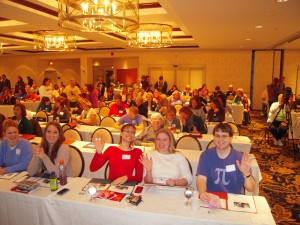
Here’s just some of the participants before we got started after lunch on Saturday.


Here I am torturing Meeka, one of our cover dogs from Love Has No Age Limit. Like all the dogs in the book she was rescued (found as a stray in this case) and adopted by Shannon who brought her to the seminar. What a treat for me to meet her.


And here I am with Ken, attempting to have his training skills flow into me in some kind of magical transfer… I’ll let you know if it works.

Expectations: Adults versus Puppies

Wednesday, April 20th, 2011

Karen London and I are working on our edits to the new booklet on adopting adolescent and older dogs, and something hit me as I was writing that I thought was worth talking about. After considering my own experiences bringing “non-puppies” into my home, talking with folks in rescues and shelters, and working with clients for so many years, it strikes me that one of the biggest problems people have when they adopt an “older” dog (not old, but not puppy either) relate to unrealistic expectations.

I don’t mean that in the usual sense, say, for example, expecting a dog to behave perfectly on day one, but more in the sense that we have certain expectations of adults that we don’t have with puppies. Take house training, for example. Everyone expects puppies to have “accidents” in the house for a few weeks or so, but people are often shocked and angered when an adult dog urinates on the rug just hours after arriving. But of course, most dogs aren’t “house trained” in the sense that we define it (always go outside, never inside) but are trained not to go in a particular place. That doesn’t mean that they can generalize what “house” means, given that they don’t have access to our brains and can’t download the way we see the world.

In my experience people don’t realize how important basic house training is for the first few days when an adopted dogs enters the home. This is especially important for dogs who haven’t had much experience in a variety of houses. If they were taught to potty in one specific backyard and not in a specific living room, why would they generalize that to another location? The fact is, some do and some don’t, so it’s job one to pay attention when you first bring a new home dog. This doesn’t seem like rocket science, but I think it’s not intuitive, and I suspect that our reactions to an adult dog urinating in our houses are more like those we’d have if an adult human peed on our living room carpet. (Yuck, what an image, sorry!).

Staying close by and coming when called seem to present a similar disconnect between “puppy versus non-puppy.” Young puppies have an inherent follow response, and we don’t need to do much when we bring them home to keep them close by. Of course, we’re wise to start recall training right away, but it’s seductive to forget that and imagine your pup will follow you everywhere forever. All this relates to one of the biggest problems that I see owners, shelters and rescue group deal with: dogs who are either let outside off leash intentionally, or escape out the front door or through a hole in the fence and can’t be called back. I’m sure I don’t need to tell you that this causes no end of grief for the dogs, the fosters and the new families. Yet, it seems ever so common to expect an adopted dog to behave like a puppy and follow you everywhere, leashes be damned.

I’d love to hear your thoughts on this: What did you find surprising, or important to remember if and when you brought home an adopted dog who was well beyond puppy hood? I’m sure your stories will be helpful to us all.

MEANWHILE, back on the farm: Brrrr. Snow, sleet, hail, thunder and a ridiculous amount of stuff in between fell yesterday, but at least we escaped the damaging storms that plagued so much of the country. I hope you and yours are all safe and sound. Anyone out there need some sympathy?

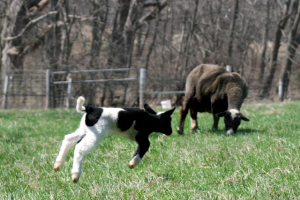
This weekend some dear friends came to help with the sheep chores, and then we all got reinforced by being able to let the lambs out of the barn and go up the hill for the first time in their little lives. The day was warm and sunny (very rare this spring!), and we soaked up the breeze, the sun and the green grass like sponges. As you can see, the lambs seemed to like it too.

xx

And the Winner Is!

Wednesday, March 30th, 2011

As many of you know, we asked for photographs of dogs to grace the cover of our new booklet on welcoming an adopted dog into your home. Karen London and I are working hard on the text right now (too short?! no, too long!? rinse and repeat . . . ) but I can tell you that the official title is Love Has No Age Limit and after looking at over 700 photographs (wow!) we have settled on the photograph you see below.

So here he is: A dog named Theo, who like many of the dogs whose photos were submitted, came with an amazing story. He was found running loose along a highway in New Jersey, and sat in a shelter for 3 months before Kimberly Wang of Eardog Productions in New York found his picture on Petfinder. Kimberly spent three hours with him at the shelter, and was entranced by his eagerness to learn and his “natural tendency to make sustained, relaxed eye contact,” in spite of being an untrained, goofy adolescent. She brought him home and now he is an accomplished photo model, a Licensed Service and Therapy dog, and a friend to all he meets.  I love that he is named after Theo Van Gogh, the painter’s brother who devoted his life to supporting others, just as Theo the dog is doing today.

But, wait, there’s more . . . So many great photographs came in that we are going to use lots more of them by putting another photo on the back cover and starting every section with a picture. We’re also going to put a selection of photos, and the stories that came with them, on a page on the website, once we get then selected and approved by their owners. That’ll take us a few weeks perhaps, but stayed tuned, we’ll let you know as soon as it’s up.

Here’s Theo:


MEANWHILE, back on the farm: Triplets! Rosebud had the first lambs of the spring, 3 little ewe lambs who are terminally cute. (Check out their photo on Facebook!) More than that, bless them for having full bellies when I discovered them in the morning. I had said that I hoped Rosebud would continue her history of having healthy lambs all by herself, producing just the right quantities of creamy, colostrum-rich milk and being an attentive mom to two healthy lambs.  She did all that but went one better, by having triplets. I shouldn’t be surprised, she had triplets last year too. What a girl.  Next up is Spot (due today, but this line seems to be later than the woolly breeds by 2-4 days, Rosebud was actually due last Friday) and then the noble Dorothy and the piggy ewe, Brittany, who are both due on Saturday.)

Willie is thrilled to be off leash right now, although still no playing outside and no herding. The herding restriction is hard for both of us; it’s great weather, the ground is dry and it would be good for the sheep to move around. We’ll just have to be patient, surgery is scheduled for May 14th. I’d do it sooner but Jim’s family comes first. Willie’s is doing his exercises 3 times a day (with a few exceptions during family crisis days) and he is getting visibly stronger on both shoulders. We’ll post a video of his exercises as soon as we can get them.

Lastly, thank you to everyone who sent best wishes to my family. Jim’s sister is finally back in her own home, under hospice care. We are also incredibly lucky to have a family member who is a nurse, and she is there pretty much 24/7. Jim and I will go up to visit as often as we can. One day at a time . . . a good reminder to all of  us to live one day, one minute, one moment at a time.