Welcome to the official Patricia McConnell website. Skip directly to: main content, navigation, search box.

Archive for the ‘Tootsie’ Category

Safe Off Leash?

Friday, January 11th, 2013

Last weekend Jim, Willie, Tootsie and I stayed in a lovely log cabin owned by friends in the woods in eastern Wisconsin. I mention that because for the first time in her nine years of life, Tootsie got to run off leash in an unfenced area off the farm. Wooo Hooo! Some people might not understand what a huge step that was for a little puppy mill dog, but I’m guessing that many of you get it completely. I was over the moon with happiness that I could unsnap the lead, and trust that she would stop when told, come when called, and as importantly, get to sniff and explore with more freedom than she’s ever had in her nine years of life.

The decision I made got me thinking about the issue in general: When IS it safe to let a dog off leash? What do you need to know to evaluate the risk and decide whether to take it? I thought it might be an interesting exercise to list some of my criteria and decision points in regards to Tootsie, and to hear your thoughts and experiences in addition.

I should probably mention here that it is my belief that one of the things dogs want more than anything in the world is a certain amount of autonomy. Some dogs have a ton of it, others almost none, but surely every dog wants to be able to do what she wants to do, when she wants to do it at least some of the time. Being off leash fulfills that to a great extent, but it also puts dogs at the potential of risk. So how does one decide when to unsnap the lead? Here are at least some of the things that need to be considered:

CONTROL: It is something of an irony that the more control we have over our dogs, the more freedom we can give them. Never is that more true when asking if a dog can be safe off leash, and it was the question I asked myself late Friday night when I decided it was 99.999% a sure thing that once off leash and out of the car, Tootsie would sniff around, relieve herself and then immediately come when I called. But how does one know if a dog will come when called in any context?  Ah, you don’t, not 100%, but here’s what I think you need to get to 99.9999%:

STOP ON A DIME: People often assume that all one needs to manage an off leash dog is a good recall, but I’m a big proponent of first teaching a dog to stop on cue. Asking a dog to stop on a dime might be critical for the dog’s safety, and if you think about it, that’s a very different exercise than asking a dog to come back to you. I can’t count the number of times I asked Willie to stop and stand still (I use “Stand,” a cue common in sheep herding that asks a dog to do exactly that: don’t lie down, but stop moving). Perhaps he was starting to sniff beside a partially frozen stream, or I wanted him to wait for me to catch up before he went around a corner on a trail we were walking.

Besides being a handy cue, I’ve learned it is much more effective to ask a dog to stop first before calling him to come back to you, especially if he is moving fast in another direction. Think about it: If a dog is running away from you, in order to back to you she has to 1) stop, 2) turn around and 3) come back to you. That’s three things, right? I’ve found it far more effective, especially with dogs who love to run, to teach them first to stop on cue before asking them to do a recall. It’s not all that hard to do: Just let your dog get a step or two ahead of you and say “Whoa!” or “Stand” and then reinforce with something ridiculously wonderful. Gradually use the cue when the dog is either 1) farther away from you and 2) moving faster. Try to keep those 2 components separate as much as you can, and gradually build up to asking the dog to stop while tearing off in another direction. Manage this carefully though and set your dog up to win: don’t yell “Whoa” when  your beagle is disappearing into the woods after a rabbit if you haven’t gotten full compliance at a much easier level. However, a good stop is not enough…. you also need:

A RIDICULOUSLY GOOD RECALL: Coming when called when there’s no environmental competition simply doesn’t count as a “good enough recall”. One of the reasons I decided to let Tootsie off leash in the woods last weekend is because we have spent several months working on her coming when called while running away from me at a dead run toward something she really, really wanted. I’ve worked on her recall ever since I got her a year and a half ago (if you missed those blogs, she had been a puppy mill brood bitch for 7 years). It took me months to let her off leash at the farm, and then only in specific contexts in which I felt her behavior was completely predictable. But it’s one thing to have a dog come when called in a predictable and consistent context. It’s an entirely different matter to be able to get a dog to come to you when it is already dashing away toward something it wants.

I was lucky here, because the farm provided the perfect set up. First, I have several fenced areas where I could safely let Tootsie off leash and work on her recall. The area around the house and barn is not fenced however, and has a road that runs by about 75 yards from the house, so I was much more cautious about letting her off leash there. In that context I first worked on teaching Tootsie to heel beside me as we walked from the house to the barn. She adores food, and so it didn’t take long to get a reliable response. Then I began asking her to stop or recall when I released her from the heel. I knew she would run straight to the barn, so I had no worries about her safety. I had her favorite food (chicken) in my pocket and asked her to stop the first time when she had just barely left my side. Gradually I began to give the cue when she was farther and farther away from me. Once I could get to her turn on a dime and run back to me even when twenty yards away I began to test it in other contexts. And sure enough, she flipped her little body in mid-air and came running.

CONTEXT: Location, Location, Location. Realtors aren’t the only ones who emphasize the importance of location. There are simply many places I would never let Tootsie off leash. Here’s an example: we went recently to visit a friend who lives in a suburb, with a small lawn between the house and the road. I asked her to potty before we went inside, and never would have considered letting her off leash in that context. Why? Because first, we were just too close to a road for comfort, she could have gotten into the road before I could blurt out a cue. Second, what would be the point? The cost/benefit balance was skewed far to the negative: the risk in no way was worth the pay off. At the cabin however, the closest road was a good 600 yards away,  and the payoff was huge. She got to be a dog off the farm for the first time in her little life, and although I’m sure some people would argue one should never take any risk at all, I’m not one of them. The only 100% guarantee of safety for Tootsie was to live in a cage, and she’d already done that for seven years. Enough is enough.

WHO’S YOUR DOG? If asked to name three things we all needed to consider before letting our dogs off leash, I’d say knowing each dog as a personality is the third. Tootsie spent 7 years in a cage, and didn’t know that the noises people made were meaningful for most of her life. She’s come incredibly far, but she’s still a Cavalier King Charles Spaniel that I got at age 7 who had never been trained to do anything for most of her life. Willie, on the other hand, came with recall software pre-installed. I could just about take him anywhere and let him off leash, although I still don’t take chances, because, really, what’s the point?

NEVER DONE: One last point: Don’t ever stop “training your dog to come.” I still often reinforce Willie for coming when called, sometimes with voice, sometimes with the toss of a toy or letting him chase me as I run away from him.  And I’ll never stop watching Tootsie like a hawk if she is off leash, and reminding her how very, very fun it is to come when called.

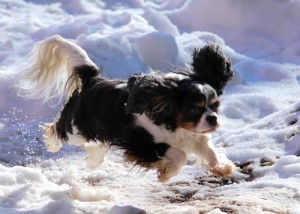
Here’s the little girl now, rounding the corner of the barn when I called her back to me from a dead sprint. She looks so serious, doesn’t she? But damn, she sure comes running!

MEANWHILE, back on the farm: A bit of a sad day. We’ve had a doe fawn living in the Orchard Pasture all spring and summer. Something was terribly wrong with her, she clearly wasn’t able to cope with living on her own. She would run smack into the fences at a dead run and was never able to jump them like all the other deer. She did well over the summer when there was a lot of food, but because she stayed in a very small area there was no way she was going to make it through the winter. There was also the concern about coyotes; eventually they would have found her and killed her. And so I contacted a DNR warden who came out, agreed that she was probably blind, and that she would slowly starve over the winter. Deer can’t be captured and re-located (they die of stress, it is horrifically cruel to try to capture and relocate them), and it was inevitable that the coyotes would find and kill her. The warden agreed that she should be put down, and did so humanely with one perfect shot. I know it was the right thing to do, and I know that deer are as common out here as beetles, but oh lordy they are lovely animals, and I’m feeling a big of sadness that such a beautiful thing didn’t make it.

Here she was yesterday:


Lure & Clicker Training to teach Sit – Advantages & Disadvantages
Friday, May 4th, 2012

It makes me so happy to say that Tootsie is doing great. Right now she’s sleeping in her crate beside my desk. The door is open, but she loves it there. The only places she likes as well are 1) being in bed with me, 2) being on the couch or 3) being by herself in the crate in the back of the car. She likes it so well in the car crate that I am actually having to train to leave it. I’m assuming this is baggage from her puppy mill days and that she feels most secure and comfortable in a small, confined space.

She’s progressed so well in so many ways: I’m especially taken with her flipping around mid-air when outside after I call her to come, ears flying like a furry dumbo, her open, happy mouth taking up half of her tiny little Cavalier head. As I mentioned in an earlier post, now that house training is behind us (wheee!), she can be outside off leash as long as I watch her like a hawk and keep her close to the house, she no longer barks to wake us up and produce her dinner, so it’s time to continue work on standard training. We’ve gotten started on sitting on cue, but I thought it would be fun to start her on clicker training at the same time.

I’ve worked on sit off and on, never with much diligence, but she is getting the hang of it. I started with lure training–using the smell of a great treat to ‘lure’ her body into a sitting position. Now that I’m going to start her with a clicker, I find myself thinking about the two different methods of training: luring and clicker training. Both have advantages and disadvantages, but I find that combining the two of them can be especially effective in some contexts.

Luring has the advantage of initial speed: In the case of sit, a la Ian Dunbar, you hold a tiny, tasty treat at the crown of a dog’s head and move it back toward their tail (not up, straight back.) As a dog’s nose follows the treat straight back toward their tail, their body finds it hard to stay standing, and so the hips automatically collapse and voila, your dog is sitting. Bingo, the treat gets popped into the mouth and your dog just got rewarded for sitting. Once you have the behavior established, you turn the motion of luring into a visual signal, and then bring in the verbal cue and start minimizing the hand motion.  (For a more detailed description, see The Puppy Primer.)

Luring also has a disadvantage: If you’re not careful to drop out the lure and the visual signal early on, the movement becomes the cue. You can end up with a dog who only sits when you move your hand, not when you say “Sit.”

Clicker training has the advantage of creating razor sharp precision, which helps you communicate clearly with your dog. It’s a great thing to teach a dog that their behavior can influence your own, and in a good way at that. I especially like that in most cases, the dog initiates the action, rather than you ‘helping’ him or her. However, strict operant conditioning suggests that you don’t do anything to initiate the behavior, you wait until the dog initiates him or herself, then click and treat to reinforce it. But truth be told, I’m not someone who is going to wait for a dog to sit when they feel like it, click opportunistically and then wait again for the next time. Not when I can lure a dog into a sit, get 15 reps into one sessions, and then take over with a clicker once I’ve got the behavior started. I tend to mix methods for actions that are easy to lure and for movements or behaviors that dogs do naturally. I should warn you: some trainers feels strongly that methods should never be combined, but I’m an equal opportunity employer, and so have no problems doing so as long as you know how to use them together without confusing your dog.

[10 minute break while Trisha goes to work with Tootsie]

First I used a lure/hand signal (with treat) to raise her chin and get her to sit down. My hand was just inches from her mouth and head. She responded well, and I repeated it 3 times.  Then I moved my hand 2 feet from her head, moved it with the same motion as while luring her (just farther away). She responded well until I moved my hand farther away. Now my hand was so far away from her head its motion probably  looked like a completely different signal. I stopped there because I wanted to  move on to clicker training.

I “loaded” the clicker with 25 click/treats (small dog kibble, which she adores… she adores bird seed shells for heaven’s sake, so finding a motivating treat is not a problem with Tootsie.).

Then I lured 3 times relatively close to her head (to create a success) and click/treated when she sat. I then proceeded to disappear the visual signal, added the word “Sit” and in 20 trials had her sitting just to the word “Sit.”

Ah, but here’s an important lesson: I noticed that while saying “Sit” I held both of my hands behind my back. Wondering if that might in itself be a visual signal, I moved the position of one of my arms. Sure enough, she looked at me as if completely confused. When I put both hands behind my back, she sat again when I said “Sit.” But the cue that she was responding to wasn’t the word, it was the position of my hands. Easily fixed, I just began moving my arms and hands into different positions, saying “Sit” and waiting up to 3 seconds for a response, and clicking immediately when she responded correctly. By the time we stopped she was sitting to the word sit no matter what I did with my hands.

And then… experienced trainers can predict the next stage…. I moved three feet backward into the kitchen. Now I was in a different room. Tootsie again looked completely befuddled. Easy to fix; just critical to remember that any action, any posture, any context, any location can be a relevant cue to a dog. In just a few trials she was sitting just to the word in the kitchen as well as the living room. We stopped so that Tootsie didn’t become a Tootsie roll sausage and I could finish this blog.  We’ll take it up again tonight and tomorrow, and start on some tricks this weekend. Ain’t training grand!!!

Question for you all: I know that some trainers are true purists, only using one method or the other. I’m a fan of mix and matching, as long as one understands the potential pit falls. You? [And fyi, I haven't forgotten about following up on the clicker study I wrote about earlier (clickers versus just food as reinforcement): I'm playing phone tag with the author, but I'll let you know as soon as I know more.]

MEANWHILE, back on the farm: Willie and I have 3 new sheep to work. I don’t like working him on my small ewe flock now, because they have young lambs and huge bags of milk that have got to be miserably uncomfortable when they flap/slap around whilst the poor ewe is being pushed by a dog. Willie and I try to work them slowly and carefully, but there are times it’s just not possible to keep them from speeding up. There’s another reason: Willie has lost a tremendous amount of confidence since his surgery and confinement, and my most aggressive ewe, Barbie, has gone after him and won several times now. I hate having a dog fight a ewe with a young lamb but I don’t want her winning over and over again and continuing to erode Willie’s confidence. So I have 3 new Katahdin ewes with no udders and no lambs. They are flighty and easy to move and will be great for Willie while he builds up his confidence. Jim, Willie and I just split the 3 newbies off and put them in the orchard pasture high behind the farm house. It took split second timing and quarter-horse short stopping by Willie, but we got it done. Everytime I see him slam his forequarters into the ground I wince: cross your paws for him that he’s not lame tonight, I can’t help but worry. I’ll do some stretching as soon as I’m done here and ice him if his shoulder feels hot.

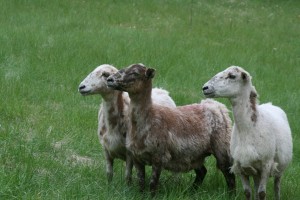
Here are the new girls, as yet not named (though I’m leaning toward Chili for the red one in the middle). Okay, they aren’t bathing beauties, but they will have a good life here this summer and will be perfect for Willie and me to get our paws back into the game. Those of you who work sheep know that the one in the middle is going to be the challenge: see that lifted chin? Oh my!

Here’s a wider shot, showing you the only reason I could get a close shot of the sheep! Good boy Willie.

Therapy Dogs – Born or Made?

Thursday, January 19th, 2012

As many of you know I recently presented a seminar on animal assisted therapy in Naples Florida. (Yes, it’ll be out as a DVD later this winter. Happy Dance!) One of the motivations for doing the seminar was the number of clients I had who wanted me to help them prepare their dog for therapy work. Sometimes it was like swimming downstream on a warm, cozy river. Their dog was a perfect fit and ended up doing wonderful work in the community. Other times… well,  it was reminiscent of trying to paddle up a cold, frothy waterfall. The fact is, therapy work can be hard work, and it takes a special kind of dog to be both good at it and to enjoy it. The directors of AAA and AAT (AAActivities and AATherapy) will tell you that one of their greatest challenges is working with people who want to volunteer but whose dogs just don’t qualify. Here’s a summary of the characteristics of a good therapy dog prospect, in hopes it will be helpful for those who are interested in doing this wonderful work:

Affiliative: This seems like a no-brainer, but the fact is that many dogs are presented for therapy work who really don’t like strangers all that much. They love their owners and good friends, but aren’t all that interested in other people. Good therapy dogs need to be the kind of dogs who ADORE people, all people, and want nothing more than to connect with them. It is, after all, the emotional connection that is often the therapeutic part of AAA and AAT.  It seems to me that dogs sort into 4 categories: 1) adore people, care little for other dogs, 2) adore dogs, care little for unfamiliar people, 3) adore members of both species and are thrilled to meet new ones and 4) adore neither dogs or people, except maybe their owner. Needless to say, only categories 1 and 3 are good therapy prospects.

Physically Calm: Many of the dogs who think all people hung the moon regrettably don’t fit into this category. Leaping, licking, pawing and body slamming just don’t work in senior centers and hospitals. This is why so many dogs don’t qualify when they are young, but could be great prospects when they are older. I wrote a chapter with Aubrey Fine for his great book The Handbook of Animal Assisted Therapy, and we had a long discussion about how many dogs would be GREAT for therapy work when they are six. Or eight. Or ten, but their owners get them evaluated at the age of two, the dogs are not “passed” and their owners never try again.

Psychologically Sound and Non-reactive: It doesn’t matter how much training or conditioning you do, therapy dogs need a certain level of rock solid soundness to be good prospects. Of course, the context does matter: some dogs are great in senior centers but are uncomfortable around children and would be disasters in a children’s hospital. It’s important to remember that AAA and AAT include a vast range of experiences, so every dog must be evaluated based on what they are going to be doing.  But it’s still essential to keep in mind that although your job is in part to protect your dog, once you are inside a facility you will have limited control over what happens. And what can happen (someone grabbing your dog, weird noisy medical equipment coming on, a medical crisis that results in tremendous chaos) is sometimes enough to terrify a sensitive dog.

Included in this category, although albeit somewhat different conceptually, is the state of being “emotionally mature” or able to handle frustration and deal with the world with a calm, measured demeanor. Again, just as in people, sometimes this takes several years to master.

Ridiculously clean and healthy: Unless you work in health care facilities it is easy to forget how differently sanitation needs to be handled in facilities and hospitals than it does in your own home. Pet Pals here in Madison, which organizes visits to the Children’s Hospital through the UW Vet School, requires that all dogs in the program go through extensive veterinary evaluations twice a year. This includes an entire day of testing for a vast range of diseases, from salmonella to MRSA. In this case the dogs are visiting children who are often immune compromised, and so their requirements are more stringent than some, but any facility, from a senior center to a hospital, is a very, very different place than your home. Germs love the kind of places that therapy dogs go to visit, and they can move around like wild-fire within very vulnerable populations.

Aware of their Job? This is gravy, pure gravy, but the fact is that some dogs do more than happily sit with strangers or participate in structured therapy treatment plans, as beneficial as that can be to some people. These dogs seem to sense why they are there, and seek out people who are especially needy, and make an emotional connection with them that changes their life. These connections happen, and hearing about them is enough to make you all gooey-eyed. Special stuff indeed.

I’ll leave the training and evaluations required to be a registered therapy team for another blog, but I thought it’d be interesting to ask all of you to add to this list–specifically, what type of personality do you think a therapy dog needs to be successful? If you’ve either had a working AAA or AAT dog, or been the beneficiary of one, I’d love to hear what criteria you’d put on the list. FYI, I’ll write another time about what the handler at the other end of the leash needs (a list too often ignored!), and some good books for people interested in getting involved, but right now I’d like to think about the dogs themselves. Aside from training for specific cues and conditioning to things like medical equipment, what traits do you think good therapy dogs need?

MEANWHILE, back on the farm: It was eight below (Fahrenheit) when I got up yesterday morning, three below today. I think the high is expected to be around eight or so, and we’re expecting 2 to 7 inches of snow tomorrow (2 to 7? that’s a big difference!).  I wish I didn’t have to drive to town to get ready to start teaching at the university (“The Biology and Philosophy of Human/Animal Relationships”), but still it’ll be sort of fun to get the snow. If it had been snowing all winter I’d be tired of it, but we’ve hardly had any winter at all til now, so it feels sort of good in some strange, possibly masochistic kind of way.

The great news is that Tootsie, who began her life here explaining to me that her paws did not participate in wet or cold, now trots happily outside in the worst of weather, does her business and then runs, ears flapping and tongue lolling, back into the garage. When we got her as a puppy mill dog she understandably had no concept of going outside and eliminating on cue right away, and then going right back in if the weather was inclement. She’d stand at the end of the garage and look plaintive and miserable, but refuse to go out. And even in great weather, once out she’d sniff and sniff and sniff and sniff… you get the idea.  What a great reminder of how handy it is to put peeing and pooping on cue.

And now you should see her! Out she runs, does her business and then runs back in… while Willie stays outside and looks at me like “WHAT? Go back inside now? Whatever for?” So Tootsie goes back inside and Willie and I play outside for awhile. I should tell you though that yesterday there was one time, during the coldest part of the morning, when she did refuse to go out. But she’d been outside to pee recently, and I took it as “Truly, I don’t have to go at all, and it’s really, really cold. Would it work for you if I stayed inside this time?” And indeed it did. Honor your dog, right? The next time I took her out her bladder was fuller, and out she went, did her business and ran to me for her treat. Now, I just have to work on her barking if she sees me and Willie outside through the window… One thing at a time!

Willie is good good good. His shoulder seems good (almost afraid to write that) and he’s loving everyone he meets lately. He still isn’t buddies with Tootsie. They STILL ignore each other, it’s a bit strange sometimes, but he is very tolerant of her and the only sign of problems I see is when I come home she has taken over our greeting rituals. Rather than being all over me, Willie runs to get a toy and lets her get the first attention. I’m not liking that, I think he is a bit frustrated, but doesn’t like competing with Tootsie for attention, and unwilling to get into any conflict about it… I’ll be working on that in the near future too. Never a dull moment with dogs, hey?

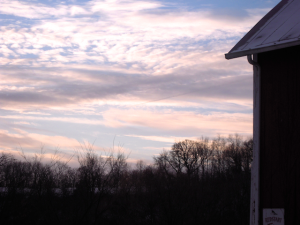
Why do I live in a place that can be colder in the winter than the inside of your freezer? Here’s the reason: Sunrise yesterday.  Eight below. And a sky simply too beautiful for words…


Cotton Top Tamarins-The World’s Cutest Monkey
Monday, January 16th, 2012

Well, they’re not dogs. Or cats. Or domestic animals of any kind. But I spent two years working with Cotton Top Tamarins and hearing my university BFF describe how she is continuing her work with them was one of the highlights of my trip to Florida.

Anne Savage, Senior Conservation Biologist at Disney World, has been studying Cotton Top Tamarins in the wild since graduate school at UW-Madison. She and I worked together with the squirrel-sized monkeys in the lab of Charles Snowdon, who did non-intrusive behavioral research on their vocalizations and reproductive behavior. The lab was committed to letting them live in family groups (rare at the time) in enriched environments (also rare at the time) and Anne and I spent many a night planning how to improve their environment, help young mothers raise their babies (adolescents aren’t always so good at it in many species) and working with the vets to deal with illnesses and rare injuries. We designed probably the first functional incubator for rejected baby Cotton Tops and worked hard to eliminate the need for them in the first place.

The species has to work hard at reproduction: Female Cotton Tops usually have twins–rare for a monkey–and become pregnant just days after giving birth. So the females have to produce milk for twins while they are also gestating a new set, which is why the males do most of the carrying of the young. Chuck’s lab learned that the species must be kept in family groups to thrive, because adolescents have to learn to transfer and carry the infants before they give birth themselves or assist a female in raising the young. Watching youngsters figure out how to transfer a baby from one back to another provided endless amusement for us.

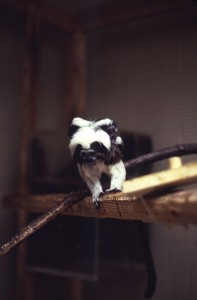
Here’s an old photo from the lab of a male carrying 2 very young infants on his back. (Did I mention they are the cutest monkeys that ever lived?) Those two little white triangles on either side of the male’s head are the babies clinging to his back. You can see from the photo that the monkeys had real wood to walk on (that was a fight with the authorities!), but by the time we left the entire cage was full of ropes and plants and toys. It was gratifying work and I learned so much doing it.

I worked with the monkeys for two years between undergrad and graduate school (when I studied vocalizations from professional animal handlers to working domestic animals), and Anne went on to do field work in Columbia on CT’s as an endangered species. If you ever meet her, ask her how she talked machine gun-toting rebels who invaded her research station and threatened to kill or kidnap her into helping her with the research instead. Seriously. That’s Anne.  She’s continued the research ever since, working toward conserving the forest for the monkeys by not just trying to discourage forest destruction, but by organizing economic opportunities for the locals to enable them to make a good living and still conserve the forest around them. You can read more about it on Proyecto Titi (Titi is the local name for CTs). One of the most impressive projects is organizing businesses for women making “eco-mochillas,” or environmentally friendly bags crocheted from the endless amount of plastic that pollutes the villages in Columbia (and Kenya, and Rwanda, etc etc etc). (I bought 2 in Disney World, and you could too when you go, or buy them off their website. I’m just saying….) So it helps conserve the forest, protects the Cotton Top Tamarins, provides an income for the residents and decreases pollution. I’d call that a win/win/win/win. Here’s a much better photo of a Cotton Top:

It was also fun to hear about the plans for an Avatar experience at Animal Kingdom. Now that will be worth checking out (2014 I think?). And there’s lots of other great research going on in the Conservation Biology Dept; check out this work that uses elephant’s dislike of bees to keep elephants from destroying crop land of villagers. Very creative.

MEANWHILE, back on the farm. Willie and Tootsie are doing really well. Willie adored the male of the house sitting couple, and seems to be relaxed and back to himself. The sitter did say that he seemed obsessed with Sushi, but when I got back the issue went back to being easily managed. He’ll begin to stalk her but can be easily distracted and stays calm and relaxed once he is.  Willie’s leg and shoulder seem really good, although (of course), just when I was consciously thinking “Oh my, he really is almost sound again” this afternoon, he slid a bit on the snow and yelped, then held up his left paw. For a second I died a thousand deaths, but he went right back to using it normally again. I can’t find the slightest hitch in his gait, but of course, I’ll be extra careful tonight, and do lots of massage on it and hold off on his exercises until tomorrow.

Mostly, I just have to say that I truly enjoyed all the wonderful people I met in Florida and am grateful to so many people who made it a great experience AND I’m sooooo glad to be home!!!! I love my farm, I love my animals,  I love Wisconsin, and yes yes yes, right now, I love snow!


Yup, Dogs Can Be Disgusted!

Tuesday, November 29th, 2011

Well, it seems appropriate now to talk about disgust after a weekend of gluttony. (But what fun cooking paprika chicken and pot roast and roasted brussels sprouts and home made bread and pumpkin and cherry/raspberry/rhubarb pie. Not to mention eating all the turkey that others cooked and I ate up as if I was starving.)

It’s been interesting reading about whether dogs people believe that dogs can experience disgust. Recall that 66.2 % of seminar participants said yes, and 78.3% of blog readers who responded said yes (this may have changed as later responses came in, but not significantly). (The Morris research listed only 34% of people responding yes, but a blog reader commented wisely that the question wasn’t “Can your dog…” but “Have you observed your dog experiencing disgust.”)

But here’s the deal. Disgust is perhaps the most basic of all emotions. Disgust, or “an aversion to something offensive,” is seen in all mammals, most often in response to a smell or taste that is aversive for some reason. Our expressions of disgust are similar across species, as Darwin noted in The Expressions of the Emotions in Man and Animals. Here’s is a more current illustration of that from Youtube:


Disgust is registered primarily in the Anterior Insula of the brain, an area that is active both when one feels disgusted and when one views a disgusted expression on the face of another. Because of its close association with the sense of smell, disgust has been postulated to be the “first emotion,” designed to prevent the ingestion of dangerous substances. However, I was surprised to find very little about disgust in Panskepp’s classic book on emotions in animals, Affective Neuroscience. In spite of that, I know of no biologist who argues that other mammals don’t experience disgust on a basic level.

Of course, what is perceived as disgusting is both species specific (the stink of fox poop not being a human favorite) and culturally transmitted. Not surprisingly, this  is especially true of food: for example, some cultures find big, fat juicy insects and their larvae highly palatable and others, not so much. There’s an interesting article in Time Online about the research of Andrea Morales and Gavan Fitzsimons who found that just being next to something perceived as disgusting made an item less attractive (ie, don’t try to sell cookies next to Kitty Litter at the supermarket.)

That brings to mind a seminar I did in Canada in which the host hotel thought it would be a hoot to serve the chocolate pudding desert in the shape of dog feces. Seriously. It looked exactly like poop sitting on a white plate. They were actually surprised that no one ate it, but not as surprised as we were that they did it in the first place. We all laughed, and then looked at each other with somewhat stunned expressions on our faces, and pushed the plate away.

It also reminds me of John Rogerson’s technique of inhibiting dog-dog aggression by throwing a bag of dog feces into the face of the offending dog. I’ve never done it, but I’ll bet it would absolutely get a dog’s attention. Of course, some dogs eat feces, but I doubt they’d enjoy poop-in-the-face. Personally I’d rather not use it as a training technique (pretty negative for the person too), but I have thought it would be a great last ditch tool if you were walking down the street with a bag of poop in your hand and a dog charging at your reactive dog.

This all gets me thinking about the use of ‘disgust’ in behavior modification. You all know I’m a positive trainer, but that doesn’t mean that I wouldn’t suggest someone use something aversive to prevent some behavior problems if the solution is humane. I’m thinking about Bitter Apple for example: I just sprayed a plant with it to prevent Tootsie from chewing on the leaves.  But what about an aversive scent versus taste? Any use for that? I’ve seen commercial products that are supposed to keep dogs out of plants, etc, but frankly I’ve never seen them work very well. You?

Here’s another great example of the expression of disgust, by the way, sent in by a reader from Europe of her Pap at a show after being forced to be in cold, wet grass and then touched by a judge with cold, wet hands. Thank you Ute for sending these photos, they are great!


MEANWHILE, back on the farm: Willie’s shoulder is as good as it’s been since the injury last February. He is allowed to run around outside for brief periods with no hobbles and longer ones with the hobbles. Great news is that my adrenals are now getting used to seeing him running around, so I don’t suffer from cortisol toxicity every time I see him run anymore! He is not a fan of the treadmill now, he came out of it yesterday and sniffed the floor of the room for a full three minutes before acknowledging me or Courtney. But it’s helping him, so I sympathized, gave him lots of cuddles when he did come over and then told him to suck it up.

Tootsie continues to make tremendous strides. I am so proud of her. Her recall is coming along beautifully, and I can now take her up into the pasture and keep her from hysterically and desperately eating as much sheep poop as it is possible to cram into her mouth. She gets lots of more appropriate treats and is actually spend time sniffing around the grass, apparently interested in something besides gobbling up sheep poop as if she was starving to death. And for one brief magical moment, Willie and Tootsie actually sniffed each other at the same time a few days ago. Will wonders never cease?

What Are You Thankful For?

Wednesday, November 23rd, 2011

Well, I keep putting off writing about the emotion of disgust (and soon jealousy and guilt), but it’s Thanksgiving tomorrow and it just didn’t feel right to be writing about such a negative emotion. Emotions are catching; maybe writing about disgust disgusts me enough to put me off? Sounds amusingly logical, but I think it’s more that I’d rather take this time to reflect and savor some gratitude. Disgust sounds like a good topic after I eat too much this weekend.

Gratitude is a good topic for today, yes? (Question: Is it an emotion?) Gratitude is good for us, and often what is good for us is good for our dogs and other companion animals. I don’t say that in a vague, gosh-gee-whiz kind of way. There is some good research showing that taking time to be grateful, whether it’s writing a letter to someone you’ve never thanked or writing down three things you are grateful for each day, makes for a happier person. Feeling grateful decreases negative stress, and negative stress isn’t good for your health, so take 3 things to be grateful for and call me in the morning. No wait, send them in on the blog. What a wonderful weekend it will be for me and other readers to spend time each day reading what others are grateful for.

Here are some things I am grateful for:

Life. Someone near and dear to me was run over by a car two weeks ago.  She is alive and will recover, but it will be a long haul. Jim’s sister and one of his brothers both died this summer, within two and a half months of each other. I’m mentioning this not for sympathy, but to remind us all that this life we have is tenuous stuff; I am grateful for every moment that I am well enough to whine and complain about minor problems. But for tomorrow and this weekend, no complaining.  I’m going to bask in blessings.

Love. It’s everywhere, and the more you generate the more you get back. I am grateful every day for the blanket of love from Jim, Willie, and now Tootsie, that warms me like a fireplace on a snowy day.  And I am buoyed by the love I still feel for Luke, Lassie,  Tulip and Pippy Tay (and Ayla and Misty and Drift and Bo Peep and Fudge and so many other animals I’ve loved so much.) I know everyone is not so lucky in love, I wasn’t either for much of my life. Here are wishes to all of you that you can savor the love that comes your way, and send out more than  you thought you held inside. This is also a love letter to all of you who have said such wonderful things to me about the effect my work has had on your life. I’ll never be able to say how much it means to me, but I can say Thank You, and mean it from my heart and soul.

Laughter. Okay, I suspect I’m starting to sound trite and maudlin here, but really… what would life be if we couldn’t laugh? And how many animals can? We don’t even know if dogs laugh, much less have a sense of humor. I’m so thankful that we humans do, surely it’s one of the best parts of being human.

The three things I’ve written above break all tenets of good writing, being general and lacking in detail and specificity. So here are a few more things I’m grateful for:

The scent from the top of Willie’s head. I can’t describe it, but it’s fresh and clean and I soak it up like oxygen every night.

The way it feels when my oldest ewe Dorothy nibbles grain from the palm of my hand.

The whipped-butter color of sunlight spotlighting the trees on the back hills.

Jim’s eyebrows. No one has better ones. Who knew eyebrows could be so attractive?


MEANWHILE, back on the farm:

Willie is grateful that he can be off leash now and is allowed to play with toys a little bit every day.

Tootsie is grateful that she gets to sleep on laps and lick food out of Kongs. She is on my lap right now (Willie is beside us.)

Sushi is grateful for sunbeams to nap in and fish for dinner. (And is meowing from the kitchen for me to get up and feed her some for the love of god.)

Dorothy is grateful for leafy, alfalfa hay and nibbles of corn and oats.

Here is a quote I was just sent by a colleague. It deserves to be passed along: “I would maintain that thanks are the highest form of thought; and that gratitude is happiness doubled by wonder.” G. K. Chesterton

And You? What is your happiness doubled by wonder?


Here are two of the wonderful creatures in my life. We are all so lucky to have each other.


Results: Survey on Emotions in Animals

Wednesday, November 16th, 2011

THANKS to you all for contributing to the survey! I’ll give you the results of the blog survey first and then compare them on the right with a survey done at the Madison Seminar (thanks!) and with research done by Morris et. al. in 2008 (Cognition & Emotion 22(1), 3-20). First, emotions and dogs (of course!)

CAN DOGS EXPERIENCE THE FOLLOWING EMOTIONS?

EMOTION   BLOG YES                SEMINAR YES                      MORRIS 2008 YES

FEAR                   100%                               100%                                       93%

JOY                       100%                              99.5%                                      99%

ANGER                85.7%                             95.1%                                       65%

DISGUST            78.3%                              66.2%                                      34%

GUILT                 22.9%                              40.0%                                      74%

JEALOUSY         82.9%                               84.6                                        81%

Pretty interesting, hey? Note that Fear, Anger and Jealousy have relatively similar responses between blog readers, seminar attendees and animal owners as asked by Morris et al. (Although isn’t it interesting that only 93% of dog owners thought dogs could experience fear? Oh my. Look, though, at the answers to Disgust and Guilt. Wow, quite a difference, hey? And only 65% of Morris’s respondents thought dogs could be angry, while 86% of blog readers did.


IF ONE ASKS THE SAME QUESTION ABOUT “ANIMALS:” (And yes, the question does arise, as well it should, what animals? Grasshoppers?  Morris’ research actually asked animal owners: “Is your animals ever fearful?” The respondents could have birds, horses, hamsters, etc. So in that sense I didn’t follow the methods of the research, but I was curious what folks would say to the general question and would like to compare it later to my UW student’s answers, so bear with me….). You’ll see that the Madison seminar attendees were not asked this question:

EMOTION       BLOG YES               MORRIS YES

FEAR                      100%                                      97%

JOY                          98.4%                                    98%

ANGER                   93.5 %                                    68%

DISGUST               82.3%                                     33%

GUILT                    47.6%                                      41%

JEALOUSY           87.3%                                       63%

* Percentages don’t always add up to 100% because some answers were “don’t know.” In addition, some respondents included humans (logically) and I think answered if ANY animal could, while others answered if ALL animals could. A good example of a poorly worded question! Note to self.

AND  HAMSTERS? Fewer of you responded here, 50 versus 70 for dogs (understandably, and good for you for saying you didn’t know!). Summarizing, all three groups are less likely to attribute all emotions except Fear to hamsters than dogs (Yes to Joy in Hamsters was from 80 to 91% — the highest number from Morris’ research interestingly enough!). For example, 83% of blog readers thought dogs could be jealous, but only 36 % thought hamsters could.

Interesting stuff, hey? Here’s what I plan to do next week: Enroll you in why ALL mammals can experience Disgust, Fear and Anger, show you some research that suggests that indeed dogs can experience something akin to human Jealousy, and agree with many of you that Guilt is a complicated construct that of all the emotions is least like to be similar in dogs and people. (Great research on that to come too!)

Til then, see you in Cleveland I hope this weekend, and if not, definitely in Orlando January 7th for an all new seminar on Canine Communication that I am having a ball working on, or Naples on January 12th for a half-day seminar on using dogs in AAT and AAA (details to come VERY soon.)

MEANWHILE, back on the farm: Oh the weather! Why am I inside for heaven’s sake! It’s been sunny and 50′s, and everyone who has lived here a few years know how very sweet the weather is for this time of year. Tootsie did beautifully with the snow after a few days, but now the ground is dry again so I’m sure we’ll have to start over once it snows or rains again. Her biggest strides in the last few weeks have been coming when called. She’s doing so well I am even taking her outside off leash, but only under certain circumstances: I have incredibly good food and she knows it; we’re behind the house and she can’t be distracted by cars on the road; I know she needs to pee;  Willie is beside us and is under 100% vocal control and she pays some attention to where he goes; and, most importantly, we only stay out for 3-4 minutes maximum.  In other contexts she’s on leash and I practice calling TOOTSIE COME! and run the other way and give her treat treat treat for turning and running to me. I gotta tell you, there’s not much cuter than watching her fly across the grass, ears flapping like Dumbo, tail turning like a crank, mouth drooling in anticipation of treats.

And good news on the Willie front too. He’s progressed enough that he gets occasional times outside without the Hobbles (rare and short), and today, for the FIRST TIME since February, I took him up the hill behind the house and let him run free (with Hobbles on, but still…) I’ll take it back a notch tomorrow and keep him extra quiet until I see how he does. We go one two steps forward and one step back, but mostly we’re going in the right direction. My dream of working him on sheep in November is gone (today was going to be the day, by the way. I circled it on the calendar many months ago.)  His PT says probably not until well into 2012. Deep breath. We’ll be okay, it’ll come before we know it, and at least he can be off leash outside now for awhile.

Willie and Tootsie are about the same with each other. They continue to pretend that they are the only dog in the house. They do sneak sniffs more often when the other isn’t looking, and Willie gets my eternal gratitude for tolerating all kinds of rude behavior from her. He lets her lick food out of the same plate (allowed after the humans are done with dinner), ignores it when she dances on his head to get up to our faces, and let’s her take over a sleeping place without so much of a grumble. Again, I see no love lost, but they seem to be accepting each other as the new normal. I’ll keep you posted.

It’s gorgeous outside. I just wish I was able to spend more time out there. But it is great to feel like we’re getting ready for winter. Our chest freezer (large enough to put a cow into. Standing up. Well, okay, not quite, but it’s HUGE) is full to the brim with strawberries and raspberries and rhubarb and apple butter and chard and broccoli and spinach and 1/4 of a kindly raised hog, an entire lamb from the farm, and 15 organic, local chickens. And a gazillion other things. Trips to the market will be little more than orange juice and toilet paper, flour and sugar.  And best of all, all the ewes have been bred by the new ram, King Charles. (I named him KC because he seemed tiny to me when he arrived. I named him after, you guessed it, King Charles Cavalier Spaniels).

Here’s the evening sun on the back hills behind Lady Godiva, Spot and Rosebud, who have come down for their nightly alfalfa. This was last week, now the snow is long gone, the sun is shining and it’s warm and balmy.


I love the patterns of snow on branches and sun on leaves:

What Emotions Do You Share with Your Dog?

Wednesday, November 9th, 2011

Surely you’d agree that both you and your dog can be frightened, but what about feeling jealous? Guilty? Ashamed? Ah, now it gets trickier, doesn’t it? Emotions like jealousy and guilt are called “secondary” emotions, and many biologists, psychologists and philosophers believe that non-human animals can’t experience them. The argument is that they can’t be experienced without a relatively high level of cognition, particularly the ability to be self aware and knowledgeable about the mental state of others.

I’ll talk in the next post about research related to whether dogs feel guilt or jealousy, but for now, I’d like to replicate another piece of research that asked people what emotions they think animals experience. [If you came to the Madison Seminar, no fair answering after you saw the research results!]

So here’s your question: Which of these emotions can animals experience? (I ask the question as it was asked by the researcher. I’ll ask next about dogs specifically.)

Fear, Joy, Anger, Disgust, Guilt, Jealousy.

Answer by copying that list into a comment and force yourself (sorry) to say Yes or No after each of the 6 emotions listed. We’ll total up your answers and compare it with research done a few years ago, and with the answers we got from the audience in Madison at the Advanced Seminar.

Here are the same emotions:

Fear, Joy, Anger, Disgust, Guilt, Jealousy.

Now answer Yes or No if this time we’re asking about Dogs. Then answer for a different animal, a Hamster. We’ll report back on your answers and how they compare to the general public, the Madison audience and what the research says in about a week’s time. No fair writing about the research yet if you know about it, we’ll all talk about that after the ‘survey’ comes in.

MEANWHILE, back on the farm: Brrrrr. First real snow, along with bitter winds, sleet, rain, the whole nine yards. Tootsie has already explained to me that she couldn’t possibly walk on just plain old wet grass, so cold, snowy grass, she explained to me this morning, is out of the question. But we’re making huge progress. Here’s what has worked well so far:

1. Obviously, the best treats in the house came out once the rain began last week. Tootsie learned she gets cooked lamb heart for walking on wet grass, instead of commercial dog treats if it’s dry. She taught me it was much more effective to drop the treat on the ground rather than hold it in my hand, so I learned to drop a trail of treats from the garage to the grass to lure her out. (Thank heavens Willie has a great “leave it!” Boy has it come in handy lately!)

2. Treats helped tremendously, but I think the biggest factor in getting her onto wet grass (which she does now willingly) was that she wanted something even more. Tootsie was obsessed with cars when she came to the farm; I have absolutely no idea why. Does she associate them with her escape from the mill? Did someone drive up to feed her every day? (The Amish don’t drive but they often will be in a car that someone else does.) So I “Premacked” it. If she came out and peed on the wet grass (a low probability behavior) she got to run to the car and leap and dance around it, and even get put inside (a high probability behavior.. she’d do anything when I first got her to be allowed to run to a car.)  Why she loves this so much I may never know, but it clearly was what she wanted more than anything in the world–so much so it was hard to get her past a car for the first 2 weeks, so I just used it as a reinforcement.

So we’ve got wet grass taken care of, and house training has been going exceptionally well. Now on to the next challenge: walking on snow and ice. Oh my, poor little girl, this will be a challenge for her, what a switch for her after living all her life inside. Picture me cooking up lots and lots of extra good treats for snow falls…

Willie is being SO good with her. I would not say he is happy she’s there, but no more snake face and mostly he looks happy and content. Every once in a while I think he looks sad, and I assume it’s about her, but it seems less and less, especially as he gets more and more freedom and he’s learned that our belly rub sessions on the living room floor are still part of our day. She’s also getting a little less pushy (although we have a long way to go there, but one day at a time.)

Here’s Tootsie imitating Andy Rooney (note the eyebrows), considering put paw to snow for the first time:


Success! I lured her out with raw meat dropped on the ground. She paused at the border, so I gave Willie a bunch of treats as she watched.  Ah, the power of another dog!  Finally she ventured out onto the snow and got 3 treats for it. Then, bless her, she sniffed around and finally squatted and urinated. This got her 1) pieces of lamb kidney, 2) much clapping and ridiculous celebrating from me, 3) the chance to run back to the car and dance around it and 4) the chance to go back into the house (whence she also got more food, more excitement, and belly rubs.) I’m sure we’re not done with this, but she’s making great progress, none-the-less. I’ll be buying her a little coat soon. (I can not believe those words came out of my mouth. Me? Buy a dog a coat? Really? But she is truly so frail right now, I just can’t imagine her dealing with 30 below weather.)


TOOT TOOT TOOTSIE, HELLO!

Wednesday, November 2nd, 2011

Here’s TOOTSIE!

Also known as:

Little Bit, Mini Me and my favorite, Mop of the Woods.

There’s a new kid on the block, or at the farm I should say. Meet Tootsie, a 7 year old King Charles Cavalier who was rescued by Lucky Star Cavalier Rescue from an Amish Puppy Mill, after the owners had used her up. Her mouth and ears were horribly infected; she had twenty teeth extracted.  She also was fat as a tick, so you couldn’t say she was starving. She weighed 22 lbs (now she weighs 15 and is still a bit overweight).

And what, you might ask, is a Cavalier doing at Redstart Farm? Doesn’t every farm need a Cavalier? (What, you think we farmers don’t have laps?)  Seriously, there is logic to all this. Here’s a brief version of the back story:  If you have been following the blog for awhile, you know that after Lassie died I had my heart set on getting back up to 3 dogs–Willie, a little lap dog from a shelter or rescue, and another Border Collie. I had wanted the lap dog first, but then a litter of BCs came along that looked too good to pass up, so last summer we raised Hope, a Border Collie pup with great herding lines.

It’s a long story, as you know if you followed the bouncing ball last year, but it turned out that Hope and Willie brought out the worst in each other, and I decided it was in both of their best interests to place Hope in another home. It was a brutally hard decision for me to make, and I was roundly criticized by some for it, but I did what I believed to be right for both of the dogs, took some deep breaths, and went back to looking for the next dog. If you know Willie’s history (extremely uncomfortable, and at one time aggressive, to unfamiliar dogs) you know that picking the right dog for him was a challenge, and not as easy as it would have been with any other dog I’ve ever had. But early in the year, a dear friend and I found a little fluff-ball-oxytocin pump from a rescue who sounded perfect, and was about to come out to the farm when Willie was badly injured.

And so, the next dog was put on hold for many, long months while we worked through Willie’s injury in February, his surgery in May and his first 5 months of PT. Once Willie was able to have a bit of off-leash time I began looking again. One of the places I looked was at Cavalier rescue, because Willie has had some great experiences with them. One of my sitters has two females who come to the farm often, and Willie gets along beautifully with them. In addition, one of his best friends when he was younger was Brody, a sweet little male Cav, who used to love to wrestle play with Willie on the living room floor.

After consultations with two wonderful women in rescue, Nancy and Leslie, and two super rescue groups, Lucky Star Cavalier Rescue and Greater Chicago Cavalier Rescue, we all agreed that Tootsie might be a great match. She is a small female (least likely to make Willie nervous), quiet (good again), deferential to Willie (good again) and great around cats (and yet again). After a trial period Tootsie became a  permanent member of Redstart Farm and I can’t tell you how happy it makes me. She is great for us–she does need a lot of training, but she’s going to be a good, good little dog, and will fit in well. It also feels good to finally be able to bring a needy little dog to the farm. I’ll talk in a later post about how this adoption relates to my concerns about the problems that occur when breeding dogs for our sake rather than for theirs, but for now, it’s all about integrating Tootsie into the farm.

As you can imagine, Willie’s feelings about all this are paramount to me. I am happy to say that so far things are going well, given how little time has passed. She and Willie are not buddies, and I don’t know that they ever will be. But that’s okay; he can’t have a playmate now because he is still on a great many restrictions, so I couldn’t bring in a dog he wanted to play with. At first he was a bit uncomfortable about her in the house, but less so than he normally would be with a new dog in the house. Willie does well with unfamiliar dogs in the great outdoors (a huge change from his behavior 2-3 years ago) but he is nervous with new dogs inside the house. As expected, he was not 100% comfortable with her in the house at first, although he was still pretty darned polite. Mostly he made what I call “snake face,” hard flat eyes, flattened ears and a sour look that made it clear he wasn’t thrilled with the addition. But he was appropriate, and in very few days he appears to have accepted her presence. He still seems happy and relaxed and seems to think of her as part of the ‘new normal’ of life.

Of course, I’ve worked hard hard hard on counter conditioning him around her getting food and petting, and now he’ll even let her eat out of the same plate when they get snacks after our dinner. Resource guarding was one of my primary concerns with Willie, and that is going extremely well so far. She pushes in between us for petting and he puts up with that too, although he clearly doesn’t like it. Who could blame him? She’s the one who needs work here; she is super pushy and will be learning some manners soon. (Thus the name, Mini Me.)  A good sign I think: he is starting to sneak in sniffs when he can, as if pretending he just happened to find his nose in the area of her belly and groin. “Oh my, did my nose end up under your tail? I have no idea how that happened.”

She, on the other hand, pretends he isn’t there. She is an especially small Cav (her legs are ridiculously short) and he must look like a giant to her. I suspect they will become more and more comfortable together, and who knows, maybe they will learn to be buddies. It’s very very early …;

I’ll write updates about how things are going when I can. Weeks one and two have been all about:

1) House Training: She is a mill dog after all–but Leslie at Lucky Star made a GREAT start. I took her out every 10 min for the first 2 weeks. Seriously. She is still in shock that she gets a treat every times she pees. She’s doing great, but I am still on it all the time.

2) Teaching her to respond when I say Tootsie. That was her name when she was in foster care, but she had no idea what it meant when I said it. Around day 15 she literally had a Helen Keller moment when (I think) she realized that the noises I made meant something. I would give a lot to have had a video of her face when she made the connection.

3) Leash Manners: Not charging away at 20 mph when on a leash. I never trust her off leash now, so we worked hard on teaching her to stay close to me when the leash is on. It’s taken a lot more treats, but she’s making fantastic progress.

4) Barking: I was warned she barked in the morning at 5:30 until she was let out of her crate. Oh my, not good for me and Willie and our super sensitive ears. We’ve worked very  hard on this too (began by setting the alarm for 5 am, then slowly later etc etc.) She does NOT bark in her crate in the morning (the goal is no crate at all, but the house training issue with a mill dog takes priority) YEAH! But she does bark at other times when she wants out, sounding something like a huge, operatic mouse. We’re working on it and she’s making progress on that too.

Best of all? She is super friendly and is much less shy than most mill dogs. She loves people, men and women both. She has some health challenges; a minor heart murmur and subluxated knee (also minor), and of course there’s her heart to worry about given that she’s a Cav. I don’t know how long her life with us will last, she is already seven years old, but she’s found a home at Redstart Farm, and in my heart forever.

Here she is:

And on one of her first walks in the country, my goodness this exercise stuff can tire a girl out!