Welcome to the official Patricia McConnell website. Skip directly to: main content, navigation, search box.

Posts Tagged ‘positive dog training methods’

Are You “All Positive?”

Friday, February 18th, 2011

Recently there have been some debates and discussions about whether it is possible to be a “100% positive” trainer. This has become an issue because some seminar hosts have policies that they will not hire anyone for a seminar unless they only use positive reinforcement and “never use punishment or aversives.” Some people are being asked to sign pledges that they will never use punishment as a trainer.

I’m curious what you think. Are you a “100% positive trainer?” Do you ever use “punishment?”  Do you use what some people call “aversives”? Ever? If so, what kind and when? I’ll weigh in on this debate next week, (as you can guess I have a few opinions about the matter) but I’d love to hear what YOU think.

MEANWHILE, back on the farm: The snow is melting! It’s been well over freezing during the day all week, and as a result 1) we can actually see bare ground in some places, 2) the snow that’s left re-freezes every night so walking most places involves either teetering on a mouse-size mountain range of ice peaks and valleys, sinking into ankle deep mud, or having your boot fall through a foot of snow with a thin cover of ice on it. Let’s just say the footing is highly variable. There’s enough open ground that it’s muddy paw time here now, and I am reminded of how valuable it is to cue your dog when you are about to lift his feet. I’ve been saying “Ready” before I pick up each of Willie’s paws (I also do them in the same order) and he now lifts up 3 of his 4 paws for me when I say the word. It’s always the same one that he doesn’t pick up himself, and I suspect that it is because it is harder for him to do so. We are always working on some problems he has in his left shoulder and right hip, so I go especially slowly picking up his right hind paw, and wipe it off as fast as I can. Willie’s behavior is a great reminder to us all to be observant and thoughtful about our dog’s responses.

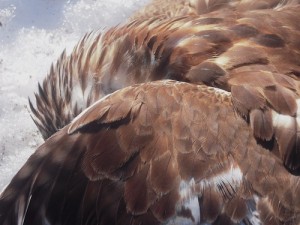
Besides the discovery of lots of dog poop (a universal sign of spring in snow country), I discovered something far more interesting today. I found a dead hawk below the pines lining the driveway, clearly one who had died recently. I believe it is an immature Red Tail, (Buteo jamaicensis) the most common hawk in the area.  There’s a pair that nests less than 100 yards from the farm house every year, and I wonder if it was one of their young from last year. Egg laying begins in late winter, in March or April, but I often have seen courtship begin in late February. I don’t know why the hawk died, it has no superficial injuries. The best guess (and it is only a guess) is that it starved to death. As I explained to my UW students recently, deep snow favors small rodents who can move through tunnels under the snow while staying out of sight of predators, and disfavors aerial predators like Red Tails. I wonder if the snow is melting just a few days or weeks too late for this one. I’m sorry that it died, but grateful to have a chance to appreciate its beautiful feathers.

Chase This, Not That!

Tuesday, June 15th, 2010

A dog’s love of a good chase is both a blessing and a curse. It makes playing with them extra fun; what a joy it is to play fetch and chase with some dogs! And it’s got a dark side too–chasers love to chase cats, cars, joggers and bicyclists, and that doesn’t tend to work out so well for all involved.

In an earlier post I talked about teaching my new pup Hope not to chase Sushi the cat, and several readers asked how I am doing that. Here’s a summary of both a generic plan and how it looks in detail in one home, with one dog, and one cat. Obviously, the details vary tremendously, but the basic plan is relatively universal.

1. MANAGE AND PREVENT: What could be more fun than chasing something if a dog is so inclined? Dogs are, after all, cursorial predators (meaning they run things down for a living), and that tendency is still very strong in many of them, 12,000 + years later. (And admittedly, not so much in others.) There is little more reinforcing than a great chase to some dogs, so once you know it’s an issue, job #1 is to prevent it from happening unless you can use the situation as a training session. That means leashes, gates, etc.. whatever you need to do to keep your dog from getting reinforced by a super fun chase game.

At the farm: Once I knew Hope loved to chase Sushi (happened once outside and once inside), I used leashes, gates and management to prevent it from happening again. If Hope was outside loose, then Sushi was inside.  If Hope was inside, Sushi was in her kitty suite if I couldn’t be on “cat duty.”

2. MASTER at least one incompatible behavior. While you are managing the situation, work on teaching at least one (more is better) behavior that inherently prevents chasing and gives you a chance to give your dog a whoppingly wonderful reinforcement. You could use “Watch” (turn away and look at me), sit down, lie down, turn away and chase you, go get a toy, etc etc. Your choice should be based on finding something that replaces chasing (or even focusing on the chasee) and is something that is easy and fun for your dog to do and for you to reinforce. Don’t choose “Sit” if it’s hard for your large breed dog to sit down, or “Lie Down” if your dog is nervous outside and he likes to chase cars. Fighting fire with fire is often a good idea, so if you have a dedicated chaser, you could teach him to look at you when you say “Watch” and then let him chase you as a reinforcement.

When I say “master,” I mean to teach the behavior (again, more than one is better, gives you more flexibility) so that your dog will do it even when she is distracted. Start, as you would with all cues, with no distractions, and then work your way up to mild distractions, and then strong ones.

At the farm: We were already working on turning to me when I said his name, and sitting on cue, so I used both of those. When we started this, I had only had him for 1 week, so I didn’t want to get too elaborate. I probably said his name + reinforcement 25 times a day, and asked him to sit about the same number of times. For reinforcement he got great treats (kibble for easy responses, cooked pieces of  steak for ones when he was distracted), cooing and belly rubs (he appears to adore them) and chasing me when I ran. Well, I can’t run much, which is truly cramping my style. I hobble along like Chester dragging his bad leg while calling after Mr. Dylan (any one else remember Gunsmoke?!) But I speed up as best I can, and have  friends and Jim use running as much as they can, because herding dogs like Will seem to love little more than a good run after a friend.

3. ASK FOR A BEHAVIOR in the presence of the chasee. Use the behavior(s) you’ve been working on and give your dog a chance to be right or to be wrong. Only do this when you have some control. Don’t start with the dog and cat loose outside, or a loose dog who can see cars passing by right in front of him. Do what you need to do to create a ‘win’ and avoid a ‘loss’… if you need to use a leash, then start there. Perhaps you ask your dog to look at you when he sees the cat behind a gate (no leash necessary there) or when you let them both into the same room together (leash might help here!). If your dog chases cars, be thoughtful about how difficult it will be for your dog to respond to your cue, the one you’ve been working on so hard in other contexts.  Perhaps you start just on your front porch, not walking any closer to the street, and jackpot your dog for any positive response before going any further.

If your dog doesn’t respond to your cue, show them some great food and lure them away from the object of interest. At first I’d give the food (assuming that’s what your using at that point) even if you had to put the food beside their nose and use it to lure them toward you, but after a while you might want to use “negative punishment” and show them the food (right to their nose), lure them away from the car or cat, and then say “Oh Dear. Too bad… you would  have gotten this if you’d been good, but you missed your chance. I’m so sorry.” (It’s really fun here to eat the food yourself .. not sure it affects the dog, but boy it feels great! Unless the only food you have is Liver/Fish Chunky Yunkies or something, Yuck.) If this happens several times in a row (no response), then you need to go back to Step #2, or set up the situation so that the chasee is farther away.

When your dog does respond to your cue, Whooooo Hooo! Jackpot (10 treats in a row, one at a time, while you wax eloquently about how brilliant she is, or run like crazy, laughing and clapping, throwing yourself down on the ground and letting happy dog lick your face.. etc etc…). Give reinforcements based on the difficulty of the exercise. Once you’ve gotten several good responses in a row, start asking for a bit more from your dog (cat closer for example).

Continue this at least 3 times a day if you can, more is better. Don’t exhaust your dog (or cat!) by asking for a Watch, for example, over and over and over again in a row. Ask for one or two good responses, then move on to something else.

At the farm: I began letting Hope and Sushi together in the house and asking for him to either look at me or sit on cue as soon as he saw the cat. (Once Sushi learned she wasn’t going to get chased she stopped running away, which made things a lot easier.) This went very well, partly because I’d worked on it so hard, and partly because Hope is a relatively responsive little pup.  Once I was at 95-99% inside, I started letting my guard down outside and not worrying so much if they were both outside together (after about a week). Then, every time he saw the cat I’d say “Hope” or “Sit” and give him my best and most wonderous reinforcement.

4. USE MILD Positive Punishment when necessary if it’s relevant and suitable. This would only be applicable in some situations, not in others. Try body blocking between a dog and a cat for example (see my farm example below). Perhaps if you had a car chaser you could get between the dog (on leash of course) and the car, and back him up in space a few paces (I love “space corrections” — you’re not mad,  not raising your voice, just ‘taking the space’ back away from your dog.) I am always very cautious about positive punishment, but as I said in an earlier post, I do not think it inhumane in the least if it is done thoughtfully and carefully. After all, as defined, it is adding something (the ‘positive’ part) to decrease a behavior (which is what makes it ‘punishment’ as defined by Skinner et al). The trick is knowing your dog, what you can ‘add’ to decrease a behavior, and doing it with the right timing.

At the farm: A few times Hope ignored my cue, and was about to start another chase. Because chasing Sushi is SO reinforcing, I just couldn’t let him get away with doing it. (In many other contexts I would just let it go and go back to reinforcements… but you just can’t do that when the problem behavior is inherently as reinforcing as anything you can provide.)

Before he could start chasing, I got between them,  facing Hope, and backed him up in space a few feet. While I was backing into him (to back him up), I spoke very softly, but with a low voice, disappointed voice saying something like: “What are you doing Mr. Hope? We don’t bother cats in this house.” Okay, full disclosure, sometimes I used other words, and sometimes they weren’t quite so sweet, but I always try to use a quiet, disappointed, but still benevolent voice.

However, two times I was behind Hope, he was about to chase Sushi and I had no way of getting between them. I said his name and got nothing, and I knew darn well the chase was about to start, so I tossed my bait bag (handily in hand) such that it landed right in front of Hope. I said “no” right before it landed, and glory of glories, the timing worked out perfectly. Hope is a relatively soft dog, and it had a big effect on him. Ever since then he’s responded to my requests to look at me or sit down around the cat, but I don’t think it all would fit together if we hadn’t worked on a solid foundation of what TO DO (versus what NOT TO DO). (In other words, just saying “no” rarely works unless you teach the dog what you DO want him to do first.)

5. BE PATIENT AND HAVE STAMINA. Everything else is the easy part, this is the hard part! What can I say? This is going to take time. How much depends on your dog, you and how much he has chased something he shouldn’t in the past. If he’s been doing this for years it’s going to take a lot more time and stamina than if you can get it turned around early on. Do keep one thing in mind: Research shows that it takes 21 to 28 days of consistent practice to turn around an old habit and learn a new behavior. It turns out that most people are really good at trying something new (exercise for example) for 10 to 14 days. Do the math. Whoops. So think about your behavior around this issue, and remember that you’ll need the most support and help around day 11 to 28!

Hope is doing well, but it’s only been two weeks. I’d estimate we need at least 6 months of work, but overall things should continue to improve, with the predictable set back occurring every once in a while. Right now he still goes over to Sushi, tries to interact, and I have to ask him to sit or look at me. He’ll do that right away, but Sushi is still irritated by his very existence, and Hope still thinks it is fun to get close enough for her to swat at him. Cross your paws for poor Sushi: we finally got stalking out of the picture and now she has a dog who wants to play with her. Maybe she’ll read the blog about all the cats who like to play with dogs?

If you have a chaser that you’ve worked with, I know readers would appreciate any other ideas and tips you have for them.  I’d love to hear too how you are handling it.

Meanwhile, back on the farm: True confessions: between my smashed knee, Jim’s exhausting brace, a puppy who has to urinate ridiculously often (checking on ‘puppy vaginitis,’ will have chinese med appt soon) and now Will having oral surgery as I write… things have been a tad challenging at the farm. Will broke his root canal tooth last weekend, so he is having it extracted. (More on that soon, including some serious grousing, but I have to go check on him now.)

The best thing that has happened all week (besides a delightful visit from my nephew and his wife) is that the toys we ordered came in. We’ve been testing toys for months, and have put the winners on the website. (Along with the coolest tiny Kong keychain you can imagine. We are all stupidly entranced by it. Check it out.) We did have a bit of a surprise: we ordered a tough, stuffed sheep that we pictured as being, oh I don’t know, toy chihuahua size, and it came more corgi size. We have an entire flock in the back room. Luckily, Hope and Will think it’s too cool for words . . .

“Ready?” Using meta-communication to help your dog

Thursday, April 29th, 2010

A short post today, but I hope a helpful one. It’s inspired by the “mud luscious and puddle wonderful” nature of spring, and the need to wipe off Will’s paws as we enter the house when it’s wet outside. As I was drying Willie’s paws a few days ago, I thought about how much easier it is now that I say “Ready?” right before I pick up each leg. Since I started communicating my intention (“now I am going to pick up this paw”), he is beginning, on occasion, to pick up a paw himself, but more often he will shift his weight so that it is less awkward for him. (Yep, I could train him to pick up each paw on cue… also a potential solution, but keep reading for some potential benefits of a more generalized cue.)

Keep in mind that this is the dog who, as an adolescent, growled at me  when I picked up a paw to dry off the mud. That was 3 years ago, and I remember saying something like “Oh, don’t be silly” and continuing what I was doing. He growled one or two more times, but we worked through it and I haven’t heard him growl at anything in years. However, he doesn’t enjoy his paws being cleaned, as most dogs don’t, and the process got me thinking about how little control a dog has over having his/her body moved around, even gently, without any say in the matter. That’s especially difficult if there is any pain involved in putting more weight than usual on one limb. I’ve always been aware of Will’s bad shoulder, and have always been extra careful about picking up the other paw, but a few months ago I started saying “Ready?” right before I picked up a paw, giving him a chance to shift his weight himself.

It’s made a difference to both of us. I lean down and put my hand close to a paw and say “Ready?” and he either shifts his weight or picks it up. Paw cleaning is not only faster, it feels like Will and I are moving down the same path, instead of trying to go in opposite directions. This is a cue that has so many applications; Will’s structural troubles require acupuncture and chiropracty, and he’s not the kind of hail-fellow-well-met who takes being handled lightly. I would bet the farm (and, hey, I have one) that handling Will with force and punishment would have created a severe aggression problem within a few months. In both cases, we give Will lots of options, using patience and communication during the treatments. He adores both practitioners, but he literally hides behind me when the greetings are over and it’s time for treatments. But we work through it, sort of like a dance; sometimes asking, sometimes quietly insisting, but always with an awareness that Will desperately needs to have some say in what is happening to him.

I know many others use cues like “Ready” for a variety of reasons. I’ve heard similar cues most often in obedience, meaning “Okay, time to start working together”. But I’ll bet there are many examples from your own experience of using a cue to communicate your intentions to a dog. I’d love to hear them. I think we’d all learn something from hearing about all the ways that concept can be used. (By the way, signals like “Ready” are called “meta-communication,” meaning “communication about communication.” A play bow is an example in dogs, meaning “Everything that happens next is in play, don’t take these bites and growls seriously!”

Meanwhile, back on the farm: The new fence is working beautifully (more on Will and the fence soon), the bottle lambs have learned to use the self feeder, though they still mug me relentlessly for more, and Snickers has stopped looking for her 3rd lamb, the one I had to take to a friend because 1/2 of Snicker’s bag dried up. The tulips and blossoming trees are in full bloom. Here are Tulip’s tulips, the flowers I planted over my Great Pyrenees grave, her body deep in the soil, nestled onto a bed of of hundreds of tulips, warm and safe in the small hill in front of the house, where she’d stand strong and tall, and bark out her great, white presence to the world.

Silo Sadness & Sister Happy

Monday, April 26th, 2010

Good news and bad news:

Best and wonderful news for me is that my sister, Dr. Wendy Barker, is coming to do a reading for her new book, Nothing Between Us, this Thursday night at UW. (Come one come all!) Her book has not a darn thing to do with dogs, but it’s pure and simply brilliant and I can’t wait for her reading. (For those of you who are interested in a novel in “prose/poetry” form about a multi-racial affair and life in the 60′s in Berkeley, California, the talk is in Helen C. White, Room 66191, 7 pm, Thursday the 29th). Full disclosure: Yup, she is my sister and so my objectivity might be a tad, uh, challenged? But I’m not the only one raving about this book… everyone I know who has read it loves it…

Sad news is about the farm. It might sound strange, but I have to have my silo taken down this Friday, and I’m grieving the loss.  It’s stands as a wonderful bridge to the past, and as a structure that adds complexity and depth to the farm. I’ve let ivy grow up it and in summer it’s quite the picture. However, it has to go. The huge storm we had a few weeks ago undermined it’s foundation, and either it comes down in a controlled way, or it comes down sometime in the future on its own. It could land on the barn, on the sheep or on Willie. None of those things are likely, but then, how much of life actually turns out to be? In addition, there is now about 2-3 feet of air, instead of ground, on one side, the side that all of us walk by several times a day. If an animal fell in, they’d slide down to the bottom of the empty silo, about 15-12 feet, and it would end up one of those feature stories on the local news, in which 3 fire departments spend all day rescuing a trapped dog/cat/raccoon while the owner stands in the background wringing her hands. We have the hole covered with plywood and straw bales right now (in back of the silo, out of sight in this photo) . . . but still. Stuff happens.  Here how it looked this morning after taking the sheep up the hill . . .


Here’s a good addition to the farm: The fence in the foreground in the photo below is a new portable, electric fence. It will allow us to make much better use of the pasture, by doing controlled grazing and forcing the sheep to eat in the areas that they tend to avoid. Right now they are in an area that they usually avoid because although it has great grass, it’s in a dip between the woods and a slight hill to the right. That makes them less able to spot danger from a distance, and even on little farms they are predisposed to spend their time where it is safest. Also, they like to graze uphill (less work on their necks) and because of that they always end up overgrazing the top of the hill and wasting good grass in other areas. With 9 adults and 19 lambs, I need all the pasture I can get this year.

Of course, electric fences like this have their disadvantages: If they turn off an animal can get a head stuck and, worst case, die, they are labor intensive and they don’t work as well if it’s super dry and hard to get the stakes and the ground rod into the ground. My biggest worry isn’t any of the above though: it’s that Willie gets hit by the fence when he’s close to me, and associates it with me, or with working sheep. At some point he’s just going to have to learn, but I have to think about how to set it up so that it happens without him making the wrong association. Meanwhile, all is peaceful now!

Could Breeders and Shelters Work Together?

Friday, April 23rd, 2010

Thank you so much for all your insightful comments about overpopulated shelters and whether responsible breeders could help reduce the number of dogs who enter shelters in the first place. Here are a few, admittedly somewhat random, thoughts about the issue.

One: Boy would I like to see more collaborative efforts between good breeders, shelters and rescue groups. I know that already occurs in some areas, and Here Here! to that, but I wish somehow we could more often use the energy and commitment of these groups to 1) publicize a universally understood definition of “responsible breeder” so that the public understands what that really means 2) create more, affordable support systems to help people when they need help with training and behavioral problems. (FYI, I too have heard a common reason given for a surrender is “owner moving,” a far more socially acceptable reason for giving up a dog than “I don’t want him anymore because he has become a pain in the ass…..”. We should remember though, if I recall it correctly, that one of Patronek’s studies found that most people gave up a dog only after many months of struggle, that they did not make the decision lightly and that most of them were distressed about having to give up the dog. I know that’s not true in all cases, and that some people think of dogs as furniture, but there are still many who would much rather not take a dog to the shelter.)

Two: Influence breed clubs to add behavioral stability to a criteria in shows. It is indeed true, as some of the comments have mentioned, that many clubs in Europe require animals to be carefully screened by vets, and are given behavioral and soundness tests before they can be registered. I visited a Warmblood stud farm in the Netherlands once, and was told that the club had decided only 12 studs could be registered that year, and the farm’s drop-dead gorgeous and bomb-proof stallion had been rated “number 13.” No foals for him, at least not that year. Wow. That would never fly over here in the land of the free, but at least we could start advocating that breed clubs add more to a championship than conforming to a structural standard and having a perfect gait. I know many competitors argue that just being in a dog show is proof enough of a dog’s disposition (me own mum used to make this argument to me), but you know . . . it’s not.

Three: Legislation? I don’t know. I am torn about this myself. On the one hand I agree with the argument that the ‘commercial’ facilities will be the least affected by this. Right now in Wisconsin we finally got a “Puppy Mill bill” passed, but the language says that breeders must adhere to standards that “are to be determined.” Last I heard the make up of the committee deciding on the standards had no behaviorist, no trainers, and lots of you guessed it, large scale breeders. (I’ll find out more about this in the weeks to come….it’s on my “To Do” list when I catch my breath from UW.) On the other hand, perhaps licensing will really will have the effect of 1) improving large scale breeders and 2) educating the public about what they should, at a minimum, expect.

Four: Helping breeders and rescue groups to be realistic: There were several comments from people who felt that some breeders or groups set their standards for a new home unrealistically high.  I have heard this complaint from quite a few people, including a dear friend and veterinarian with a long history of taking in special needs dogs and going to the mat for them. She finally gave up after waiting for 6 months to adopt an older, needy dog from the same group who had adopted her her first dog. She went so far beyond the call of duty with this dog that she deserved to be sainted, and yet the rescue club couldn’t decide if she was worthy of another one. How do we help breeders and groups be more realistic about good homes? Oh dear, I don’t know, but I do think we need to collectively work on it.

I might have a better idea of how to solve these problems if I wasn’t so damned hung over. Last night I had a total of one and a half glasses of red wine and I was a happy girl. Not so happy this morning though. It took me a few hours to figure out why I felt so crummy, and when I did, I actually ran into Andrea’s office and said “Oh good grief! Maybe I feel so crappy ‘cuz I’m hung over! Do you think?”).  I guess it is clear that this is not a common occurrence in my life.

Meanwhile, back on the farm: Willie is much better about the bedroom, but we’re not done yet. I did figure out that it’s all about the bedside table. If I even turn toward it to take a sip of water he’ll get up and slip out of the room. I am guessing it’s about the drawer, the one I open to get my reading glasses. It has a low, growly sound when it is being opened. But he’s better: a few nights ago he never left the room at all, (and then regressed the next night), and he now comes back in soon after I turn out the light (also on the bedside table.) One step at a time. I have to confess I have done no counter-conditioning, no DAP (which, fyi, I have found to be useful in some cases). This is out of pure laziness and nothing else. By the time I walk up the stairs at night I consider washing my face and brushing my teeth a significant effort.

It’s been gorgeous, just plain and simply gorgeous. The warmth we are experiencing is 2-3 weeks early, and a big worry to those of us who worry about the plants and the environment. It is also just a tad unsettling to see things happening when we don’t expect them, but the tulips and many of the trees are now in bloom. Here’s Willie lying in front of Tulip’s grave site, where she used to stand and broadcast her presence to the coyotes across the road.

And here’s a fuzzy photo of the bottle lambs. Granted the only thing in focus is my chubby little hand, but I included it because what you see is pretty much what I usually see: a black and white milk shake of lambs jockeying for position.

“Responsible Breeding” an Oxymoron?

Tuesday, April 20th, 2010

I’m working on a column for Bark magazine, in which I’m going to talk about one way to decrease the number of dogs needing adoption from shelters and rescues. Right now the two primary efforts to decrease the number of dogs killed in shelters are 1) encourage spay/neuter & discourage breeding and 2) encourage adoptions of dogs from shelters and rescue groups. I say Here! Here! in general to both of those, and it is heartening how successful both of those efforts have been.

However, there is one important aspect of this issue that is missing, and that is encouraging responsible breeding. Ah, some would say, responsible breeding?! Isn’t that an oxymoron? Breeding is a dirty word in some circles. After all, aren’t there too many dogs out there already? How could anyone justify breeding a litter when so many dogs in shelters and rescues need homes? But if you look at the data, the picture becomes a tad less black and white. Based on the extensive research of Gary Patronek & Andrew Rowan, there are about 7.3 million dogs acquired by households in the U.S. each year and about 6.2 million puppies produced every year by breeders, amateurs and puppy mills. Hmmmm…. Interesting math here, yes? So where do those 1.8 to 2.1 million dogs killed in shelters every year come from?  They estimate that about 4 + million dogs enter shelters every year, 400,000 from amateur breeders who don’t find a home for the litter, 2,2 million strays (.6 million are reclaimed) and 1.8 million owner surrenders.

There is little controversy about the fact that most dogs end up in shelters because of what owners describe as “behavioral problems.” Many of these problems could be easily handled if owners in the first place acquired the right dog for their households, and had someone to act as a coach as their dog matured. And that is why, I would argue, we need a third leg of prevention efforts to keep dogs from dying in shelters, which is based on keeping dogs out of shelters in the first place. And that’s where responsible breeders come in. I don’t think we have a good communal idea of what responsible breeding means, and I think we need one as a country.

Many members of the general public have no idea what a responsible breeder would look like. I can’t tell you how many clients I’ve had who said things like: “Oh, I can’t tell you about the behavior of the father, because we couldn’t get anywhere near him.” (Oh my, this is a dog who was bred?) I’ve had clients who competed in Conformation who wanted me to help get them a title on a dog who was insecure, shy, or behaviorally unstable ever since youth. They wanted the title so that they could breed the dog.

If I was queen, we would have a universal understanding of what a responsible breeder is, and reinforce them for their good work. As someone who bred BCs years ago (Lassie had 2 litters), I can tell you that doing it right is very, very hard work. If you carefully select a mating based on genetics, physical and behavioral health, care for the dam and the litter as they should be cared for, provide an enriched environment for the maturing pups, sell only to the best of homes and act as a resource (and possible home) for the rest of the dog’s life… well, that’s a huge commitment. And yet, when doing all that years ago, I’ve had people treat me as if I was a social pariah.  Breeders, even the really good ones, tend to be castigated in this country, and yet, shouldn’t we be reinforcing responsible ones?  A truly responsible breeder maintains responsibility for every pup he or she raises, which means that the number of dogs going into rescues or shelters would drop so significantly that they would have to redefine their job. (And wouldn’t that be great!)

I’d love to hear what you think about all this. It’s true that I’m not completely objective, having bred litters from 4 females in the past, and am considering getting another BC from a breeder sometime in the future. (Criteria = “bomb proof” thank you very much. One Willie is enough!) But it saddens me that truly responsible breeders are so often castigated (while the irresponsible ones don’t care), and that so many dogs enter shelters and rescues because no one was there to help the owners solve what are often minor behavioral problems, or direct them to the right dog in the first place.

Meanwhile, back on the farm: Babies everywhere, there’s just no getting around it. My bottle babies from Truffles are getting more milk from her (yeah!), but not enough for triplets, so Jim and I visited Ann Topham of Fantome Farm fame (her goat milk is internationally known, and for good reason) and picked up 5 gallons of goat milk. It took 2 refrigerators to hold it, but it should last the babies a good long time. When I was at Ann’s earlier, I stumbled on her own birthing drama.  Here’s a doe who was 2 days late and was clearly in labor. When they start looking at their own bellies, you know something is up!

Ann called our mutual vet, the good Dr. Jeff Kunart, who came out and helped the doe deliver two HUGE twins while I was there. Here you can see the two front hooves just starting out. The nose was right behind, and once the shoulders were through, the kid flowed out like water.

Here he is, just seconds after being born.

Leadership and Frolicking Lambs

Friday, April 16th, 2010

One last comment, for now, about our relationships with our dogs.  I had mentioned in the last post that I believe that dogs do better if they see us as what I call “benevolent leaders,” in the sense of good parents or good teachers. Here’s my thinking:

Dogs are dependent upon us, granted some more than others, but most of our dogs have no control over when and what they eat, where they spend their time and who they spend it with. They can’t open the door to go outside, they can’t leave their social group to go find another one that they like better, and they can’t provision themselves with their preferred food. They have to know, at some level, that we hold most of the cards. We are able to open doors, we are the ones who can open the cabinets and get out the dog food and we decide who makes up the “pack.”

Because of that, at least in part, dogs know that we have more “social freedom” than they do, and much of their life is dependent on how we use it. Let me be anthropomorphic for a moment . . .not always a good thing, true, but sometimes useful. If you were dependent upon someone else, how would you like them to behave? Think of a great boss, or a great teacher or ideal parent. Wouldn’t they be a person who 1) was clear and consistent, 2) established clear and reasonable boundaries  and 3) saw you for who you really are, and acted in ways to bring out the best of you and inhibit your dark side?

I think that insecure dogs especially are in need of people who teach them to be patient and polite, who help them learn to inhibit impulsive behavior, and to establish boundaries in a fair and clear way so that everyone knows what to expect. We know that part of what makes a social animal nervous and insecure is a lack of ability to predict what is going to happen to them. And more than that, I think insecure dogs need a sense that their human is someone that they can count on, to take charge and get them out of trouble when necessary, and to create clear and fair boundaries that help them learn emotional control.

I have seen so many dogs in my office whose owners adored them, but who were afraid to deny them anything. No boundaries, no rules beyond “please don’t pee in the house.” I had one client whose dog began to growl at her because she didn’t get up out of her chair and go across the room to pick up a toy for the dog. This particular dog had taught his human, literally, to fetch for him, and if she didn’t pick up on his cues fast enough to pick up his toy and hand it to him, he began to growl and threaten her. And yet, I got no sense that this was a happy dog. You might think that he was in heaven, living in some kind of canine fantasy with a person who waited on him hand and foot.  But he was nervous and insecure, and after we started using positive reinforcement to teach him other ways to behave, and decided on some reasonable boundaries, he not only stopped bullying  his owner, he seemed like a much happier dog.

And so, although I have concerns about what the word means to some people, I still use the term “benevolent leader,” in the belief that most dogs are relieved to be able to count on their human to, as one dictionary defines “to lead,” to “guide something along the way.” That’s not a bad thing to do for the animals who are so dependent upon us. We just need to do it with love, patience, benevolence and most of all–a good sense of humor.

Meanwhile, back on the farm: It’s exquisite spring weather, 60′s and sunny and all emerald green grass and liquid bird song. Here are 2 of the 3 bottle lambs that Truffles doesn’t make enough milk for. They are just starting to frolic after getting their bellies full of goat milk.

And here are the 3 ewes who lambed most recently. The rest of the flock has dashed up the hill for 2 acres of clover and grasses, while these 3 stay closer to the barn. That’s Truffles, the ewe with the problem udder, on the left. Her 3 lambs are the ones on the left too, although the one with the most black is in the foreground. Dorothy is in the middle with her twin lambs, while Snickers is on the right with her all white triplets. Snickers and Dorothy are especially cautious about leaving the safety of the barn. Dorothy is so cautious that I have to feed her separately because she is hesitant to leave the barn to feed with the others. Her lambs are tiny, tiny tiny tiny, but their little bellies are full when I check on them. I gave Dorothy extra grain last night because I’m a tad worried that she isn’t getting enough food.

As I write this they are all at the top of the hill on an Irish green pasture. I can almost hear them tearing the tips of the grass off as I write . . .

Dog Training and the “D” Word

Wednesday, April 14th, 2010

I’ll start with the bottom line. I don’t use the word “dominance” when talking to people about training their dogs. There’s just no profit in it. Even given that dominance is about “priority access” and “social freedom,” but not about how to get it, I still see nothing but the potential for confusion and misuse. Given that in general parlance dominance means “total control,” and that it is so often it is equated with force (completely inappropriately), I avoid the term as if it were toxic.  Which is exactly what I think it can be in this context.

Look at all the absurd uses of the concept sent in by readers. “Expressions of dominance” include: A dog sitting with its back to you, forging in front on walks, jumping up on people, pulling washing off of a clothes line (one of my personal favorites), acting scared when someone approaches, a “refusal to be potty trained,” (did the dog hire a lawyer?), using signs of fear or appeasement to manipulate their owners (no kidding), and another personal favorite–dogs who are good retrievers as youngsters should be avoided because they are acting as alphas by provisioning the pack (bringing back a chicken in this case) and are thus predisposed to be dominant. Oh my. Oh my my my.

Thank you all so much for adding fuel to my fire that we need to drop the concept of dominance in relation to dog training. However, if we put aside the issue of training, and take an intellectual look at the issue of social relationships in depth, the waters can get a bit muddy. Independent of issues related to training, the questions still remain: How DO dogs perceive us? Is there any possible relevance to social hierarchy in our relationship with dogs? One reader responded to an earlier post that if dominance is about priority access to resources, we need to acknowledge that most of us inherently have that. We control the doorway, the food, the toys, when dogs potty, etc etc.

There are good arguments on either side of this question. On the one hand, social hierarchies are always between individuals of the same species, so how could they relate to relationships between people and dogs? On the other hand, why do dogs use the same social signals to people that they do to other dogs if they don’t see us as part of their social units? Why do some dogs grovel with appeasement displays, and others go stiff and hard-eyed when we go to pick up their bone? How do we describe those dogs? Because I think the issue is so complicated and so easily misunderstood, I tend to use terms that avoid the D word.  I might describe a dog as being “on offense” if it goes stiff and presents what is called an “offensive pucker.” I’ll talk about a dog with an appeasement display that includes flattened ears and a retracted commissure or “submissive grin” as it is often called. (I realize, as I am writing this, that I am still more likely to describe a dog’s posture as ‘submissive,’ perhaps because I find it so descriptive and because I don’t see people abusing that term like they do “dominant.”)

Personally, I do suspect that there are some aspects of social hierarchy that relate to our relationship with our dogs. However, I also think it is exceptionally complicated and easily misunderstood. I think we have a lot to learn about how dogs perceive us, and how they categorize us in relation to other dogs. We clearly are not dogs to them, but then… we clearly are members of their ‘pack.’ I have no definitive answers to this question, but I love pondering the question. It’s a little like thinking about how many stars there are in the sky….

Soon I am going to write about another aspect of our relationship with dogs that I think is important, and that’s the concept of “leadership.” I know that some of you will disagree, but I truly believe that because dogs are so completely dependent upon us, they are happier and more secure if their humans exemplify the best of what we think of as being a good leader. You know: the person everyone wants to stand beside, and automatically wants to be chair of the committee even though he or she never volunteers for it. I talk about being a “benevolent leader” in some of my writings, although I deeply regret that even the term “leader” has been co-opted by some to be equated with “dominance.” I don’t think it is, any more than good parents or good teachers are ‘dominant.”  Stay tuned for more …. but I gotta go now and get more milk for the bottle lambs.

Meanwhile, back on the farm, and speaking of bottle lambs, it is still all about the lambs at the farm. Explodo ewe is still holding out, and Truffles bag is still full and hard and giving almost no milk. Her triplets are bottle junkies now, and feeding them 5 times a day is getting a bit tiresome. I’m leaving now to go get more milk and set up a self feeder, which will help tremendously. I was hoping my Chinese medicine vet could come out, because western medicine has not been successful in clearing up Truffles’ udder, but my vet is booked solid for the next 10 days. Still have my paws crossed though, optimistic that I am. Truffles triplets are flourishing, at least the 2 Bl & Wh ones are. The little white ewe lamb is a fussy eater, and isn’t getting as much milk as the others, but she’s hanging in there. I tried to get a picture for you, but I can’t get them far enough away from me to get much beyond this:

Apologies, I seem stuck on pictures of lambs and spring flowers: Here’s another spring ephemeral, called Pasque Flowers, from Walking Iron County Park outside of Mazomanie. A gorgeous set of prairies and native wild flowers….

Unexplained Fears & Lambs Coming Out of Our Ears

Monday, April 12th, 2010

I’ll be working on a post about social status and dog training this week, keep your eyes peeled. Meanwhile, something happened on Saturday that related to our discussion about fears . . .

I mentioned last week that Willie has become fearful of being in the bedroom with me at night. He is better, although he still leaves the room when I get into bed, but he is not slinking out anymore as if he saw monsters sitting on my shoulder. (And yes, by the way, it appears that whatever scared him is associated with me–all of his tongue flicking and slinking was directed toward me, but only once I get into bed. The issue seems to be specific to Trisha + Bed = Scary. (Oh lordy, one could construct a lot of jokes out of that. Sigh.) Speaking of unexplained fears, here’s an explained one that might shed a little light on the ones we can’t figure out.

On Saturday a dear friend came to visit from northern Wisconsin, and after driving 4 hours let her Akbash, her Golden Retriever and a Lab she is babysitting out of the car to relive themselves. Unbeknownst to us, my cat Sushi was sitting on the porch, and the Akbash and GR took one look at her and began lure coursing with her as the rabbit. Luckily she was only about 30 yards from a tree, and she got up it when the dogs were only a few feet away. She must have climbed 25 feet up, but got herself down within a few minutes once it was safe. (We didn’t see her come down, we were busy rounding up loose dogs at that point.) We found her soon after, shaken up and with what looked like a minor eye injury, but otherwise still intact. However, she clearly had been terrified, and for the next 48 hours she panicked every time she saw Willie. Now, Willie had been in the house, and had no part in chasing her. But he’s a dog, and apparently that was enough to set her off.

Fears are like that: When we, or any mammal, is truly frightened, the change in neurochemistry in our brains creates a state of hyper awareness. It is as if the brain is saying “I need to pay attention to everything, because I don’t know yet what it was that related to the danger, so I’ll take it all in and sort it out later.” In the famous story told in all animal behavior classes, an entomologist who was struck by a car in a pedestrian cross walk can still tell you the species identification of all the insects plastered onto the grill of the vehicle that hit him. Apparently he’s never felt the same way about moths again. The downside of this hyper awareness is that we can develop conditioned fears to things that had nothing to do with the actual trauma or injury. In Sushi’s case, it made some sense: Willie wasn’t anywhere near her when she was being chased, but he is a dog after all. But the association can be illogical and meaningless, and still have tremendous power. We can get nervous when we hear the song that was playing on the radio when we had a car accident, or our dogs can associate us with something that happened in our presence that had nothing to do with what scared them. But we were there, and sometimes that’s enough.

As readers have wisely commented, it could be related to smells (I think that is often over looked in dogs, because we as a species are so oblivious to scents), or sounds that we can’t hear ourselves. I think it often has to do with pain; I’ve seen many clients whose dogs had an abrupt injury and associated their owners or another dog with it. I also wonder about barometric pressure, stray voltage (I had a case of “Separation Anxiety” that turned out to relate to a huge power surge by a nearby power generating plant right next door) and who knows what else. Temple Grandin talks about a horse afraid of anyone with a black hat on, because the man who beat her wore a black hat. I’ve had clients whose dogs were afraid of anyone who smelled like pepperoni (abusive pizza delivery man), anyone with bushy, blond hair (who knows why!), and Hereford cows (not Holsteins) because the dog was looking at Herefords when he got hit by an electric fence. Sometimes we can figure out the association, sometimes we can’t, but it does help a bit to remember that the association is often illogical.

Meanwhile, back in the barn: Lambs lambs lambs. On Saturday morning, Truffles had triplets. She’s a 4 year old ewe who has always had 2 great lambs every year, but this time she had triplets, 3 little lambs, with 2 of them marked like Border Collies. Her cousin Snickers looked like she would lamb too, having an udder that blew up like a balloon on Saturday morning, and she became less and less interested in food as the day went on. Sunday morning it was clear she’d been digging, a sign of early labor, and she even left a rare chance at fresh grass to run back into the barn as if her babies were imminent. But, then . . . nothing. Hour after hour, nothing. Sunday morning it was also clear that Truffles wasn’t producing any milk. Her lambs were hunched and cold, and her bag was hard as a rock. Thus, much of Sunday was phone calls to the vet, visits to pick up goat milk, teaching the lambs to nurse out of a bottle, picking up medicine at the vet clinic, herding the flock with older lambs onto the front lawn for their first fresh grass in weeks, herding them back into the barn and taking the lambless sheep onto the front lawn (pasture isn’t grown up enough, needs to be rested), massaging Truffles’ bag with warm towels, feeding the lambs every few hours . . . (Don’t take any of this as a complaint. Except the worrying part, I love lambing season and was so grateful that I was home and not needing to work most of the weekend!)

Late Sunday afternoon, just when I was getting truly worried about Snickers and her blank-eyed, listless look and lack of any signs of labor, Jim, bless him, drove to the vet clinic to get oral calcium that might help her along.  I went into the barn to do another round of cleaning and feeding, and there were 3 little lambs with fat, full bellies, all standing beside Snickers. She had had them all in just minutes, cleaned them up and got all 3 fed in about a half an hour. This morning Dorothy (finally!) had twins, 2 lovely little boys (but wouldn’t you know that’s who I wanted to keep a ewe lamb from, she is my best ewe hands down….), one white and one grey & white. That’s 17 lambs out of 7 ewes. Holy moley. And there is one more to go, Explodo Ewe Barbie. Still no milk from Truffles though. She doesn’t have mastitis, and I actually wish she did. Then I could give her antibiotics and milk her out and use warm compresses and probably pull, her udder and her lambs through. But this hard bag is worse–the bag is full of fluid and the ducts are blocked, and the milk can’t get through. It might resolve in another few days and it might not. If it does, she still might not be able to provide enough milk, even for twins much less triplets. Looks like I’ll be constructing a self feeder soon.

Here are some of the older lambs, with the front runner impersonating a Border Collie.

Here are the 9 older lambs (there are 8 others in the barn), checking out Willie. Notice that Lady Godiva, whose lambs are the two in the front on your left, has come over to lure her babies away from the wolf lying in the dirt. She came a little closer, nickered, and her black lamb followed her away. The black and white ewe lamb ignored her completely, and continued to check out Willie, who bless him, stayed quiet and calm throughout.

Spring Frost & Big Bellies

Friday, April 9th, 2010

Next week I’ll start writing about social hierarchies, the “D’ word and dog training. Eeee Hah!  But for now, it’s Friday, I get a weekend without 4 hours a day of grading papers or doing grant reviews for the first time in a month. Ooooooooooh, there’ll be lots of gardening and cleaning of house and playing with critters and eating and exercising and cleaning up the house and watching of golf (yep, no kidding).

Some sad news: Something happened a few nights ago that scared Willie so much that he won’t sleep in the bedroom anymore. He goes upstairs with me, and as soon as we both enter the room he begins to tongue flick and flatten his ears. He then slinks out of the room as if it contained monsters. He sleeps in the adjoining bathroom, and slips back into the bedroom sometime during the night. It seems to have something to do with me, but only me in that room in that context. Before we go upstairs we usually spend at least an hour lying together on the living room floor while I watch television. We cuddle and I rub his belly and he licks my face, and we have a mammalian love cuddle fest and then we go upstairs and he acts like I’m a werewolf. Here’s my guess: either something fell off of the bed (which I tend to pile with books and magazine, or I had a nightmare and made some kind of racket. He is so easily frightened that I can imagine either one being the cause. Poor Will, he is such a bundle of anxiety sometimes. And poor me, because it feels lousy, like I’ve become an abusive dog owner. I know intellectually that it has nothing to do with anything I’ve consciously done, but still . . . He seemed a little better last night, so hopefully this will resolve itself soon. I’m going to try some counter classical conditioning to see if I can speed things along.

Back in the barn, four more ewes are still due, and I admit to getting a tad impatient. However, I’m not the one carrying around 2 or 3 lambs the size of adult dogs inside my belly, so I have little to complain about. This weekend I’ll put the 9 lambs we have already out on grass for the first time. Can’t wait, the lambs of my new ram seem to be especially playful and spring loaded. I’ll try to get pictures. . .

Meanwhile, last night we had a hard, hard freeze. You can see the frost on the daffodils here. They should be fine, they are super hardy, but I am a bit concerned about some of the buds on the trees. Our atypically warm weather pushed a lot of plants too hard and too fast, and the buds of things like lilacs and apple trees aren’t as hardy as the buds. All paws crossed. . .

Here’s a dog-sized view of Barbie’s belly–taken two weeks ago. Now we call her the EXPLODO EWE… stay tuned.