Welcome to the official Patricia McConnell website. Skip directly to: main content, navigation, search box.

Posts Tagged ‘Suzanne Hetts’

Happiness in Animals?

Friday, September 21st, 2012

Of course! It seems like a simple question, but as is often the case, our big, complicated brains allow us to add nuance to the answer. I’ve gone on record as arguing that yes indeed, mammals like dogs and horses can be happy, how could they not be? Feeling good is a way for the body to tell the brain (as if they were separate, forgive me for this simplistic duality) that it is in an environment that is safe and healthy. The neuro-hormones associated with happiness, like dopamine and oxytocin are shared by all mammals, and expressive mammals like dogs have the same facial expressions as we do when we are happy ourselves. I write about this in the book For the Love of a Dog and show examples in the DVD of the same name.

However, I was reminded that the question has more depth than “can a dog feel happy?” while reading  the book Mental Health and Well-being in Animals, edited by Frank McMillan. It is an excellent book for anyone interested in the mental life of animals, with chapters by Pam Reid, Marian Dawkins (on suffering, always an extremely thoughtful writer), Mark Bekoff, Suzanne Hetts, Temple Grandin, Jaak Panskepp, Bernie Rolland, and on and on. A truly impressive collection of knowledgeable, thoughtful people.

McMillan himself wrote the chapter titled “Do Animals Experience True Happiness?” In it, he reminds us that the concept of “happy” has two meanings: 1) a temporary mood or short term experience (joy, enthusiasm, pleasure) and 2) a long-term state associated with, in his words, “one’s evaluative overview of life.” In other words, there is a difference between being happy the moment you discovered you won a prize, and whether you’d describe your life as a happy one. “We just want you to be happy, dear,” coming from your parents isn’t asking that you have a few seconds of pleasure from a chocolate chip cookie, but rather enjoy a long-term state of satisfaction and contentment with life overall.

McMillan suggests that we use the term “happy” for the short-term state and “happiness” for the long-term one. It’s the “happy life” aspect of happiness that causes people to question whether animals can experience happiness. All biologists I know agree that mammals can experience short term pleasure, but some argue that animals like dogs are not able to evaluate and make judgements about their lives. McMillan writes an extremely thoughtful and thought-provoking article about this issue, arguing in part that animals exhibit many of the same needs that people have in order to achieve long-term happiness (such as control over their environment, a sense of achievement, and comparisons with others).

These are important and interesting arguments, and McMillan ends the article with an anecdote of a Beagle named Billy, whose relentless enthusiasm makes it impossible not to describe him as an animal who experiences happiness. Billy’s case brings us the concept of “set point,” or the well recognized tendency of individuals to have a base level of happiness (or lack thereof) that may be influenced by short term events, but not for long. I’d add that given what we now know about neurobiology and behavior, much of a person’s emotional approach to life is a question of how their brains function, based both on genetics and experience. Thus, it seems to me that “happiness” is not just a matter of cognitive judgements about one’s life, but also about one’s brain function and physiology. Our dogs may not make the same kind of judgements about their lives as we do (Oh, if only I’d…. when I was younger!), but it does seem reasonable that individual mammals have the same set of biological factors that influence whether we are generally cheerful or not as we go through out days. I’ve known so many dogs I’d call truly happy, others I’d categorize as experiencing “happy” times but not true happiness.  You?  Willie, by the way, seems to tilt between extreme joy and extreme anxiety on a daily basis.  What about your dogs? (And you… would you describe yourself as a “happy person?” Do you think that influences your dog(s)?)

MEANWHILE, back on the farm: Holy moly, there is a lot going on. The wolf controversy continues to take lots of my time (about to do an interview on it now, testifying next week at the NRB in Eau Claire) and I have lots of evening talks to prepare for. In addition, fall in the country is wonderful and, well …, full. There are apples to pick & process for my annual apple/wild plum butter sauce, tons of gardening to do (just ordered a few tons of mulch, oh my), barns to clean out, windows to wash, garages to clean, trees to trim, thistles to kill, and on and on. And now, cats to get final vaccinations for . . .

Introducing the next, and hopefully VERY long, chapter in life on the farm. As many of you know, after a feral cat had kittens in my barn I had hopes of taming her and keeping one her kittens as barn cats. She had other plans, being a truly wild animal, and after I had her spayed, she attempted to lure her kitten away from the barn and into the woods. One can hardly blame her; after all, from her perspective, I stole her kittens (probably ate them for all she knew), trapped and tortured her and then expected her to stay? I wish I knew where she was, but am glad that she is spayed and won’t be having more litters.

That left me with no cats on the farm at all, and when the cats away…. Yup, the mice will play. Worse, the rats were not just increasing, they were beginning to hold conventions. I expected to walk into the barn and find them holding little cell phones and video cameras. I could write an entire article on rats, and how much I adore domestic ones as pets, and how much I dislike having to rid the barn of them. I’ll summarize by saying that the last time I pretended there were no rats in the barn they ended up in my house. It’s one thing to have a pet rat. It’s another altogether to see a wild one run across your kitchen floor and discover the gaping holes they’d chewed in your cabinets. (And to hear your friends suggest that they might never visit again.)

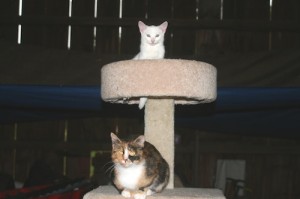
As often happens, the  universe provided: Right after Xena the feral cat disappeared and Calico had found a wonderful new home, I learned that neighbors had a momma cat who showed up in their shed half dead, starved and pregnant. She eventually had 7 healthy kittens, thanks to the care and concern my friends showered upon her. Momma was clearly raised around people, she was super friendly and sought out people to rub against. When I contacted them they had one kitten left and also needed to find a home for momma. And so, here they are, momma Nellie (bottom) and kitten Polly, who are now settled into Redstart Farm, I hope for many, many years to come. They came with horrific diarrhea but I think we have that turned around. Nellie continues to gain weight and Polly is growing like a weed. Polly (both cats are polydactyl) is all white but her eyes are green and she does not appear to be deaf. She might have some health challenges in the future (all white cats are more susceptible to skin cancer) but I’ll give her the absolute best life I can. And how many barn cats have a cat tree in the hay mow?

Here’s one of fall’s most reliable predictors: the wild sunflowers in bloom in front of the barn. It is always bittersweet to see them.

But it is cool (yeah!) and raining today (even better) and we get to be home this weekend. Willie and I will work sheep a little, but I’m afraid his shoulder is regressing. He was visibly limping last week, so we’re back to exercise restrictions and lots of PT exercises. I  honestly don’t know if he’s going to be able to do the physical work to be able to compete in trials–driving a big course takes lots of ‘short stopping’ and stress on his injured ligaments. (His tendon was surgically repaired, but no such possibility for the medial ligaments that were torn.) We’ll see, I’m taking a long term, philosophic approach, and remind myself every day that Willie still can work sheep at the farm, and that’s more important to him than anything else. He’s entered in one more trial and a sheepdog clinic in mid October, we’ll see how he’s doing. He doesn’t know about any of this and is happy it’s cool and that Jim and I are home and he gets to work sheep a little bit. Life is good.

BFF in Pennsylvania, Power of Pets in Madison WI

Tuesday, August 10th, 2010

A quick post today, trying to catch up before I leave for Toronto on Friday.  Sunday at the BFF conference was great, I’ll write a post soon about Pam Reid’s talks on cognition, her talk about stress, and Emily Levine’s talk on compulsive disorders in dogs.  All of them were great, very valuable. I thought this conference had the highest level of talks I’ve seen, and many others seemed to agree.

Although it’s hard to pack up and go before you have your paws on the ground, I’m very much looking forward to meeting folks in Toronto, and to traveling to Seattle to speak in mid-September. It is hard to turn around this fast when you’ve been traveling, leaving the farm and the dogs, sheep and Sushi, I won’t pretend it’s not, but I do meet such interesting people and always learn so much.

I get all the benefits later in September when I give the same talk I gave at BFF on “The Power of Pets” in Madison WI on September 23rd, a fund raiser for the Dane County Humane Society. I get to meet lots of great people in my own backyard (no airports!) and talk about a topic I love: the biology and psychology of why we love our dogs soooooo much. Please come up and say hi if you are a blog reader (and thanks for all of you who did in Pennsylvania, I LOVED meeting you and seeing real faces behind the people out there in cyberspace.) You can get tickets from DCHS for just the evening talk or, you can also come to the reception beforehand. The numbers are limited so we’ll all have enough time to talk. If you come to the  reception, PLEASE bring a photo of your pet, nothing would make me happier than to coo over your dog or cat!

Here’s a photo from BFF of all the speakers and the organizers, Dana and Carolyn. I am using the one in which we are all cracking up, because that’s pretty much what we looked like when we went to dinner together every night. I suppose this is where I should thank Suzanne Hetts and Nancy Williams for introducing me to a Peachtini. Always glad to add one more fruit serving to my nutrition for the day. (Not to mention adding about 3 pounds. My only complaint about the conference is that if you add Pia Silvani, Suzanne Hetts, Nancy Williams and Pam Reid up together, you would still barely manage a Size 2. I said I was representing the cows of Wisconsin.)

From left to right, back row: Dana Crevling, conference organizer queen who lost her soulmate dog the same day that Pia lost hers. Together they decided to do something to honor them. Next is Carolyn Barney who was a invaluable help in the  organization, Nancy Williams, Pia Silvani, Trish King, yours truly, and Vinnie Castalano. In the front is Suzanne Hetts, Pam Reid and Emily Levine. Not pictured are the legions of wonderful people from St. Hubert’s Animal Welfare Center in NJ, who did tons of work. It looks like we raised lots of money for St. Hubert’s and that felt great to all of us.

“Dominance” Mythologies, Suzanne Hetts
Saturday, August 7th, 2010

I’m at the Best Friends Forever Conference in Pennsylvania, taking a quick break from the talks. I have to say that this is one of the best seminars I’ve attended: the quality of the talks is outstanding. Suzanne Hetts gave one today that was fantastic: absolutely the best organized and most informative talk on what dominance is and isn’t that I’ve heard. I couldn’t begin to summarize it all, but here is some especially useful information from it, based on common mythologies that people have about dominance.

Common Underlying Assumptions about Dominance, from Suzanne Hetts:

I. Most (all?) interactions between dogs are competitive (going out the door first, who gets the toy, etc.). Is this true? No, it’s not. The fact is, many interactions between dogs are not competitive. A great example is the tug game. Some people argue that you have to ‘win’ or the dog won’t respect you, yet many dogs love to play tug for the sake of playing tug and will give you back the toy if you drop it. Suzanne showed a video of one of her dog repeatedly giving the toy back to her husband, Dan, clearly in hopes that he would continue the game. That’s exactly how Hope plays with me BUT not how he plays with Willie. I don’t think Hope is “playing” tug with Willie, I think he simply wants the toy for himself. He grabs it closer and closer to Willie’s mouth, and if he gets it he takes it away. However, Willie and Lassie played tug for long periods of time, both holding only the very end of the toy, giving it back to one another if necessary.  Conclusion: some interactions may be competitive, but lots and lots of them aren’t.

II. Dominance is about Control and “Obedience.” The confusion between ‘dominance’ and ‘obedience’ is pervasive, but they are NOT the same thing. “Dominance” is about who wins a competitive interaction over something that both individuals want, not about responding to a cue or “command.” Calling your dog to come has absolutely nothing to do with ‘social dominance,’ whether the dog comes or not! Confusing those concepts has caused a lot of problems in the dog training world, not to mention to lots of dogs.

III. All dogs are social climbers and are always ready to challenge others (humans or dogs) for social rank. Not true again. First, many people argue reasonably that we know little about “dominance” between 2 species. As used in science, it is between animals of the same species. Second, Suzanne argued, that if anything, most domestic dogs are predisposed to take a subordinate role to humans. We could talk about this aspect for hours (and pages), but she made several excellent points in relation to it. If this hangs you up, ask anyone if they would take a real bone away from a wolf. And as importantly, it is simply not true that all animals of a social group “want” to be high ranking. There are many costs to being in a high social rank, and many benefits to being a subordinate.

IV. Some dogs are just “dominant.” Whoa, careful here again. Dominance is a descriptor of a relationship, not a personality or an individual. If you have 2 individuals and a piece of food between them that they both want, one individual would be described as “dominant” if he or she gets the food 20 out of 20 trials. That’s all the concept meant as it was and IS used in science. What’s often not considered by the general public and advocates of “getting dominance” over your dog, is that it is context dependent. Indiv A might get the bone every time, but Indiv B might get the sleeping place. Motivation and context is everything, and behavior in one context does NOT necessarily predict behavior in another.

I could go on, but better get back to the conference. Most importantly, Suzanne did an excellent job of advocating for people in the dog world to be able to talk about the concept knowledgeably, to avoid polarized conversations that only divide and confuse, to use terms with precision and knowledge, and to avoid repeating assumptions. She advocating for people on both ends of the extremes on this issue to take a deep breath (my words) and educate themselves about what science tells us about social relationships. Here here.

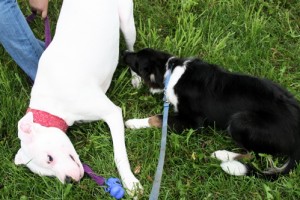
Before I go, here’s a photo I took the day before I left, of Hope’s new friend, Lily, a young Dogo Argentino (sp?), who tends to lie down every time she meets puppies and young children. Clearly she is trying to exert her dominance here!  Lily and Hope couldn’t play, because she had just had minor surgery, but I suspect rollicksome play is in their future.

Great Article on Dog-Dog Aggression

Thursday, July 15th, 2010

Have you seen the latest issue of The APDT Chronicle? It has a fantastic article by Suzanne Hetts and Daniel Estep (both CAAB & Ph.D) titled Safety and Ethics in Working with Dog-to-Dog Aggression. Anyone who treats dog-dog aggression, or who has a dog who might have that problem would do well to read it. (And to stay tuned, Chronicle will have more articles on dog-dog aggression in several issues to follow–Pia Silvani and I are writing one together for an upcoming issue.)

One of the important points they make is that dog-dog aggression is often not taken as seriously as aggression toward humans, and yet, it can have horrific effects on both species. No one knows better than they: their Dalmation and Irish Setter were brutally attacked by a loose dog last year, and were only saved thanks to the efforts of 4 people–Dan, Suzanne and 2 brave and altruistic passers-by. Suzanne’s hand was broken and was in a cast for 5 weeks. Dan, Suzanne and the dogs were seriously traumatized . . . how could they not have been?

And yet, we all know of people who are willing to work with dog-dog aggression cases, but not cases in which humans are the targets (at least not directly.) However, aggression toward any species can result in serious injury, even death, and needs to be taken seriously before someone takes on the task of trying to help with it. The article in The Chronicle does a great job of listing what is needed to be able to ethically and responsibly work with dog-dog aggression cases. If you can’t get a hold of a copy of the magazine (July/August 2010), they summarize it on their website, Animal Behavior Associates.

MEANWHILE, back on the farm: I’m in the usual flurry of trip prep, leaving tomorrow at dark thirty to do a seminar for Dogs of Course outside of Boston. I speak on The Biology of Emotions on  Saturday, and Ken Ramirez talks on Sunday on Solving Training Problems, Non-Food Reinforcers among other things. I’m staying on to hear Ken’s talk; I always learn a lot when I listen to him speak. The seminar is booked solid and I don’t think they can take any more registrations (waiting list?), but come up and say hi if you are a blog reader. It always warms my cockles, wherever the heck my cockles are, to meet a blog reader in person.

Speaking of cockles, or words vaguely related (sorry, can you tell I’m getting a little slap happy?), here’s a visitor to the farm. There are lots of turkeys in the area, they’ve flourished here once they were re-introduced, but they usually don’t come knocking on the front door. This one was all by himself beside the garage as I drove up. As I struggled to quietly get out my camera and get the window down. he strolled across the driveway and meandered up the hill behind the house, but in the pictures he is just a few feet from the garage. The pictures aren’t great quality, but I can’t resist giving him (her?) some press.


Veterinarians on the Front Lines

Sunday, October 4th, 2009

Greetings from Oregon. I just finished up with two talks at UC-Davis and a day long seminar in Corvallis, Oregon, sponsored jointly by OSU and Wonder Dogs. The participants and hosts could not have been more delightful, and I thank everyone for making the trip enjoyable and more than worthwhile.

All three events had a large number of veterinary students attending, and it was such a joy to see them there. So many bright, energetic people… truly is inspiring, and especially good to see so many of them interested in behavior.

One of my talks at UC-Davis, specifically for vet students and veterinarians, was on Canine Aggression. I appreciated the opportunity to speak about such an important topic, and thought I’d convey a summary of one of the points I made, which was what can vets do in their clinics if they don’t have the time or interest in becoming a behaviorist or trainer and treating “aggression” problems directly? (I use the term “aggression” broadly, in the sense that the general public does.)

Here’s some thoughts, not just for vets, but also for anyone to ask themselves about the “behavioral wellness” of their dog. (Behavioral wellness is a term coined by CAABs Suzanne Hetts and Daniel Estep) and it is such a good one I’ve incorporated it into my vocabulary.) Here is what I wish vets would do in their clinics, understanding how limited there time is:

1) Ask questions related to behavior, but make them specific! “Any behavioral problems?” is just as likely to get a “no” from someone whose dog has bitten them as from someone whose dog is an angel. Here are some examples of questions I wish vets or vet techs could ask:

~ “How is house training going?” or better yet, “Are you giving your puppy a treat every time he goes potty outside?”

~ “How is your dog doing with normal handling? Any growls or tooth displays when you clean her paws or examine her mouth?”

~ “Is your pup getting out and about without being overwhelmed by places.. (like a crowded farmer’s market) that are too scary?”

~ “Can you leave your dog alone during the day without any problems? Need any help there?”

~ “Is your dog comfortable with strangers coming into the house? Does he get along well with other dogs, either the others at home or dogs he meets on the street?”

Etc… There is an excellent list of questions on Hetts and Esteps’ website, check it out and mention it to your veterinarian if you get a chance. The biggest challenge here is to be specific: one person might say a dog is just “fine” with visitors, even though he’s hiding under the table and growling. The more specific the question, the better, as in “Any growls, for any reason?”

2) Alert owners to problems that you see in the clinic. A vet friend recently told me about a 4 month old pit cross who stood in the corner, stiff and whale-eyed when she entered, and then bark/charged at a vet tech who came into the room during the exam. The owners thought it was normal behavior, and had no clue that it was a sign of potential serious trouble.

3) Have posters and charts up to help people learn to read their dogs. Dream Dog Productions has a great set of posters that should be in vet clinics along with signs of gum disease. Many owners simply don’t know the signs of fear in a dog, unless the dog is cowering like a cartoon character, and the more we can get the word out, the better.

4) Educate owners about treatment when you can. Most behavioral problems are NOT “dominance” problems, and suggesting those methods can cause more harm than good in many cases. (More on that in subsequent posts!)

5) Have resources easily available. Have books, booklets in the clinic to help with behavioral problems (we have a Beh’l Rx form for vets to use to mark the resources they think would help a client); know who to refer to in the area if you see potential behavioral problems and know what training centers and classes use positive methods that are based on solid science rather than opinion; make contact with Veterinary Behaviorists, CAABs and progressive trainers who have a sterling reputation.

I’d love to hear your thoughts: Any vets, vet techs like to chime in and add what trainers and behaviorists could do to help vet clinics prevent behavioral problems?

Meanwhile, not on the farm (but missing it a lot): Even though I’m not there, here is a photo from last week, when friends, Jim and I went in search of apples. It was a great success, and before I left for the west coast I got two huge batches of apple sauce in the freezer. I’ll turn them into apple/wild plum butter when I get back. We also found a wild grape vine (these are truly wild, a native wild plant in Wisconsin) that was groaning with fruit. I couldn’t pass it up, and ended up with about a 1/2 gallon of grape juice in the freezer. Not sure what I’ll do with, might add it to the carrot bread muffins waiting to be made from the mounds of carrots I have in the frig!

Here’s a bushel basket brimming with apples, and a wonderful old tool for harvesting the apples directly off the tree (cider can’t be made from apples that land on the ground, at least not safely).


Cesar Millan and Merial

Wednesday, June 24th, 2009

You may have heard by now that the pharmaceutical company Merial (they make Heartguard and Frontline) have teamed up with Cesar Millan to promote their products. They are offering veterinary clinics a deal this summer in which they can give any client who buys Heartguard or Frontline a free DVD from Cesar titled “Mastering Leadership!” They will even include a DVD that clinics can use to “entertain” their clinics in the waiting room (they did not use the word “educate”) with segments from “Mastering Leadership with Cesar.”

I’m happy to say that the American College of Veterinary Behaviorists and several CAABs (Certified Applied Animal Behaviorists) have written Merial to complain. The paragraph below is an excerpt from a letter by CAAB Suzanne Hetts Ph.D.

“Scientific research about how animals learn, about canid social behavior, and social relationships between dogs and humans does not support Mr. Millan’s training methods or his view of those relationships… This marketing campaign makes it clear that Merial did not do their homework when it comes to the science of animal behavior. Instead of relying on the academically trained, scientific community of veterinary and applied animal behaviorists or even to certified dog trainers, you instead turned to a media personality. Because you clearly don’t care about science when it comes to animal behavior and training, I now wonder what other scientific information you might choose to ignore in marketing and product development.”

Here Here, Suzanne!  The American College of Vet Behaviorists also has written an excellent statement, click on their name to read it. If you are so inclined, you can let your views known to Merial by writing Scott.Line@Merial.com. I say all this knowing full well how many people love Cesar and how much they think he has helped dogs. I personally believe that  Cesar loves dogs without question and wants to help them. I love that he advocates for more exercise for dogs and illustrates that many behavioral problems can be solved. However, I am deeply at odds with his perspective that behavioral problems are primarily caused by “dominance” issues, and that owners need to be physically forceful to achieve “leadership.” (I do appreciate that he has switched a bit from “dominance” to “leadership”… although I have no doubt that he and I define it differently and I worry that his use of it will undermine its value.)

I’ve never met Cesar (would love to) but I suspect that he is one of those remarkable individuals who has incredible presence. You know, one of those people who walk into a room and everyone stops talking to look at them. Gradually the person is surrounded by people who just want to stand next to this person who has… something? But what? What is presence?  Good question–Malcolm Gladwell first brought it up to me when we were talking about an article he wrote on Cesar, and he said he was thinking about writing a book about it.  I suspect that would be tough. How do you measure presence? Who has it and who doesn’t?

No matter what it is, people with it can do all kinds of things that the rest of us can’t. My suspicion (and it’s only that) is that dogs also respond to Cesar’s presence (confidence? being comfortable in your own skin?). That also means that those methods won’t work so well with people who don’t have that quality. Thus, his methods are problematic from two perspectives: they are often based on a misunderstanding of dominance and what it has to do with canine behavior, and they also assume a quality that Cesar doesn’t even know he has, and can’t be replicated.

Personally, I’d love to have an open and sincere conversation with Cesar about this. If I can get the podcast up and running, I’ll do my best to try to have him on. This issue will come up often I suspect for me in the next few days, because soon I’m leaving for meetings in Chicago between me, other CAABs and Board Certified Veterinary Behaviorists to find common ground and resolve some conflicts. (Ex: statements by some vets that all behavioral problems are medical problems and can only be diagnosed and treated by veterinarians, whether the vets have had any training in behavior or not. Guess which side of that argument I’ll be on? I’ll keep you posted…).

Meanwhile, back at the farm: It’s still brutally hot and humid, I worry most about old Martha, who lungs clearly are still not up to par. More people die of the heat than the cold, especially the elderly with respiratory troubles, and that describes Martha 2.0 to a tee. Willie and I only move the sheep in slow motion (if possible) and only early in the day or late in the evening.  The bird life hasn’t slowed down though, here are the serviceberries by the kitchen window that the Catbirds and Cedar Waxwings are gorging on.

And here’s Will, hoping I’ll send him in to get the sheep. Note his ear position, targeted towared me, anticipating a signal I suspect.